
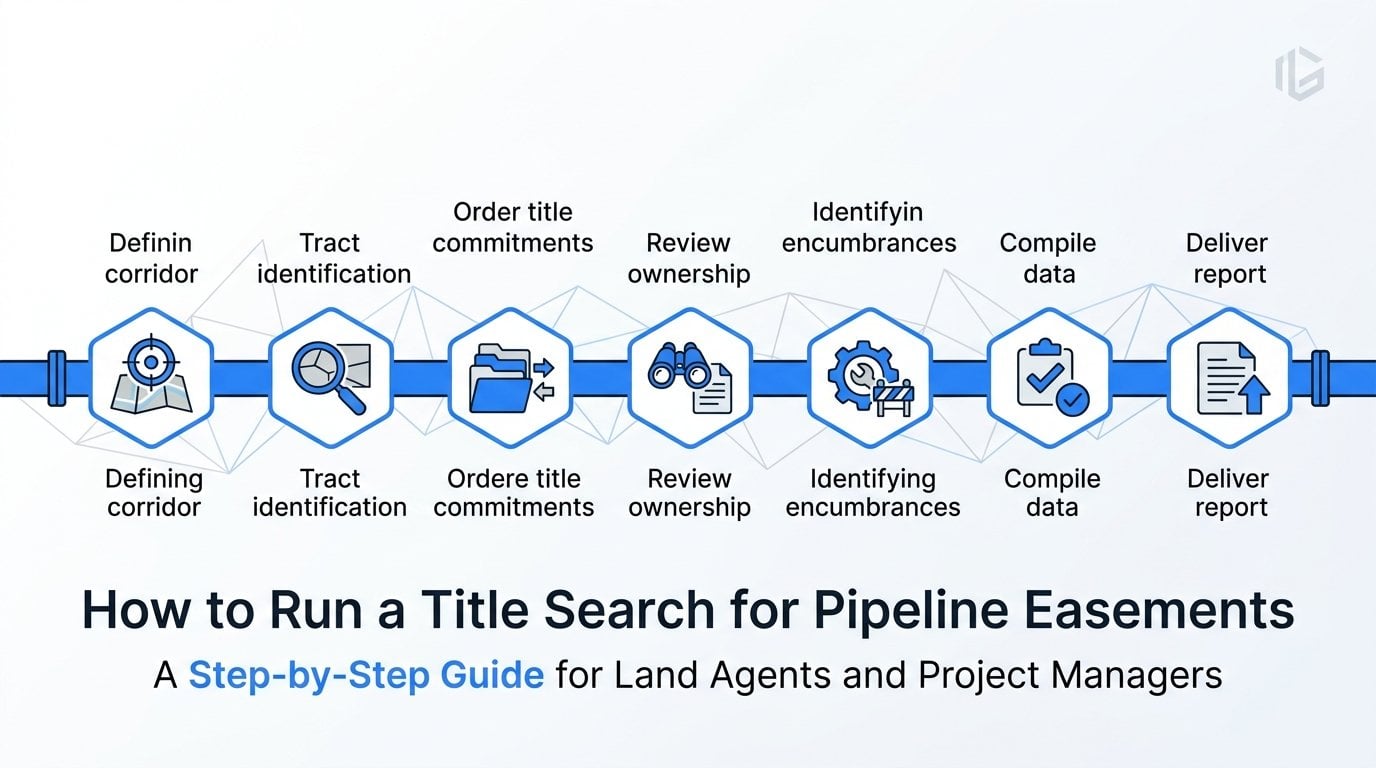
A pipeline easement is only as good as the title work behind it. A title search for pipeline easements differs from a single-parcel search: it is linear, it spans many tracts and often several counties, and its real question is who has the authority to grant the right-of-way and what could block it. By the end of this guide you will have a repeatable seven-step process that runs from defining the corridor to delivering a tract-by-tract report your land agents can act on.
Before you start, have the route or tract list in hand, access to county records (online or in person), and a working grasp of chain of title. This guide is informational, not legal advice. Recording rules, search periods, and signature requirements vary by state.
Step 1: Define the corridor and build a tract list
Start with the route alignment, whether a survey centerline, shapefile, or KMZ, and the proposed easement width. Include temporary workspace and any additional areas for pull sites or staging. These dimensions decide which parcels you search and how much of each one is affected, so a route that clips a corner of a tract still puts that tract on your list.
Convert the alignment into a tract list. For each tract, record:
- County and parcel ID
- Current assessor owner name
- Legal description (and section, township, and range where applicable)
- Approximate length of route crossing
Flag every point where the route crosses a county line. Each county has its own recorder or clerk, its own indexes, and often its own recording quirks, so you will be working in separate record sets.
Decide the search period. You can search the full chain back to a patent or sovereign grant, or a limited period such as a set number of years or a root of title. Common limited periods run in the range of 40 to 60 years, but standards vary by state and by client. Confirm the requirement in writing before you start. A limited search is not always enough: an older easement or severed mineral interest outside the window can still bind the land.
Mistake to avoid: relying on tax-map acreage alone. Assessor parcels are administrative conveniences and often differ from the legal descriptions in the deeds. Use the tax map to locate tracts, then work from the recorded legal description.
Step 2: Gather the right records sources
The county recorder or clerk is your primary source: deeds, easements, mortgages, releases, and plats. Add assessor and tax records for ownership leads and tax status, and probate and court records for estates, judgments, and litigation.
Check which indexes each county offers. Grantor-grantee indexes are universal; tract indexes, where they exist, are far faster for a linear project because they organize by land rather than by name. Coverage is uneven. Some counties have images online back to the 1800s, others only a recent window, and some require a courthouse visit or a local abstractor. Identify these counties early so they do not become your deadline problem, since slow title searches usually trace back to records access surprises like these.
Then look beyond the courthouse:
- Federal origins: BLM General Land Office patent records show the first transfer out of federal ownership in many western and public-land states.
- State land records: needed wherever the corridor crosses state-owned or formerly state-granted land.
- Railroad, highway, and utility corridors: request records when the route follows or crosses them. These rights are often held under separate instruments or agencies and may not appear in the county index under the landowner’s name.
Tip: keep a source log from the first day. For each tract, note every source searched, the date range covered, and any gaps. Your report must state its effective date and limits, and the log is how you support those statements.
Step 3: Build the chain of title for each tract
Begin with the current vesting deed and work backward. At each link, confirm that the grantor matches the prior grantee and that the legal description carries forward. Continue to the end of your search period. If you want a deeper walkthrough of this task, see our guide to the chain of title search process.
Watch for the usual breaks: name variations and initials, missing spouses, deceased owners with no recorded probate, trusts, and entity changes such as mergers, conversions, or dissolved companies. Each may require probate, trust, or corporate records to bridge the gap.
As you go, separate the fee owner from severed interests. Mineral, timber, and life estates may be held by different people, and co-tenants each own an undivided share. Depending on state law, all co-owners may need to sign, or the easement may bind only the share of those who do. Record every owner and fractional interest you find; do not collapse them into the name on the tax roll. Severed minerals in particular follow their own research path, covered in our mineral rights title search process guide.
Example. Imagine a 160-acre tract that was split by a deed in the 1970s. The current owner holds the northern portion under a new legal description, but that description omits a narrow strip along the old section line, exactly where your route crosses. A search that only confirms the current owner’s deed would miss it. Working backward reveals that the strip never left the original grantor’s family, so the person who must sign is someone else entirely.
When a legal description does not match the route, plot it. A rough plotted description will expose omissions and overlaps that reading alone will not.
Step 4: Find existing easements, rights-of-way, and restrictions
Two terms are worth keeping straight. An easement is a right to use land for a specific purpose, while the land stays with the owner. A right-of-way is the strip of land that the easement or other grant covers, and the word is also used for the right itself. Read the instrument rather than the label.
Search for recorded easements by grantor name, tract, and section-township-range, not only the current owner’s name. An easement granted in 1958 sits in the index under the owner of 1958. The current owner’s name will not find it.
Read each instrument for:
- Width and location, and how the location is described
- Exclusivity and whether other uses are allowed
- Assignment rights and successor language
- Permitted uses, such as product type or additional lines
An existing pipeline easement may already cover your route, or it may conflict with it. Check whether the holder has rights to add lines.
No recorded easement does not mean no easement. Look for visible pipelines, utility markers, and worn access routes that suggest unrecorded, prescriptive, or implied rights. These need field or survey confirmation, so flag them for the land agent rather than resolving them from the desk.
Also check for restrictions that limit construction: plat notes, restrictive covenants, conservation easements, and surface-use or leasing terms in oil and gas leases. Finally, plot every finding on the route map. Overlaps and crossings that are invisible in a list become obvious on a map. Catching these items early is the best way to avoid the common title search defects that derail deals later.
Step 5: Check liens, mortgages, and other encumbrances
Identify open mortgages and deeds of trust on each tract. A senior lender can foreclose and wipe out a junior easement, so lender consent, or a subordination or non-disturbance agreement, may be needed to protect the right-of-way. A subordination agreement places the lender’s lien behind the easement, and a non-disturbance agreement has the lender agree not to disturb the easement on foreclosure.
Then search for other claims against the land and its owners:
- Judgments and tax liens
- Mechanics’ liens
- Lis pendens notices and pending litigation
Verify delinquent taxes with the county treasurer rather than relying on the assessor’s data, which may lag. Tax status checks across many tracts are a natural fit for automated property tax searches, which can save hours on a long route.
For each mortgage you find, look for a recorded release. Old mortgages that were paid off but never released show up as open items on a search. This is a common false positive. Resolve it by finding the release, which may be indexed oddly or recorded in another county, or by noting that a release or payoff confirmation is needed.
Finally, consider state-specific rules about who must sign. Homestead and marital rights can require a spouse’s signature even when the spouse is not on title. Do not assume. Note the issue and state that the requirement should be confirmed under local law.
Step 6: Resolve gaps, conflicts, and special land types
By now you will have a list of problems. The typical ones are heirship where an owner died without a recorded probate, landlocked tracts, boundary overlaps between adjoining descriptions, and legal descriptions that do not close mathematically.
Special land types need their own approach because the grant process and granting authority differ:
- Federal land (BLM, Forest Service): rights-of-way are granted by the managing agency under its own application process. Confirm current procedures with the agency, as they change.
- Tribal land: typically involves tribal and federal approval, and often trust status that alters who can grant what.
- State sovereign land: usually handled by a state land agency under its own rules.
- Railroad right-of-way: the railroad’s interest may be an easement or fee, depending on the original grant, and the railroad usually controls crossings.
For each issue, decide whether it can be cured, needs counsel, or should be noted as an exception:
- Cure: a corrective deed, an opened probate, or a quiet title action. These are for the attorney and land team to pursue, not the searcher.
- Escalate: anything involving interpretation of ambiguous grants or competing claims.
- Note as an exception: anything you can describe accurately but cannot resolve.
Do not guess at ownership. If the record does not show who holds an interest, say so and mark it as a requirement for the land agent or attorney. Projects like these share many of the hurdles described in our look at oil and gas title search challenges.
Step 7: Compile the report and hand off to land acquisition
For each tract, the report should state:
- Effective date of the search
- Vesting owner and the interest held, including co-tenants and severed interests
- Legal description
- Existing easements and rights-of-way
- Encumbrances
- Exceptions and limits
- Requirements to cure
Attach copies or links to every recorded instrument you rely on, identified by book and page or instrument number, so anyone can check your work. For layout ideas, review these title abstract report format examples.
Format the package for the land agent. Include owner contact leads from the records, who must sign, and a tract-by-tract status table keyed to the route map so the team can see at a glance which tracts are clear, which have open requirements, and which are blocked.
Before release, run a quality check:
- Reread each legal description against the route and confirm it covers the crossing.
- Verify names and recording references against the source documents.
- Confirm the effective date and that it matches your source log.
On a project with dozens or hundreds of tracts, the bottleneck is usually data entry. AI-powered tools such as TitleTrackr can support the workflow by extracting grantors, grantees, and legal descriptions from recorded instruments into abstracts, generating report drafts, and tracking orders across tracts. A person still needs to review the output against the documents, because the searcher remains responsible for the result. If you are comparing options, see our roundup of the best tools for oil and gas land title research.
Before the Report Goes Out: Final Checks and Next Moves
Before sending the report, confirm that every tract has a vesting owner, an effective date, and a listed requirement or exception. A tract with none of these is not finished, it is unexamined. Then have an attorney review the report before easements are negotiated, since the legal conclusions about who must sign and what survives foreclosure belong to counsel.
After delivery, expect questions from the land team. Keep your source log and working files organized so you can answer them quickly, and update the report with a new effective date if negotiations stretch on and new instruments get recorded. Learn more about our services
Leave a Reply