
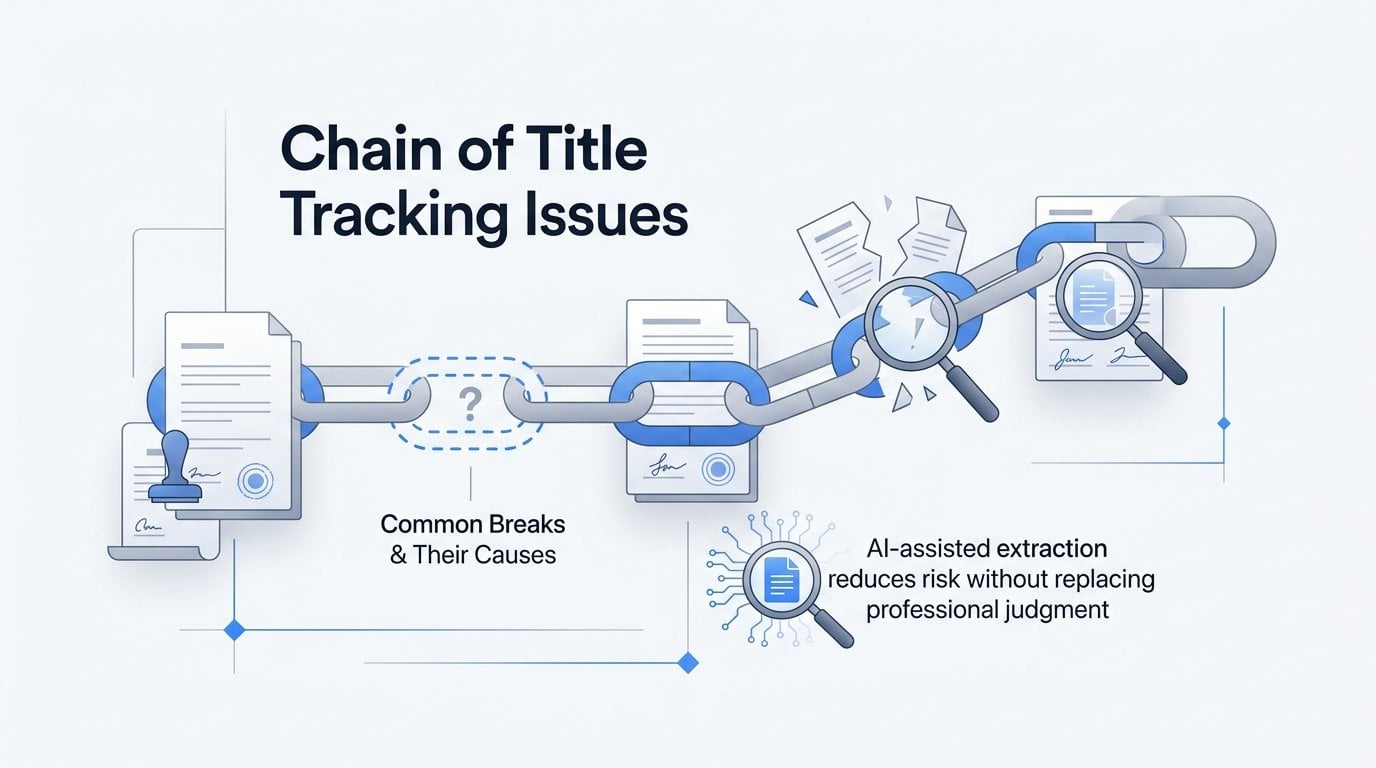
Chain of title tracking issues rarely announce themselves. A chain can look complete in the grantor/grantee index and still contain a missing conveyance, a misread legal description, or an heir who never appears in the deed records. Most of these problems are detectable, but only if the examiner treats the chain as something to be reconstructed and tested link by link, not retrieved from a single search. What follows covers the break types that show up most often, why they happen, how searchers resolve and document them, and where AI-assisted extraction reduces the risk without removing the examiner’s judgment.
Where Chain of Title Breaks Down in Practice
Three terms get blurred in daily conversation. A chain of title is the sequence of recorded transfers connecting the original grant to the current owner. A title search is the process of examining records to find those transfers and any encumbrances. An abstract is the condensed, ordered summary of what the search found. The chain is the thing being proven; the search and abstract are how you prove it.
That distinction matters because tracking is continuous reconstruction. Each instrument you find points to the next one you need: the grantor in deed five must have received title from someone in deed four. A single lookup of the current owner’s name tells you almost nothing about whether that logic holds all the way back.
Typical break types
- Missing conveyance. A deed comes from a grantor who never appears as a grantee. This is commonly called a wild deed: an instrument outside the chain because the link connecting its grantor to the prior owner is absent from the index.
- Unreleased liens. A mortgage or judgment lien was paid off, but no release was recorded, so it still appears as an open encumbrance.
- Unrecorded instruments. A deed, lease, or easement was signed and delivered but never recorded, so it leaves no trace in the indexes.
Consider an illustration. You are building the chain for a 40-acre tract. The current owner took title by warranty deed from Harold Mercer. Searching backward, you find no deed into Harold Mercer in the county grantee index. The record offers three possibilities: he acquired the land by a deed indexed under a different name or description, by inheritance with no deed at all, or by an instrument that was never recorded. You now search backward from the gap, checking name variants, the tract index, and probate records for a Mercer estate. The chain is not proven until one of those searches produces the missing link or an examiner decides the gap needs curative work.
Name and Legal Description Errors That Hide Links in the Chain
The grantor/grantee index is a name-based tool, and names are unstable. A single owner may appear as “John A. Smith,” “J. A. Smith,” “John Smith Jr.,” or a misspelling the indexer typed from a handwritten deed. Women may convey under maiden names and take title under married names. Entities change names, merge, convert, or are absorbed by successors, and the instrument that documents the change may sit in a corporate filing, not the land records. Any of these can break index matching and make a link look missing when it is only misfiled.
A common misconception runs the other direction: an exact name match is not proof of the same person. Two men named John Smith can live in the same county. Match on more than the name, using legal description, marital status recitals, addresses, dates, and the logical sequence of ownership.
Legal description problems
Descriptions cause quieter failures. Watch for:
- Metes-and-bounds errors, such as a transposed bearing, a wrong distance, or a call that fails to close.
- Lot and block mismatches, where a deed cites the wrong subdivision phase or a plat that was later replatted.
- Partial-parcel conveyances, where a grantor sells off a piece and the remainder’s description is never updated.
- Drifting descriptions, where the wording changes from deed to deed so it is unclear the same land is being conveyed.
The grantor/grantee index can miss an instrument for reasons beyond names: it was indexed under the wrong party, indexed late, or skipped. Searchers cross-check with a tract index or parcel index, which organizes records by land description instead of by name. Running both approaches against each other is one of the most reliable ways to surface an instrument that one index buried. Where a tract index does not exist, a search by section, township, and range, or by subdivision and lot, serves a similar purpose, though it is slower.
Recording and Document Defects That Undermine Validity
Another misconception worth correcting: recorded does not mean valid. A recording office accepts an instrument for filing; it does not certify that the instrument transfers good title. Examiners have to read the document itself.
Execution defects are the usual starting point. Look for a missing or defective notarial acknowledgment, an unsigned instrument, missing witnesses where the jurisdiction requires them, and a missing spouse joinder where homestead or marital property rules call for it. These requirements differ by state, and some states have curative statutes that cure certain defects after a set period. Treat any of these as a flag for attorney or underwriter review rather than something to resolve on your own reading of the law.
Forgery, fraud, and delivery
Forged, fraudulent, or undelivered deeds usually surface only through careful review. No index will flag them. Signals include a signature that differs sharply from other instruments by the same person, a notary commission that looks inconsistent with the date, a deed recorded shortly after the grantor’s death, or a conveyance that makes little economic sense. Searchers generally report what they see and escalate; they do not decide that a deed is forged.
Timing and priority
Late-recorded and out-of-order instruments complicate the picture. A deed signed in 2009 but recorded in 2015 may sit after later-dated instruments in the record. Whether the earlier or later interest prevails depends on the jurisdiction’s recording statute: a race statute favors whoever records first, a notice statute protects a later buyer without notice, and a race-notice statute requires both good faith and first recording. Confirm which rule governs the county before drawing conclusions about priority.
Finally, clerical problems: wrong book and page references in later instruments, poor microfilm or scan quality, and handwritten records that are hard to read. A misread digit in a book and page cite can send you to the wrong instrument entirely, so verify cited references against what you actually retrieve.
Heirship, Probate, and Mineral Severance Complications
Some of the largest gaps in a chain contain no deed at all. When an owner dies intestate, title passes by statute to heirs, and no conveyance may ever be recorded. If the estate was never probated, the deed records show the decedent as owner indefinitely while the real owners are several people, some of whom may have since died themselves. Missing or unknown heirs leave ownership undocumented in the places a standard search looks.
Divided ownership
Ownership is also divided in ways a single deed does not capture. A severed mineral estate exists when mineral rights are separated from the surface, often through a reservation in an earlier deed (“grantor reserves all oil, gas, and minerals”). Once severed, each estate has its own chain. Fractional interests compound the problem: a one-half mineral interest passed equally among four children becomes four one-eighth interests, and each of those may split again in the next generation.
For oil and gas landmen, this decides who must sign a lease and who is owed royalties. For renewable developers, the same problem appears in easements and leases for wind, solar, or transmission across many tracts. A missed co-owner or a mineral owner with surface-use rights can stall a project that otherwise looks fully assembled.
Records to pull
- Probate files: wills, letters testamentary or of administration, inventories, and final decrees that name the people receiving the land.
- Affidavits of heirship: sworn statements by someone with knowledge of the family, identifying the decedent’s heirs. Acceptance varies by jurisdiction and by underwriter, and some will require a court proceeding instead.
- Court orders: adjudications of heirship, partition orders, and judgments affecting the interest.
An affidavit of heirship that satisfies one underwriter may not satisfy another, so confirm requirements before building a report around one.
How Searchers Resolve and Document Chain Problems
A repeatable sequence keeps gaps from slipping through:
- Build a chronological chain for each tract, starting from the earliest available grant and moving forward, or from the current owner backward if that is your convention. Stay consistent.
- For every transfer, confirm the grantor received title from the prior grantee. Flag each place where that does not hold.
- Rerun the search for each flagged gap using name variations, maiden names, entity successors, and alternative indexes such as tract or parcel indexes.
- Pull supporting records (probate, court, corporate filings) for gaps that name searches do not close.
- Record what you found, what you could not find, and what search you ran to look for it.
Curative options
When a gap or defect remains, the usual tools are a corrective deed from the proper party, an affidavit addressing a specific fact, a recorded release of lien, or a quiet title action, a court proceeding that resolves competing claims. Curative is the work of fixing a defect so title becomes insurable or marketable. Which option fits depends on the defect and jurisdiction, so escalate to an attorney or the underwriter when the fix involves legal sufficiency, forgery concerns, or a contested interest.
Writing it up
The report should state each exception and requirement plainly, so the reader knows what must be cured and by whom. “Requirement: record a release of the 2014 deed of trust to First County Bank” is useful. “Possible lien issue” is not.
A short review checklist for every conveyance helps keep the chain consistent:
- Grantor and grantee named, and the grantor traces to a prior grantee
- Execution date and acknowledgment present
- Recording date, book, and page, or instrument number
- Legal description matching the subject land, or the portion conveyed
- Reservations, exceptions, and marital or entity recitals noted
Reducing Tracking Errors With AI-Assisted Title Workflows
Many chain errors are workflow errors in disguise. Re-keying names, dates, and book and page numbers from a document into a spreadsheet or report invites transposition. Abstracts written in different formats by different people make comparisons harder, and a gap that one abstractor would catch can hide in another’s layout. Across a large order volume, context gets lost: the note about a name variant stays in someone’s head instead of the file.
Document auto-extraction targets the first problem. TitleTrackr’s platform reads recorded documents and pulls grantor, grantee, dates, recording data, and legal descriptions into structured fields, so the examiner reviews and corrects data instead of typing it from scratch. Instant abstracts and automated report generation then build from those same fields, which keeps the chain view in a consistent format from order to order, and order management keeps documents, notes, and status tied to the file.
Where the examiner still decides
Structured data makes inconsistencies easier to see, such as a grantor with no matching prior grantee or a description that shifts between deeds. It does not settle them. Whether two name variants are the same person, whether a description is legally sufficient, and whether a defect needs curative are judgment calls. The software flags; the examiner decides.
Adopting it sensibly
Start with one order type, such as a standard residential search or a specific lease-assembly project. Run extraction alongside your manual abstracts for a set period, compare the two field by field, and log every correction you make. That log shows where extraction performs well on your document mix, where it needs closer review, and what accuracy and time savings you can actually claim in your own operation.
Disciplined Review Catches What Indexes Miss
Nearly every break described here leaves evidence: a grantor with no source, a description that drifts, a death with no estate record, a lien with no release. The common thread is that a clean index search does not equal a clean chain. Structured, link-by-link review, with each gap flagged and each exception written up clearly, is what finds these problems before a closing or a lease signing does.
If you are weighing how automated extraction and order management could fit your own workflow, a pilot on one order type is a low-risk way to test it. Learn more about our services.
Leave a Reply