
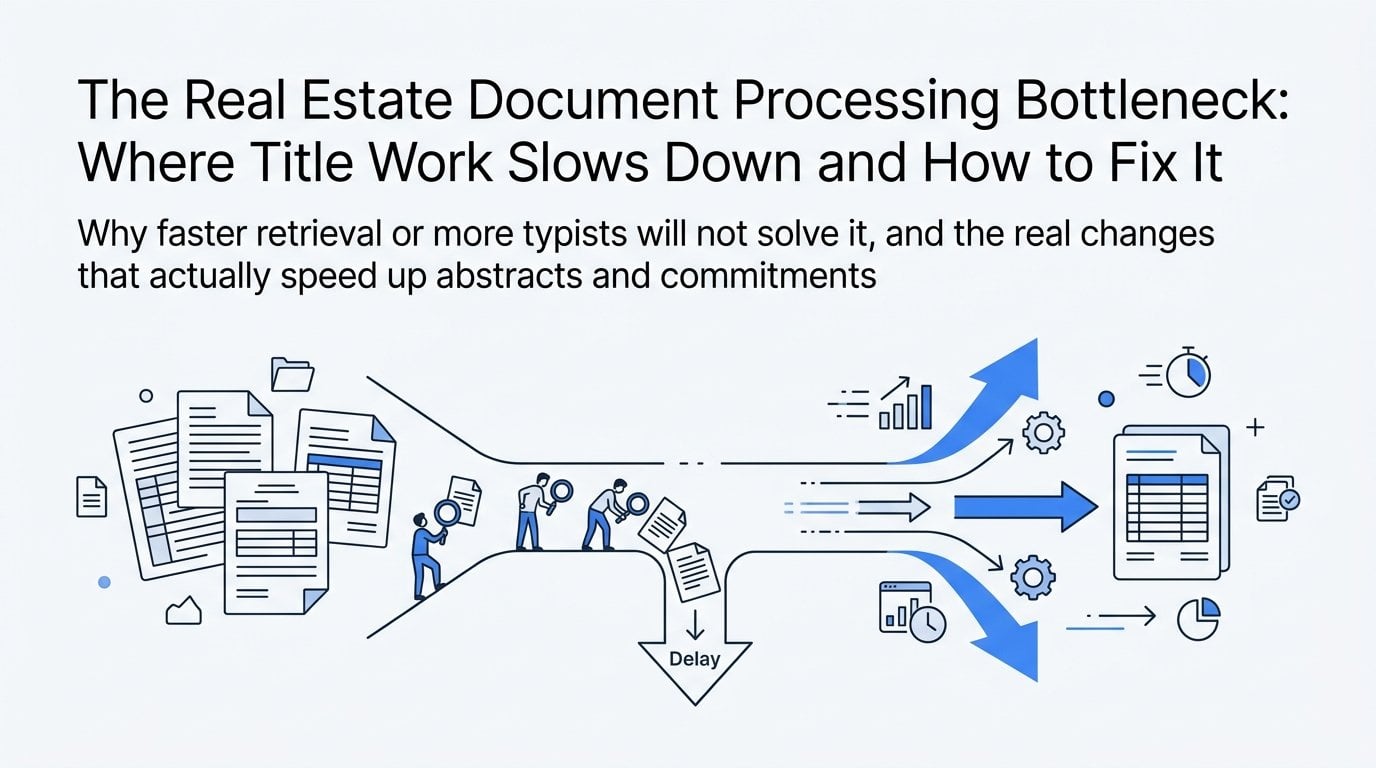
The real estate document processing bottleneck is the point in a title or land workflow where records pile up faster than people can read, key, and verify them. It usually sits between document retrieval and a finished abstract or commitment. Most teams assume the delay is in getting records, but in many workflows the slowest stretch begins after the documents are already in hand.
This matters because the fix depends on the diagnosis. Buying faster retrieval, hiring more typists, or adding templates will not help if the constraint is human reading and re-keying of unstructured documents. The sections below locate the stall, explain why it persists, and show which changes actually move it.
Where Documents Pile Up in a Title Workflow
A typical order moves through seven stages: order intake, record retrieval, document review, data entry, abstract or commitment drafting, quality review, and delivery. Intake and delivery are short. Retrieval can be slow when a courthouse is closed or a county portal is unreliable, but it is often parallelizable and increasingly digital. Review and keying are where hours accumulate, because they depend on a person reading every page.
For example, imagine a chain of title with 60 instruments. They include typed warranty deeds from recent decades, a few mortgages and releases, an easement, and several handwritten or poorly typed legacy deeds scanned at low resolution. For each instrument, the searcher must identify the document type, then pull out the parties, the legal description, recording book and page or instrument number, the dates, and any reservations or exceptions. That is a handful of fields across dozens of documents, and several of those fields must be exactly right. This is an illustration, not measured data, but anyone who has worked a chain like this will recognize the shape of the effort.
Bottleneck versus slow step
A slow step is not automatically a bottleneck. The bottleneck is the step that limits how many orders you can finish in a given period. Speeding up any other step changes nothing about total output. You can test your own workflow with three checks:
- Where does work wait? The stage with the longest queue in front of it is the likely constraint.
- What starves downstream? If drafting and quality review sit idle waiting for keyed data, the stage before them is the limit.
- What happens when you add capacity elsewhere? If faster retrieval just makes the review pile taller, retrieval was never the constraint.
It also helps to separate touch time, the minutes someone is actively working an order, from queue time, the time it sits waiting. A step can have modest touch time and still dominate turnaround if its queue is long.
Why Manual Extraction Keeps Being the Constraint
Extraction stays manual because the inputs are stubbornly unstructured. Records arrive as scanned PDFs of varying quality, and counties format their instruments differently. The same fact, such as a legal description, may be written as metes and bounds with courses and distances, as lot and block within a platted subdivision, or as a Public Land Survey System reference to section, township, and range. Each style demands different reading habits and different checks, and none of them can be scanned for by eye in a few seconds.
The re-keying multiplier
Reading the document once is only part of the cost. The same grantor, grantee, and legal description are often typed into the order system, then the abstract, then the commitment, and sometimes a tracking spreadsheet. Every re-entry costs time and creates another chance for a transposed digit or a misspelled name. Two copies of the same data that drift apart are a quality problem as well as an efficiency problem.
Why headcount is a weak answer
Demand is uneven. A refinance rush or a lease-acquisition push can double the inbound volume within weeks, while experienced searchers are scarce and a new hire needs months before their work can go out with light review. Staffing for peak means paying for idle capacity the rest of the year. Staffing for average means the queue grows exactly when clients are most impatient.
Scale in energy and land development
Oil and gas and renewable projects magnify the problem. A wind or solar project may involve hundreds of tracts, each with its own ownership history, plus many leases, easements, and rights-of-way that must be confirmed before a developer commits capital. A landman team working a drilling unit faces a similar volume of mineral and leasehold instruments. When each tract requires the same manual read-and-key cycle, the constraint scales linearly with project size, and the project schedule inherits it.
The Real Cost: Turnaround, Errors, and Missed Deals
The most visible cost is time. Closings slip while a commitment waits on a chain that is still being keyed. Landman teams hold lease negotiations because tract data is not ready. Development schedules stall when rights-of-way remain unconfirmed, and a site that cannot be cleared quickly may lose out to one that can. These costs rarely appear as a line item, which is why they are easy to underestimate.
The less visible cost is error propagation. Suppose a legal description is mis-keyed once during abstracting. That version flows into the commitment, and the mistake may surface only when an underwriter, attorney, or surveyor compares it against the source. The result can be an unnecessary exception, a delay for correction, or a curative issue: a defect in the chain that must be fixed, for instance by a corrective deed or affidavit, before the title is acceptable. A single wrong name or call can cost far more to unwind than it cost to type.
Measure it before you trust a hunch
Gut feeling usually blames the wrong stage. Take a representative batch of recent orders and track three numbers:
- Touch time per document: active minutes spent reading and keying each instrument, grouped by document type.
- Queue time per order: hours or days between stages, especially between retrieval and review and between keying and drafting.
- Rework rate: the share of orders sent back from quality review or corrected after delivery, and what the corrections were.
A simple spreadsheet is enough. Industry cost figures are tempting, but your own numbers are more persuasive and more relevant to your decisions.
Common Fixes That Don’t Remove the Bottleneck
Several familiar responses help at the margins without changing the constraint.
Hiring more typists or outsourcing. This adds capacity, and sometimes that is exactly what a short-term surge requires. But output quality varies by person and vendor, and the work still depends on manual reading. You have moved the queue to another desk or another company rather than removing it, and you now manage handoffs on top of everything else.
Templates and checklists. These improve consistency of format and reduce omissions in the finished product. They do not read the documents. The searcher still has to find each fact on each page, so the dominant time cost is untouched.
Basic OCR on its own. Optical character recognition converts an image into text. That is useful, but it is not structured extraction. The output is a block of characters, sometimes with errors in poor scans, and a person must still decide that one string is the grantor, another is the legal description, and a third is a recording reference. Searching text is easier than reading images, yet the interpretation and verification work remains.
A misconception worth retiring
Many searchers hear “automation” and assume the goal is to remove human judgment. In title work that would be a mistake, because judgment about what a reservation means, whether a description closes, or whether a gap in the chain matters is the profession. The sensible goal is to move that judgment to where it adds the most value: reviewing results and resolving exceptions, rather than spending hours transcribing fields that a system could capture and present for checking.
How AI Document Extraction Changes the Workflow
AI-based auto-extraction differs from plain OCR in what it produces. The system reads each instrument, classifies the document type (deed, mortgage, release, easement, lease, and so on), and pulls out structured fields: grantor, grantee, legal description, recording information, dates, and reservations or exceptions. Well-designed tools link each field back to the place in the source document it came from, so a reviewer can verify a value in seconds rather than hunting for it.
The downstream effect is where the larger saving tends to appear. Once data exists as fields, it can populate an abstract (a condensed summary of each instrument affecting the property) and a title commitment (the document stating the conditions under which a title insurer will issue a policy) without anyone retyping it. The re-keying multiplier described earlier largely disappears because one extracted record feeds every output.
Where TitleTrackr fits
As of October 2026, TitleTrackr is an AI-powered platform built specifically for title work. It combines document auto-extraction, instant abstract generation, automated report generation, title commitment reports, search agents, and an order management system in one place, so intake, extraction, drafting, and tracking are not spread across separate tools. It is aimed at title searchers, abstractors, landmen, and land and energy developers who handle high instrument counts.
Honest limits
Extraction is not infallible. Faint scans, skewed pages, heavy handwriting, and unusual or poorly drafted instruments can produce low-confidence or incorrect fields, and those cases need a person. The realistic model is that the searcher becomes the reviewer: checking extracted values against the source, resolving ambiguities, and applying professional judgment to the findings. That is a different job from transcription, and for most orders a faster one.
Rolling Out Automation Without Losing Accuracy
A staged rollout protects quality while giving you evidence rather than promises.
- Baseline. Using the metrics above, record touch time, queue time, and rework on a representative batch of recent orders, including a mix of easy and difficult chains.
- Pilot on a familiar set. Choose documents your team knows well. Have the tool process them and compare its output with an abstract a searcher produced independently. Note every discrepancy and whether it came from the tool, the scan, or the human.
- Define review rules. Decide in advance what always gets a human check. Legal descriptions are the obvious candidate, along with party names and any field the tool marks as low confidence.
- Expand by order type. Add order types gradually, starting with those that look most like your pilot. Keep tracking the same three metrics. If queue time has not dropped at the review and keying stage, the constraint has not moved, and you should find out why before expanding further.
Checklist for evaluating tools
- Source linking: every extracted field should point to the original page and location.
- Audit trail: a record of what was extracted, what was edited, and by whom.
- Export formats: outputs that fit your commitments, reports, and any systems you already use.
- Legacy document handling: test it on your worst scans and oldest instruments, not just clean samples.
- Order management fit: extraction that connects to order tracking, so data does not need to be moved by hand.
Find Your Own Constraint Before You Change Anything
In most title and land workflows, the real estate document processing bottleneck is not retrieval. It is the reading, extracting, and re-keying that happens after the records arrive. That is the step to measure, and the one where automation can change throughput rather than just shift the queue.
This week, time one batch of orders. Record touch time per document, queue time between stages, and how often work comes back for correction. Then see how automated extraction would handle that same batch in a TitleTrackr demo, with your own documents and your own review standards as the test. Learn more about our services.
Leave a Reply