
Picture this: a title professional sits down to a stack of recorded instruments — deeds going back forty years, a handful of oil and gas leases, a mechanics lien buried in the middle, and a mineral reservation written in language that would make most attorneys pause. Every document needs to be read, interpreted, and its key data points extracted before the abstract can even begin to take shape. This is the daily reality for abstractors, landmen, and title typists across the country, and it is slow, painstaking work where a single missed detail can unravel an entire closing.
The phrase “title reader” captures this function perfectly, whether it refers to the experienced professional doing that reading or, increasingly, the AI-powered software designed to assist them. Both are focused on the same core task: pulling meaning from recorded legal instruments and turning raw documents into structured, actionable data.
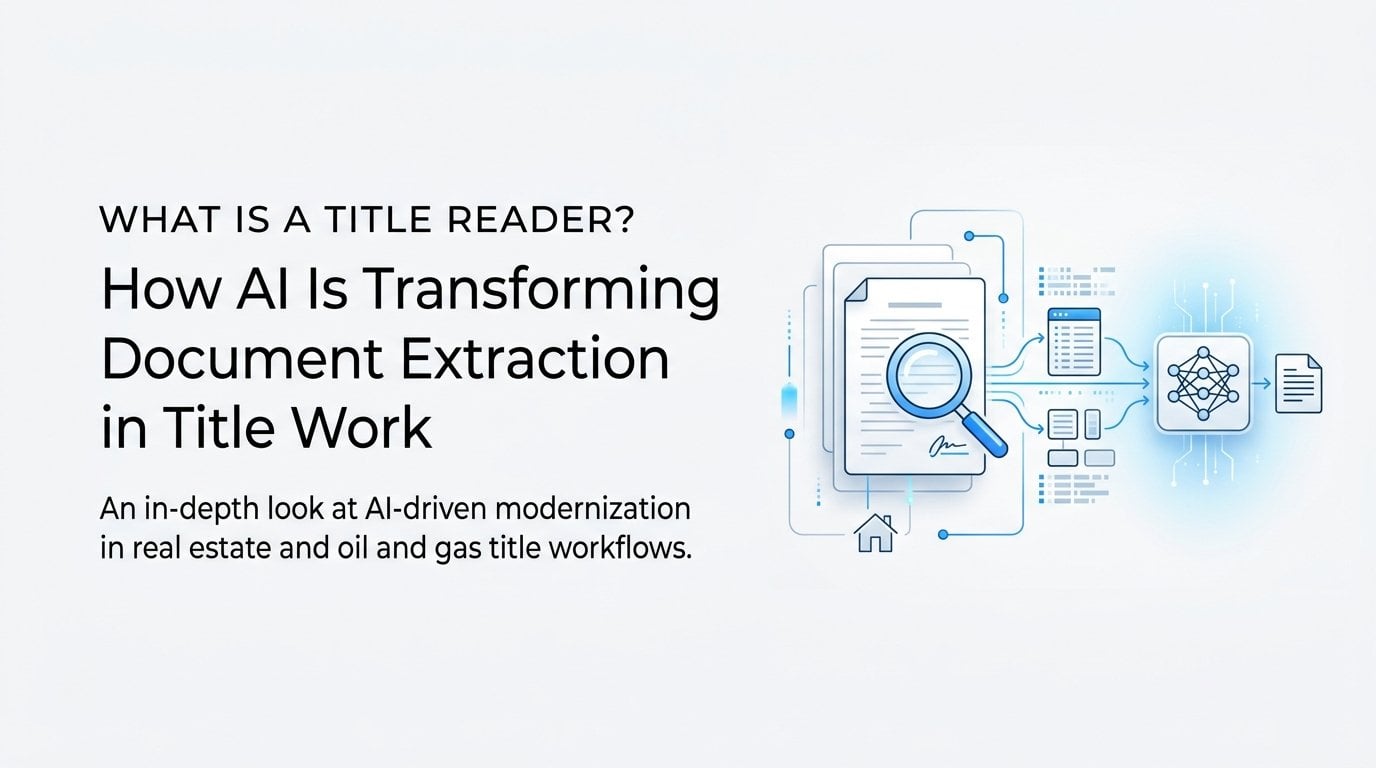
This article breaks down what title reading actually involves, why the manual version creates real operational challenges, and how AI-powered document extraction is changing the workflow for abstractors, oil and gas landmen, renewable energy developers, and the title industry at large. Whether you are new to the concept or evaluating modern tools, understanding what a title reader does, and what it should do, is the starting point.
The Role of a Title Reader in Property Research
At its core, a title reader is responsible for interpreting recorded land documents to trace the history of ownership for a given parcel, identify any encumbrances that affect the property, and flag defects or gaps in the chain of title. It is detective work grounded in legal language, and the output of that work forms the foundation of every title search, abstract, and commitment.
The document types a title reader encounters are varied and each comes with its own structure, terminology, and set of data fields that matter. A typical title search might involve:
Warranty and Quitclaim Deeds: The backbone of any ownership chain, these instruments convey title from grantor to grantee and must be read carefully for legal descriptions, consideration amounts, and any reservations or exceptions carved out by the grantor.
Deeds of Trust and Mortgages: These encumber the property as security for a debt and must be tracked alongside corresponding releases to confirm they have been satisfied.
Easements and Right-of-Way Agreements: These affect how the property can be used and must be identified and described accurately in any abstract or commitment.
Oil and Gas Leases and Mineral Deeds: Critical in energy-producing regions, these instruments convey or sever mineral interests from surface rights and require careful reading to understand the scope of what was conveyed, reserved, or leased.
Judgments, Tax Liens, and Mechanic’s Liens: These involuntary encumbrances attach to property by operation of law and are easy to overlook when scanning through a long instrument index.
Affidavits of Heirship and Court Orders: These fill gaps in the chain of title where formal conveyances may be missing and require interpretive judgment to apply correctly.
Within the broader title search and abstracting workflow, the title reader sits at the front end of the process. Once county courthouse records or digital document repositories are accessed, the title reader works through the relevant instruments chronologically, extracting key information and building the chain of title that an examiner will later review. Everything downstream — the abstract, the title commitment, the underwriter’s decision — depends on the quality of that initial reading.
This is why the role demands both legal literacy and meticulous attention to detail. A deed with a complex metes-and-bounds description, an oil and gas lease with a partial assignment buried in an exhibit, a release that only covers a portion of the original mortgage — these are the nuances that separate a competent title reader from an exceptional one. The stakes of getting it wrong are significant, which is exactly why the volume demands of modern title work have made this role a prime candidate for AI assistance.
Why Manual Title Reading Creates Bottlenecks
The volume challenge in title work is not abstract. A single residential title search might involve reviewing thirty to fifty recorded instruments. A commercial property with a complex ownership history could require reading through hundreds. For an oil and gas landman running a title on a multi-tract acreage position, the instrument count can climb into the thousands across a chain going back a century or more.
Each of those instruments must be individually opened, read, and interpreted. Key data fields — grantor and grantee names, legal descriptions, recording information, encumbrance details — must be extracted and recorded, either into an abstract template, a runsheet, or an order management system. When this is done manually, the time adds up quickly.
The accuracy stakes compound the pressure. Title defects are not minor inconveniences. A missed lien can surface at closing and halt a transaction. A misread legal description can mean the abstract covers the wrong parcel entirely. An overlooked mineral reservation can affect the validity of an oil and gas lease and create disputes over royalty payment obligations that take years and significant legal expense to resolve. In renewable energy development, where surface use agreements and mineral severances directly affect project feasibility, errors in title reading can have downstream consequences that extend well beyond the initial transaction.
Title insurance exists in part to backstop these risks, but claims are costly for everyone involved. The better answer is accuracy at the source, which means getting the reading right the first time.
For high-volume abstracting operations, the turnaround time pressure is real. Clients expect fast delivery, and the competitive landscape rewards firms that can process searches quickly without sacrificing accuracy. When title readers are manually working through large document sets, throughput becomes a constraint. Experienced professionals are a limited resource, and the repetitive data extraction work that makes up a significant portion of the job is not the highest-value use of their expertise.
Landmen conducting due diligence on large land packages face a similar dynamic. The time required to manually read and organize title information across dozens of tracts is a bottleneck that affects acquisition timelines, deal velocity, and ultimately the competitiveness of a land team. When the reading work slows down, everything downstream slows with it.
This is the operational reality that AI-powered title reading tools are designed to address: not eliminating the human professional, but handling the high-volume, repetitive extraction work so that skilled people can focus on interpretation, exception handling, and quality control.
AI-Powered Title Readers: What the Technology Actually Does
Understanding what an AI title reader actually does requires looking at the technology beneath the surface. Modern AI document extraction in a title context typically combines several capabilities working together.
The process begins with optical character recognition, commonly called OCR. OCR converts scanned document images into machine-readable text. This sounds straightforward, but title documents present real challenges: historical handwriting, faded ink, inconsistent scan quality, and documents formatted in dozens of different ways depending on the jurisdiction and the era in which they were recorded. Quality OCR tuned for legal documents is a meaningful technical requirement, not a given.
On top of OCR, purpose-built AI title readers apply natural language processing and machine learning models trained specifically on title document types. This is where the distinction between a general-purpose document reader and a title-specific tool becomes critical.
Generic document extraction tools are trained on broad document corpora. They can identify common fields in standardized forms, but they struggle with the highly specific legal language, abbreviations, and structural variations found in real estate and land records. A general tool might identify a name in a deed but fail to correctly classify it as a grantor versus a grantee. It might extract a legal description but miss the fact that it contains a reservation that qualifies the conveyance.
A purpose-built AI title reader trained on actual land records performs significantly better on these nuances. It understands that “W/D” likely refers to a warranty deed, that a legal description beginning with a township and range reference is in the Public Land Survey System, and that language like “save and except the mineral interests” has specific legal meaning that needs to be captured and flagged.
The data fields a capable AI title reader can extract include:
Grantor and Grantee Names: Correctly identified and normalized, which matters for index searching and chain-of-title tracing.
Legal Descriptions: Extracted in full, including any exceptions or reservations embedded within them.
Instrument Numbers and Recording Information: Book, page, document number, recording date, and county — the reference data that ties each instrument to the public record.
Consideration Amounts: Where disclosed, these can inform valuation and transfer tax analysis.
Encumbrance Details: Lien amounts, maturity dates, partial release language, and other terms that affect how the instrument interacts with the title chain.
Oil and Gas Lease Terms: Lessor and lessee, primary term, royalty rate, acreage description, and any special provisions that affect the scope of the lease.
The result is structured data derived from unstructured documents, delivered at a speed that manual reading cannot match. That structured data then becomes the input for the downstream workflow, which is where the real efficiency gains compound.
How Title Readers Fit Into the Modern Abstracting Workflow
Extracting data from a document is only valuable if that data flows efficiently into the next step. This is the workflow integration question, and it is where many standalone extraction tools fall short.
In a well-designed abstracting workflow, AI-extracted data moves directly from document reading into abstract generation, title commitment drafting, and order management without requiring manual re-entry. When a title reader identifies the grantor, grantee, legal description, and recording information from a deed, that data should populate the relevant fields in the abstract template automatically. When an encumbrance is identified, it should surface in the commitment’s Schedule B exceptions without the typist having to retype it from scratch.
For abstractors and title typists, this shift in workflow has a meaningful impact on daily work. The time spent on manual data entry — reading a document, then typing its contents into a system — is replaced by review and quality control. Instead of transcribing information, the professional is confirming that the AI extraction is accurate, flagging anything that requires closer examination, and focusing attention on the instruments that present genuine interpretive complexity.
This is not a reduction in professional involvement. It is a reallocation of professional effort toward higher-value work. Experienced abstractors bring judgment that AI cannot replicate: recognizing when a chain has a gap that needs to be addressed, understanding how a court judgment affects a specific property interest, or knowing when to flag an ambiguous legal description for examiner review. AI extraction handles the volume; human professionals handle the complexity.
For oil and gas landmen and renewable energy developers, the workflow integration story looks somewhat different but equally important. Title reading in a land context feeds into runsheets — structured documents that track mineral ownership, royalty interests, and lease status across a chain of title. Manually populating a runsheet from a large instrument set is time-consuming work that is well-suited to AI acceleration.
When AI-extracted data flows directly into runsheet templates, landmen can move faster through large acreage positions, identify ownership gaps or conflicts more quickly, and spend more time on the analytical work that drives leasing and acquisition decisions. For renewable energy developers conducting due diligence on large land packages, the ability to process title information at scale without proportionally scaling headcount is a meaningful operational advantage.
Platforms like TitleTrackr are built around this integrated workflow model, connecting document extraction directly to abstract generation, order management, and reporting tools so that extracted data moves through the process without friction.
What to Look for in an AI Title Reading Solution
Not all AI document extraction tools are created equal, and the title industry has specific requirements that generic solutions do not address well. When evaluating an AI title reading solution, several capabilities deserve close attention.
Accuracy on Historical and Handwritten Documents: A significant portion of the title record predates digital document creation. Instruments recorded decades ago may be handwritten, typed on vintage typewriters, or scanned from deteriorating originals. An AI title reader that performs well on clean modern documents but struggles with historical records has limited utility for many title searches. Look for tools that have been specifically trained and tested on the kinds of historical documents common in your jurisdiction and practice area.
Support for Oil and Gas and Mineral Instruments: If your work involves energy-related title, the AI tool needs to understand oil and gas leases, mineral deeds, assignments of leases, and division orders. These instruments have their own structure and terminology that differs meaningfully from standard real estate records. A tool trained only on residential real estate documents will not serve landmen and energy developers well.
Jurisdiction-Specific Document Formats: Recorded document formats vary by county and state. Grantor-grantee indexes, instrument numbering systems, and recording conventions differ across jurisdictions. A capable AI title reader should handle this variability without requiring extensive manual configuration for each new county or state.
Workflow Integration: As discussed, a standalone extraction tool that requires manual re-entry of data into other systems captures only a fraction of the available efficiency gain. The right solution connects directly to your abstract generation, order management, and file storage tools. Ask vendors specifically how extracted data flows into downstream systems and what integrations are available or built in.
Human Oversight Design: The best AI title readers are built to assist professional review, not circumvent it. Look for tools that make it easy to see what was extracted, flag low-confidence extractions for human review, and provide clear audit trails. Complex title issues — gaps in the chain, conflicting instruments, ambiguous descriptions — still require experienced human judgment. The AI should make it easier to get to those issues faster, not harder to catch them when they arise.
Evaluating these capabilities through a real-world pilot on documents from your actual practice area is the most reliable way to assess whether a tool will perform as promised.
From Document Pile to Clean Title Chain
The transformation that AI title reading enables is straightforward to describe but significant in practice. What once required a professional to manually open, read, interpret, and transcribe data from each recorded instrument in a set can now be substantially accelerated through AI extraction. The document pile becomes structured data faster, and the professionals working with that data can redirect their time toward analysis, exception handling, and quality control.
It is worth being clear about what this does not change. A title reader, whether human or AI-assisted, is only as valuable as the workflow it feeds into. The goal is always a complete, accurate, and defensible chain of title. AI extraction accelerates the path to that goal; it does not alter the destination or reduce the professional responsibility for getting there. The judgment required to interpret a complex title situation, identify a defect, or advise on how to cure a cloud on title remains firmly in human hands.
Looking ahead, AI title reading capabilities continue to evolve. Models are becoming more accurate on historical documents, better at handling the full range of oil and gas instruments, and more tightly integrated with the broader title workflow. For professionals in real estate, oil and gas, and renewable energy land work, this trajectory means that the tools available today are a starting point, not a ceiling.
The title professionals who will be best positioned in this environment are those who understand how to work effectively with AI tools, apply their expertise where it matters most, and build workflows that take full advantage of what the technology can do.
If you are an abstractor, landman, or developer looking to see what AI-powered document extraction looks like in practice, Learn more about our services and explore how TitleTrackr’s title reading and abstract generation tools can fit into your workflow.
Leave a Reply