
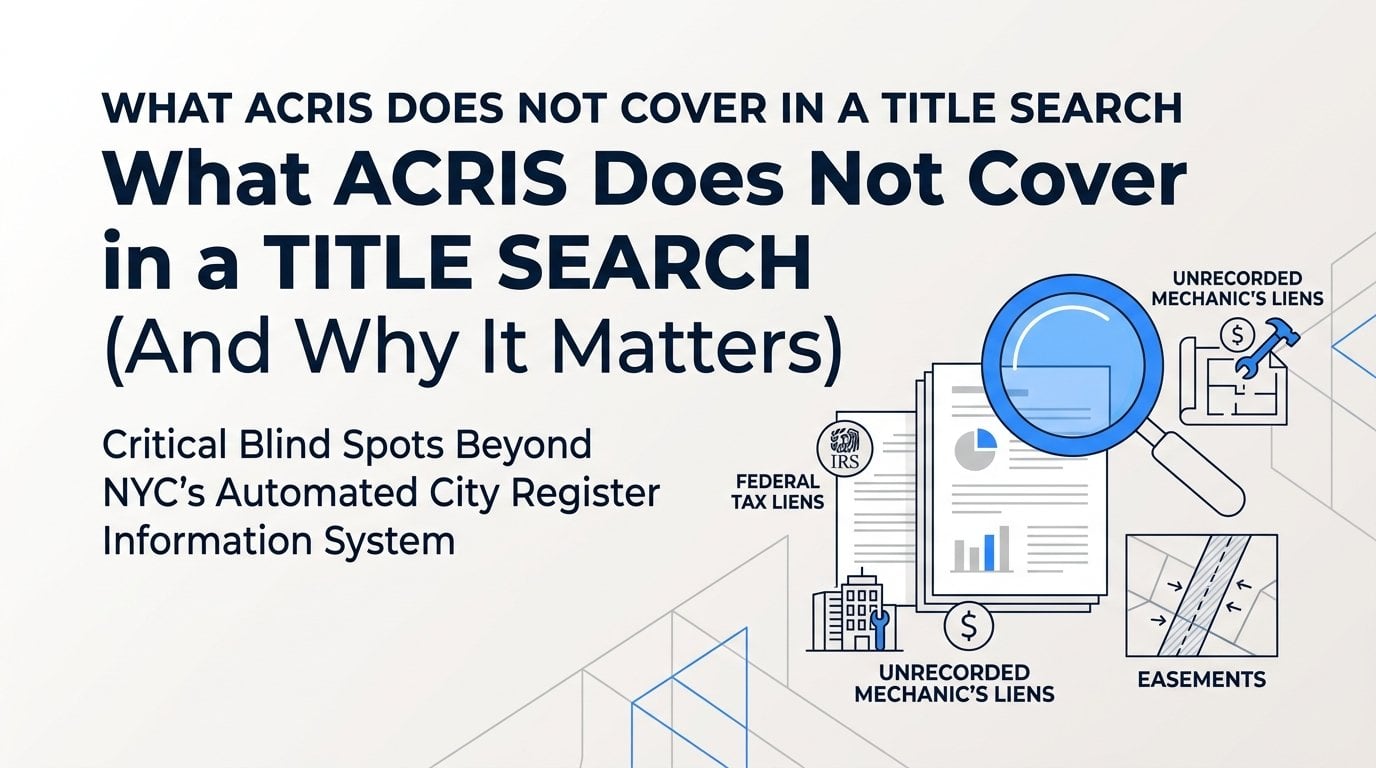
Picture this: a title searcher runs a thorough ACRIS search on a Brooklyn brownstone, documents look clean, the chain of title traces back without obvious breaks, and the deal closes. Then, weeks later, a federal tax lien surfaces. Or a mechanic’s lien that was filed but never recorded in the City Register’s system. Or an easement that was never memorialized in any recorded instrument at all. The transaction that looked clean wasn’t — and ACRIS never gave any indication there was a problem.
This is not a hypothetical edge case. It is the kind of professional reality that experienced NYC title searchers and abstractors understand well. ACRIS is a genuinely valuable public resource, and any title professional working in New York City should know how to use it. But knowing how to use it also means knowing exactly what it cannot do.
ACRIS, the Automated City Register Information System, is the NYC Department of Finance’s online portal for accessing recorded documents in Manhattan, Brooklyn, Queens, and the Bronx. It gives searchers indexed access to deeds, mortgages, satisfactions, and other recorded instruments by borough, block, and lot. For a starting point, that is powerful. But ACRIS is a recording system, not a title search. The gap between those two things is where professional risk lives.
This article maps that gap in detail: where ACRIS ends, what it structurally cannot show, and how working title professionals build complete searches that account for everything the system was never designed to capture.
What the System Was Built to Do
To understand ACRIS’s limitations, it helps to understand its actual purpose. The Automated City Register Information System is the NYC Department of Finance’s public-access portal for recorded documents maintained by the City Register. It covers four of New York City’s five boroughs: Manhattan, Brooklyn, Queens, and the Bronx. Staten Island is explicitly excluded — more on that shortly.
Within those four boroughs, ACRIS indexes recorded instruments by BBL: borough, block, and lot. A searcher can pull deeds, mortgages, mortgage satisfactions, assignments, consolidation agreements, easements that have been formally recorded, and certain other instruments tied to a specific property identifier. For document retrieval purposes, this is a meaningful capability. The system is searchable, publicly accessible, and covers a substantial volume of recorded real property transactions.
The critical word is “recorded.” ACRIS is an index of documents that have been formally submitted to and accepted by the City Register, then entered into the system. It was designed to give the public access to that recorded document universe. It was not designed to serve as a comprehensive title plant, to track encumbrances that exist outside the recording system, or to surface conditions affecting a property that were never memorialized in a recorded instrument.
That design distinction is not a flaw in ACRIS — it is simply what the system is. A deed index is not a title search. A recording portal is not a title plant. The professionals who use ACRIS most effectively are those who treat it as one research layer among many, rather than as a complete answer to the question of what affects title to a property.
With that foundation in place, the gaps become much easier to understand — and much harder to overlook.
The Recording Gap: When Documents Exist But Don’t Appear
The most structurally fundamental limitation of ACRIS is also the most straightforward: the system only reflects documents that have been formally recorded with the City Register. Anything that affects title but was never recorded simply does not exist in ACRIS, regardless of its legal significance.
Unrecorded instruments are more common than many newer title professionals expect. Certain easements are created by agreement between parties and never submitted for recording. Informal arrangements affecting access, use, or encroachment may be binding on successors in interest without ever appearing in any database. An unrecorded deed can pass equitable title in ways that create real complications for a subsequent purchaser. None of these will surface in an ACRIS search, because ACRIS has nothing to index.
Beyond unrecorded instruments, there is the practical issue of indexing delays. ACRIS reflects documents that have been recorded and entered into the system — but recording and system visibility are not instantaneous. A document may be submitted, accepted, and assigned a recording date, yet remain unsearchable for a period afterward. In an active transaction environment, this creates a window of risk: a lien or encumbrance recorded shortly before closing may not yet appear in ACRIS at the time of the search.
Then there is the problem of indexing errors. ACRIS organizes documents by BBL, which means a document recorded under an incorrect block or lot number may be effectively invisible to a standard property search. This is a known practical issue among NYC title professionals. A clerical error at the point of recording — a transposed digit in a block number, for example — can cause an instrument to be indexed in a location where a searcher following the correct BBL would never find it. Cross-reference searches and careful attention to adjacent lot numbers can help surface these misfiled instruments, but only if the searcher knows to look.
The cumulative effect of these gaps is significant. A clean ACRIS result does not mean a clean title — it means that no adverse instruments have been recorded under the correct BBL and made searchable in the system at the time of the search. That is a narrower statement than it might initially appear, and treating it as equivalent to a clean title is a professional risk.
Liens, Judgments, and Encumbrances That Live Elsewhere
Some of the most consequential title risks in NYC transactions are those that exist in legal systems entirely separate from the City Register. ACRIS cannot surface these because they are not recorded there — they are entered in court systems, federal databases, and agency records that operate independently.
Federal tax liens are a prime example. When the IRS files a federal tax lien against an individual or entity, that lien attaches to all property owned by the debtor. Federal tax liens are filed with the IRS and may be indexed in separate federal lien databases, but they do not necessarily appear in ACRIS. A searcher who relies solely on ACRIS for lien information may have no visibility into a federal tax lien that significantly clouds title.
Judgment liens present a similar challenge. Judgments entered in New York State Supreme Court or federal court can create liens against real property, but the records live in court systems — not in ACRIS. State court judgment searches and federal court searches are separate research tasks that a complete NYC title search must include.
Mechanic’s liens in New York are filed with the County Clerk, and while some of this information may overlap with City Register records in certain contexts, a dedicated mechanic’s lien search is a standard component of thorough NYC title work for exactly this reason.
Lis pendens, or notices of pending litigation, are another category that requires court record searches. A lis pendens filed in connection with a foreclosure action or other property dispute is a critical piece of title information — and it lives in court records, not in ACRIS.
Environmental liens can arise from contamination-related enforcement actions and may be filed through state environmental agencies. These encumbrances may not appear in ACRIS at all, requiring separate environmental lien searches depending on the property’s history and location.
Estate and probate proceedings, bankruptcy filings, and matrimonial actions can all affect title in ways that ACRIS will never reflect. A property that is part of an estate may have competing claims among heirs. A bankruptcy filing creates an automatic stay that affects the debtor’s property. A divorce proceeding may involve equitable distribution claims against real property. All of these matters are handled through court systems — surrogate’s court, federal bankruptcy court, state supreme court — that are entirely separate from the City Register’s recording system.
What No Database Can Show: Survey Issues and Physical Conditions
Here is a category of title risk that is worth understanding clearly: some conditions affecting a property will never appear in any recorded document database, no matter how thorough the search. These are physical and legal conditions that exist in the real world, not in the recording system.
ACRIS contains no survey data. Encroachments — a neighbor’s fence that crosses a property line, a building that extends beyond its lot — are not recorded anywhere. Boundary disputes, adverse possession claims, and easements established by long use rather than formal agreement are invisible to any database search. These conditions require a physical survey conducted by a licensed surveyor, along with legal analysis of what the survey reveals. No ACRIS result, however clean, can substitute for that work.
Easements by prescription deserve particular attention. When a party has used a portion of property openly, continuously, and adversely for the statutory period, an easement by prescription may arise as a matter of law — without any recorded instrument, without any filing, and without any notice in any database. The only way to identify the risk of such a claim is through physical inspection and, where appropriate, survey work.
Utility easements and rights-of-way present a related challenge. Some utility easements are formally recorded and will appear in ACRIS. Others are established by separate agreements with city agencies or through long-standing use, and may affect the property without any recorded instrument that a database search would surface.
Zoning violations, open building permits, and code enforcement actions are tracked by the NYC Department of Buildings, not the City Register. A property may have unresolved DOB violations, open permits from work performed years ago, or active enforcement actions — none of which will appear in ACRIS. DOB records are a standard component of thorough NYC title and due diligence work for exactly this reason. A clean ACRIS result provides no information whatsoever about a property’s DOB status.
The Staten Island Blind Spot and NYC-Specific Gaps
For title professionals working across all five boroughs, one of the most important facts about ACRIS is what it does not cover at all: Staten Island. Richmond County property records are maintained by the Richmond County Clerk’s office, not the City Register. ACRIS provides zero coverage for Staten Island properties. A searcher who does not know this — or who assumes that ACRIS covers all of New York City — will find nothing in ACRIS for a Staten Island property and may not understand why.
This is a structural jurisdictional gap, not a data quality issue. Staten Island simply operates under a different system, and any title work for Richmond County properties requires working directly with the Richmond County Clerk’s records. For professionals who primarily work in the four ACRIS boroughs and occasionally encounter Staten Island assignments, this distinction is critical to flag early in the research process.
Cooperative apartment ownership presents another NYC-specific gap that ACRIS is not equipped to address. Co-op ownership in New York City is structured as personal property: the owner holds shares in a cooperative corporation and a proprietary lease, rather than fee-simple title to real property. Because co-op transfers involve the sale of corporate shares rather than the conveyance of real property, they are not recorded in ACRIS the way deed transactions are.
Financing for co-op purchases is secured by UCC-1 filings, which are filed with the New York State Department of State — not recorded with the City Register. A title or lien search for a co-op unit therefore requires UCC searches through the NYS Department of State, not an ACRIS mortgage search. For professionals accustomed to fee-simple property searches, the co-op framework requires a fundamentally different research approach.
Properties subject to HPD regulatory agreements, HDFC (Housing Development Fund Corporation) restrictions, or other city agency covenants carry binding obligations that may appear in agency records rather than ACRIS. Affordable housing restrictions, rent regulation requirements, and similar encumbrances can significantly affect a property’s use and transferability — and a searcher relying solely on ACRIS may have no visibility into them.
Building a Search That Actually Covers the Ground
Given everything that ACRIS does not cover, what does a complete NYC title search actually look like? The answer is a layered, multi-source research process that treats ACRIS as one component rather than the whole.
A thorough NYC title search typically layers ACRIS with several additional searches, depending on the property type and transaction. State court searches surface lis pendens and judgment liens. Federal court searches cover bankruptcies and federal judgments. IRS lien searches address federal tax liens. NYC Department of Buildings records reveal open permits, violations, and code enforcement actions. NYC HPD records surface housing court cases and regulatory agreements. NYC DEP searches address water and sewer liens. For Staten Island properties, Richmond County Clerk records replace ACRIS entirely. For co-op units, UCC searches through the NYS Department of State address the financing picture.
This is not a short list, and managing it requires both professional knowledge and organizational discipline. Each source has its own search interface, its own indexing logic, and its own update cadence. Keeping track of what has been searched, what has been found, and how the results fit together across sources is itself a significant professional task.
This is where purpose-built title technology can make a meaningful difference. AI-powered platforms like TitleTrackr are designed to help title professionals organize complex, multi-source research: extracting key data from documents automatically, generating structured abstracts from large document sets, and managing orders in a way that keeps multi-source searches organized and auditable. The technology does not replace the professional judgment required to know which sources to search or how to interpret what is found — but it can reduce the friction of managing complexity, and it can help ensure that nothing falls through the cracks in a multi-source workflow.
Knowing the boundaries of any single data source is itself a professional skill. The searchers and abstractors who produce the most reliable work are those who understand not just how to use ACRIS, but exactly where it ends — and what needs to happen after that.
The Bottom Line on ACRIS and Real Title Work
ACRIS is a powerful public resource, and working title professionals in New York City should know it well. But the core message of this article is straightforward: ACRIS is a recording system, and a recording system is not a title search.
The gaps are real and they matter. Unrecorded instruments affect title without appearing in any database. Judgment liens, federal tax liens, and bankruptcy proceedings live in court systems that ACRIS does not touch. Physical conditions like encroachments, prescriptive easements, and boundary disputes require survey work that no database search can substitute for. DOB violations and HPD regulatory agreements live in agency records entirely separate from the City Register. Staten Island is not covered at all. Co-op ownership requires a different research framework entirely.
Each of these gaps represents a category of professional risk for the title searcher who treats ACRIS as a complete answer. Each one also represents an area where professional knowledge, disciplined multi-source research, and the right tools make the difference between a reliable result and an exposure.
As title technology continues to evolve, platforms built specifically for this work can help professionals manage the complexity of multi-source NYC searches more efficiently, without sacrificing the thoroughness that complete title work demands. If you are looking for tools designed for exactly this kind of work, Learn more about our services and see how TitleTrackr supports abstractors and title searchers working in complex markets like New York City.
Leave a Reply