
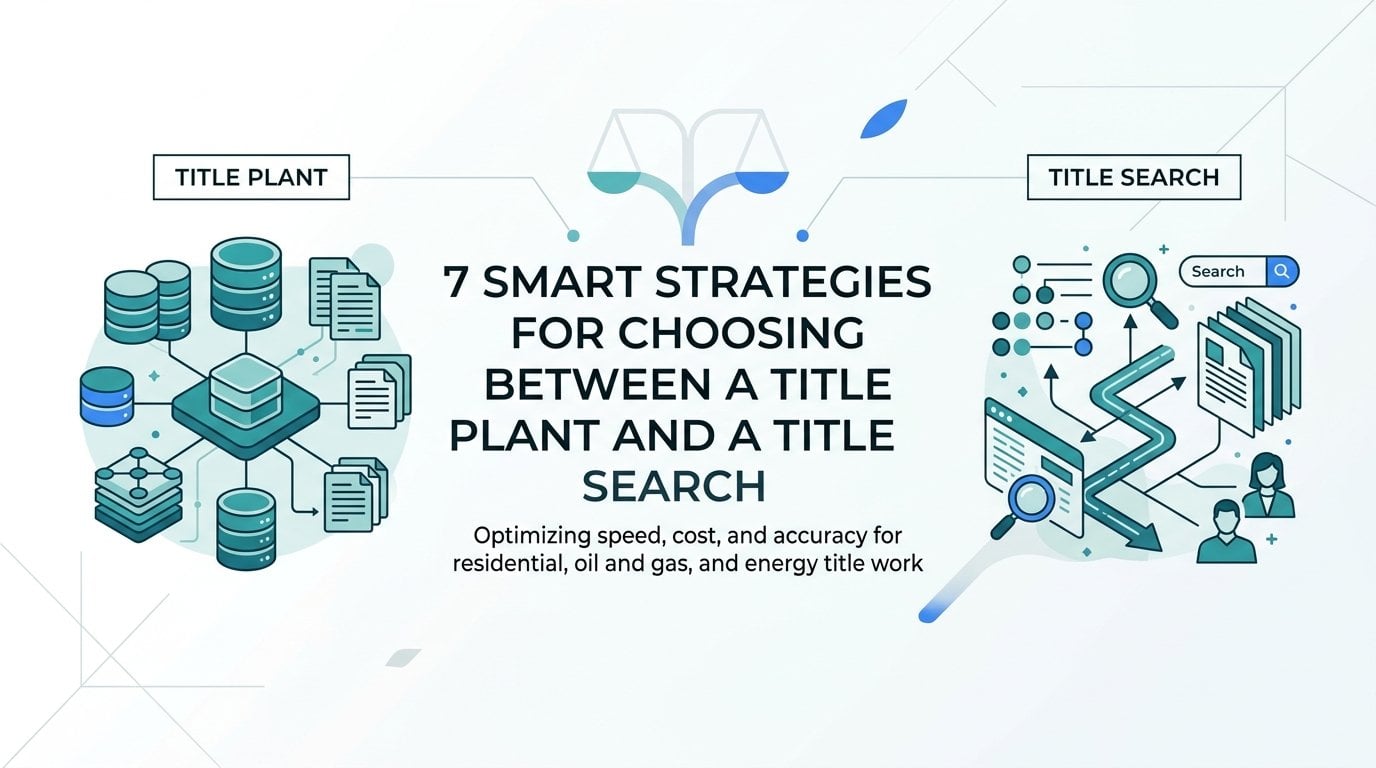
When you’re working a title order — whether it’s a residential closing, an oil and gas lease, or a renewable energy land acquisition — one of the first decisions you’ll face is where to pull your information from: a title plant or a traditional title search. These two approaches aren’t interchangeable, and choosing the wrong one for a given situation can cost you time, money, and accuracy.
A title plant is a privately maintained, indexed repository of property records, often organized by parcel or grantor/grantee, that allows for rapid, structured lookups without visiting the courthouse. A title search, by contrast, typically involves going directly to public records at county courthouses, recorder offices, or online portals to trace the chain of title from the current owner back through history.
Both methods have legitimate roles in modern title work. The challenge is knowing when each is the right tool, how to combine them effectively, and how emerging AI-powered platforms are changing the calculus entirely. For title searchers, abstractors, landmen, and energy developers, getting this decision right is foundational to producing accurate, defensible work product.
This guide walks through seven practical strategies to help you navigate the title plant vs. title search decision, covering geographic realities, cost considerations, chain-of-title complexity, energy and mineral rights scenarios, and how technology is reshaping both approaches.
1. Match Your Data Source to the County’s Infrastructure
The Challenge It Solves
One of the most common efficiency killers in title work is assuming a title plant exists for a county when it doesn’t. Professionals who operate across multiple states or regions can easily lose hours chasing plant access that simply isn’t available, particularly in rural areas where private indexing infrastructure was never built.
The Strategy Explained
Title plant coverage is geographically uneven. Urban and suburban counties in states like California, Texas, and Florida often have robust private plant networks. But many rural counties, particularly in the South, Midwest, and energy-producing states like Wyoming, North Dakota, and West Virginia, have no private plant at all. In these areas, courthouse records aren’t a fallback option. They’re the only option.
The practical solution is building a territory reference map for every county you regularly work. Document which counties have plant access, which operators maintain those plants, and what the known update lag is for each. This becomes a living reference document your team can consult before starting any order.
Implementation Steps
1. List every county in your active search territory and research whether a private title plant exists for each one.
2. Note the plant operator, access method (subscription, per-search, or through a title company relationship), and any known limitations such as update frequency or instrument coverage gaps.
3. Flag counties where courthouse-only searches are required and document the online access options available for each, including state portals or third-party aggregators.
4. Update this reference map quarterly, since plant coverage and online courthouse access can change as counties digitize records or new operators enter a market.
Pro Tips
Don’t rely on secondhand information about plant coverage. Call the county recorder’s office directly, or contact local abstracting associations to get accurate, current information. A five-minute phone call can save you hours of misdirected effort on a search that requires courthouse records from the start.
2. Leverage Plant Speed Without Ignoring Its Limits
The Challenge It Solves
In high-volume residential title work, turnaround time is often the defining competitive factor. When a lender or closing attorney needs a search completed quickly, title plants offer a significant speed advantage. The risk is treating that speed as a substitute for completeness, particularly when a plant’s records haven’t caught up with recent recordings.
The Strategy Explained
Title plants allow structured, indexed lookups that are typically faster than manual courthouse searches for standard transactions. A searcher with plant access can often complete a residential search in a fraction of the time it would take to work through courthouse indexes manually. For straightforward chains of title in plant-covered counties, this efficiency is genuinely valuable.
The limitation to watch is update lag. Most plants are updated on a regular cycle, but that cycle can range from daily to several weeks depending on the operator. For time-sensitive closings where instruments may have been recorded recently, a plant search alone may miss the most current filings. Knowing your plant’s update frequency lets you decide when a supplemental courthouse check is warranted.
Implementation Steps
1. Confirm the update frequency of any plant you use regularly and document it in your territory reference map.
2. For transactions with tight timelines, check the plant’s last update date against the recording date of instruments you’d expect to find.
3. When the lag window creates meaningful risk, run a targeted courthouse check covering only the period since the plant’s last update rather than duplicating the entire search.
4. Build this supplemental check into your standard workflow for any search where a recent lien, deed, or encumbrance could affect the transaction.
Pro Tips
Think of the plant as your primary index and the courthouse as your quality control layer for the current recording window. This hybrid approach captures most of the speed benefit while protecting against the most common plant limitation. Documenting which sources you used and when is also essential for defensible work product.
3. Default to Direct Public Records for Complex Chains of Title
The Challenge It Solves
Not every title situation is a clean, straightforward chain from seller to buyer. Estates, foreclosures, tax deed sales, adverse possession claims, and prescription easements all involve legal proceedings and instruments that may not be fully captured in a private title plant. Relying on plant records alone in these scenarios creates real exposure.
The Strategy Explained
Title plants are built for efficiency on standard transactions. They index recorded instruments, but their coverage of probate proceedings, court judgments, tax sale redemption periods, and other legally complex events is often incomplete. For these situations, the courthouse isn’t just a backup. It’s the authoritative source, and there’s no substitute for going directly to primary records.
Recognize the triggers that should automatically route a search to courthouse records: any indication of estate administration in the chain, a prior foreclosure or deed in lieu, a tax deed or tax sale, questions about adverse possession, or easements that may have arisen by prescription rather than express grant. These scenarios require the kind of depth and verification that only primary source research can provide.
Implementation Steps
1. Create a checklist of complexity triggers that automatically flag a search for courthouse-first methodology: estate involvement, foreclosure history, tax deed, judgment liens, or gaps in the chain.
2. For estate-related chains, pull probate court records directly rather than relying on deed recordings alone, since personal representative deeds may not tell the full story.
3. For foreclosure histories, verify the foreclosure was completed correctly, including notice requirements and redemption period expiration, using court records rather than plant abstracts.
4. Document your reasoning for choosing courthouse records in your order notes so the methodology is transparent in your work product.
Pro Tips
When a chain looks clean in the plant but something feels off, trust your instinct and go to primary sources. Title plants are organized for speed, not for catching the edge cases that create real liability. The extra time spent at the courthouse on a complex chain is always cheaper than a title claim.
4. Apply a Different Framework for Oil, Gas, and Mineral Title
The Challenge It Solves
Mineral title work operates by a fundamentally different set of rules than surface title work. The depth of history required, the complexity of ownership fractions, and the range of source documents involved make standard title plant methodology inadequate for most oil, gas, and mineral searches. Landmen and energy developers who treat mineral title like a residential search create serious gaps in their work product.
The Strategy Explained
Mineral title often requires searching back to patent, the original federal or state land grant, which can mean tracing ownership through 100 years or more of conveyances. Title plants, which are typically organized around surface ownership and standard recorded instruments, rarely index mineral severances, royalty assignments, or division orders comprehensively. For mineral work, the courthouse is the starting point, not the fallback.
Beyond the courthouse, mineral title work routinely requires additional source layers: Bureau of Land Management records for federal lands, state oil and gas commission filings, PACER for federal bankruptcy records that may have affected mineral ownership, and sometimes state archives for early patent records. Renewable energy land work adds another layer of complexity, involving surface easements, accommodation doctrine considerations, and sometimes mineral rights that interact with surface use agreements.
Implementation Steps
1. For every mineral or leasehold title assignment, start by identifying the land’s original patent and work forward chronologically using a run sheet to track ownership percentages through each severance, assignment, and lease.
2. Check BLM records for any federal land involvement and state oil and gas commission records for existing leases, pooling orders, or unitization agreements affecting the tract.
3. Search federal bankruptcy records through PACER when any prior owner in the mineral chain shows signs of financial distress, since bankruptcy can affect mineral ownership in ways that don’t always appear in county records.
4. For renewable energy projects, separately analyze surface rights, easement chains, and any mineral accommodation doctrine issues that may affect project development.
Pro Tips
Never assume a title plant’s mineral coverage is complete. Even plants that index mineral instruments typically do so inconsistently. Run sheet methodology, built on primary courthouse and federal records, is the professional standard for a reason. It’s the only approach that gives you a defensible ownership picture at the fraction level.
5. Calculate the True Cost Before Committing to Either Approach
The Challenge It Solves
Many title professionals default to one method out of habit rather than economics. Plant access can feel like a sunk cost once you’re subscribed, leading to overuse in situations where it’s not the best fit. Courthouse searches can feel like the “safe” choice without accounting for the real labor time they require. Neither instinct leads to an optimized cost structure.
The Strategy Explained
The true cost of any search method includes more than the direct fees. Title plant access typically involves subscription fees or per-search charges. For high-volume operations working consistently in plant-covered counties, this can be highly cost-effective since the per-search cost drops as volume increases. For low-volume operators or those who work a plant-covered county only occasionally, the subscription cost may not justify access at all.
Courthouse searches carry recorder fees, copy costs, and, for in-person visits, travel time and labor. Online courthouse access has reduced but not eliminated these costs. The bigger variable is labor: a plant search can often be completed significantly faster than a manual courthouse search for a standard transaction, and that time difference has a real dollar value in any operation that bills by the search or manages searcher capacity.
Implementation Steps
1. Calculate your average labor time for a standard search using each method in each county you work regularly, and assign a dollar value to that time based on your actual labor costs.
2. Add the direct costs: plant subscription or per-search fees versus recorder fees and copy costs for courthouse searches.
3. Compare total cost per search across both methods for each county and transaction type, factoring in your actual search volume to determine whether a plant subscription is economically justified.
4. Revisit this calculation when your volume changes significantly, when a plant operator changes its pricing, or when a county improves its online access options in ways that reduce courthouse search labor time.
Pro Tips
Build your cost model at the county and transaction type level, not as a blanket policy. A plant subscription that pays for itself on residential searches in a high-volume urban county may be a poor investment for the occasional rural agricultural parcel in the same state. Granular cost awareness leads to smarter sourcing decisions across your entire operation.
6. Use AI-Powered Extraction to Maximize Either Source
The Challenge It Solves
Even when you’ve made the right call on where to pull your documents, processing those documents into a usable abstract or report is still a time-intensive step. Whether you’re working from a title plant or courthouse records, the bottleneck often shifts from document retrieval to document analysis and report generation. AI-powered tools are specifically designed to address this bottleneck.
The Strategy Explained
AI document extraction tools can process deeds, mortgages, easements, and other instruments pulled from either a title plant or courthouse records, automatically identifying and capturing the key data points that go into an abstract or title report. This means the efficiency gains from AI aren’t dependent on which source you used. They apply regardless of whether your documents came from a plant lookup or a courthouse run.
Platforms like TitleTrackr are built specifically for this workflow. Automated deed extraction pulls grantor, grantee, legal description, consideration, and encumbrance data without manual re-keying. Instant abstract generation takes that extracted data and produces a structured deliverable in a fraction of the time it would take to draft manually. For title searchers and abstractors working under deadline pressure, this changes the math on how many orders can be completed in a given day.
Implementation Steps
1. Identify the document types in your most common search types and confirm that your AI extraction tool is trained to handle them accurately, including older handwritten instruments if your work involves historical chains.
2. Integrate AI extraction into your workflow immediately after document collection, whether those documents came from a plant or courthouse, so the analysis step begins as soon as retrieval is complete.
3. Use automated abstract generation for standard search types where the output format is consistent, reserving manual drafting for complex situations that require interpretive judgment.
4. Review AI-generated output before delivery, using it as a structured first draft rather than a final product, and document your review process as part of your quality control record.
Pro Tips
The professionals who get the most out of AI extraction are those who integrate it early in the workflow rather than treating it as a formatting tool at the end. When extraction happens immediately after retrieval, you can identify missing instruments or chain gaps sooner, which reduces the cost of going back to the source for additional documents.
7. Build a Hybrid Protocol for Your Most Common Search Types
The Challenge It Solves
Ad hoc decision-making about which source to use creates inconsistency across a team and makes it difficult to audit methodology after the fact. When every searcher is making independent calls about plant versus courthouse without a shared framework, quality control becomes reactive rather than systematic. A documented hybrid protocol solves this at the operational level.
The Strategy Explained
A hybrid protocol is a situation-specific decision matrix that defines which source or combination of sources to use for each search type your operation handles regularly. It doesn’t have to be complicated. At its core, it’s a set of documented rules: residential searches in plant-covered counties use the plant with a supplemental courthouse check for the current recording window; complex chains trigger courthouse-primary methodology; mineral and leasehold title always follows run sheet methodology using courthouse and federal records.
The protocol becomes more powerful when it’s embedded in an order management system. When your team logs a new order, the system can prompt for the transaction type and county, then surface the correct methodology based on your documented rules. This standardizes practice across searchers, creates an audit trail for every order, and makes onboarding new team members significantly easier since the decision logic is built into the workflow rather than stored in individual searchers’ heads.
Implementation Steps
1. Map your most common search types: standard residential, commercial, agricultural, oil and gas leasehold, mineral title, renewable energy easement, and any others specific to your operation.
2. For each search type, document the default methodology, including primary source, supplemental checks, and any triggers that escalate to a more intensive approach.
3. Build this decision matrix into your order management system so that methodology selection is prompted at order intake rather than left to individual judgment at search time.
4. Review the protocol quarterly and update it when you add new counties to your territory, change plant subscriptions, or encounter new search scenarios that your current matrix doesn’t cover.
Pro Tips
Make sure your protocol captures not just what methodology to use, but why. When a searcher or auditor looks at a completed order six months later, the documented reasoning behind the source selection is as important as the sources themselves. Order management systems that support methodology notes and source logging make this documentation automatic rather than an extra step.
Putting It All Together
There is no universal answer to the title plant vs. title search question, and that’s actually the point. The professionals who produce the most accurate, efficient work product are those who understand both tools deeply and know when to use each one, when to combine them, and when to bring in technology to accelerate the process.
The seven strategies in this guide give you a practical framework for making that call consistently. Start by mapping your territory’s plant coverage so you’re never caught assuming access that doesn’t exist. Use plant speed where it’s justified, but know its limits. Default to primary courthouse records when complexity demands it, and apply an entirely different framework when mineral or energy title is involved. Build your cost model at the search-type level, not as a blanket policy. Layer AI extraction on top of whatever source you use to compress the time between document collection and deliverable. And formalize all of it into a hybrid protocol that your entire team can follow.
For most title searchers and abstractors, the practical path forward is a clear internal protocol that accounts for geography, transaction type, complexity, and timeline. For landmen and energy developers working mineral and leasehold titles, that protocol needs to go further, accounting for the unique gaps that title plants typically leave in subsurface ownership histories.
AI-powered platforms are making it easier than ever to process documents quickly regardless of where they come from. Tools that automate deed extraction, generate instant abstracts, and manage orders in a centralized system reduce the friction of either approach and give title professionals more time to focus on the judgment calls that actually require human expertise.
If you’re ready to see how AI can streamline your title workflow, whether you’re pulling from a plant, the courthouse, or both, learn more about our services and explore what TitleTrackr’s platform can do for your operation.
Leave a Reply