
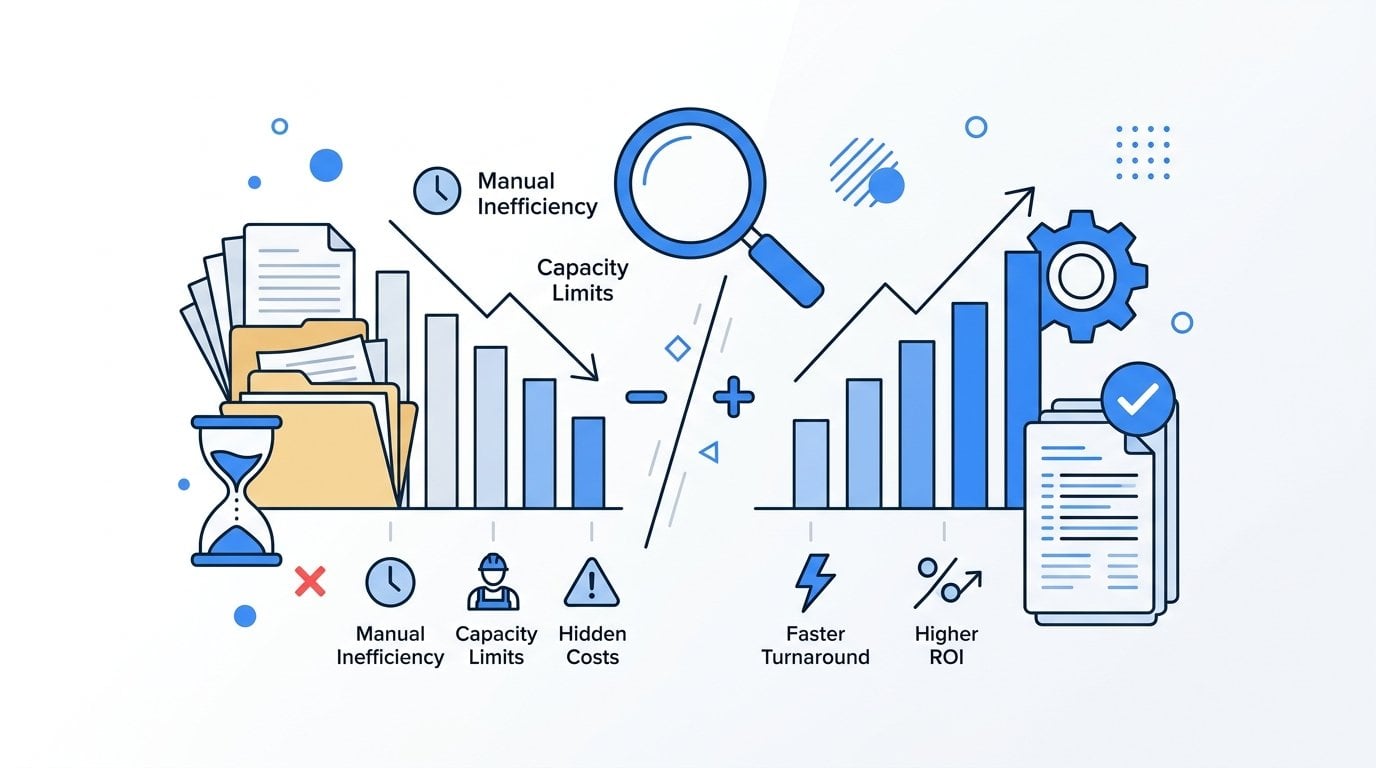
If you’ve spent any real time in title work, you know the rhythm: pull the deed, check the mortgage, cross-reference the release, format the report, repeat. It’s meticulous, it’s necessary, and on a busy week, it can feel like you’re running a marathon on a treadmill. The work never stops, but the capacity to take on more of it hits a ceiling fast.
So when the phrase “automated title abstracting cost” comes up, most professionals instinctively think about the price tag on a software subscription. That’s understandable. But it’s also the wrong starting point. The more useful question isn’t “what does automation cost?” It’s “what am I already paying to do this manually, and what am I leaving on the table by not automating?”
This article breaks down both sides of that equation. We’ll walk through the real, often-invisible costs of traditional abstracting, explain what drives pricing in automated platforms, and give you a practical framework for evaluating whether automation makes financial sense for your specific operation, whether you’re a solo abstractor handling a handful of searches per week or a firm processing dozens of orders daily. By the end, you’ll have the clarity to make a decision based on value, not just sticker price.
The Real Price of Manual Title Abstracting
Let’s start with an honest accounting of what manual abstracting actually costs, because most professionals underestimate it. The visible costs are easy enough to tally: document retrieval fees from county clerks or third-party data providers, time spent on each search, and the occasional re-search when something doesn’t add up. But the full picture is considerably more expensive than that.
Consider the time-per-search variable. On a straightforward residential property with clean records, an experienced abstractor might move quickly. But introduce a rural parcel with gaps in the chain, a mineral rights split, or a county with inconsistent indexing, and that same search can balloon into hours of work. The complexity isn’t always predictable, which makes labor costs difficult to budget with any precision.
Then there’s the formatting and report generation phase, which is consistently underestimated. Pulling the documents is one thing. Organizing them into a coherent, professionally formatted abstract or commitment report is another layer of work entirely. For typists and abstractors who bill by the search rather than the hour, this phase often eats directly into margin.
Error correction adds another layer of cost that rarely shows up in any line item. When a missed lien, an overlooked easement, or a formatting inconsistency requires a re-search, the cost isn’t just the time to fix it. It’s the delay it creates for the client, the potential for legal exposure, and the reputational hit that comes with delivering work that needs to be redone. These costs are real, even when they’re hard to quantify.
Volume amplifies all of this. A solo abstractor handling five searches per week operates in a different cost environment than a firm processing fifty. At higher volumes, the inefficiencies compound. Time spent on administrative tasks, like tracking order status, following up with county offices, and manually logging completed work, scales with order count. At some point, the overhead of managing the work becomes nearly as burdensome as doing the work itself.
This is where opportunity cost enters the picture. Every hour spent on repetitive, automatable tasks is an hour not spent on higher-value work: complex searches that require genuine expertise, client relationships, or simply taking on more orders. For a solo professional, that ceiling on capacity is a direct ceiling on revenue. For a firm, it translates into headcount decisions that carry their own significant costs.
What Drives the Cost of Automated Title Abstracting Software
Not all automated abstracting platforms are priced the same way, and understanding the pricing models in the market is the first step toward evaluating which one fits your operation.
The three most common structures you’ll encounter are per-search pricing, subscription tiers, and enterprise licensing. Each has a different logic, and each suits a different type of user.
Per-search or per-report pricing: You pay only for what you use. This model works well for lower-volume users who don’t have consistent, predictable order flow. There’s no commitment, no monthly minimum, and no paying for capacity you’re not using. The tradeoff is that per-unit costs tend to be higher than what you’d pay on a subscription basis if your volume is steady.
Subscription tiers: A flat monthly or annual rate that covers a defined volume of searches or reports. This model rewards consistency. If you’re running a title search firm or abstracting company with reliable order volume, subscriptions almost always offer better unit economics than per-search pricing. Many platforms offer multiple tiers so you can right-size your plan as volume grows.
Enterprise or custom licensing: Designed for large organizations with specialized requirements, high volume, or the need for custom integrations. Pricing is typically negotiated directly and may include dedicated support, custom workflows, or API access. This model is less common among individual professionals but relevant for larger title operations or energy companies with significant land research needs.
Beyond the pricing model itself, specific features drive costs higher, and knowing which ones are worth paying for matters. AI-powered document extraction is one of the most significant value drivers in the market. The ability to automatically pull key data from deeds, mortgages, liens, and other instruments, including older documents with inconsistent formatting or handwritten elements, saves substantial time per search. Platforms that do this well tend to charge more for it, and generally, the premium is justified.
Automated report generation is another feature that meaningfully affects both cost and value. If a platform can produce a formatted abstract or title commitment report directly from extracted data, it eliminates one of the most time-consuming phases of the abstracting workflow. The quality of the output matters here: a report that still requires significant manual cleanup doesn’t deliver the same value as one that’s client-ready.
Order management integration is a feature that’s easy to overlook until you realize how much time you’re spending tracking orders in spreadsheets or email threads. Platforms that include built-in order management eliminate the need for separate tools and reduce administrative overhead, particularly for firms handling multiple simultaneous orders.
One distinction worth making: purpose-built platforms designed specifically for title work tend to offer more relevant feature sets than general document automation tools that have been adapted for the industry. A general-purpose tool might handle document extraction reasonably well but fall short on the specific output formats, terminology, and workflows that title professionals actually need. Fit matters as much as functionality.
Who Pays What: Cost Profiles by Role and Volume
The right pricing model and the right platform depend heavily on who you are and how you work. Automated title abstracting cost looks very different depending on your role, your volume, and the complexity of the work you handle.
Solo abstractors and typists are often the most price-sensitive segment, and understandably so. With lower and sometimes unpredictable order volume, committing to a high monthly subscription can feel risky. Per-search or entry-level subscription pricing tends to make the most sense here. But the value proposition for solo professionals is particularly compelling: automation allows a single person to produce work at a pace and quality level that would otherwise require a support team. The ability to deliver polished, professionally formatted abstracts quickly is a genuine competitive advantage when you’re competing with larger firms for client relationships.
Title search firms and abstracting companies operate at a scale where subscription economics become significantly more attractive. When you’re processing dozens of orders per week, the per-unit cost of a subscription model drops substantially compared to pay-as-you-go pricing. More importantly, the ROI accelerates with volume. Time savings that add up to a few hours per week at low volume translate into days of recovered capacity at scale. For firms that have considered adding headcount to keep up with demand, automation often represents a more cost-effective path to increased throughput.
Order management becomes especially critical at this level. When multiple abstractors are working simultaneously on different orders, having a centralized system to track status, assign work, and manage client communication isn’t a nice-to-have. It’s operational infrastructure. Platforms that bundle this capability with abstracting tools offer compounding value.
Oil and gas landmen and energy developers represent a specialized segment with needs that general real estate title tools often don’t address well. Run sheets, mineral rights chain of title, royalty interest calculations, and the specific document types associated with oil and gas conveyances require purpose-built functionality. A platform that handles residential real estate abstracts efficiently may be poorly suited to the complexity of mineral title work.
For landmen and energy developers, the evaluation criteria should include whether the platform supports the specific workflows and output formats relevant to land and energy work, not just whether it automates document extraction in general. Renewable energy developers face a similar consideration: land research for project site acquisition often involves large volumes of parcels across multiple counties, making scalability and efficiency particularly important.
Calculating ROI: A Framework for Title Professionals
Evaluating the financial case for automation doesn’t require a finance degree. A straightforward framework can give you a working estimate of whether the numbers make sense for your operation.
Start with time savings per search. Estimate how long your current manual process takes from document retrieval through final report delivery. Then estimate how long the same search would take with an automated platform, accounting for the time you’d still spend reviewing and verifying output. The difference is your time savings per search.
Multiply that by your effective hourly rate. If you’re a solo professional who bills by the search, this requires a bit of translation: divide your typical per-search fee by the hours you currently spend on it to get an implied hourly rate. For firms paying abstractor salaries, use the fully loaded hourly cost including benefits and overhead.
Then multiply by your monthly search volume. Time saved per search multiplied by hourly rate multiplied by monthly volume gives you a rough estimate of the labor value automation could recover each month. Subtract the monthly software cost, and you have a baseline net gain figure.
That calculation alone is useful, but it understates the full picture. Error reduction adds value that’s harder to quantify but very real. Manual abstracting errors, whether a missed lien, an incorrect legal description, or an overlooked encumbrance, can trigger costly re-searches, client disputes, or in serious cases, legal exposure. Automation doesn’t eliminate the need for professional review, but it reduces the likelihood of errors that stem from fatigue, inconsistency, or simple oversight in repetitive tasks.
Capacity increase is the third dimension of ROI, and often the most significant for growing operations. If automation allows you to handle more orders without adding headcount, the incremental revenue from that additional capacity flows directly to the bottom line. This is where the math can become compelling quickly, especially for firms that are currently turning away work or stretching timelines due to capacity constraints.
One factor to build into any ROI timeline: the implementation curve. Most platforms require some onboarding period, and users typically don’t reach full efficiency on day one. A realistic ROI assessment should account for a ramp-up period, particularly if your team is adopting new technology for the first time. Most well-designed platforms minimize this with intuitive interfaces and dedicated onboarding support, but it’s worth asking about before you commit.
Features That Justify the Investment (And Red Flags to Avoid)
Not every feature on a platform’s marketing page translates into real value for title professionals. Knowing which capabilities are worth paying for, and which are noise, helps you evaluate options more clearly.
AI-powered document extraction is the core capability that drives most of the time savings in automated abstracting. The key differentiator isn’t just whether a platform does extraction, but how well it handles the messy reality of county records: inconsistent formatting, older handwritten documents, scanned images of varying quality, and non-standard legal descriptions. Platforms that perform reliably across these conditions are worth more than those that work well only on clean, modern documents.
Instant abstract and report generation is the feature that closes the loop. Extraction gets the data; report generation turns it into a deliverable. If the output requires extensive manual reformatting before it can go to a client, the time savings are significantly eroded. Look for platforms that produce output in formats your clients actually use.
Integrated order management eliminates the need for separate tracking tools and reduces the administrative overhead that scales with volume. For firms handling multiple simultaneous orders, this integration is a meaningful efficiency gain.
On the red flag side, watch for pricing structures that charge per document upload without volume caps or reasonable limits. These models can make costs unpredictable and expensive at scale. Lack of responsive customer support is another concern, particularly during onboarding when questions are most likely to arise. And be cautious of platforms that market themselves as general document automation tools with a title industry add-on. The nuances of title work, from specific report formats to chain-of-title logic, benefit from purpose-built design.
Before committing to any platform, ask directly: Is there a free trial? What does onboarding look like, and what support is provided during that period? Does the platform have specific functionality for your niche, whether that’s residential abstracting, oil and gas landwork, or energy development? The answers will tell you a great deal about whether the platform was built for professionals like you or adapted from something more generic.
Putting the Numbers in Perspective
Here’s the reframe that changes how most title professionals think about this decision: automated abstracting isn’t an expense category. It’s a capacity multiplier.
The question isn’t whether you can afford the software. It’s whether you can afford to keep operating at your current throughput ceiling. Every search that takes longer than it needs to, every hour spent on formatting that a platform could handle automatically, and every order you can’t take because your pipeline is already full represents a real cost, even if it never shows up on an invoice.
The decision factors that matter most are straightforward. Volume determines which pricing model fits. Role and niche determine which features you actually need. Budget model, whether you prefer predictable monthly costs or pay-as-you-go flexibility, determines which structure to look for. And your current pain points, whether that’s turnaround time, error rates, or administrative overhead, point toward which capabilities to prioritize.
If you’re a solo abstractor looking to compete on speed and output quality, automation levels the playing field. If you’re running a firm and watching your team’s capacity max out, automation is often more cost-effective than hiring. If you’re a landman or energy developer working through complex mineral title research at scale, a purpose-built platform saves time that general tools simply can’t.
TitleTrackr is built specifically for this work: AI-powered document extraction, instant abstract generation, integrated order management, and workflows designed for the full range of title professionals, from residential abstractors to oil and gas landmen. Learn more about our services and see how the platform fits your operation.
Leave a Reply