
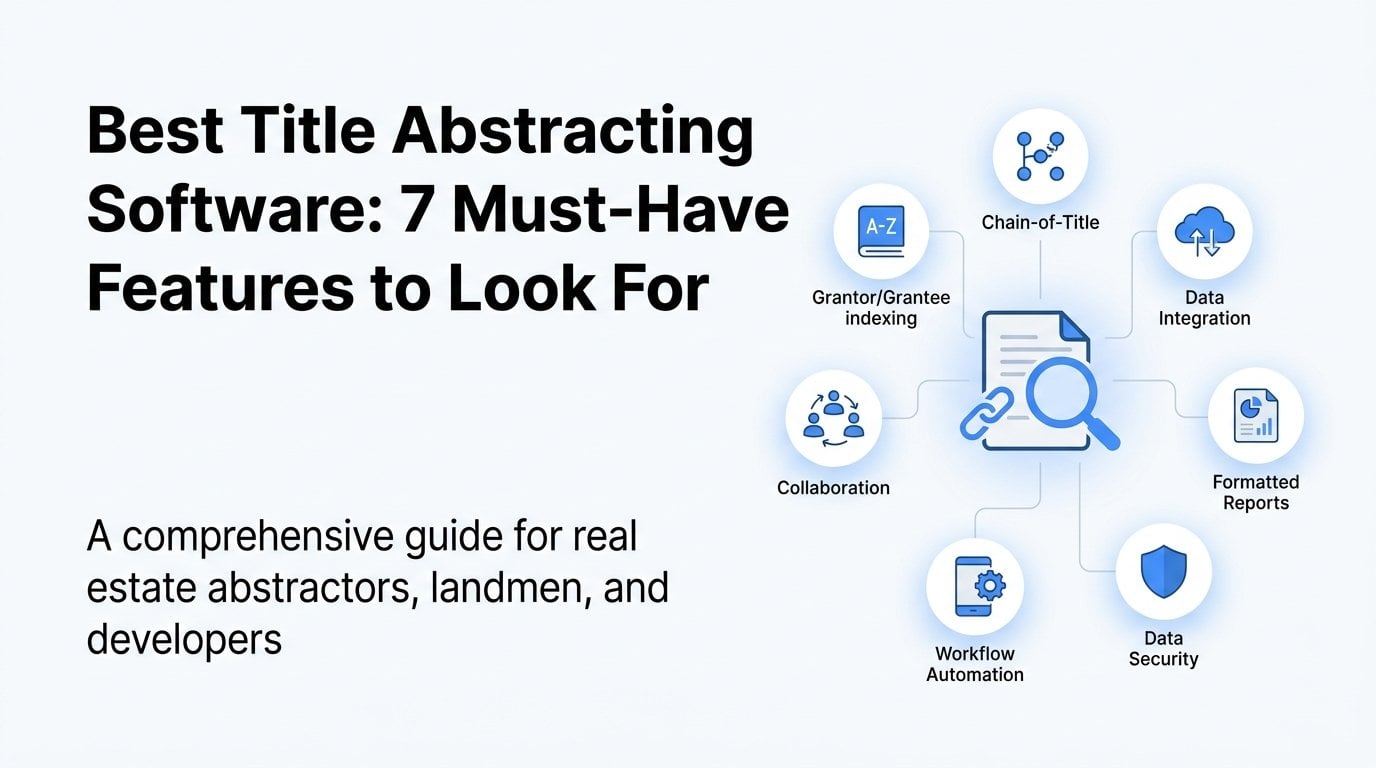
If you’ve searched for the best title abstracting software, you’re probably already frustrated. Generic document tools, broad legal platforms, and adapted PDF readers weren’t built for the realities of title work. They don’t understand grantor/grantee indexing. They can’t compile a chain of title. And they certainly weren’t designed with oil and gas run sheets or title commitment schedules in mind.
Real estate abstractors, landmen, and land developers need something different: software purpose-built for the specific demands of title work. The right platform doesn’t just store documents. It extracts data automatically, generates formatted reports, manages search orders, and keeps your chain of title organized from the first recorded instrument to the final commitment.
Whether you’re running a solo abstractor practice, managing a high-volume title plant, or conducting due diligence on a large energy land assemblage, this guide breaks down the seven most important capabilities to evaluate before choosing a platform. By the end, you’ll know exactly what to look for, what questions to ask vendors, and how to match software features to the specific demands of your work.
1. AI-Powered Document Extraction That Actually Understands Title Instruments
The Challenge It Solves
Most document processing tools use generic optical character recognition. They can read text from a scanned image, but they have no understanding of what that text means in the context of a deed, easement, or mineral conveyance. For abstractors, this means manual re-entry of grantor and grantee names, legal descriptions, recording data, and encumbrance details — one of the most time-consuming parts of the entire workflow.
The Strategy Explained
The best title abstracting software uses AI trained specifically on title instruments. That distinction matters enormously. A model trained on real deeds, easements, mortgages, and mineral conveyances learns to recognize document structure, extract the right fields, and flag ambiguities that generic OCR would miss entirely.
Look for platforms that automatically extract grantor and grantee information, legal descriptions, instrument types, recording numbers, book and page references, and encumbrance details. This isn’t just about speed. Accurate extraction reduces the risk of errors that can compromise a chain of title analysis or delay a closing.
TitleTrackr’s AI-powered document auto-extraction is built specifically for this purpose, pulling structured data from title instruments without requiring manual field entry for every document.

Implementation Steps
1. Ask vendors whether their AI was trained on title-specific documents or adapted from a general legal or document processing model.
2. Test extraction accuracy on a sample set of your most complex document types, including older handwritten instruments if relevant to your work.
3. Confirm which fields are extracted automatically and which require manual review or correction before accepting data into your workflow.
Pro Tips
Pay close attention to how the platform handles older, handwritten, or poorly scanned documents. These are common in historical title searches and represent the hardest extraction challenge. A platform that performs well on clean modern deeds but struggles with century-old instruments will create gaps in exactly the searches where accuracy matters most.
2. Automated Abstract and Report Generation
The Challenge It Solves
Extracting data from individual instruments is only half the job. Organizing that data into a formatted, deliverable abstract or title report is where many abstractors spend a disproportionate amount of time. Manually compiling instruments into a coherent chain of title document, formatting entries consistently, and ensuring completeness is tedious work that software should handle automatically.
The Strategy Explained
Purpose-built title abstracting software takes the extracted instrument data and compiles it into structured abstracts and reports automatically. This means the platform understands how a chain of title should be organized, how instruments should be sequenced, and what a complete deliverable looks like for your client or underwriter.
Look for platforms that offer instant abstract generation, meaning you can produce a formatted report directly from your extracted data without manually assembling each entry. TitleTrackr’s automated abstract and report generation does exactly this, turning extracted instrument data into professional deliverables without the formatting overhead.
This capability is especially valuable in high-volume environments where turnaround time is a competitive differentiator. The faster you can move from document retrieval to deliverable, the more orders you can handle without sacrificing accuracy.
Implementation Steps
1. Request a demo that walks through the full workflow from document upload to final abstract output, not just the extraction step in isolation.
2. Evaluate whether the report format matches the standards expected by your clients, underwriters, or the jurisdictions you work in.
3. Confirm whether reports are editable after generation, so you can make manual corrections or additions when instruments require special handling.
Pro Tips
Ask whether the platform supports multiple report formats or templates. Abstractors working across different states, counties, or client types often need to produce different report structures. A platform that locks you into a single output format will create friction as your client base grows.
3. Order Management Built for Title Workflows
The Challenge It Solves
Generic project management tools were not designed for title work. Adapting them to track search orders, client assignments, document status, and deadlines requires significant customization — and even then, they rarely map cleanly to how title professionals actually manage their pipeline. The result is often a patchwork of spreadsheets, email threads, and manual tracking that creates unnecessary administrative overhead.
The Strategy Explained
Title-specific order management understands the structure of a search order from the start. It tracks which properties are under search, which documents have been retrieved, what the current status of each order is, and when deliverables are due. It connects order tracking directly to the document extraction and report generation workflow, so nothing falls through the cracks.
TitleTrackr’s order management system is built around the actual lifecycle of a title search order, not a generic task or project framework. This means less configuration time and a workflow that reflects how abstractors and title companies actually operate.
For firms handling multiple concurrent orders across different clients and counties, this kind of integrated order management is not a convenience. It’s a core operational requirement.
Implementation Steps
1. Map your current order intake and tracking process before evaluating software, so you can assess whether a platform’s order management structure matches your actual workflow.
2. Evaluate whether the system supports client-specific workflows, since different clients often have different search scope requirements and deliverable formats.
3. Confirm whether order status is visible to clients through a portal or only internally, depending on your transparency preferences.
Pro Tips
Look for deadline tracking and notification features within the order management system. Title searches often have contractual or underwriter-imposed turnaround requirements. A platform that surfaces upcoming deadlines proactively reduces the risk of missed deliverables during high-volume periods.
4. Search Agent Capabilities for Faster County Record Searches
The Challenge It Solves
Navigating county recorder portals, assessor databases, and public record systems is one of the most repetitive and time-consuming parts of title research. Each county has its own interface, search logic, and document delivery method. Manually searching dozens of portals across a multi-county land assemblage or a complex chain of title can consume hours that should be spent on analysis, not navigation.
The Strategy Explained
The best title abstracting platforms include search agent capabilities that automate retrieval from public county records. Rather than manually navigating each county’s portal, a search agent can query the relevant databases, retrieve documents, and feed them directly into your extraction workflow.
This capability dramatically reduces the time spent on record acquisition, which is often the first major bottleneck in any title search. TitleTrackr’s search agents are designed to handle this retrieval step, allowing abstractors to focus their expertise on analysis and chain of title construction rather than portal navigation.
For landmen and energy developers working across multiple counties or states on a single project, search agent automation is particularly valuable. The time savings compound quickly when you’re pulling records from many jurisdictions simultaneously.
Implementation Steps
1. Identify which county systems and public record portals are most relevant to your typical work geography before evaluating search agent coverage.
2. Ask vendors specifically which counties and states their search agents support, and whether coverage is expanding.
3. Test the search agent workflow on a real search to evaluate retrieval accuracy and completeness before relying on it for client deliverables.
Pro Tips
TitleTrackr also offers a Chrome extension for document capture, which provides an additional layer of flexibility when working with county systems that aren’t fully covered by automated search agents. Having both automated and assisted capture options in a single platform ensures you’re never blocked by a county system’s technical limitations.
5. Title Commitment Support and Chain of Title Integrity
The Challenge It Solves
A title commitment is a structured legal document with specific requirements. Schedule A defines the proposed insured transaction. Schedule B lists exceptions and requirements. Generic document tools have no concept of this structure, which means abstractors using them must manually organize every element of the commitment without system support. Gaps in the chain of title or missing instruments often go undetected until they cause problems at closing.
The Strategy Explained
Purpose-built title abstracting software supports the specific structure of title commitments and provides chain of title tracking that helps identify gaps, breaks, or missing instruments before they become problems. This is proactive quality control built into the platform itself, not an afterthought.
Look for platforms that support Schedule A and Schedule B organization, flag chain of title breaks automatically, and allow you to visualize the sequence of instruments in a property’s history. TitleTrackr’s title commitment report generation is designed around these exact requirements, giving abstractors and title officers a structured environment for producing compliant commitments.
Chain of title integrity is not just about organization. It’s about catching errors before they reach underwriters or closing tables, where corrections are far more costly and time-consuming.
Implementation Steps
1. Confirm whether the platform supports Schedule A and Schedule B formatting for title commitments, or whether commitment preparation still requires manual assembly in a separate tool.
2. Evaluate whether the system flags gaps or breaks in the chain of title automatically, or whether this analysis remains entirely manual.
3. Ask whether the platform maintains an audit trail of changes to the chain of title record, which is important for quality control and liability documentation.
Pro Tips
Chain of title visualization, the ability to see the sequence of instruments as a connected timeline rather than a list, is a feature worth specifically requesting in any demo. It makes gap identification significantly faster, especially in complex searches with many instruments spanning long time periods.
6. Specialized Tools for Oil and Gas Landmen and Energy Developers
The Challenge It Solves
Oil and gas title work operates in a different dimension of complexity from standard real estate abstracting. Mineral rights severances, royalty interest calculations, working interest tracking, and run sheet compilation require managing fractional ownership across dozens or hundreds of instruments. Most title software ignores this entirely, leaving landmen to manage critical calculations in separate spreadsheets that aren’t connected to their title data.
The Strategy Explained
The best software for oil and gas landmen and energy developers includes specialized tools built for mineral title work. This means run sheet generation that tracks the chain of title for mineral interests specifically, royalty interest calculations that account for fractional conveyances, and mineral rights tracking that maintains a clear picture of who owns what percentage across a complex ownership history.
TitleTrackr offers a dedicated run sheet calculator and a royalty calculator built specifically for this work. These tools eliminate the need for separate spreadsheet management and connect mineral interest calculations directly to your title research workflow.
Renewable energy developers face similar complexity when assembling surface rights, easements, and mineral rights clearance across large land assemblages. Purpose-built software that handles these requirements natively is a significant operational advantage over generic tools.
Implementation Steps
1. Identify whether your work involves mineral interest tracking, royalty calculations, or run sheet generation before evaluating software, so you can specifically test these features rather than assuming they exist.
2. Test the run sheet and royalty calculation tools against a real project to verify that fractional interest math is handled correctly across complex conveyance chains.
3. Confirm whether the platform supports the specific instrument types common in your geography, including mineral deeds, royalty deeds, pooling agreements, and production sharing arrangements.
Pro Tips
For renewable energy developers, pay particular attention to how the platform handles easement tracking and surface rights documentation alongside mineral rights. Projects that require both surface and mineral clearance benefit most from a platform that manages all of these instrument types within a single unified workflow rather than requiring separate tools for each category.
7. Implementation, Integrations, and Long-Term Support
The Challenge It Solves
Even the most capable platform fails in practice if onboarding is poor, integrations with your existing systems don’t exist, or vendor support disappears after the sale. Title professionals often evaluate software on features alone, then discover that implementation complexity or missing integrations create friction that erodes the efficiency gains they expected.
The Strategy Explained
Before committing to any title abstracting platform, evaluate the vendor’s implementation resources, the quality of their onboarding process, and their integration ecosystem. Does the platform connect with county record systems you rely on? Does it integrate with title plants or underwriter systems in your market? Is there a clear implementation path for migrating existing orders and documents?
Long-term support quality is equally important. Title work doesn’t pause for software issues. You need a vendor who responds quickly, understands the domain, and can support you when a search is on deadline.
TitleTrackr’s AI assistant provides in-platform support that understands title work context, reducing the friction of getting help when you need it. Combined with a purpose-built platform designed for abstractors, landmen, and developers, the support experience reflects the same domain expertise as the product itself.
Implementation Steps
1. Ask for a detailed onboarding timeline and implementation plan before signing any contract, including how existing data and documents will be migrated if applicable.
2. Request a list of current integrations and confirm that the systems most critical to your workflow are included or on the development roadmap.
3. Evaluate support responsiveness during the sales process itself. How quickly vendors respond to pre-sale questions is often a reliable indicator of how they’ll respond to post-sale support requests.
Pro Tips
Ask specifically about the vendor’s roadmap for new county integrations and feature development. Title technology is evolving quickly, and a platform that is actively expanding its county coverage and AI capabilities will deliver increasing value over time. A static platform may meet your needs today but fall behind as your work volume or geography expands.
Putting It All Together: Your Software Selection Roadmap
Choosing the best title abstracting software comes down to one fundamental question: was it built for title work, or adapted to it? Generic document tools and broad legal platforms can handle some tasks, but they rarely address the specific demands of chain of title analysis, mineral rights conveyances, run sheet generation, or title commitment preparation.
For teams that handle residential real estate closings alongside abstracting work, it’s also worth reviewing the leading options for real estate title search software built specifically for that transaction side of the market.
As you evaluate platforms, use these seven capabilities as your evaluation framework. Start with AI-powered document extraction and automated report generation, since these directly address the highest-volume bottlenecks in most abstracting workflows. Then assess order management, search agent coverage, and title commitment support. If your work involves oil and gas or renewable energy, treat specialized mineral title tools as non-negotiable requirements rather than optional features.
Finally, don’t underestimate implementation and support. A platform with strong features and weak onboarding will cost you more time than it saves in the first months of use.
TitleTrackr was designed from the ground up for exactly this work. Every feature reflects the real demands of abstractors, landmen, and energy developers, not a generic document workflow adapted to fit. If you’re ready to see how purpose-built title abstracting software performs against your real workload, learn more about our services and explore how the platform maps to the specific requirements of your practice.
Leave a Reply