

Think of a title search on a property as a deep-dive background check for a piece of real estate. It’s a meticulous examination of public records to confirm who the legal owner is and, just as importantly, to uncover any hidden claims, debts, or disputes tied to the property. This step is absolutely critical, ensuring the seller actually has the undisputed right to sell it to you.
Ultimately, a title search protects you and your clients from inheriting someone else’s costly legal and financial baggage.
Why a Title Search Matters for Your Property

Buying a property is one of the biggest financial moves anyone can make. For industry professionals, a title search is the first and most important line of defense against the unseen risks that could threaten a client's investment and derail a transaction. Without one, a buyer could unknowingly purchase a property weighed down by old debts or legal problems, creating a nightmare scenario for everyone involved.
The entire process is designed to establish a "clear title." This is the seal of approval confirming the property is free from any "title clouds" or defects that could challenge ownership down the road. It's the bedrock of a secure real estate deal.
Protecting Your Investment from Hidden Dangers
Imagine this: a client buys their dream home, and months later, they discover a contractor put a lien on it for a job the previous owner never paid for. All of a sudden, they are on the hook for a debt that isn't theirs, and you're dealing with the fallout. This is exactly the kind of costly problem a thorough title search is designed to prevent.
A detailed look into a property's past can bring several nasty surprises to light, including:
- Unpaid Property Taxes: Previous owners might have left behind tax bills that now fall on the new buyer.
- Outstanding Mortgages or Liens: The property could be collateral for an old loan or a judgment from a lawsuit.
- Undisclosed Heirs: Someone with a legitimate claim to the property from a will or estate could suddenly appear.
- Filing Errors or Forgery: Simple mistakes in public records or even outright fraud in the property's history can create huge ownership disputes.
A title search is not just a formality; it's a crucial due diligence step that safeguards ownership rights and provides peace of mind. It ensures the property being purchased is truly free and clear, protecting all parties in the transaction.
The Role of Professionals in the Search
Digging through deeds, tax records, court judgments, and other legal documents is a complex and painstaking process. It’s not a weekend DIY project. This is why the work is handled by specialists like title companies, real estate attorneys, or dedicated title abstractors who have the expertise to navigate these records efficiently.
For those in the industry, understanding the details is everything. You can learn more about the critical role of title abstractors in modern real estate transactions to see just how much expertise is needed for a successful outcome.
By verifying the seller’s right to transfer ownership and flagging any potential roadblocks, a title search turns a risky venture into a confident step toward property ownership. It’s a non-negotiable for any serious buyer, lender, or investor.
How a Traditional Title Search Works (And Why It's So Slow)

Before technology stepped in, doing a title search on a property was a grueling, hands-on job that created significant bottlenecks. It meant a title examiner had to physically go to county courthouses and record offices, ready to spend hours—sometimes days—hunched over dusty old books. This old-school process was the standard for decades, and its inefficiencies highlight exactly why the industry has been begging for an upgrade.
Think of it as a full-blown historical investigation. Examiners would comb through massive deed books, trying to make sense of faded, cursive handwriting and navigate legal documents that were often a disorganized mess. The goal was always the same: build a complete history of the property’s ownership, known as the “chain of title.”
This chain is the official timeline of every single person who has ever owned the property. If a property is a couple of hundred years old, that chain could have dozens of links, and each one represents a transaction where something could have gone wrong. A single missing document or a transfer that wasn't recorded correctly can break the chain, creating a major headache known as a title defect.
Putting a Fragmented Puzzle Back Together
The work of a traditional title examiner is a lot like being a detective. They aren't just looking at deeds; they're on the hunt for any piece of paper that could cloud the property's legal standing. This manual process is where delays and errors begin to stack up.
This manual deep-dive involves several key steps:
- Deeds and Mortgages: The examiner carefully traces every ownership transfer through recorded deeds and hunts for any old mortgages that were never officially paid off.
- Tax Records: A separate trip to the municipal tax office is a must. They have to confirm all property taxes are paid up, because an unpaid tax bill creates a lien that jumps to the front of the line.
- Court Judgments: The search continues in court records. Examiners look for legal judgments from lawsuits, divorces, or other disputes that could be attached to the property as a lien.
- Public Records and Maps: They also have to check probate records for inheritance claims and review old surveys and plat maps to make sure there are no boundary disputes or surprise easements.
A traditional title search is basically a high-stakes scavenger hunt through mountains of paper. The entire outcome hinges on the accuracy of ancient filing systems and the examiner's skill in catching tiny errors buried in dense legal jargon.
The High Cost of Human Error
It’s not hard to see why this manual process is so slow and risky. A typical old-school title search can take anywhere from a few days to a couple of weeks, creating bottlenecks that can derail a real estate closing and leave everyone frustrated. In fact, studies have shown that simple manual data entry can have an error rate as high as 4%. That number is terrifying when you're dealing with a six-figure property transaction.
The room for human error is huge. A misfiled document, a misspelled name on a deed from 1925, or a lien that gets overlooked can have devastating consequences for the new owner. These aren't just typos; they're ticking time bombs of liability. For a deeper dive into industry practices, you can find more insights over on the TitleTrackr blog.
At the end of the day, the traditional title search on a property exposes a major weakness in the real estate world. Its reliance on manual labor makes it slow, expensive, and wide open to the very mistakes it’s supposed to prevent. This set the stage perfectly for a tech revolution, where automation can finally bring some much-needed speed and certainty to an archaic process.
Common Roadblocks to a Clear Title
Think of a title search on a property as a deep dive into its life story. Most of the time, the story is straightforward. But sometimes, you run into unexpected plot twists. These roadblocks, known in the business as "title clouds" or defects, are hangovers from a property's past that can cause serious headaches for a new owner.
The whole point of the search is to find these skeletons in the closet. A clean report is a green light, but a report showing clouds means it's time to pump the brakes. These issues aren't just paperwork problems; they carry real financial and legal risks that have to be sorted out before closing.
Financial Burdens Hiding in Plain Sight
More often than not, the roadblocks you'll find are financial claims, or liens, stuck to the property. A lien is just a legal IOU that uses the property as collateral for a debt. If these aren't cleared before closing, they become the new owner's problem.
Some of the most common financial snags include:
- Outstanding Mortgages: You'd be surprised how often a previous owner’s old mortgage or home equity line of credit was never officially paid off and released. This old "senior" lien can jump the line and take priority over a new mortgage.
- Unpaid Property Taxes: Local governments don't mess around with unpaid taxes. They can slap a powerful lien on a property that often becomes a "super-priority" lien, meaning it gets paid before almost anyone else.
- Contractor Liens (Mechanic's Liens): If a past owner stiffed a contractor on a kitchen remodel or a new roof, that contractor has the right to file a lien against the property to get their money.
- Legal Judgments: If a prior owner lost a lawsuit, a court can place a judgment lien on their assets—including the house you're trying to buy.
Think of a title cloud as a financial ghost tethered to the property. A thorough title search is the only way to see these ghosts and ensure they are dealt with before they start haunting the new owner's bank account.
Complex Legal and Clerical Entanglements
Beyond simple debts, a title search can uncover a minefield of legal knots and administrative mistakes. These are often trickier to untangle because they come from simple human error, poorly written documents, or messy family situations from decades ago.
For example, a tiny clerical error made on a deed 50 years ago—like a misspelled name or a typo in the property description—can create a break in the chain of title. That small mistake can suddenly cast doubt on whether the current owner even has the right to sell the property. Even worse are forgeries; a single fraudulent signature on a past deed could blow up the entire chain of title.
To give you a better idea, here's a quick look at some common defects and the trouble they can cause.
Common Title Defects and Their Potential Impact
| Title Defect | Description | Potential Impact on Owner |
|---|---|---|
| Unreleased Mortgages | A previous mortgage was paid off, but the lien release was never officially recorded. | Difficulty securing a new loan or selling the property until the old lien is cleared. |
| Errors in Public Records | Simple mistakes like typos in names or legal descriptions on deeds and other documents. | Can create breaks in the chain of title, casting doubt on the legality of ownership. |
| Unknown Heirs | A previous owner passed away, and a previously unknown heir steps forward with a claim. | Potential for a partial or complete loss of ownership rights; costly legal battles. |
| Forgeries & Fraud | A past deed or document was signed fraudulently without the true owner's knowledge. | The entire transfer of ownership could be deemed invalid, leading to a total loss of the property. |
| Boundary Disputes | A neighbor's fence or structure encroaches on the property line; survey discrepancies. | Loss of use of part of the property; potential legal action to resolve the dispute. |
As you can see, the risks are very real. These aren't just abstract legal theories—they are tangible problems that can lead to expensive court fights, make it impossible to sell the property later, or in the worst-case scenario, cause a buyer to lose their home entirely.
Each of these issues highlights why a meticulous search is so critical. For a closer look at how these problems are spotted and solved, feel free to check out the common questions and answers on our TitleTrackr FAQ page. This is why a professional and accurate title search on a property isn't just a box to check—it’s fundamental financial protection.
How AI Is Changing the Title Search Game
For generations, the title search on a property has been a painstaking, manual slog through dusty record books and county databases. It was a process that worked, but it was slow, expensive, and left plenty of room for human error. That entire approach is now being turned on its head.
We're in the middle of a massive shift from manual labor to intelligent automation, and it's being driven by artificial intelligence and machine learning. This isn't just about digitizing old steps; it's a complete reinvention of the workflow.
AI-powered platforms are transforming how we handle due diligence. Instead of an examiner spending days or weeks digging through records, these systems can scan and analyze millions of digital documents from countless sources in seconds. It’s not just a faster version of the old way—it’s a fundamentally smarter one that gives your business a competitive edge.
These systems use sophisticated algorithms to do what a human simply can't: spot subtle patterns, instantly flag potential title defects, and assess risk with incredible speed and precision.
From Weeks to Minutes
The most obvious impact of AI is the radical drop in turnaround time. A traditional search that could hold up a closing for weeks can now be done in a tiny fraction of that time. This leap forward isn’t just an improvement; it’s a new industry standard that helps you close more deals, faster.
This speed gives real estate professionals the power to make faster, more informed decisions. It clears out the bottlenecks that used to plague transactions, creating a more fluid and responsive market for everyone.
For instance, a platform like TitleTrackr can cross-reference data from deeds, tax records, and court judgments almost instantly. This means you can get a comprehensive preliminary report back in minutes, not days, putting your entire due diligence process on the fast track.
The infographic below shows some of the common roadblocks that AI can help identify and resolve far more efficiently.
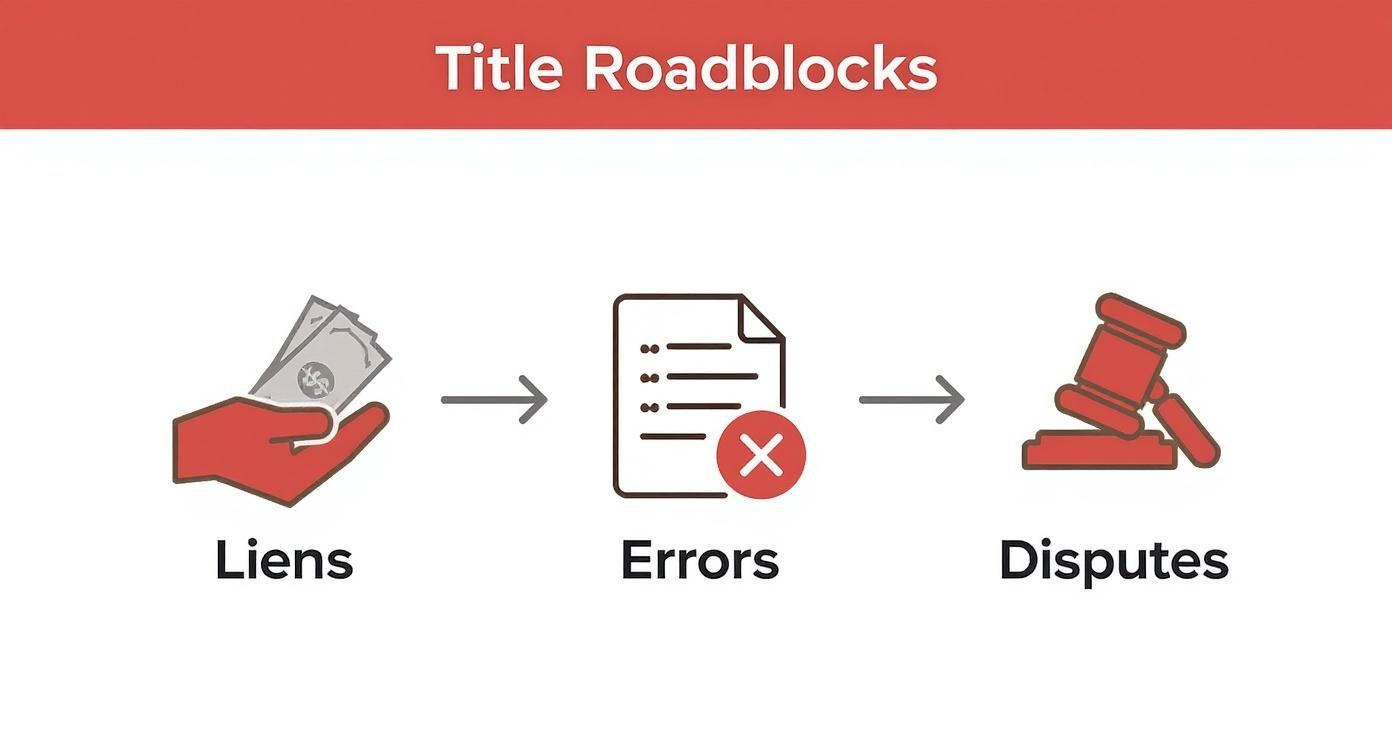
It’s a great visual reminder of how quickly things like financial liens, clerical errors, and ownership disputes can derail a deal, which is why fast, accurate detection is so critical.
Deeper Insights and Greater Accuracy
Speed is great, but AI also delivers a level of accuracy that manual processes just can't match. Human error is a real and significant risk in traditional searches. One missed document or misinterpreted entry can lead to massive, costly problems down the road.
AI systems are designed to minimize that risk. They're trained on huge datasets of legal and property documents, which allows them to recognize inconsistencies and potential issues that might slip past the human eye. The result isn't just greater efficiency—it's deeper, more reliable insight.
The move toward machine learning and automation has massively improved efficiency and accuracy in real estate. Reports for 2025 show that companies using these algorithms have cut manual errors by up to 40% and slashed turnaround times by as much as 60%. Firms investing in this tech have also seen a 25% boost in client satisfaction and a 15% rise in transaction volume. You can dig into more key industry trends for 2025 at Skyline Title Support.
The New Standard for Due Diligence
This shift isn't just about cool new tools. It's about raising the bar for what a thorough title search on a property should be. AI-powered analysis is quickly becoming the new benchmark for excellence in the industry.
The benefits are pretty clear:
- Radical Efficiency: What once took weeks now takes minutes, helping deals close faster.
- Reduced Human Error: Automation slashes the risk of costly mistakes that come from sifting through complex records by hand.
- Deeper Analysis: AI can spot connections and risks across vast datasets that would be impossible for a person to find manually.
- Smarter Decisions: With faster, more accurate data, real estate pros can make moves with much greater confidence.
As this technology keeps getting better, AI-driven platforms will become an even more essential part of the real estate transaction, making sure every decision is backed by the most complete and accurate information out there.
Choosing the Right Title Search Partner
Picking the right partner for a title search on a property is a huge decision. It's not just about getting a report; it’s about protecting the entire real estate transaction from risk and costly setbacks. Your choice ultimately determines the speed, accuracy, and depth of insight you get back.
You've got options, from traditional manual services to modern automated solutions. The best partners do more than just pull records—they deliver confidence. They give you the tools and clear insights you need to close deals faster and with far greater assurance.
Key Criteria for Evaluating a Title Search Provider
When you're comparing providers, you need to cut through the noise and focus on what actually matters. A great partner should stand out in a few key areas, making sure you get reliable results without frustrating delays.
Here’s what you should be looking for:
- Use of Advanced Technology: Do they use AI and automation? This is probably the biggest differentiator in the market today. A modern partner can deliver results with a level of speed and precision that manual work just can't compete with.
- Speed of Delivery: In real estate, time is always money. How long are you going to be waiting? Look for a provider that can turn around a comprehensive report in minutes or hours, not days or weeks. This keeps your deals moving.
- Comprehensiveness of the Search: Does the search dig deep into public records? We’re talking deeds, liens, tax records, and court judgments. A shallow search can miss critical defects, leaving you completely exposed.
- Clarity and Usability of Reports: Is the final report easy to understand and act on? A dense, jargon-filled document doesn't help anyone. The best providers deliver clear, actionable insights that make your next steps obvious.
Choosing a title search partner is about more than just finding a vendor—it's about investing in a solution that minimizes risk and maximizes confidence. The right partner should feel like an extension of your team, providing the tools and insights needed for secure and efficient transactions.
Why an AI-Driven Approach Makes the Difference
Honestly, a provider that embraces AI is going to check all those boxes by default. An AI-powered platform like TitleTrackr was built from the ground up to solve the core problems that real estate professionals face every day. It replaces slow, error-prone manual work with a smart, automated system that just delivers better results.
By using intelligent automation, TitleTrackr gives you:
- Unmatched Speed: You can generate professional, detailed reports in seconds. The long waits that come with traditional methods are completely eliminated.
- Superior Accuracy: The system uses algorithms trained to spot inconsistencies and potential defects that a human eye might easily miss, dramatically reducing the risk of human error.
- Deeper Insights: You can go beyond just surface-level data. Chat-driven analysis helps you uncover key information and context buried inside complex legal documents.
At the end of the day, choosing a partner that uses advanced tech for a title search on a property isn’t a luxury anymore—it’s a necessity if you want to stay competitive and secure.
If you’re ready to see how an AI-driven platform can completely change your workflow and give you the certainty you need, we invite you to see the difference for yourself. Request a demo of TitleTrackr today and discover how you can bring greater speed, accuracy, and control to your entire title search process.
Got Questions About Property Title Searches? We've Got Answers.
Even after you get the basics down, a title search on a property can stir up a lot of specific questions. Let's tackle some of the most common ones that come up. Think of this as a quick-reference guide to clear up any lingering confusion so you can move forward with total confidence.
Each answer is designed to be a practical tool you can use.
How Long Does a Title Search on a Property Usually Take?
This is a real "it depends" situation. The old-school, manual approach can take anywhere from a few days to several weeks. Why the huge range? It all comes down to the property's age, how messy its ownership history is (what we call the "chain of title"), and how swamped the local county records office is.
On the flip side, an AI-powered title search platform can spit out a comprehensive preliminary report in just a few minutes. By automating the grunt work of digging through digital records and analyzing the data, these tools slash the turnaround time. For real estate pros, that means speeding up due diligence and getting deals done way faster.
What Is the Difference Between a Title Search and Title Insurance?
This is a critical one to get right. A title search is the investigation—the deep dive into public records to find any existing skeletons in the property's closet. The whole point is to uncover problems before you buy. It’s like a diagnostic health check-up for the property’s legal past.
Title insurance is the policy that protects you (and your lender) from financial loss if a title problem was missed during the search or pops up unexpectedly later. Think of it as the health insurance policy that covers you for those unforeseen issues. You can't get the insurance without doing the check-up first; a thorough title search is always required before a policy is issued.
A title search is the proactive dig to make sure the coast is clear. Title insurance is the safety net that protects you if a storm hits later. You absolutely need both for a secure real estate investment.
Can I Do a Title Search on a Property Myself?
Technically, you can. But you really shouldn't. Poring over county records is a maze, and making sense of legal documents takes a trained eye. It’s incredibly easy for an amateur to miss a subtle but costly detail, like a hidden lien or a gap in the ownership history. A mistake here could lead to massive financial and legal headaches down the road.
Professionals have the experience, but they also have access to specialized databases and tools that the public doesn't. Using a pro title company or an AI-powered service ensures you get the full, accurate picture. Trust me, the risk of a DIY search just isn't worth the few bucks you might save.
Who Is Responsible for Ordering the Title Search?
Typically, the buyer foots the bill for the title search on a property. In most deals, the buyer's mortgage lender will insist on it—along with a title insurance policy—to protect their own investment in the property.
But this isn't set in stone. Sometimes, the cost can be a negotiating point in the purchase agreement, and a motivated seller might offer to cover it. No matter who pays, it's a non-negotiable step that protects both the buyer and the lender by making sure the property's title is clean before any money changes hands.
What Happens if a Problem Is Found During the Search?
Finding a "cloud on the title" or another defect is actually a good thing—it means the search did its job. When an issue like an unpaid lien, a boundary dispute, or a simple clerical error is discovered, it doesn't automatically sink the deal. It just presses pause on the closing process until the problem is fixed.
Usually, it's the seller's job to clear up the title. This could mean:
- Paying off old debts to get a lien released.
- Filing corrective paperwork to fix errors in the public record.
- Taking legal action, like a "quiet title action," to settle an ownership dispute.
Once the title insurer and the buyer are satisfied that the issues are resolved, the transaction can move forward. This whole process shows why it’s so important to get the search done early—fixing title defects can take time.
Ready to transform your title search workflow from weeks into minutes? Discover how TitleTrackr uses AI to deliver unparalleled speed, accuracy, and insight. Stop chasing down records and start making faster, more confident decisions.
Request a demo of TitleTrackr today and see the future of property title searches.
 blog.titletrackr.com
Leave a comment