

When you buy a piece of property, you're not just buying the land and the building—you're buying its history. A title report for property is essentially that history, compiled into a single, critical document. Think of it as a comprehensive background check on the real estate itself.
This report digs into public records to confirm the seller's legal right to actually sell the property and, just as importantly, uncovers any hidden issues that could haunt the new owner. It's the foundation of a secure deal, and with the right tools, it can become your competitive advantage.
Why a Title Report Is the Bedrock of Your Deal
A title report isn't just another piece of paper in the closing stack; it's the very foundation of a secure real estate investment. It’s your best defense against future surprises, giving you a crystal-clear picture of what your client is really getting. For industry professionals, mastering this process is key to building trust and closing deals efficiently.
Its most fundamental job is to prove the seller has the legal authority to transfer ownership. Without this verification, a buyer could pour their life savings into a property only to discover the sale was never valid in the first place. The report meticulously traces the chain of ownership, ensuring there are no weak links or fraudulent transfers in the property’s past.
Uncovering Financial Skeletons and Legal Landmines
Beyond just verifying ownership, a title report is your tool for sniffing out liabilities that are tied directly to the property—problems that will become your client's burden the second the deal closes. Leveraging a powerful platform to identify these issues early can transform your workflow and elevate your service.
- Financial Liens: This is a big one. It includes everything from unpaid property taxes and outstanding mortgages to court judgments against the owner that have been secured against the property.
- Easements and Restrictions: The report will tell you if anyone else has a right to use part of the property. This could be a utility company needing access to power lines or a neighborhood covenant that dictates what you can (or can't) build.
- Legal Claims: It also flags potential legal headaches like pending lawsuits, boundary disputes with neighbors, or even undisclosed heirs who might suddenly appear to claim a stake in the property.
A clean title report is the ultimate safeguard against inheriting someone else's problems. It transforms a potentially risky purchase into a secure, defensible asset for your client.
Skipping this step or getting it wrong can lead to nightmarish legal battles and, in the most extreme cases, the complete loss of the property. That’s why over 90% of real estate sales in developed markets rely on these reports to ensure a clean handoff. It’s a global best practice, a point echoed by industry leaders like the National Association of REALTORS®.
To give you a clearer picture, here’s a quick summary of what a title report brings to light.
Key Information Unlocked by a Title Report
This table breaks down the critical data points a title report provides, making it an indispensable tool for any real estate professional or buyer.
| Information Category | What It Reveals | Why It's Critical |
|---|---|---|
| Ownership Verification | The current legal owner and the chain of title. | Confirms the seller has the right to sell, preventing fraud. |
| Financial Liens | Unpaid mortgages, taxes, and judgments. | Protects the buyer from inheriting the seller's debts. |
| Easements & Covenants | Rights of way and land use restrictions. | Informs the buyer of limitations on property use. |
| Legal Issues | Pending lawsuits or boundary disputes. | Avoids future legal battles and ownership challenges. |
Ultimately, this report gives you the confidence that the title is "clean," allowing the transaction to move forward securely.
The entire process depends on the exhaustive research done by title professionals. You can dive deeper into what these experts do in our guide for title abstractors. Today, powerful solutions like TitleTrackr are helping these pros do their job faster and more accurately, compressing weeks of manual digging into just a few hours of automated analysis. For you, that means a massive competitive edge.
Breaking Down the Title Report Section by Section
At first glance, a title report for property can look like a wall of dense legal text. It’s intimidating. But don't think of it as a legal textbook; think of it as a detailed biography of the property you're dealing with. Each section tells a crucial part of the story, and learning to read them is the key to spotting problems before they become deal-breakers.
Instead of one long narrative, the report is split into distinct parts, each with a specific job. Let's decode these sections one by one, using real-world examples to show you what to look for and why it matters so much to your client.
This infographic gives a great visual overview of how a title report protects a buyer from all sorts of hidden risks.
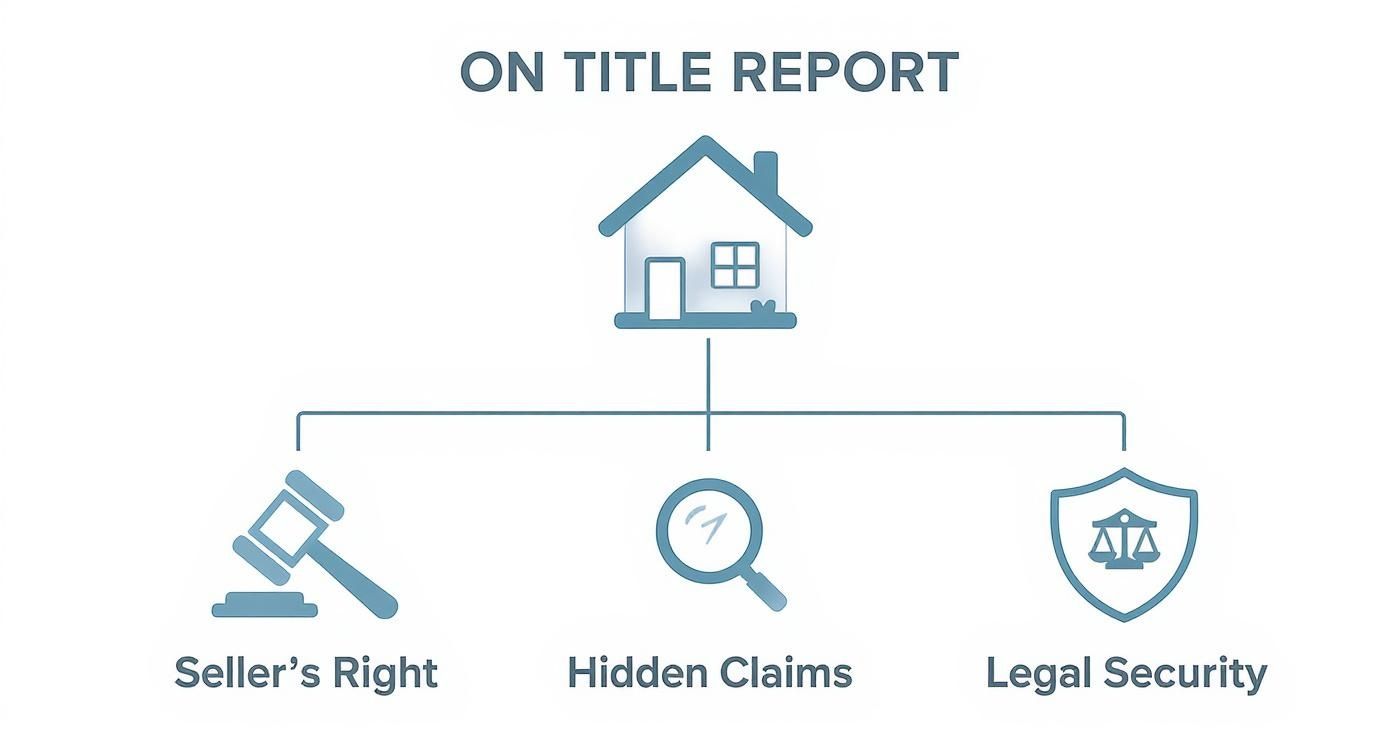
As you can see, a solid title examination doesn't just confirm the seller’s right to sell. It actively hunts for hidden claims and ultimately gives the new owner a legally secure foundation for their investment.
The Legal Property Description
This is the property’s official fingerprint. It’s not the street address you pop into Google Maps; it's the precise, legally recognized description that draws the exact boundaries of the land. Everything else in the report hinges on this specific parcel of real estate being correctly identified.
An error here can be a complete disaster. Imagine your client thinks they’re buying a five-acre lot, only to find out the legal description actually covers just four and a half acres. That last half-acre? It belongs to the neighbor. You've just walked your client into an inevitable boundary dispute.
Statement of Ownership and Liens
Next up, the report names the current vested owner—the person or entity that actually has the legal right to sell. This part confirms you're negotiating with the right person and that the chain of ownership is solid and unbroken.
This is also where the money trail shows up in the form of liens, which are legal claims against the property for an unpaid debt. If the seller has an outstanding mortgage, unpaid property taxes, or even a bill from a contractor (a mechanic's lien), it will be listed right here.
Every single lien must be paid off before the title can transfer to a new owner. An unresolved lien is like a financial anchor, holding the property in place until the debt is settled.
For example, a $5,000 mechanic's lien from a roofer who never got paid can stop a $500,000 sale dead in its tracks. The title simply isn't "clear" until that lien is paid, which usually happens with the seller's funds at closing.
Encumbrances, Easements, and Restrictions
This section answers a critical question: Who else has rights to this property, even if they don't own it? These are called encumbrances, and they can seriously limit what your client can do with their new land.
- Easements: This is a right given to someone else to use a portion of the property for a specific reason. A classic example is a utility easement that lets the power company access lines running across the backyard. This could be a deal-breaker for a client who has their heart set on a swimming pool right where that easement sits.
- Covenants, Conditions, and Restrictions (CC&Rs): You’ll see these all the time in planned communities and subdivisions. CC&Rs are the rules of the neighborhood. They might dictate the color you can paint your house, the type of fence you can build, or even where you can park your RV.
Skimming over these restrictions can lead to some very unhappy clients down the road when they find out their dream renovation violates the neighborhood rules.
The Schedule of Exceptions
Finally, we have the schedule of exceptions. Think of this as the "fine print" of the title insurance policy. It's a list of all the specific items and issues that the policy will not cover.
This list will almost always include the easements and CC&Rs we just talked about, since those are existing conditions that transfer with the property. It might also note other known issues, like mineral rights that a previous owner sold off or a shared driveway agreement with the next-door neighbor.
This section is all about setting clear expectations. It tells the buyer exactly which pre-existing conditions they are agreeing to live with. Understanding this list inside and out is crucial for helping your client make a truly informed decision.
The Journey of a Title Search From Past to Present
Ever wonder how a title report for property actually comes to life? It’s not just a single document; it’s the result of a journey that blends old-school historical investigation with today's most powerful technology. Think of it as moving from dusty courthouse archives straight into a digital, data-driven world.
Understanding how that journey has evolved is key to appreciating why speed and accuracy are non-negotiable in modern real estate.

Let's pull back the curtain. We’ll look at the traditional, hands-on methods that have been the industry's backbone for decades and see how they stack up against the tech-first solutions that are completely reshaping the game.
The Traditional Approach: A Manual Deep Dive
The old-school title search is a meticulous, hands-on process. A title abstractor is essentially a property historian, piecing together a story from records that can be scattered and sometimes centuries old. This means digging through physical ledgers at county recorder's offices, sifting through tax assessor databases, and checking civil court records.
The searcher painstakingly follows the chain of title backward, examining every deed, mortgage, and filing to make sure ownership was handed off correctly at every step. It’s work that demands intense focus and a whole lot of patience.
This manual effort isn't just slow; it’s also wide open to human error. One missed document or a misinterpreted legal description can throw a wrench into the entire transaction, jeopardizing a sale or even leading to future claims against the new owner.
The Modern Solution: AI-Powered Precision
Now, let’s fast forward. If a manual search is like trying to navigate a maze with a flashlight, an AI-powered platform is like having a GPS that sees the entire map instantly. This is where solutions like TitleTrackr completely change the game.
Instead of a person manually poring over documents one by one, sophisticated AI algorithms can scan millions of records in minutes. These systems are trained to spot relevant information, flag inconsistencies, and assemble a preliminary report with incredible speed.
This isn't about replacing human expertise. It’s about augmenting it. AI does the heavy lifting—the data collection and initial analysis—freeing up skilled professionals to focus on what they do best: interpretation, problem-solving, and communicating with clients.
The scale here is massive. The global real estate market was valued at USD 4.13 trillion and is projected to hit USD 5.85 trillion by 2030. That means millions of transactions every year, and every single one needs a solid title report. You can learn more about the sheer size of the global real estate market and why efficiency is so critical.
Comparing the Two Methods
The difference between the old and new ways isn't just about speed. It’s about efficiency, accuracy, and predictability—the things that directly impact your bottom line.
Here’s how adopting modern tech gives you a real business advantage:
- Drastic Reduction in Turnaround Time: A search that used to take days, or even weeks, can now be done in a matter of hours. This acceleration gets you to a "clear to close" faster, which is a massive win in today's competitive market.
- Significantly Reduced Human Error: AI doesn't get tired or distracted. It can spot anomalies across huge datasets that a person might easily miss, resulting in a far more accurate and reliable final report.
- Greater Predictability in Closings: By identifying potential title issues almost instantly, you can start working on fixes much earlier in the process. This proactive approach smooths out the closing, eliminates last-minute surprises, and creates a much better experience for your clients.
The evolution of the title search is a perfect example of technology creating tangible business value. By shifting from a manual, reactive process to an automated, proactive one, real estate professionals can close more deals with more confidence than ever before.
Solving Common Problems Found in a Title Report
Discovering an issue on a title report for property can feel like hitting a brick wall. But a red flag doesn't automatically kill the deal. Honestly, most common title defects are entirely fixable with the right strategy, turning a potential disaster into just another task on the closing checklist. This is where a sharp real estate professional proves their worth, stepping in as a problem-solver to keep everything moving forward.
Think of it as having a playbook for clearing the path to closing. For just about every common problem, there's a clear, actionable solution. The trick is to spot the issue quickly, understand what it means for the deal, and know exactly what to do next. This approach doesn't just save transactions; it builds incredible trust with your clients.
Tackling Surprise Liens Head On
One of the most frequent hurdles you'll run into is an unexpected lien. A lien is simply a legal claim against the property for an unpaid debt, and it has to be cleared before the title can transfer to a new owner. They pop up in a few different forms, but the game plan for dealing with them is pretty similar.
- Tax Liens: The government places these for unpaid property taxes. The solution is straightforward, though non-negotiable—the outstanding tax bill must be paid in full.
- Mechanic's Liens: A contractor who worked on the property but didn't get paid can file this kind of lien. The first step is always to verify the claim's validity and the amount with the seller.
- Judgment Liens: These come from lawsuits. If the property owner lost a case and owes a monetary judgment, the property is used as collateral to make sure the debt gets paid.
No matter the type of lien, the process kicks off with verification. Once you confirm it's legit, the seller is typically on the hook for paying the debt from their sale proceeds at closing. Your job is to coordinate with the title company to get a lien release—the official document that removes the claim—and make sure it gets properly recorded.
Uncovering a lien isn't a dead end; it's a detour. By treating it as a standard part of the closing process, you can systematically resolve the issue without alarming your client.
The whole point is to keep these old financial claims from clouding the new owner's title. With a clear plan, you can get these issues managed efficiently.
Correcting Errors in Public Records
You'd be surprised how often simple clerical errors gum up the works. A typo in a legal description, a misspelled name, or a paid-off mortgage that was never officially discharged can create massive title headaches. These little mistakes in public records can cast real doubt on the chain of ownership.
For instance, say a previous owner paid off their mortgage a decade ago, but the lender dropped the ball and never recorded the satisfaction of mortgage. That old loan will still show up as an active lien on the report. Fixing it means tracking down the original lender to get them to file the right paperwork to clear the record.
If there's an error in the property's legal description, you might need to file a corrective deed to officially fix the mistake in the public record. While these issues can be time-consuming, they’re usually procedural. It's more about persistence and follow-up than it is about complex negotiations.
Untangling Ownership and Easement Issues
Some of the trickiest problems involve people and their rights to the property. Finding out there's an unknown heir with a legitimate claim or discovering a poorly documented easement can bring a transaction to a screeching halt.
An undisclosed heir might pop up if a past owner died without a proper will, leaving the ownership chain unclear. Sorting this out often requires legal action, like a probate court proceeding, to formally identify the rightful heirs and get their sign-off on the sale.
Likewise, an unrecorded easement can cause major problems. Imagine your client is excited to build a fence, only to find out the neighbor has a long-standing (but undocumented) right to cross that exact spot to get to their own property. Clarifying these rights might mean negotiating a formal easement agreement and recording it so it's legally binding for all future owners.
To help you navigate these potential minefields, here’s a quick-reference guide for some of the most common title issues you’ll encounter.
A Guide to Resolving Title Report Red Flags
This table is a practical cheat sheet designed for real estate professionals. Use it to quickly identify common title issues and understand the typical first steps toward a resolution, keeping your transactions on track.
| Common Title Issue | Potential Impact on Transaction | First Step to Resolution |
|---|---|---|
| Undisclosed Lien | Seller cannot provide clear title; lender may not fund the loan. | Verify the lien's validity and amount with the seller and title company. |
| Error in Legal Description | Can create ambiguity over property boundaries and ownership. | Request a corrective deed to be drafted and filed in the public record. |
| Break in the Chain of Title | Ownership history is unclear, making it impossible to verify the seller's right to sell. | Work with the title company to trace the ownership history and obtain a quitclaim deed if necessary. |
| Unrecorded Easement | Buyer's intended use of the property may be restricted. | Negotiate a formal easement agreement with the benefiting party and have it legally recorded. |
| Undisclosed Heir | A surprise party may have a legal claim to the property. | The seller may need to initiate a probate court action to legally clear the title. |
Remember, every title issue has a unique context, but this guide gives you a solid starting point. The key is to address red flags immediately and work closely with the title company and attorneys to find a clear path forward.
How Technology Delivers a Faster Clear to Close
In a market where every minute counts, speed isn’t just a goal—it’s the price of admission. The old way of manually producing a title report for property simply can’t keep up anymore. Today, modern technology isn't some convenient add-on; it’s the fundamental advantage that separates thriving professionals from those just struggling to stay afloat.
This is about more than just doing the same work faster. It’s a complete shift from being a reactive problem-solver—putting out fires as they pop up—to becoming a proactive deal manager who sees issues coming and resolves them before they can cause delays. You’re taking control of the transaction timeline instead of letting it control you.

From Days of Waiting to Hours of Progress
The most immediate benefit you'll feel when using an AI-driven platform is the radical compression of time. A title search and review that used to take days, or even weeks, can now be wrapped up in a matter of hours. This isn't just a minor tweak; it’s a total transformation of your entire workflow.
Think about the domino effect. Faster title reports lead to quicker lender approvals, earlier closing dates, and much happier clients who aren't stuck waiting in limbo. In a competitive bidding war, being able to promise and deliver a faster close can be the single detail that wins your client the house.
Eliminating Costly Human Errors
Beyond pure speed, technology brings a level of precision that’s tough for even the most diligent human to match every single time. AI algorithms can scan millions of documents and data points without getting tired, flagging inconsistencies and potential red flags with incredible accuracy. This automation drastically cuts down the risk of human error—a misplaced decimal, an overlooked document, or a misinterpreted legal description.
These aren't small mistakes. They can snowball into huge financial liabilities and legal headaches down the road. It’s no surprise that some industry leaders report an efficiency boost of up to 90% after implementing AI tools, a figure driven by both speed and a sharp drop in costly errors.
Technology empowers you to move from simply reviewing documents to actively managing your entire transaction pipeline. It automates the administrative burden, freeing you to focus on high-value client activities that truly grow your business.
This shift is everything. Instead of getting bogged down in paperwork, you can spend your time advising clients, negotiating better terms, and building the relationships that fuel your business.
Gaining Centralized Control Over Your Pipeline
One of the most powerful advantages of modern platforms like TitleTrackr is having a single, centralized dashboard to manage every single transaction. Gone are the days of hunting through email chains, spreadsheets, and scattered files just to check the status of a deal.
Imagine having a real-time, at-a-glance view of your entire pipeline:
- Track Progress Instantly: See exactly where each title report stands, from the initial order to the final review.
- Identify Bottlenecks Early: Quickly spot deals that are stalled and take immediate action to get them moving again.
- Collaborate Seamlessly: Share updates and documents with clients, lenders, and attorneys from one secure place.
This level of organization brings a new sense of predictability to your work. You can handle a higher volume of transactions with less stress and deliver a superior service that makes you stand out. Technology like this isn't the future—it’s the new standard for professionals who are serious about closing deals faster. For those ready to make the leap, exploring a TitleTrackr free trial can be the first step.
The logical next step for any real estate professional ready to harness these benefits is to see the technology in action. By requesting a demo, you can witness firsthand how an AI-driven platform can be tailored to your specific needs, helping you secure a faster clear to close on every single deal.
Why Title Reports Matter in a Global Market
A clean title report for property isn't just about a local transaction; it's a critical piece of the entire global real estate economy. As capital flows more freely across borders than ever before, international investors are looking to put their money into property markets all over the world. But before they commit millions to an unfamiliar legal system, they need one thing above all else: certainty.
Think of the title report as the universal language of trust in real estate. A transparent, reliable system for verifying property ownership is what separates a stable, attractive market from a complete gamble. It gives international investors the confidence to pour capital into new regions, knowing their money is sitting on a solid legal foundation. Without that assurance, the risk is just too high, and billions in potential investment will simply go elsewhere.
Fueling Economic Growth and Stability
This isn't just about big-money investors, either. In many emerging economies, establishing formal property rights is a top priority for kickstarting economic growth. When people have a clear, legally sound title to their land, they can suddenly use it as collateral for loans. They can start businesses. They can invest in their family's future. That entire process hinges on the principles of a solid title search.
A strong title system does more than protect one person's property; it creates stability across the entire market. It cuts down on ownership disputes, makes transactions smoother, and builds a predictable environment for both local and foreign investment. That kind of stability is a magnet for capital, which ultimately fuels development and creates opportunity.
In the global marketplace, a title report is more than a document; it’s a passport for property. It certifies a property’s legitimacy, allowing it to be traded and developed with confidence on an international stage.
Understanding this bigger picture adds a whole new level of authority to what you do. You're not just closing a single deal; you're a part of the global engine that drives economic progress.
And the demand is only growing. The global property management market, for example, was valued at around USD 27.8 billion in 2025 and is completely dependent on secure ownership records. Europe accounts for over 30% of this market, while the Asia Pacific region is expanding at a blistering 10.8% CAGR. All that growth means the volume and complexity of title verifications are exploding. You can dig into these numbers yourself in this global property management market report.
As a professional in this space, you're right at the center of a massive industry shift. Technology and trusted data are the keys to unlocking these global opportunities. With tools like TitleTrackr, you can deliver the speed and accuracy that international markets demand, making sure you stay essential in the global real estate ecosystem.
Common Questions About Property Title Reports
Even the most experienced pros run into the same questions about title reports for property time and time again. Let's clear up a few of the most common ones that pop up during a real estate deal.
How Long Is a Title Report Valid?
Think of a title report as a snapshot in time. It shows what the public record looked like on the exact day it was pulled, but it doesn't have an expiration date because things can change in an instant.
A lien or other claim could be filed at any moment. That's why a final title update, often called a "date-down," is always done right before closing to make sure the coast is still clear.
What Is the Difference Between a Title Report and Title Insurance?
It's like going to the doctor. The title report is the diagnostic tool—it’s the X-ray that looks deep into the property’s history to find any potential problems or broken bones.
Title insurance, on the other hand, is the protection plan you get based on those findings. It’s what shields the new owner from financial loss if a claim related to the property's past suddenly appears down the road.
Can a Buyer Cancel a Contract Because of the Title Report?
Yes, and it happens more often than you'd think. Most purchase agreements have a title contingency clause baked right in.
This gives the buyer a window of time to review the report. If they find something concerning, they usually have the right to object, ask the seller to fix the problem, or walk away from the deal entirely and get their earnest money back.
For more in-depth answers, feel free to check out our full FAQ page about title processes.
Ready to turn your title search process from a multi-day headache into a matter of hours? With TitleTrackr, you can automate the grunt work, sidestep costly errors, and finally get a firm grip on your entire transaction pipeline. See how our AI-driven platform delivers a faster clear to close. Request a demo with TitleTrackr today.
 blog.titletrackr.com
Leave a comment