

Picture this: you're on the home stretch of a real estate deal, everything looks good, and then bam—a hidden property lien pops up out of nowhere. It’s the kind of surprise that can completely torpedo a transaction, turning a golden opportunity into a legal and financial mess.
That's why finding property liens isn't just a box-checking exercise. For title professionals, investors, and law firms, it's a critical risk management function. To protect your investment and reputation, you must understand the real-world dangers of an incomplete search.
Why You Absolutely Must Uncover Property Liens
Overlooking even a single lien can bring a closing to a screeching halt or, worse, leave the new owner inheriting someone else's debt. This isn't just a hypothetical problem. An investor, eager to close quickly, might miss a mechanic's lien filed by a contractor for unpaid work months earlier.
Suddenly, the deal is dead in the water. That investor is now stuck at the negotiating table, trying to sort out a debt that has nothing to do with them. This is a tangible risk that threatens the profitability and timeline of every single transaction.
Without a thorough search, you’re essentially inviting unexpected claims that can drain your funds and put the entire project in jeopardy. Let’s break down the financial fallout:
- Deals Get Stuck: A lien creates a "cloud" on the title. Until it’s cleared, the property cannot be sold or refinanced.
- You Inherit Debt: The new owner could be on the hook for the previous owner's unpaid property taxes, contractor bills, or even court judgments.
- Legal Headaches: Fighting a lien, even a fraudulent one, costs serious time and money in legal fees—expenses that destroy a project's budget.
The Real Cost of Cutting Corners
Skipping a comprehensive lien search is like advising a client to buy a used car without checking the vehicle history report. You might be inheriting a host of problems lurking just under the surface.
For instance, a property could have a judgment lien attached to it from a lawsuit the previous owner lost. If your search doesn't find it, that lien sticks to the property. This means the creditor could force a sale to collect their money, even after the new owner takes possession.
A property lien is a legal claim against a piece of real estate, used as security for a debt. It effectively prevents the property from changing hands with a clear title until that debt is paid off.
The legal tangles involved here highlight why a meticulous, technology-driven search is so important. These aren't just numbers on a page; they're legal claims that can have serious power. You can get more context on the broader real estate market from the experts at JLL.com, but the bottom line is clear.
Proactively finding property liens is non-negotiable for professional due diligence. A deep dive protects your investment and ensures you get a clean, transferable title, saving your clients from disastrous and expensive surprises down the road.
The Manual Approach to Finding Property Liens
Before digital tools streamlined everything, finding property liens was a job that required patience, travel, and a high tolerance for dust. This old-school, manual approach meant physically heading down to county offices and trying to make sense of often chaotic public records systems. It’s a process that puts the time, cost, and potential for human error into perspective.
Picture this: you drive to the county recorder's office, only to realize their public access hours are incredibly limited. When you finally get inside, you're faced with archaic filing systems—sometimes still on microfiche or buried in massive, heavy ledgers. All the information you need is technically there, but finding it feels like a treasure hunt without a map.
Navigating Local Government Offices
Your first stop is usually the county recorder or clerk of court's office. This is where official documents like deeds, mortgages, and, of course, liens are recorded. You'll need the property's legal description or parcel ID number to even get started. With that in hand, the painstaking work of tracing the property's history begins.
The real headache is that the records are often fragmented. For instance, a single property could have a federal tax lien filed at the federal level, a mechanic's lien sitting at the county recorder's office, and a judgment lien filed with a local court. You have to physically visit each location and search their separate databases, piecing together a puzzle with parts scattered across different jurisdictions.
The manual search process is prone to error. A simple clerical mistake, a misspelled name, or a single missed document in a thick file can lead to an incomplete picture of the property's debts, putting the entire transaction and your professional reputation at risk.
Understanding these pain points is essential for anyone in real estate. While big-picture reports like the global real estate market outlook from Aberdeen focus on market trends, they often gloss over the granular, operational challenges of due diligence. Accurate title data remains a local, hands-on challenge.
This infographic lays out the serious risks of missing a lien during a manual search, from stalled deals to severe financial and legal blowback.
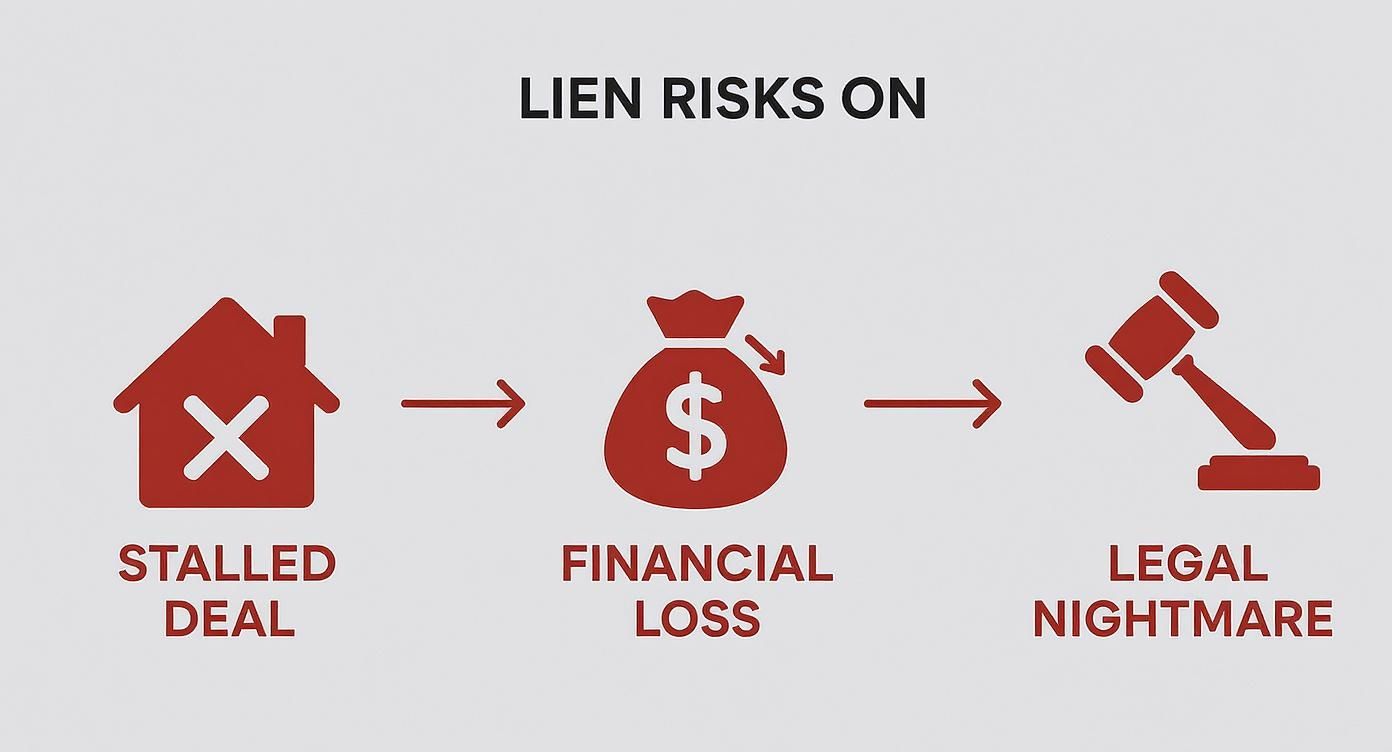
Each icon represents a common consequence of an incomplete search, highlighting why accuracy and thoroughness are non-negotiable in professional title work.
Comparing Lien Search Methods
To truly appreciate the shift in the industry, it's helpful to see a side-by-side comparison of the old way versus the new way. The table below breaks down the differences in process, time commitment, and reliability.
| Feature | Traditional Manual Search | Modern AI-Powered Solution |
|---|---|---|
| Process | Physical visits to multiple county offices; manual review of ledgers, microfiche, and print documents. | Centralized digital access; automated data extraction and analysis from multiple sources. |
| Time Required | Days to weeks, depending on the complexity and number of jurisdictions involved. | Minutes to hours, providing near-instantaneous results for most properties. |
| Accuracy & Risk | High potential for human error (missed documents, misinterpretation). | Significantly higher accuracy; AI flags inconsistencies and reduces oversight. |
| Cost | Labor-intensive, with costs tied to hours worked, travel, and administrative overhead. | Cost-effective subscription or per-search models; reduces labor and overhead costs. |
| Accessibility | Limited to office hours; physical presence required. | 24/7 access from any location with an internet connection. |
As you can see, the move toward automated solutions isn't just about convenience—it's about fundamentally improving the quality and efficiency of the entire title search process.
The Problem with Fragmented Information
Even in our digital age, many municipal websites are clunky, outdated, and incomplete. You might find a few records online, but you’ll almost certainly need to make an in-person trip to access older documents. This hybrid approach doesn’t really save the time you’d hope for, as you're constantly jumping between digital and physical records.
This process is especially draining for title abstractors, whose job demands absolute precision under tight deadlines. Juggling multiple county systems, each with its own quirks, requires deep local knowledge and a lot of patience. You can read more about the challenges and solutions for dedicated title abstractors in our guide.
Ultimately, the manual method for finding property liens is a lesson in inefficiency. It’s slow, expensive, and leaves too much room for critical oversights. Recognizing these limitations makes it crystal clear why modern, tech-driven solutions have become essential for professionals who need both speed and accuracy to stay competitive.
Turning to Title Companies and Online Databases

After getting bogged down by the painfully slow and error-prone process of digging through county records, most real estate professionals look for a better way. The next logical steps usually involve relying on legacy title companies or one of the many online databases. While these are an upgrade from dusty ledgers, they come with their own serious set of headaches that impact scalability and profitability.
Take third-party online databases, for example. They sound great on paper—pulling public records from tons of different counties into one place. This can be a huge time-saver. But you’ll quickly find that most operate on a subscription model, adding another recurring expense to your bottom line.
Even more concerning is that the data isn't always fresh. There's often a delay between a lien getting filed at the courthouse and it showing up in the database. This gap creates a dangerous blind spot where you could easily miss a brand-new claim, defeating the purpose of the search in the first place.
The Title Company Trade-Off
Hiring a traditional title company is often seen as the most reliable, "gold standard" option. You’re paying for experienced professionals who conduct thorough, insured searches, which gives you a high level of confidence. For complicated deals, that expertise is essential.
But here’s the trade-off: speed and cost. A full, comprehensive search from a title company can take days, sometimes even weeks, to land on your desk. In a hot market where every minute counts, that slow turnaround is a deal-killer. It creates a massive bottleneck that could cause you to lose out on a time-sensitive opportunity. And, of course, their services don't come cheap, adding a significant cost to every transaction.
The real challenge with both online databases and old-school title services is scalability. They’re a definite step up from doing it all yourself, but neither one gives you the instant, affordable results you need to juggle a high volume of deals efficiently.
This is exactly where so many investors and developers get stuck. You're forced to choose: risk acting on outdated information from a database or accept the slow, expensive process of a title company. Both paths make it incredibly difficult to scale your business.
Finding a Modern Solution
The shortcomings of these established methods make it clear that the industry needs a more dynamic approach. While there's a place for traditional services, their built-in delays and high costs are precisely why a new generation of tools had to emerge.
The latest platforms are built to close this gap, giving you the in-depth results of a professional search with the speed of a digital tool. The right technology delivers the best of both worlds—instant access to verified data without the typical bottlenecks. To see how AI-powered tools are tackling these exact problems, it's worth exploring what modern platforms like TitleTrackr can do. This approach finally moves us beyond the old trade-offs, making speed, accuracy, and scalability possible all at once.
How AI Is Completely Changing Lien Discovery

Let’s be honest. The old ways of finding property liens just don't cut it anymore. Manually digging through county records or trying to piece together information from third-party databases is painfully slow and full of holes. Every step is a potential bottleneck, and the risk of human error or outdated information can kill a high-stakes deal.
This is where artificial intelligence isn't just an upgrade—it's a total overhaul of the entire process.
Instead of taking days or weeks, AI-powered systems scan and make sense of millions of records from countless sources in seconds. This goes way beyond a simple keyword search. These platforms intelligently connect the dots, cross-referencing names, addresses, and parcel numbers across different datasets to find hidden claims a human researcher could easily miss.
Slash Turnaround Times from Days to Minutes
The first thing your team will notice with an AI-driven tool is the incredible speed. A task that once took a week of back-and-forth can now get done in the time it takes to grab a coffee.
Imagine an investor client looking at a dozen properties for a portfolio. You can run preliminary lien searches on all of them at once, instantly weeding out the ones with messy titles. This lets them focus their time and money only on the real opportunities, giving them a massive head start on the competition.
This isn't just about convenience; it’s about being agile enough to win. When you get reliable title information almost instantly, you can make confident offers faster than anyone still waiting on a traditional report.
Uncover Hidden Claims with Far Better Accuracy
We’re all human, and mistakes happen. A misspelled name, a transposed number in a parcel ID, or an overlooked document can lead to a disastrously wrong title report. AI dramatically reduces these risks by taking the manual work—and the human error—out of data extraction.
Think about a property owner with a common name like "John Smith." A manual search can quickly become a nightmare of trying to figure out which liens belong to the right John Smith. AI, on the other hand, digs deeper. It analyzes other data points like middle initials, past addresses, and transaction histories to confirm the right match with a very high degree of confidence.
The real power of AI in lien discovery is its ability to see patterns and connections that are invisible to the human eye. By processing huge amounts of data, it spots red flags and potential problems before they blow up.
The global real estate market is always shifting, and clear, reliable data is everything. While big-picture trends are important for strategy (you can get a great global real estate outlook from Columbia Threadneedle to see what I mean), individual deals are won or lost in the details found during due diligence.
Scale Your Operations Without Hiring an Army
Perhaps the biggest impact AI has is its ability to help you grow your business without compromising on quality. With the old methods, doing more deals meant hiring more researchers, which just adds overhead and complexity.
AI-powered platforms like TitleTrackr flip that script. The technology handles the heavy lifting of gathering and analyzing data, freeing up your team to manage a bigger portfolio more effectively.
Here’s how this kind of technology helps you grow:
- Automated Reporting: Generate professional, consistent reports in seconds. Your team can stop building reports and start focusing on clients and strategy.
- Centralized Workflow: Manage every lien search from one dashboard. No more juggling dozens of county websites and third-party logins.
- Predictive Insights: Some systems can even flag properties that have a higher risk of title issues, helping you prioritize where to focus your energy.
By bringing this technology into your workflow, you're not just finding property liens faster. You're building a smarter, more accurate, and more scalable operation. See for yourself how AI is changing the title search game and request a demo of TitleTrackr to see what it can do for you.
Weaving Modern Lien Searches into Your Workflow
Let's be honest—bringing a new tool into your operation can feel like a headache you don't have time for. But adopting new tech shouldn't mean blowing up your entire process. The goal isn’t a massive overhaul, but a smart, clean upgrade to the way you already handle due diligence.
Think of an AI-powered platform for finding property liens as adding a powerful new gear, not rebuilding the whole engine.
A great way to start is with a simple pilot project. Just pick a few properties or even one team member to run searches with the new system alongside your current methods. It’s a low-risk way to see exactly how the speed, accuracy, and depth of the reports stack up without forcing everyone to switch at once.
Getting Your Team Up to Speed
Forget boring, feature-heavy training sessions. The best training zeroes in on solving the real-world headaches your team faces every day.
Instead of a generic demo, walk them through a genuine nightmare scenario—like that property with a common name and a dozen potential judgment liens. When they see the technology untangle that mess in minutes, the tool sells itself. Adoption becomes something they want to do, not something they're forced to do.
You can also get proactive with automated alerts. Many local governments now offer free property alert services that send you an email the moment a new document is recorded on a property you're tracking. These are a great supplement to your primary search tools.
Integrating new technology is less about learning a new program and more about rethinking what's possible. When a comprehensive lien search takes minutes instead of days, you can vet more properties, close deals faster, and provide better insights to your clients.
This leap in efficiency has a direct, positive impact on how you communicate with your clients.
Using Detailed Reports to Add Real Value
The reports you get from modern AI platforms are more than just data—they're powerful communication tools. They let you present your findings clearly to clients, partners, and attorneys without making them sift through archaic, hard-to-read county documents.
Here's how you can use these reports:
- Visually pinpoint potential risks with clean summaries and direct links to the source documents.
- Deliver faster updates to everyone involved, which keeps the deal from stalling.
- Build a much stronger case when you're negotiating how to resolve a lien.
At the end of the day, folding a modern search platform like TitleTrackr into your workflow is about empowering your team to work smarter, not harder. It gets rid of the bottlenecks and administrative drag from old-school methods, freeing up your people to focus on high-value analysis and making the right strategic calls.
Ready to see how easily this can fit into your process? Request a demo of TitleTrackr and discover a faster, more accurate approach to finding property liens.
Common Questions About Finding Property Liens
Even with the best tools, you're bound to run into questions when you're in the trenches digging for property liens. Knowing how to handle these curveballs is what keeps a deal moving forward. Let's tackle some of the most common uncertainties head-on.
One of the first things professionals ask about is the difference between a voluntary and an involuntary lien. It’s pretty straightforward: a voluntary lien is one a property owner agrees to, like a mortgage. An involuntary lien, on the other hand, gets placed on a property without their consent—think tax liens from the IRS or a mechanic's lien from an unpaid contractor.
What Happens When You Find a Lien
Discovering a lien can feel like hitting a brick wall, but it doesn't automatically kill the deal. The first step is to verify its validity. Was it filed correctly? Has the debt already been settled? You'd be surprised how often searches uncover liens that are full of procedural errors or are simply outdated.
If the lien is legitimate, the next move is to open a line of communication with the creditor. Many would rather negotiate a settlement than get tangled up in a long, drawn-out legal fight. This is almost always the quickest way to get the title cleared and move the transaction forward.
The most critical thing to remember is that a lien creates a "cloud" on the property's title. This legal encumbrance makes it nearly impossible to sell or refinance the property until the underlying debt is satisfied and the lien is officially released.
Can You Dispute a Fraudulent Lien
Absolutely. It’s an unfortunate reality, but fraudulent liens happen. Sometimes they’re the result of a clerical error, but other times, they're filed with malicious intent. If you have reason to believe a lien is invalid, you have every right to challenge it in court.
The process involves filing a lawsuit to "vacate" the lien, where you'll need to present solid evidence proving the claim is false. If you win, the court can order its removal, and you might even be able to collect damages from the person who filed it. For a deeper dive into common issues, you can explore more answers on our comprehensive FAQ page about title searches.
Ultimately, getting through these issues comes down to having fast, accurate information. Modern tools don't just help you find liens; they give you the detailed documentation you need to resolve them quickly and with total confidence.
Stop letting hidden liens and slow searches create bottlenecks in your workflow. With TitleTrackr, you can get instant, AI-powered reports that uncover every claim with unmatched accuracy. See how our platform transforms due diligence and gives you a powerful competitive advantage.
 blog.titletrackr.com
Leave a comment