

Launching a title company is more than just a business venture; it's about building an engine of trust at the heart of the real estate market. Before you close your first transaction, you must lay a strategic foundation that protects your assets, defines tax obligations, and steers your growth. Getting this framework right from day one is the difference between thriving and facing a mountain of legal and financial headaches down the road. This blueprint will guide you through the essential steps, showing you how to build a modern, efficient, and profitable title agency.
Structuring Your Title Company for Success
Your first major decision is choosing a business structure. This single choice impacts everything—from personal liability and tax obligations to your ability to attract investors.
LLC or Corporation: What's the Right Choice?
For most new title agencies, the debate boils down to a Limited Liability Company (LLC) or a Corporation (typically an S Corp or C Corp).
An LLC is a popular starting point for its simplicity and protection. It creates a critical liability shield, keeping your personal assets separate from business debts, while offering "pass-through" taxation. This means the company's profits are taxed on your personal return, avoiding the "double taxation" common with C Corps.
A corporation, on the other hand, might be more attractive if you plan to seek outside investment. While it can offer certain tax advantages, it comes with stricter operational rules, such as holding formal board meetings and keeping detailed corporate minutes—a level of formality not required of LLCs.
Our recommendation: An LLC offers an ideal blend of protection and flexibility for a new title company. However, this is not a decision to make in a vacuum. Consult with a CPA and an attorney to analyze your specific goals and financial situation to ensure you choose the structure that truly fits your vision.
Crafting a Winning Business Plan
Your business plan is your operational roadmap, not just a document for lenders. A vague plan is a fast track to failure. You need a detailed, data-driven blueprint that proves you understand your market and have a clear path to profitability. A solid plan forces you to get brutally honest about every part of your business, from your hiring strategy to the technology you'll need to compete.
Here’s what your plan must include:
- Executive Summary: A powerful elevator pitch outlining your mission, goals, and what makes your company unique.
- Company Description: Get specific about your legal structure and the services you'll offer—title searches, escrow services, closing coordination.
- Market Analysis: Define your target clients. Are you serving residential agents, commercial developers, or mortgage lenders? Conduct a deep dive into competing title companies in your area to identify their weaknesses and your opportunities.
- Services and Operations Plan: Map out your day-to-day workflow. How will you handle title searches and examinations? This is where you'll realize the importance of partnering with specialized pros. Learning the process for finding skilled abstractors early on will give you a significant competitive advantage.
Building Realistic Financial Projections
Finally, we get to the numbers. Your financial projections are the core of your business plan, translating your strategic vision into concrete figures. This is where realism is non-negotiable; lenders and underwriters will scrutinize these numbers intensely. Ensure you include a detailed startup cost analysis, a break-even analysis, and projected profit and loss statements for at least the first three to five years. This isn't just about showing your passion; it's about proving your new company is a viable, profitable business.
Navigating State Licensing and Compliance
With your business plan and legal structure in place, it’s time to tackle the regulatory landscape. The title industry is built on trust, enforced through a complex web of state-specific rules. A single misstep here—a missed license or an incorrect bond—can halt your progress instantly. There's no federal standard, meaning the rulebook for Texas is completely different from Florida's. Your first task is to become an expert in the regulations of the state where you plan to operate.
Understanding Core Licensing Requirements
Most states require a two-pronged licensing approach.
First, your business entity needs a Title Agency License. This officially grants your LLC or corporation the authority to operate as a title insurance business in that state.
Second, you and your key personnel will need an individual Title Agent License. This personal license is for those performing the core work—conducting searches, underwriting, and signing policies. Some states may also require separate licenses for escrow officers, so investigate these specialized roles.
Securing Essential Bonds and Insurance
Next, you must establish financial safeguards to protect your clients and your company. The two non-negotiables are surety bonds and Errors and Omissions (E&O) insurance.
A surety bond is a financial guarantee that your company will adhere to all regulations. If you fail to do so, the bond covers any financial losses your clients may incur.
Key Takeaway: When applying for bonds and insurance, underwriters will place your business under a microscope. They're looking for financial stability, clean backgrounds for key staff, and robust internal controls. A well-prepared application is your first opportunity to prove you’re a low-risk partner worth backing.
Errors and Omissions (E&O) insurance is your critical safety net. It protects your company from claims of negligence or mistakes. A minor typo on a title report can escalate into a major lawsuit; E&O covers your legal fees and any potential settlements. It is not optional.
Building Your Financial Foundation
Let's talk capital. Starting a title company requires a significant investment. You should budget for initial startup costs ranging from $100,000 to $300,000, though this can vary based on your location and scale.
Licensing alone can cost between $1,000 and $5,000. The surety bond could range from $10,000 to $50,000. And don't underestimate technology—your title production software can easily consume 20-30% of your total startup budget. For a deeper dive into market stats, you can always check the latest market report from ALTA.
To create a clearer picture, here’s a breakdown of typical first-year expenses.
Typical Startup Cost Breakdown for a New Title Company
A detailed look at the initial expenses to anticipate when launching your title agency in the first year.
| Expense Category | Estimated Cost Range | Key Considerations |
|---|---|---|
| Licensing & Bonding | $11,000 – $55,000 | Varies widely by state. Includes agency and individual agent licenses plus the required surety bond. |
| Technology & Software | $20,000 – $90,000 | Your title production platform is the biggest ticket item. Also includes hardware, IT setup, and security. |
| Office & Overhead | $24,000 – $72,000 | Rent for a small office space, utilities, and office supplies for the first year. |
| E&O Insurance | $5,000 – $15,000 | Your first year's premium. This depends on coverage limits, your team's experience, and transaction volume. |
| Salaries & Staffing | $50,000 – $100,000+ | Budget for at least one experienced agent and administrative support for the first 6-12 months. |
| Marketing & Business Dev | $5,000 – $20,000 | Website development, networking events, marketing materials, and initial advertising campaigns. |
| Working Capital | $10,000 – $30,000 | A cash reserve to cover unforeseen expenses and keep operations running before revenue becomes consistent. |
These figures are a starting point, but they provide a realistic budget framework for your financial plan.
The entire process—from structuring the business to planning the finances—is visualized below.
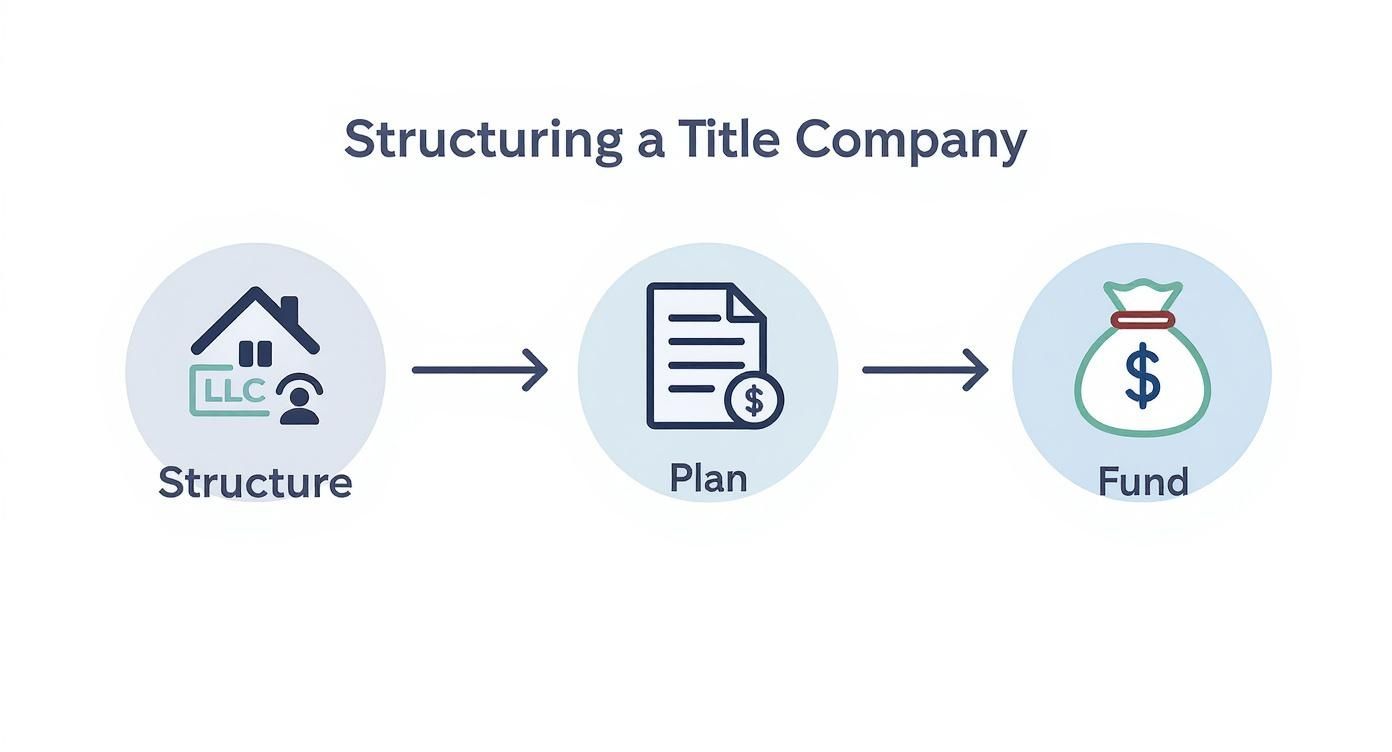
As you can see, getting the legal and planning pieces right is the foundation for securing the capital you need to cover all these compliance and operational costs.
Establishing Compliant Escrow Accounting
Finally, and most critically, you must establish perfect escrow accounting procedures. This is not just good practice—it's the law. Your operations will be governed by the Real Estate Settlement Procedures Act (RESPA) and state-specific banking regulations. You must maintain client funds in separate, meticulously managed escrow accounts. This money is not yours and can never be commingled with your company's operating funds.
- Dedicated Escrow Accounts: Open at least one bank account used exclusively for holding client funds during closings.
- Three-Way Reconciliation: This is non-negotiable. You must regularly reconcile your bank statements, escrow trial balance, and individual closing file ledgers. Everything must match to the penny.
- Clear Record-Keeping: Maintain detailed, organized records for every dollar that moves through your escrow accounts. Modern title software helps automate this, but ultimate responsibility for compliance rests with you.
Building Your Operational Tech Stack
In today’s title industry, speed and precision are the baseline for survival. Your success hinges on the technology you choose and the people you hire to run it. A clunky, outdated system creates bottlenecks, frustrates clients, and invites costly mistakes. The right tech stack, however, acts as a force multiplier for a talented team, serving as the operational core that powers every transaction. Getting this right from day one is how you build a reputation for seamless, reliable closings.
Choosing Your Title Production Software
Your title production software is the heart of your operation. It's where your team will manage everything from order entry and document creation to closing disclosures and final policy generation. Think of it as the central nervous system for your workflow. When evaluating platforms, focus on the user experience and workflow. How intuitive is the interface? Can it integrate smoothly with your underwriter’s systems and other third-party services? The goal is to find a system that minimizes manual data entry, which is the primary source of errors.
Your tech stack shouldn't just manage your work; it should make your work easier, faster, and more accurate. The right platform automates tedious tasks, freeing your team to focus on building client relationships and solving complex title issues.
The People Behind the Platform
Technology is only as effective as the people using it. As you map out how to open a title company, remember your first hires are critical. You're not just filling seats; you're building your company's culture and market reputation.
Here are the key roles to prioritize:
- Experienced Title Officer: This is your in-house expert, capable of dissecting complex title searches, identifying potential clouds on title, and clearing defects.
- Meticulous Escrow Agent: This individual manages your escrow accounts—a massive responsibility. They must be incredibly detail-oriented, trustworthy, and an expert in RESPA compliance.
- Proactive Processor: This person is the coordinator who keeps all the moving parts of a closing on track, juggling agents, lenders, and clients with superb communication skills.
When interviewing, look for candidates who embrace technology as a tool for efficiency and growth. A team that is eager to leverage modern software is a team that is ready to win.
Automating for Accuracy and Speed
Leading title operations are moving beyond basic production software. The real competitive edge comes from tools that automate the most time-consuming tasks, like document analysis and data extraction. This is where AI-driven platforms like TitleTrackr are changing the game. Instead of manually reading dense legal documents, an AI-powered system can extract key information in seconds. This not only dramatically speeds up the title search but also slashes the risk of human error. An AI doesn't get tired or overlook a critical detail buried on page 47 of a deed.
Here’s a look at a modern, AI-driven interface designed to simplify complex title work.

This clean, organized dashboard brings clarity to a historically chaotic process, making it easier for your team to manage their pipeline and deliver results faster. Platforms like these offer a significant advantage, allowing you to compete with established players immediately. You can see how this works firsthand by requesting a free trial of TitleTrackr to understand the impact AI can have on your future operations.
Securing Underwriter Partnerships and Funding
With your operational framework mapped out, you now face the two biggest hurdles in launching a title company: securing a title underwriter partnership and raising the necessary capital. These are not separate tasks; they are deeply intertwined. A solid funding plan demonstrates stability to underwriters, and a letter of intent from a reputable underwriter is a powerful asset when meeting with banks or investors.
The Art of Courting an Underwriter
Let's be blunt: a title company without an underwriter cannot operate. The underwriter insures the policies you write, assuming all financial risk. Consequently, they are extremely selective about their partners. They aren't just reviewing your business plan; they are betting on you and your team. Your reputation, experience, and commitment to compliant operations are paramount. Underwriters seek leaders who understand the intricacies and stakes of the title world.
Insider Tip: Underwriters are inherently risk-averse. They are attracted to new agencies that demonstrate an obsessive focus on procedural accuracy, staff training, and fraud prevention. Showcasing your investment in secure, modern technology like TitleTrackr can significantly strengthen your application.
What Underwriters Really Look for in an Application
When you submit your application, expect a thorough investigation. They are seeking to answer one fundamental question: "Is this new agency a safe bet?" To get a "yes," you must build an airtight case in several key areas:
- Financial Stability: Provide a detailed pro forma budget, proof of capital to cover expenses for at least 6-12 months, and a healthy balance sheet.
- Team Experience: Go beyond job titles. Provide detailed bios for key players, highlighting their years in the industry, specific expertise, and relevant certifications.
- Compliance and Controls: Present a comprehensive manual of your internal controls, covering everything from escrow accounting and three-way reconciliation to data security and RESPA compliance.
- Market Opportunity: Demonstrate your market knowledge with a sharp analysis of your target area, backed by realistic policy volume projections. They want to see a clear path to profitability.
Exploring Your Funding Avenues
While pursuing underwriter partnerships, you must actively secure capital. An SBA (Small Business Administration) loan is a common starting point, often offering more favorable terms than conventional bank loans. Another path is to seek private investors or form a partnership, which can provide both capital and valuable industry connections. When pitching investors, focus on their return. Use your financial models to show a clear timeline to profitability and emphasize your competitive advantage—whether it's superior service, a niche market focus, or a technology-first approach that drives efficiency.
Your Go-To-Market Strategy for Winning Clients
You've done the heavy lifting: licenses are secured, your tech is implemented, and you've partnered with an underwriter. You are officially open for business. But an open door is meaningless without clients. Now, you must build a client pipeline from scratch. In the real estate industry, this is a ground game won through relationships.

Your entire go-to-market strategy must revolve around identifying and earning the trust of key players who control deal flow: top-producing real estate agents, busy mortgage brokers, and established local lenders.
Identifying Your Core Client Base
Before you start networking, you need a focused target list. Don't spread yourself thin trying to be everything to everyone. Research the top real estate agencies, independent brokers, and local lenders in your county. Sales data will reveal the most active agents and loan officers. These are your high-value targets. Once you have your list, the goal is to understand their business and find ways to provide real value before asking for a deal.
Earning Trust Through Value-First Networking
Top agents and lenders are constantly bombarded by title reps. To stand out, you must offer something different. Instead of asking for their business, offer something that makes their jobs easier.
Consider these value-add tactics:
- Host Educational Workshops: Offer a free class for local agents on a complex topic like RESPA guidelines, FIRPTA, or the title implications of closing in a trust.
- Provide Market Insights: Use your access to property data to create a simple monthly market report for your area and share it with your target list.
- Be a Go-To Resource: Position yourself as the expert they can call with a tricky title question, even on a deal you aren't handling. Be available to offer guidance with no strings attached.
A single act of providing upfront, no-strings-attached expertise is more powerful than a dozen sales calls. You’re not just selling a service; you're building a reputation as a reliable partner who helps solve problems.
This approach builds credibility and keeps you top-of-mind. When their current title company makes a mistake, you'll be the first person they call.
Building Your Digital Foundation
While relationships are key, a professional online presence is non-negotiable. A clean, professional website is your digital storefront. It must clearly state what you do, who you serve, and how to open an order. Team bios can help humanize your brand and build trust.
Next, focus on local SEO. This is how potential clients searching for "title company near me" will find you. Create a complete Google Business Profile with a consistent name, address, and phone number. As you close deals, encourage happy clients to leave reviews—social proof is powerful, with 77% of consumers 'always' or 'regularly' reading reviews for local businesses.
Finally, a targeted social media presence on platforms like LinkedIn can help you connect with the local real estate community. Share closing photos (with permission), celebrate an agent’s success, and post helpful content. The goal is to show you’re an active, engaged partner in their success.
Have Questions About Starting a Title Company?
Even with a detailed roadmap, launching a title business raises numerous questions. Getting clear answers is essential to building a successful agency.
Here are answers to some of the most common questions from aspiring founders.
How Much Does It Really Cost to Start a Title Company?
While there's no single magic number, a realistic budget is crucial. Most new title companies should plan for startup costs between $100,000 and $300,000. This range depends on your state's regulations, your local market, and your initial scale.
This capital covers essential expenses:
- Licensing and Bonding: Fees for agency and individual licenses, plus the surety bond.
- Insurance: Your first year's premium for a comprehensive Errors and Omissions (E&O) policy.
- Technology: Your title production software, hardware, and cybersecurity measures.
- Initial Payroll: Salaries for your core team before revenue becomes consistent.
- Office Space: Rent and setup costs for a professional closing environment.
Planning for this range provides the necessary runway to launch without cutting critical corners.
What Is the Hardest Part of Opening a Title Company?
From our experience, the single biggest hurdle for nearly every new founder is securing an underwriter partnership. This feels like the final boss battle after months of preparation. Underwriters are inherently risk-averse, as they insure every policy you write. They demand a bulletproof application that demonstrates deep industry knowledge, an impeccable compliance plan, and solid financial backing. Success often hinges on your leadership team's experience and the quality of your business plan.
Securing an underwriter isn't just a transaction; it's the start of a long-term partnership. They are betting on your ability to operate flawlessly, so you must present an operation that inspires complete confidence from day one.
How Do New Title Companies Get Their First Clients?
Forget impersonal marketing campaigns at the start. Your first clients will come from direct, relationship-based networking. The title industry is built on trust, and professionals do business with people they know, like, and respect. Your early success depends on building genuine connections with local real estate agents, loan officers, and attorneys. Provide value upfront through education and expert advice. Then, deliver flawless service on your first few deals to spark the word-of-mouth referrals that will become the lifeblood of your business.
Can You Open a Title Company with No Experience?
Technically, it may be possible in some states, but it is incredibly difficult and strongly discouraged. The title and escrow industry is complex, with a steep learning curve and severe consequences for errors. More importantly, an underwriter is highly unlikely to partner with an agency whose leadership lacks proven industry experience. Success almost always requires at least one founder with years of experience as a title officer, escrow agent, or agency manager. If you're passionate but new to the industry, your best path is to partner with a seasoned professional who can lead the operational and compliance side of the business.
We tackle more of these questions in our detailed TitleTrackr FAQ section, a valuable resource for refining your plan.
Ready to build your title company on a foundation of speed and accuracy? With TitleTrackr, you can automate manual tasks, reduce errors, and deliver an exceptional client experience from your very first closing. See how our AI-driven platform can give your new agency a competitive edge.
 blog.titletrackr.com
Leave a comment