

In the complex world of real estate, the term "color of title" frequently appears, and it’s a concept that can easily cause confusion. So, what exactly does it mean for your transaction?
Imagine you purchase a rare collectible from what seems to be a reputable dealer. The paperwork looks authentic, the item appears genuine, but you later discover a critical flaw in its provenance, making your ownership claim invalid. The documents appeared to grant you ownership, but a hidden defect rendered them worthless.
That's color of title in a nutshell. It refers to a written instrument that appears to convey ownership of a property but is actually invalid due to a fundamental, underlying flaw. It provides the appearance of a valid title, but not the legal reality. This gap between appearance and reality is where significant financial risk lies.
What is the True Meaning of Color of Title?

At its core, color of title describes a claim to a property that seems legitimate on its face but is legally defective. A person holding such a document—like a deed or a court order—often genuinely believes they are the rightful owner, having acted in good faith.
The problem is the unseen issue that makes their claim legally unenforceable. The individual with the defective title might be occupying the property, paying taxes, and improving the land, all while their claim remains fragile. The true legal owner could emerge at any time to challenge their ownership, leading to costly litigation and the potential loss of the property and any investment made in it.
Key Characteristics of a Color of Title Claim
Identifying a potential color of title issue is the first step in mitigating risk in any real estate transaction. For a claim to fall under this legal category, it typically exhibits a few distinct traits:
- A Written Instrument: The claim is not based on a verbal agreement. It originates from a physical document intended to transfer ownership, such as a deed, will, or court decree.
- Apparent Validity: On the surface, the document looks legitimate. There are no obvious signs of fraud, forgery, or glaring errors that would immediately raise red flags.
- A Hidden Defect: This is the critical flaw. An unseen issue invalidates the document's legal power. Common examples include a forged signature, a deed from a grantor who did not legally own the property, or an incorrect legal description.
“Color of title gives the illusion of ownership without the substance. It's a document that promises a right to property but ultimately fails to deliver, leaving investors and owners exposed to unforeseen challenges from superior claims.”
These hidden issues are more common than you might think. According to the American Land Title Association (ALTA), approximately 25% of all title searches uncover a defect that must be resolved before closing. You can find more title defect statistics from alta.org on their site.
Why It Matters for Real Estate Professionals
For professionals on the front lines—investors, abstractors, attorneys, and landmen—identifying color of title risk is non-negotiable. A flawed title can halt a transaction, invalidate a mortgage, and trigger significant financial losses.
This is precisely why a comprehensive title examination is not merely a procedural step but a fundamental component of due diligence. Without it, you are operating blind, unaware of the hidden landmines that could detonate an otherwise promising deal. The key is not just to perform a search, but to perform an intelligent one that can see beyond the surface.
How Color of Title Impacts Adverse Possession
While a defective deed may seem like a dead end, color of title plays a surprisingly powerful role in the legal doctrine of adverse possession. This principle allows a non-owner to potentially gain legal ownership of a property over time, but only if they meet a strict set of criteria. Having a document that provides color of title can act as a significant shortcut in this process.
Adverse possession is often misunderstood. It's not simply about "squatting" on land; it requires possessing the property in a way that is open and obvious to both the public and the true owner. In essence, the claimant must act exactly as a rightful owner would.
The Five Pillars of an Adverse Possession Claim
For an adverse possession claim to succeed, the possession must meet five critical standards. The claimant’s occupation has to be:
- Actual: They must physically use the land as an owner would, such as farming it, living on it, or building structures.
- Open and Notorious: Their presence cannot be concealed. It must be visible enough that a reasonably diligent owner would be aware of their presence.
- Hostile: This doesn't imply aggression. In legal terms, it means their possession is without the true owner's permission and infringes upon their property rights.
- Exclusive: The claimant must possess the land for their own use, not sharing it with the general public or the legal owner.
- Continuous: They must possess the property without interruption for a legally defined period, which varies significantly by state.
This is where a document providing color of title becomes a game-changer. It serves as tangible evidence that the claimant's possession was not a random act of trespassing but was based on a good-faith belief that they owned the property.
A flawed deed, in a strange twist, can become the very foundation of a successful ownership claim. It demonstrates that the possessor's actions were based on a plausible—though incorrect—belief in their ownership, which courts often look upon more favorably than a claim with no paperwork at all.
Accelerating the Path to Ownership
One of the most significant advantages of having color of title is its ability to shorten the statutory period required for an adverse possession claim. For instance, a state might normally require 20 years of continuous possession. However, if the claimant holds a defective deed, that same state might reduce the requirement to as little as 7 or 10 years.
Why the reduction? The flawed document proves the claimant's intent was not malicious. They were operating under the honest belief that they had a legitimate right to the property, a factor that many state laws recognize and reward. This makes identifying potential color of title issues in property records so critical. It’s not just about spotting risks for a current transaction, but also about understanding how an old, dormant claim could suddenly re-emerge. Uncovering these hidden defects is crucial, and modern tools are essential for bringing them to light before they can jeopardize a deal.
Recognizing Common Color of Title Scenarios
To effectively manage risk, you must move beyond textbook definitions and understand how color of title manifests in real-world situations. A document creating this illusion of ownership can appear in many forms, often looking perfectly legitimate. Only through deep analysis does the critical, underlying flaw come to light.
Spotting these situations early is the key to protecting a transaction from being derailed by legal challenges down the road. These defective documents are not just historical artifacts; they are active risks in today's property market. Each one tells a story of a transaction gone wrong, leaving a trail of uncertainty that can cloud a title for decades.
Unpacking the Most Frequent Defects
Several common scenarios give rise to color of title, each with its own set of red flags. A deed might look official at first glance, but a hidden issue can render it legally powerless. These problems tend to fall into a few key categories.
Here are four of the most common scenarios you’re likely to encounter:
- Forged or Fraudulent Deeds: This is one of the most severe defects. A deed with a forged signature is void from the start. It does not matter if the buyer was unaware of the fraud and paid fair market value—the document cannot legally transfer ownership because the true owner never consented to the sale.
- Deeds from an Unqualified Grantor: Imagine someone sells a property they believe they inherited through a will. If that will is later found to be invalid, the seller never had the legal authority to transfer the property. The deed they provided the buyer gives color of title, but it is fundamentally defective.
- Improperly Executed Documents: Legal documents are subject to strict execution requirements. A deed missing the required witness signatures, lacking a proper notary seal, or containing an incorrect legal description of the property is flawed. These procedural errors can invalidate the entire transfer.
- Deeds Based on a Void Court Order: Sometimes a property transfer occurs via a court-ordered action, like a foreclosure or probate sale. If that court order is later overturned on appeal or found to be fraudulent, any deed based on it becomes invalid, creating an immediate color of title problem for the new owner.
For professionals like landmen, who navigate complex chains of title daily, identifying these subtleties is a core competency. You can learn more about the challenges faced by landmen and discover how modern technology helps them cut through the complexity.
This visual perfectly captures how a flawed document, when combined with enough time, can eventually become a legitimate pathway to ownership through adverse possession.
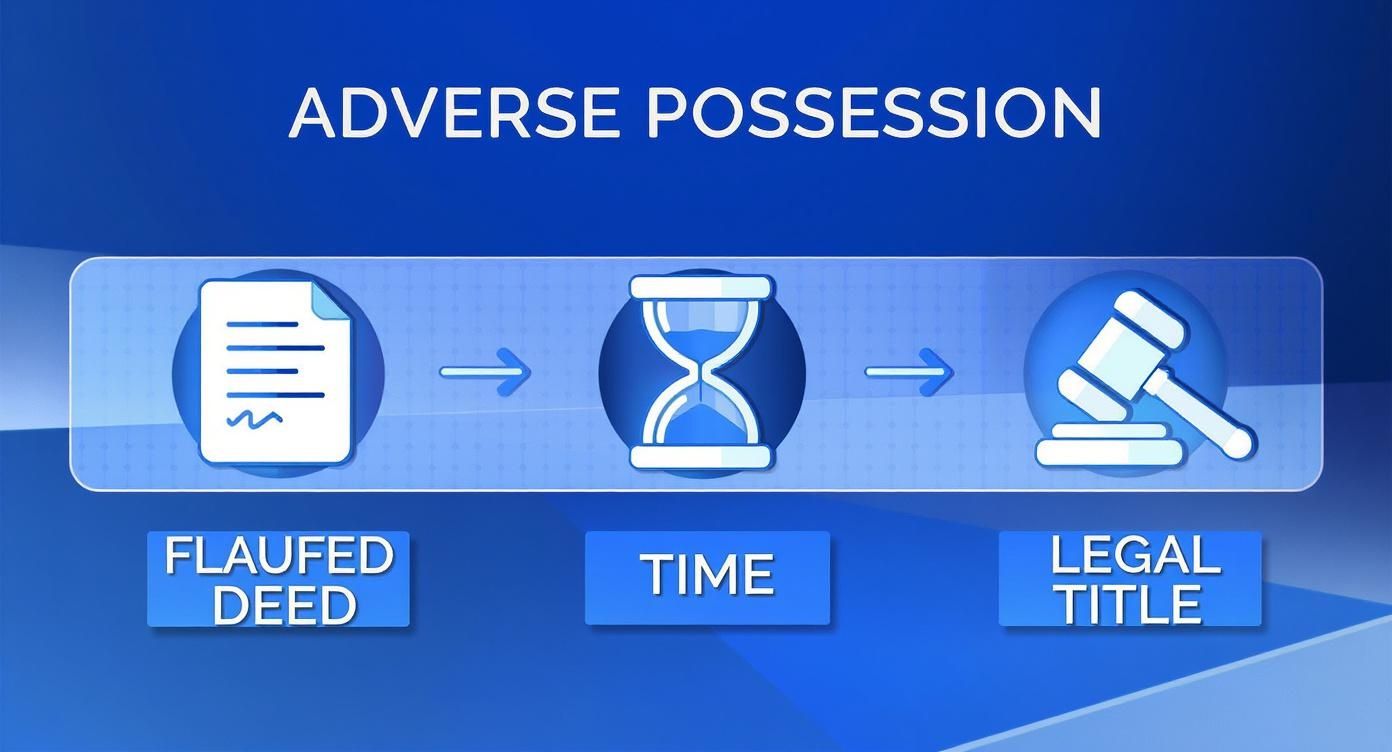
As the infographic illustrates, a defective deed is often the catalyst for an adverse possession claim, which can—if all legal requirements are met—mature into a legally recognized title.
A Summary of Common Defects
To help you spot these risks quickly, we've compiled a table breaking down the most common sources of color of title, their typical causes, and the primary risks they pose to anyone claiming ownership.
Common Sources of Color of Title Defects
| Defect Type | Common Cause | Primary Risk |
|---|---|---|
| Forged Deed | An unauthorized signature on the transfer document. | Complete invalidation of the title transfer; true owner can reclaim the property at any time. |
| Improper Execution | Missing witnesses, faulty notarization, or incorrect legal description. | The deed may be deemed void by a court, leaving the grantee with no legal ownership rights. |
| Unqualified Seller | The grantor (seller) did not have a legal title to sell the property. | The buyer receives no actual ownership rights, and the title remains with the true legal owner. |
| Void Court Order | A deed was issued based on a court ruling that was later overturned or found invalid. | The legal basis for the property transfer is removed, nullifying the grantee's claim to the title. |
Familiarity with these scenarios is crucial for any real estate professional. Each one represents a potential title dispute waiting to happen, highlighting why a meticulous, technology-driven title examination is non-negotiable for ensuring a property's ownership is clear and secure before closing.
The Difference Between Color of Title and Marketable Title
To truly grasp property risk, you must understand the stark difference between color of title and a marketable title. While they may sound related, they represent opposite ends of the ownership spectrum.
One is a convincing illusion of security; the other is the bedrock of a sound investment.
Think of it in terms of collecting fine art. Owning a property under color of title is like having a flawless replica of a masterpiece. It looks genuine and you might even believe it's the original. But ultimately, it lacks official provenance and is worthless if the true owner appears with proof.
A marketable title, in contrast, is the original painting, complete with a verified history and a certificate of authenticity. It’s a title that any reasonable buyer would accept, confident that it is free from legal challenges.
What Makes a Title Marketable
A title must be secure and unencumbered to be considered marketable. This means it has several key characteristics that a property with only color of title lacks. The goal of every real estate transaction is to ensure the title being transferred meets these non-negotiable standards.
A marketable title is defined by what it lacks. Specifically, it is free from defects such as:
- No Encumbrances: It's clear of undisclosed liens, mortgages, or easements that could restrict an owner's rights.
- No Threat of Litigation: There are no pending lawsuits or credible legal claims that could challenge the owner's right to the property.
- Clear Chain of Title: The ownership history is a clean, unbroken line with no unexplained gaps or questionable transfers.
In stark contrast, a property with color of title is always on shaky ground. The person holding the flawed deed lives with the constant risk that the rightful owner could appear at any moment to assert their superior claim, potentially wiping out the entire transaction.
The Inherent Risk of a Flawed Title
This is not just a legal technicality; it has massive, real-world consequences for everyone involved—buyers, lenders, and investors. A bank will not finance a property that only has color of title because their investment would be unsecured. Similarly, an investor would be taking an unacceptable gamble on an asset whose ownership could evaporate.
This is precisely why thorough due diligence is the foundation of every property deal. Uncovering a document that only grants color of title is a major red flag that must be resolved before any capital is committed. For developers and land researchers undertaking complex projects, starting with a clean title is everything.
Ultimately, only a marketable title provides the certainty and security needed to close a deal with confidence. Anything less is a risk not worth taking.
Putting Modern Title Examination to Work for You

Spotting a potential title defect is one thing; getting ahead of it is another. To truly safeguard a real estate investment, you need to move beyond traditional, manual approaches to title examination. While a classic title search remains a crucial part of the process, it often can't keep pace with the complexity of modern property records.
For decades, the standard has been a painstaking, page-by-page review of public records. The problem? This method is effective at finding what’s on the surface but often struggles to detect the subtle, deeply buried defects that give rise to color of title.
An old, improperly signed deed or a property transfer based on a long-forgotten—but invalid—court order are precisely the kinds of issues that can easily slip through the cracks of a purely manual review.
Going Beyond the Manual Checklist
At its core, a traditional title search is reactive. It's a historical checklist, confirming what’s already known but not always effective at uncovering the unknown. This leaves a significant gap where serious financial risks can hide.
A manual search might completely miss:
- Subtle inconsistencies buried in records from different decades that hint at a fraudulent transfer.
- Hidden connections between documents that reveal a flawed historical claim.
- Systemic red flags, like a notary whose credentials were later revoked across multiple transactions.
This is where modern technology provides a critical layer of protection. It shifts the process from merely looking at documents to intelligently analyzing them at scale.
A title examination should do more than just trace a property's past; it should secure its future. By identifying and resolving color of title issues before they can jeopardize a deal, you transform due diligence from a defensive measure into a strategic advantage.
How TitleTrackr Modernizes Due Diligence
TitleTrackr was engineered to address the limitations of manual-only searches. Our platform uses powerful analytics and AI to scan millions of records with unparalleled speed and precision, detecting the faint signals of title defects that the human eye can easily overlook.
Instead of just tracing a linear chain of ownership, our technology is trained to spot the anomalies and historical flaws that create a color of title risk. We can flag deeds with questionable signatures, identify grantors who had no clear authority to sell, and catch procedural errors that could invalidate a transfer decades later.
By transforming mountains of unstructured data into clear, actionable insights, TitleTrackr helps you manage risk proactively. You can close deals faster and with greater confidence, knowing your due diligence is backed by a deeper level of analysis.
See how our technology can protect your investments from the hidden dangers of a defective title. Request a demo of TitleTrackr today.
Got Questions About Color of Title? We've Got Answers.
We've explored some complex legal territory, and it's natural for questions to arise. Let's tackle some of the most common inquiries to clarify how color of title impacts real estate deals, financing, and legal obligations.
Can I Get a Mortgage on a Property with Color of Title?
In nearly every scenario, the answer is no. Lenders are in the business of managing risk, and a clear, marketable title is a non-negotiable requirement for underwriting a loan.
The property serves as collateral for the loan. Any cloud on the title—and color of title is a significant one—makes ownership legally uncertain. That’s a risk no financial institution is willing to take. Before financing can be secured, the title defect must be "cured."
The most common method for resolving this is through a legal proceeding called a quiet title action, where a court issues a final judgment on who the true owner is.
Is a Quitclaim Deed a Form of Color of Title?
A quitclaim deed can absolutely create color of title, but it isn't one by default. A quitclaim deed only transfers whatever interest the grantor has in the property—which could be full ownership, a partial interest, or nothing at all.
The problem arises when the grantor signs a quitclaim deed for a property they have no legal right to convey. The document itself looks legitimate and gives the buyer the appearance of ownership. That is the very definition of color of title.
It has the look and feel of a valid transfer on paper, but it’s an empty promise. The document gives the appearance of title without the legal substance to back it up because the seller had no real rights to give away.
How Do You Fix a Defect That Creates Color of Title?
For a serious defect creating color of title, the standard solution is a quiet title lawsuit. This is the most conclusive way to fix the problem. You are asking a court to examine all evidence and issue a binding judgment that settles the ownership question once and for all.
Once the court's judgment is recorded in public land records, the cloud is removed, and the title becomes clear and marketable. For minor clerical errors, a corrective deed might suffice. But for the fundamental defects associated with color of title, a quiet title action is almost always necessary.
Am I Responsible for Property Taxes with Color of Title?
Yes. If you are holding a property under color of title, the responsibility for paying property taxes typically falls to you. This is especially critical if your objective is to gain full legal ownership through adverse possession.
In fact, in many states, the consistent payment of property taxes is a mandatory requirement for a successful adverse possession claim. It is one of the strongest forms of evidence demonstrating that you are acting as a true owner would, thereby strengthening your case for eventually gaining legal title.
Uncovering complex title issues before they derail a transaction is non-negotiable. TitleTrackr uses advanced AI to comb through property records with exceptional speed and accuracy, flagging hidden defects that a manual search could easily miss. Protect your investments and close with total confidence.
 blog.titletrackr.com
Leave a comment