

The Hidden Claims That Threaten Property Titles

Picture this: your firm is handling a high-stakes commercial deal, and just before closing, a hidden legal claim surfaces—a lien left behind by a previous owner’s unpaid debt.
This is the very real threat of a lien and foreclosure, two of the most critical concepts in real estate. For title professionals, overlooking one of these claims can turn a smooth transaction into a costly disaster, jeopardizing both the deal and your firm's reputation.
A lien is a legal "hold" placed on a property because of an unpaid debt. It acts as a red flag on the property's title, signaling that a creditor has a right to the property's value. The foreclosure is the legal process that follows—it’s how the creditor forces the sale of the property to satisfy the debt.
The lien is the claim, and the foreclosure is the action. This fundamental relationship gives creditors a clear path to recover what they're owed and represents a primary source of risk in every real estate transaction.
Why This Connection Is So Important
Mastering the link between liens and foreclosures is the first step in understanding why a detailed title search isn't just a formality—it's your core defense. Liens can arise from numerous situations, each with its own set of rules and complexities.
Some of the most common types include:
- Mortgages: The most familiar type. When a loan is issued, the lender places a lien on the property as security.
- Unpaid Taxes: If property or income taxes go unpaid, the government can place a tax lien on the real estate.
- Court Judgments: If a party loses a lawsuit and owes damages, the winner can secure a judgment lien against their property.
- Contractor Bills: A mechanic's lien can be filed by contractors who performed work on a property but were not paid.
These claims are known as "clouds" on a title. They create massive uncertainty for buyers, lenders, and investors, making it incredibly risky to move forward. Uncovering them is a complex job requiring real expertise—a daily challenge for professionals in our industry. You can see how title abstractors are adapting to modern challenges by leveraging technology to make their searches more efficient and accurate.
A clouded title can halt a multi-million dollar commercial deal just as easily as it can a first-time home purchase. The principle remains the same: a clear title is essential for a secure transaction.
Without a professional, thorough investigation, a new owner could unknowingly become responsible for these old debts. This is exactly why the title industry exists—to dig deep and find these hidden claims before the deal closes, protecting everyone involved from future legal and financial headaches.
Decoding the Different Types of Property Liens
Not all liens are created equal. They vary in priority and origin, and understanding their source is key to assessing the true risk involved. Liens fall into two primary categories, each with distinct implications for the property's title and the foreclosure process.
First are voluntary liens. As the name suggests, these are claims a property owner knowingly agrees to. A mortgage is the most common example, where the borrower willingly accepts the lien as a condition of receiving a loan.
On the other side are involuntary liens. These are imposed on a property without the owner's consent, typically due to an unpaid legal or financial obligation. A government agency or a court can place an involuntary lien on a property to ensure a debt is paid.
Involuntary Liens: The Unforeseen Claims
Involuntary liens are often the source of the biggest headaches during a title search because they can appear unexpectedly. If they aren't identified and resolved, they can absolutely lead to foreclosure.
Here are a few of the most critical types you'll encounter:
- Tax Liens: When property taxes are delinquent, the local government can place a tax lien on the property. These liens are incredibly powerful and almost always have "super-priority," meaning they get paid before other liens—even the primary mortgage.
- Mechanic's Liens: Also known as construction liens, these are filed by contractors or suppliers who provided labor or materials but were never compensated. This gives them a legal claim against the asset they helped improve.
- Judgment Liens: When a defendant loses a lawsuit and is ordered to pay damages, the plaintiff can file a judgment lien against the defendant's property. This converts the court's ruling into a secured debt attached to the real estate.
A single, overlooked involuntary lien has the power to completely derail a transaction. Its priority in a foreclosure proceeding can wipe out the interests of other creditors, making its discovery a non-negotiable part of any diligent title search.
Uncovering these hidden claims is the core function of the title industry. Without a thorough search, a new owner could accidentally inherit these debts, putting their ownership in jeopardy from day one.
Voluntary vs. Involuntary Liens At a Glance
The critical distinction between these lien types is consent. This difference impacts how a lien is recorded, its priority, and the steps required to clear it from the title. A quick comparison reveals the key differences between liens taken on willingly versus those imposed by law.
| Characteristic | Voluntary Liens (e.g., Mortgage) | Involuntary Liens (e.g., Tax Lien) |
|---|---|---|
| Origin | Created by a contractual agreement between the property owner and a lender. | Imposed by a court or government entity due to an unpaid obligation. |
| Consent | The property owner explicitly agrees to the lien as part of a transaction. | The lien is placed on the property without the owner's direct consent. |
| Common Examples | Mortgages, Home Equity Lines of Credit (HELOCs). | Tax liens, mechanic's liens, judgment liens, child support liens. |
| Priority | Typically determined by the date it was recorded ("first in time, first in right"). | Priority is set by statute; tax liens often jump to the front of the line. |
This clear division is exactly why a title search cannot be a one-size-fits-all job. The nature of each lien dictates the strategy for resolving it. For example, a recent New Jersey Supreme Court ruling confirmed that tax lien foreclosures which don't allow homeowners to recover their equity are unconstitutional, completely changing how those specific involuntary liens are handled in the state.
Knowing these nuances is what separates a routine search from a truly risk-averse one. For professionals juggling hundreds of files, identifying and classifying these liens accurately and efficiently is essential—a task where modern tools like TitleTrackr can eliminate manual effort and reduce human error.
Navigating the Foreclosure Process from Start to Finish
Foreclosure is where a lien's power becomes reality. It’s the legal process that converts a claim on paper into the seizure and sale of a property. For any lienholder, it's the final, most serious step to recover an unpaid debt. The process is complex but follows a predictable path that every title professional must know intimately to assess risk accurately.
The process begins with a default—a missed mortgage payment, unpaid property taxes, or an ignored contractor’s bill. That single event triggers a sequence of legal actions designed to give the property owner a chance to resolve the issue before losing the property.
The Initial Stages: Pre-Foreclosure and Lis Pendens
Before formal legal action begins, the process enters pre-foreclosure. During this period, the lienholder sends default notices to the borrower, outlining the debt and the options to cure it. This window, which can last for months, is a critical time for resolution.
If the debt remains unpaid, the process escalates. The lienholder files a formal notice with the court and in the public records. This notice, called a lis pendens (Latin for "suit pending"), is a major red flag for title searchers. It signifies that a foreclosure lawsuit is underway and the property's title is actively in dispute.
The following infographic illustrates the two main types of liens that can lead to foreclosure, showing how both voluntary and involuntary claims are initiated.
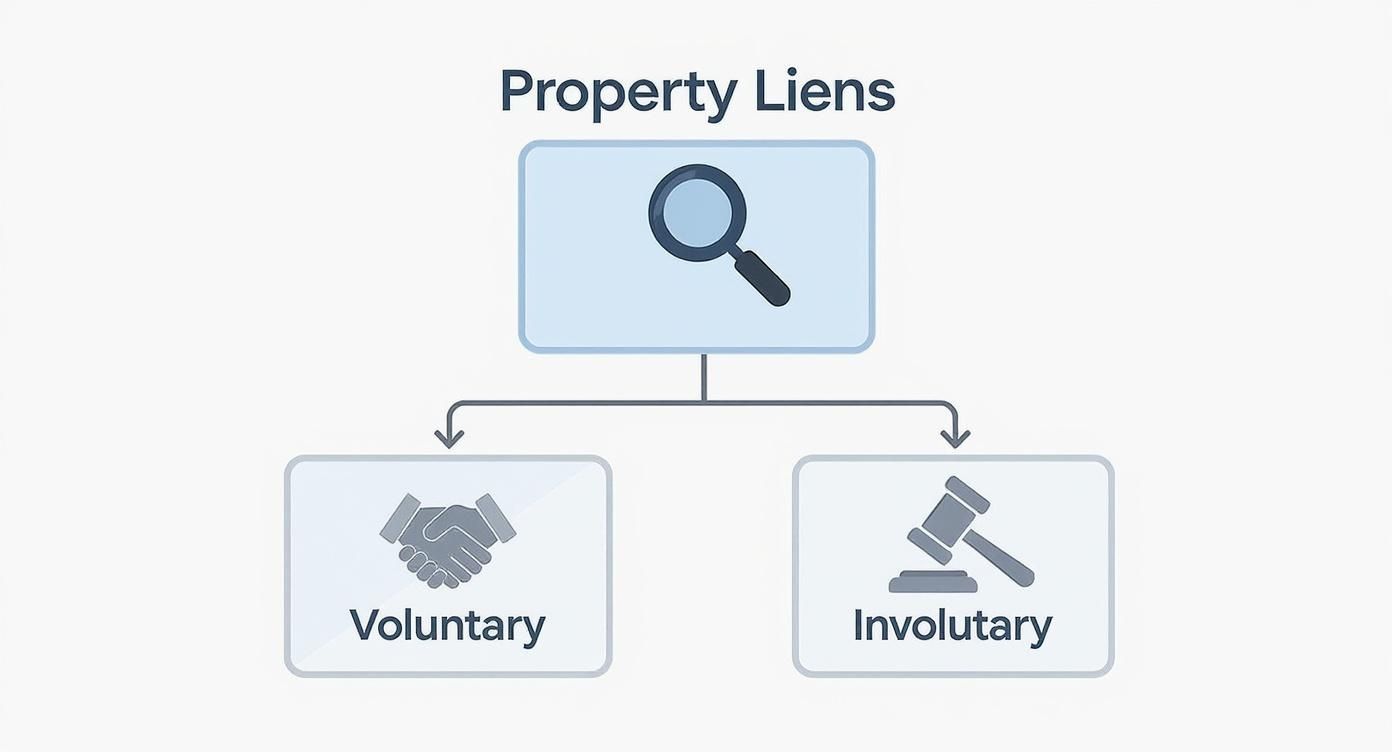
This distinction is crucial because it highlights the two different paths to foreclosure. One starts with a mutual agreement, while the other begins with a legal obligation forced upon the owner.
Judicial vs. Non-Judicial Foreclosure
Once a lis pendens is recorded, the foreclosure process follows one of two tracks, depending on state law and the terms of the original loan agreement.
- Judicial Foreclosure: This route is a formal lawsuit. The lender must go through the court system and obtain a judge's permission to sell the property. It is a longer, more complex process that provides more opportunities for the homeowner to challenge the foreclosure.
- Non-Judicial Foreclosure: In states that permit it, this process occurs outside of the courtroom. If the mortgage contains a "power of sale" clause, the lender can foreclose without a judge's approval, provided they follow strict state-mandated notification procedures. This is a much faster and more direct path.
Knowing which process applies is crucial for predicting timelines and identifying key intervention points. A judicial foreclosure can take months or even years, while a non-judicial action can conclude in just a few weeks.
A title search during a foreclosure must be meticulous. The type of foreclosure determines which public records—from court filings in a judicial case to trustee notices in a non-judicial one—must be examined. Miss a single document, and you could be looking at a clouded title for the next owner.
The Final Steps: Auction and REO
The foreclosure process culminates in a public auction, often called a sheriff's sale. The property is sold to the highest bidder, and the proceeds are used to pay off the foreclosing lienholder and any junior liens in order of priority.
If no one bids high enough to cover the debt, the property becomes Real Estate Owned (REO)—meaning it is now owned by the lender. The lender then takes title and attempts to sell the property on the open market. This transfer is the final step, extinguishing the previous owner's rights and creating a new chain of title.
This entire sequence is becoming more frequent. Last year, the U.S. saw a significant spike in foreclosure activity, with 101,513 properties receiving foreclosure filings in the third quarter alone. That's a 17 percent jump from the prior year, bringing the national rate to one in every 3,997 homes. You can read more about these foreclosure trends to see how economic pressures are impacting homeowners.
For title professionals, tracking a property through these final stages requires constant vigilance. The transition from auction to REO generates new documents that must be found and examined to ensure the final title is clean and marketable. Automating this tracking with a platform like TitleTrackr is essential for any firm handling a high volume of complex files, ensuring no critical detail is missed.
Economic Forces Driving Lien and Foreclosure Trends
Lien and foreclosure rates are a direct reflection of the economy's health. These trends are deeply connected to macroeconomic forces that ultimately impact homeowners. For real estate professionals, understanding this link is crucial for anticipating market shifts and advising clients effectively.
A lien, and especially a foreclosure, is rarely the start of the story. It's the final chapter of a long struggle with financial pressure. Factors like rising interest rates, inflation, and the increasing cost of homeownership create a high-pressure environment for many households. A once-manageable mortgage can quickly become an unsustainable burden.
This pressure is compounded by the soaring costs of maintaining a home, including rising home insurance premiums, utility bills, and property taxes. To put this in perspective, single-family homeowners with a mortgage now pay an average of $2,370 per year for property coverage—a nearly 70 percent increase from just five years ago. You can discover more about the rising costs of homeownership and how they are contributing to default rates.
The Domino Effect of Personal Hardship
While broad economic conditions set the stage, a personal financial shock is often the catalyst for a default. These sudden, life-altering events can disrupt even the most stable household budget, making it impossible to keep up with mortgage payments.
Data shows that around 94 percent of all mortgage defaults occur shortly after a homeowner experiences a significant loss of income. These personal crises are the immediate triggers that push an already-strained family over the edge.
A few common events are responsible for most of these situations:
- Job Loss or Reduced Income: This is the most direct blow, making it a struggle to cover basic needs, let alone a large mortgage payment.
- Major Medical Emergencies: Unexpected medical bills can deplete savings and create overwhelming debt, forcing a difficult choice between health and home.
- Divorce or Separation: The financial disruption of splitting a household often leaves one or both parties unable to manage the original mortgage on their own.
It's a domino effect: a lost job leads to a missed payment, which triggers a default notice. If the situation doesn't improve, the lender files a lien to protect their investment, and the foreclosure clock officially starts ticking.
Understanding the why behind a foreclosure filing is just as critical as knowing the what. Economic and personal pressures are the real story, and monitoring these trends provides crucial context for every title search you conduct.
Anticipating Market Shifts
For title professionals, tracking these economic drivers is a core part of effective risk management. When interest rates rise or unemployment figures increase, it's a signal that lien and foreclosure filings are likely to follow. This foresight allows you to prepare for a heavier workload and better advise your clients on the risks in the current market.
By watching these trends, you can shift from a reactive to a proactive stance. Instead of being caught off guard by a wave of distressed properties, you can see it coming and optimize your workflows accordingly. Staying current on these topics is vital, and you can explore more industry analysis on our dedicated resource blog.
Ultimately, every foreclosure file tells a story of economic pressure. By understanding the forces at play—from national inflation down to a single family's personal crisis—you gain deeper insight into the real risks attached to a property. This knowledge is invaluable for performing robust due diligence and protecting all parties in a transaction.
How to Proactively Manage Title Risk
Anyone who has spent hours digging through county records knows the frustration. The sheer volume of lien and foreclosure data, fragmented across countless jurisdictions, makes manual searches a slow and error-prone process. This fractured system leaves firms exposed to significant risk in a market where accuracy is non-negotiable. The traditional methods simply can't keep pace.
This isn't just an inconvenience—it's an industry-wide problem that demands a modern solution. Instead of drowning in paperwork and navigating dozens of websites, professionals need a way to cut through the noise. A dedicated platform is no longer a luxury; it's essential for transforming a cumbersome process into a streamlined, manageable workflow.
Shifting from Reactive to Proactive
The goal should always be proactive risk management—spotting potential title issues long before they can derail a closing. The fundamental flaw of manual searches is their reactive nature. You only find what you have the time and resources to look for, one county at a time, which inevitably creates dangerous blind spots.
A centralized platform flips that script. It aggregates and standardizes real-time lien and foreclosure data from countless sources into a single, intuitive interface. Suddenly, you've moved from hunting for information to having critical insights delivered to you. It’s the difference between navigating with a paper map and using a GPS with live traffic updates.
Here are the core benefits of adopting a proactive, technology-driven approach:
- Comprehensive Search Capabilities: Instantly scan across multiple counties or an entire state for liens, judgments, and foreclosure filings—all from a single dashboard. This exponentially expands your search scope while dramatically reducing the risk of a missed document.
- Automated Monitoring: Set up alerts on specific properties or parties. The moment a new lien, lis pendens, or other relevant filing is recorded, you receive a notification. This continuous monitoring ensures you're always working with the most current information.
- Time and Resource Savings: By automating the labor-intensive work of data collection, you free up your team to focus on high-value tasks like analysis, problem-solving, and client service. This efficiency boost directly impacts your bottom line.
Gaining Clarity with Centralized Data
The true power of a modern solution lies in bringing order to chaos. Forget wrestling with dozens of county websites, each with its own unique interface and data format. A platform like TitleTrackr provides a single source of truth where data is standardized, making it easy to compare records and identify red flags quickly.
With the right tools, you can move beyond just finding documents. You can begin to analyze trends, assess risk with greater confidence, and provide a higher level of service that sets you apart from the competition.
The view below shows how TitleTrackr organizes complex property data into a dashboard that is clear, comprehensive, and actionable.

This interface gives you a complete overview of a property's history, including every relevant lien and legal action, all in one place. Having this level of detail at your fingertips allows you to make informed decisions faster, mitigating risk and empowering you to close deals with confidence. The challenges of manual searches for lien and foreclosure records are solved by bringing everything together.
TitleTrackr was built by industry experts to solve these exact pain points. Our platform gives you the tools to automate monitoring, run comprehensive searches in seconds, and manage title risk before it becomes a problem. We transform a fragmented, manual process into a streamlined workflow, saving you valuable time and protecting every transaction.
Ready to see how you can transform your workflow and close deals with greater certainty? Request a demo of TitleTrackr today and discover a smarter way to manage title risk.
Frequently Asked Questions About Liens and Foreclosure
Even for seasoned industry professionals, the nuances of liens and foreclosures can be complex. We've compiled straightforward answers to some of the most common questions to provide clarity on how these processes work and what they mean for a property's title.
Think of this as a quick reference guide to cut through the legal jargon and reinforce the core concepts that drive your daily work.
What Is the Difference Between a Lien and a Foreclosure?
The simplest way to think about it is that a lien is the claim against a property, while a foreclosure is the action taken to enforce that claim.
A lien acts as a legal encumbrance on a property's title, serving as public notice that a creditor is owed money. Foreclosure is the legal process of enforcing that claim by forcing a sale of the property to satisfy the debt. One is the claim; the other is the consequence.
Can Any Lien Lead to a Foreclosure?
In theory, yes. Any valid lien—whether it's from a mortgage, unpaid taxes, a contractor's work, or a court judgment—gives the creditor the legal right to initiate foreclosure proceedings if the debt remains unpaid.
However, in practice, the decision to foreclose often depends on the debt's size and the lien's priority. A primary mortgage lender will almost certainly foreclose following a default. Conversely, a creditor with a small judgment lien may decide the cost and complexity of foreclosure aren't worthwhile, choosing instead to wait until the property is sold or refinanced to collect their debt.
What Does "Lien Priority" Mean and Why Is It Important?
Lien priority establishes the "pecking order" for payment when a property is sold at a foreclosure auction. Generally, priority is determined by the "first in time, first in right" principle—the first lien recorded in public records gets paid first from the sale proceeds.
However, critical exceptions exist. For instance, property tax liens often have "super-priority," allowing them to jump to the front of the line, even ahead of a primary mortgage. Correctly determining lien priority is absolutely essential, as a foreclosure by a senior lienholder can extinguish all junior liens below it.
This hierarchy isn't just a technicality; it's a fundamental risk factor in any real estate deal. A simple miscalculation of who's first in line can lead to devastating financial losses for lenders and investors.
How Does a Lien Affect a Property's Title?
A lien creates a "cloud" on the title, meaning the title is not clear. This cloud acts as a major red flag for potential buyers and lenders, signaling an unresolved claim that must be addressed. A clouded title makes it nearly impossible to sell or refinance a property, as no one wants to take on another party's debt.
Before a transaction can close, all liens must be paid and officially released. A release is a formal document, recorded in the public records, that confirms the debt has been satisfied and removes the cloud from the title. If you're looking for more details on this, you can find answers to other common title questions on our dedicated page.
Can You Sell a House That Is in Foreclosure?
Yes, it is possible, but time is of the essence. This typically occurs during the "pre-foreclosure" stage—the period after a default notice has been issued but before the property is sold at auction. The owner can sell the property, provided the sale price is sufficient to cover the entire mortgage debt and any other outstanding liens.
If the sale price is not enough to cover the debts, it becomes a "short sale," which requires the lender's explicit approval. This process allows the homeowner to avoid the severe credit impact of a completed foreclosure, while the lender can mitigate losses without the expense of the auction and REO process.
The complexities of lien and foreclosure research demand a level of accuracy and speed that manual methods can no longer provide. TitleTrackr delivers a powerful, all-in-one platform to automate your searches, monitor properties in real-time, and eliminate the risk of missing a critical claim. It's time to stop chasing down documents and start closing deals with confidence.
 blog.titletrackr.com
Leave a comment