

A partial release of lien is a critical legal document that frees a specific portion of a property from a lien's claim, while the lien remains in effect on the rest of the property. For professionals managing complex real estate transactions, mastering this instrument isn't just helpful—it's essential for keeping projects solvent and on schedule.
Think of a blanket mortgage on a development project. The partial release is the tool that allows the developer to sell the first completed home with a clear title, even though the larger loan is still active. This powerful document is the key to unlocking property value in stages.
Unlocking Property Value One Piece at a Time

Consider a common scenario: a developer secures a blanket mortgage—a type of lien—to finance the construction of a 100-acre housing subdivision. Without a partial release mechanism, that entire 100-acre parcel is locked down as collateral. This makes it impossible to sell individual lots to homebuyers with a clear title, as every sale would be encumbered by the developer's master loan. This is a project-killing bottleneck.
This is where the partial release of lien provides the solution. It allows the developer to strategically "release" Lot 1 from the original mortgage, sell it, and deliver a clean, unencumbered title to the new homeowner. Meanwhile, the lender’s mortgage lien remains securely attached to the other 99 acres.
Why This Distinction Matters
For any professional in the title or real estate industry, understanding the difference between a partial and a full release is fundamental. A full release extinguishes the entire lien after the debt is fully satisfied. A partial release, however, offers surgical precision. It's a cornerstone of large-scale projects involving phased development where ownership must be cleared incrementally. For a deeper analysis, you can find more insights on navigating compliant mortgage lien releases on wolterskluwer.com.
This mechanism is the financial engine that powers modern development, maintaining cash flow and project momentum. It creates a win-win scenario, offering critical flexibility for:
- Developers: They can sell off completed units to generate revenue for ongoing construction, preventing capital shortfalls.
- Property Owners: It allows them to sell a portion of their land without the immense pressure of paying off their entire mortgage first.
- Lenders: They can manage risk by ensuring sufficient collateral remains, while enabling borrowers to make sales and progress toward loan repayment.
A partial release of lien isn’t just paperwork; it’s a strategic key that unlocks complex real estate deals. It creates liquidity and flexibility, preventing a single large loan from bringing an entire multi-stage project to a grinding halt.
By isolating specific parcels for sale or refinancing, this process ensures every transaction can move forward with a clear and marketable title. It's a foundational concept that keeps both residential and commercial real estate markets running smoothly, sidestepping the legal headaches that could otherwise derail a project entirely.
Partial vs Full Lien Release at a Glance
To put it simply, the main difference comes down to scope—are you clearing a piece of the property or the whole thing? Here’s a quick breakdown.
| Feature | Partial Release of Lien | Full Release of Lien |
|---|---|---|
| Scope | Releases a specific, defined portion of the property. | Releases the entire property from the lien. |
| Lien Status | The original lien remains active on the rest of the property. | The entire lien is extinguished and no longer valid. |
| When It's Used | Phased developments, selling off parcels of land. | The underlying debt has been completely paid off. |
| Outcome | Allows the released portion to be sold with a clear title. | The property owner has a fully clear title. |
This table highlights how each tool is used for a very different purpose. One offers targeted flexibility during a project, while the other marks the successful conclusion of a debt.
When a Partial Release Is Your Best Move

In theory, a partial release of lien is a simple legal tool. In practice, it's a high-stakes maneuver that keeps projects solvent and cash flowing. These aren’t just abstract legal exercises; they are driven by the urgent needs of developers and property owners. In many situations, a partial release isn't just helpful—it's the only viable path forward.
Let's examine a classic example: a developer is building a 50-home subdivision, financed by a major construction loan. That loan is secured by a blanket lien covering the entire property. Now, the first five homes are complete and ready for sale, but a critical problem emerges.
The blanket lien is still attached to the entire tract, including those five finished homes. No buyer can secure a clear title, and the developer can't access the sales proceeds needed to fund the next construction phase. Here, the partial release becomes the hero. The developer must negotiate with the lender to release just those first five lots from the loan, allowing the sales to close and injecting vital capital back into the project.
Fueling Growth and Managing Risk
This process is a delicate balance of competing interests. The developer is laser-focused on maintaining momentum and project solvency. For them, a partial release is the engine that converts finished assets back into working capital.
For the lender, it’s all about risk management. Agreeing to release a portion of their collateral isn't a favor—it's a calculated business decision. The lender will almost always require an appraisal to ensure the remaining collateral—the other 45 undeveloped lots—is still valuable enough to secure the outstanding loan. This structured process is designed to protect all parties. To see how this benefits everyone involved, you can check out specialized resources for real estate developers managing complex titles.
More Than Just Subdivisions
This powerful tool isn't limited to large housing developments. Imagine a property owner with a mixed-use building—a profitable commercial storefront on the ground floor and residential apartments above, all under a single mortgage.
What if they want to refinance the loan on just the commercial space to fund renovations? A partial release is the key. It allows them to carve out the commercial portion from the residential units, secure a new loan against it, and leave the original mortgage on the apartments untouched.
A partial release of lien acts as a financial scalpel, allowing property owners and developers to precisely carve out value from a larger asset. It separates the interests of the owner, the lender, and the buyer, ensuring each party can achieve their goals without jeopardizing the entire project.
Ultimately, the partial release of lien is an indispensable tool for any dynamic real estate project. It transforms a static, locked-up property into a flexible asset, enabling phased sales, strategic refinancing, and sustainable development.
Navigating the Legal Maze of a Partial Release
Executing a partial release of lien is far more than a simple handshake agreement. It's a formal legal process where every detail carries significant weight. A successful outcome depends on a thorough understanding of the critical legal requirements—because a minor error can quickly snowball into a major title defect.
The entire process lives and dies by the accuracy of its documentation. This isn't just about filling out a form; it's about ensuring every piece of information is flawless and compliant with local recording statutes. A single mistake can bring the entire transaction to a screeching halt.
The Devil Is in the Details
The absolute cornerstone of any partial release document is the legal description of the specific parcel being freed from the lien. This description must be meticulously accurate, matching official records precisely, down to the last survey marker. There is zero room for ambiguity.
A vague or incorrect legal description is one of the fastest ways to get a partial release rejected by the county recorder's office. This error creates a "cloud on title," a defect that can haunt a property for years and kill future sales or financing deals until it's corrected through costly legal action.
This level of precision is non-negotiable because the document is fundamentally altering property rights. It must clearly define what is being released while also confirming that the lien remains firmly in place on all other parts of the property.
State and County Rules Reign Supreme
To complicate matters further, the rules for a partial release of lien can vary significantly from one state—or even one county—to the next. In the US, over 40 states have detailed statutes that regulate mechanic's liens, which often dictates how releases are handled. These local nuances can easily trip up even seasoned professionals who attempt a one-size-fits-all approach. For those interested, you can discover more insights about mechanic's lien regulations on Wikipedia.
Common jurisdictional requirements include:
- Proper Signatures: The document must be executed by a legally authorized representative of the lienholder. No exceptions.
- Notarization: Most jurisdictions require signatures to be notarized to be considered valid for recording.
- Recording Information: It must reference the original lien's recording details (e.g., book and page number) to properly link the release to the correct document in the public record.
Failing to meet these local standards can result in rejected filings, forcing a complete restart of the process and causing serious project delays. For professionals managing these workflows, mastering the specific requirements of each jurisdiction is vital. Our team at TitleTrackr has found that providing tools and support for title abstractors is crucial for streamlining this complex verification process.
The risks of getting it wrong are severe. An improperly executed partial release can jeopardize the entire project, leading to financial losses and legal battles that could have been easily avoided with rigorous attention to the legal framework from the start.
Your Step-by-Step Path to Securing a Partial Release
Obtaining a partial release of lien can feel daunting, but it becomes manageable when broken down into a clear, actionable roadmap. A structured approach is key to ensuring every detail is handled correctly, helping you avoid costly delays and title defects. The journey always begins with a crucial conversation and ends with a legally sound, recorded document.
The first and most important step is to initiate negotiations with the lienholder. In most cases, this is the lender holding the blanket mortgage. Before investing in surveys or appraisals, have a direct discussion to confirm their willingness to grant a partial release and to understand their specific requirements.
Preparing the Essential Paperwork
Once you have the lender’s preliminary approval, it's time to assemble the necessary documentation. This stage demands precision—a single omission can halt the entire process.
Your focus should be on perfecting these key documents:
- The Draft Release Document: This is the formal legal instrument that will be signed and recorded. It must identify all parties, reference the original lien, and clearly state the intent to release a specific portion of the property from that lien.
- An Accurate Legal Description: You will need a precise, survey-grade legal description of the exact parcel to be released. Vague descriptions are unacceptable and will lead to rejection.
- A Property Survey or Plat Map: Most lienholders require a visual aid. A survey or plat map that clearly delineates the portion being released helps them assess the impact on their remaining collateral.
Navigating Review and Final Filing
After assembling the initial paperwork, the process moves into the review and execution phase. The lienholder will conduct a thorough review, almost always requiring an appraisal to confirm that the value of the remaining property is sufficient to secure their outstanding loan. This is a critical risk-management checkpoint for them.
This infographic breaks down the core workflow for finalizing a partial lien release.
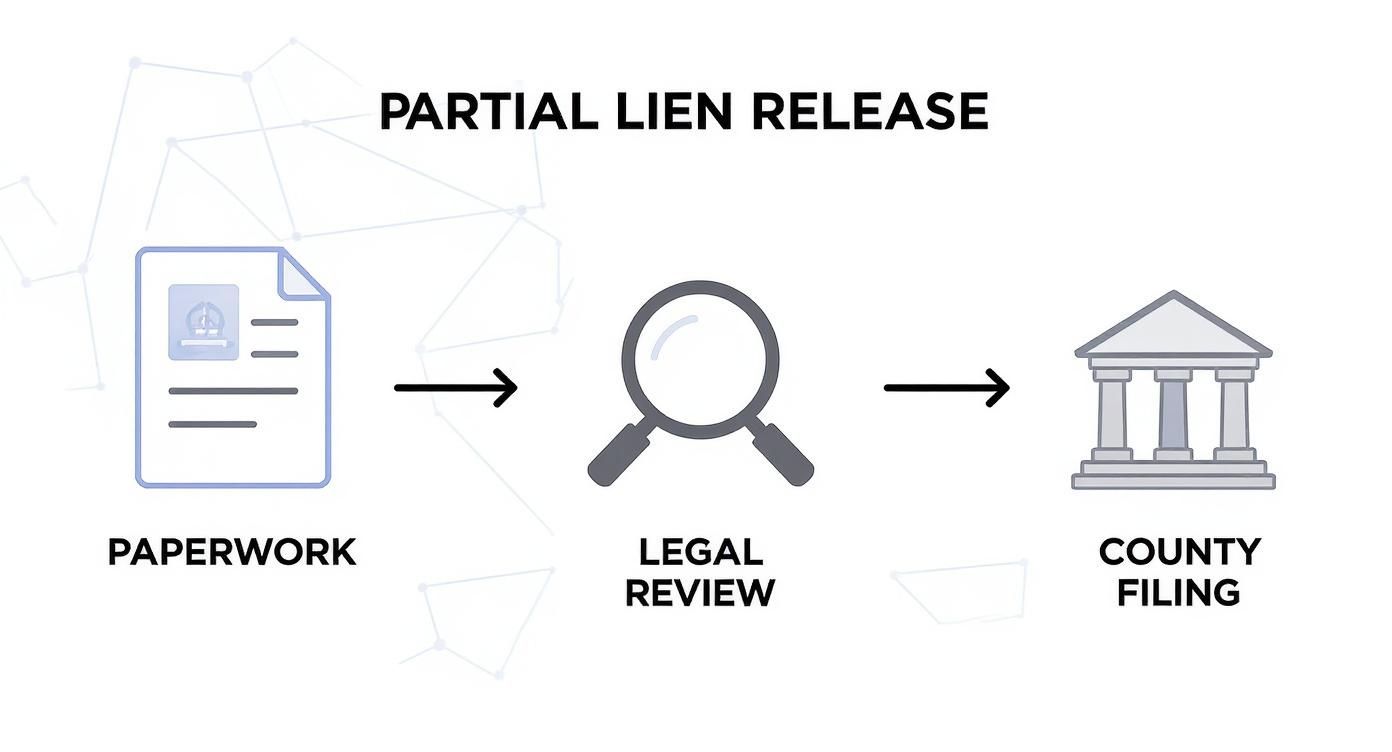
As you can see, the process flows logically from internal preparation to external legal validation and, finally, to official recording. Each step builds upon the last.
Once the lienholder grants final approval and executes the document, it must be filed with the county clerk or recorder’s office. This is the final and most critical step. It makes the release an official part of the public record, formally clearing the title for that specific parcel.
This level of procedural diligence isn't just for private deals. Even federal agencies demand meticulous management. For instance, the IRS has its own strict protocols for partial releases of federal tax liens, requiring manual determinations and extensive documentation. You can read more about the IRS guidelines for lien administration to get a sense of the complexity. A misstep in this final filing stage can render all previous work useless, leaving a stubborn cloud on the very title you worked to clear.
Costly Mistakes to Avoid in the Lien Release Process
In the high-stakes world of real estate transactions, a single error in a partial release of lien can trigger a cascade of costly problems. What should be a straightforward process can quickly devolve into a legal and financial nightmare. Getting this right demands precision, as even a minor oversight can stall projects, inflate budgets, and create title defects that can plague a property for years.
Identifying common pitfalls is the first step toward avoiding them.
Inaccurate Legal Descriptions
One of the most frequent—and damaging—mistakes is an inaccurate legal description of the property being released. If the description is vague, contains a typo, or fails to match official records perfectly, the entire document could be rendered invalid. This often creates a "cloud on the title," an ambiguity that can stop a sale or refinance dead in its tracks until it's rectified with expensive legal filings.
Overlooking Stakeholder Communication
Another critical oversight is failing to maintain clear communication with all stakeholders. It’s not enough to simply obtain the lienholder’s signature. Subcontractors, junior lienholders, and property buyers must be kept informed. Failing to provide copies of the filed release can lead to parties acting on outdated information, sparking unnecessary legal disputes or project delays.
A partial release of lien isn't just a private deal between an owner and one lienholder. It’s a public record that changes the rights of multiple parties. Poor communication breeds uncertainty and invites future claims.
Similarly, missing a filing deadline or submitting documents to the wrong county office can be disastrous. A lien release only becomes legally effective once it's recorded. A delay means the lien remains on the property in the public record, jeopardizing closing dates and eroding trust among all parties.
Ignoring Local Filing Requirements
Finally, many professionals are tripped up by treating all filings as identical. Every county clerk’s office has its own unique rules for formatting, notarization, and recording fees. Submitting a document that doesn't meet these specific local standards will result in an outright rejection, forcing you to restart the process and causing frustrating, avoidable delays. A successful partial release of lien is a matter of precision, from the first draft to the final recording stamp.
To help you sidestep these issues, we've put together a quick-glance table of common mistakes and how to prevent them. Think of it as a pre-flight checklist before you file.
Avoiding Common Partial Release Errors
| Common Mistake | Potential Consequence | Preventative Solution |
|---|---|---|
| Incorrect Legal Description | Invalidates the release, creates a cloud on the title, and halts transactions. | Double-check the legal description against the most recent deed and official county records. Use a title professional to verify. |
| Failure to Notify Stakeholders | Causes confusion, disputes, and potential legal action from uninformed parties. | Create a communication checklist. Distribute copies of the filed release to all lienholders, subcontractors, and relevant parties. |
| Missing Filing Deadlines | The lien remains legally active, jeopardizing sales, refinancings, and project timelines. | Mark your calendar with statutory deadlines. File the document immediately after it's executed and notarized. |
| Ignoring County-Specific Rules | The document is rejected by the clerk, forcing you to restart the entire process. | Check the county recorder’s website or call their office directly to confirm formatting, fee, and submission requirements before you file. |
Ultimately, treating each partial release with diligence and a healthy dose of paranoia is the best way to protect your clients and your reputation. A few extra minutes of verification upfront can save months of trouble on the back end.
How Modern Tech Ends Lien Release Headaches

Managing partial lien releases through traditional methods is a recipe for disaster. The process often devolves into a chaotic mix of spreadsheets, scattered paper files, and an endless chain of follow-up emails. This isn't just inefficient—it’s a breeding ground for the kind of expensive mistakes that can derail a project.
A missed deadline, a single typo in a legal description, or a lapse in communication can bring a multi-million dollar transaction to a grinding halt. When your team is juggling different versions of a spreadsheet or a stack of physical documents, it’s not a matter of if a critical detail will fall through the cracks, but when. The manual approach simply cannot keep up with the demands of modern real estate.
A Smarter Way to Manage Lien Releases
Now, imagine a centralized, automated reality. A single platform where every document is securely stored, every deadline is tracked automatically, and critical data is validated for accuracy the moment it's entered. This is precisely what modern title technology delivers.
Instead of wrestling with a dozen disconnected tools, professionals can leverage a single, dedicated platform to oversee the entire lien release lifecycle from initiation to final recording.
This solves all the classic problems in one elegant solution:
- Automated Tracking: The system monitors every deadline and sends proactive reminders, virtually eliminating the risk of missing a crucial filing date.
- Centralized Documents: All stakeholders—from your internal team to outside counsel—can access the latest version of surveys, release forms, and project communications in a secure, shared workspace.
- Flawless Data Validation: Intelligent tools can instantly cross-reference legal descriptions and other key data points, catching potential errors long before they can become a title defect.
Adopting the right technology is no longer a luxury; it’s a strategic necessity for eliminating human error and ensuring compliance in every partial release of lien. A dedicated platform transforms a high-risk, manual process into a controlled, predictable workflow.
For title professionals ready to move beyond manual chaos, platforms like TitleTrackr were engineered to solve these exact challenges. They provide the structure and automation needed to manage even the most complex title work with complete confidence and control.
If you are ready to see how these tools can revolutionize your daily operations, you can explore a free trial of TitleTrackr and experience the future of title management for yourself.
Still Have Questions? Let’s Clear Things Up.
Even for seasoned professionals, the nuances of a partial release of lien can raise complex questions. Getting the answers wrong can halt a transaction in its tracks, so let's clarify a few of the most common points of confusion.
Partial Release vs. Subordination Agreement
These two instruments are frequently confused, but they serve entirely different functions.
A partial release of lien permanently removes the lien's claim from a specific, defined piece of property. Once released, that parcel is free and clear of that particular debt. It is a surgical removal of the lien from a portion of the collateral.
A subordination agreement, in contrast, does not remove the lien from any part of the property. It simply alters lien priority, allowing another lender to "cut in line." The original lien remains attached to the entire property but agrees to take a lower-priority position for repayment.
Timelines and Lien Types
How long does a partial release take? The timeline can vary dramatically. With a cooperative and efficient lienholder, it might be completed in a few business days. However, if the lienholder is disorganized or the local recording office has a backlog, the process could extend to several weeks.
Can you obtain a partial release for any type of lien? It is most common with mortgages and mechanic's liens, where a portion of a project is being sold. It is sometimes possible for judgment or tax liens, but the process is often far more complex, as government agencies typically have more bureaucratic hurdles to navigate.
A critical mistake in a partial release filing can instantly cloud a property's title. This can halt sales or financing in its tracks, forcing you to file corrective documents and causing significant delays and added costs. Precision is non-negotiable.
Juggling the intricate details of lien releases shouldn't be a manual, high-stakes guessing game. With TitleTrackr, you can automate your tracking, keep all your documents in one place, and ensure every release is handled with precision. See how our AI-driven platform can bring clarity and control to your workflow. Request a demo with TitleTrackr and see the difference for yourself.
 blog.titletrackr.com
Leave a comment