

Discovering a lien on a property is a critical moment. For industry professionals, the immediate priority is clear: get it removed efficiently to keep the transaction on track. The process involves three primary paths: pay the debt in full, negotiate a settlement, or, if the lien is invalid, dispute it legally.
Once the underlying debt is resolved, the creditor must provide a formal "lien release." This document is the key. It must be filed with the local county recorder's office to officially clear the lien from the property's title. This final step is non-negotiable—it's what makes the property marketable and ready for closing.
What a Lien on Your Property Actually Means
Before diving into removal strategies, let's clarify what a lien represents. A property lien is a legal claim a creditor places on real estate to secure an unpaid debt.
Think of it as a legal encumbrance on the property’s title. It’s a public notice to potential buyers, lenders, and title professionals that a third party has a financial interest in the asset. This "cloud" on the title can halt a sale or refinance dead in its tracks. No underwriter will approve a loan for a property with outstanding claims, and a buyer expects—and deserves—a clean title.
The Most Common Types of Liens
Liens vary by origin, and identifying the specific type is the first step toward an effective resolution strategy.
- Mortgage Liens: The most common voluntary lien, created when a property owner takes out a home loan. The lender holds this lien until the mortgage is paid in full.
- Tax Liens: Filed by government entities for unpaid property, state, or federal income taxes. These are high-priority liens that can supersede other claims.
- Mechanic's Liens: Also known as construction liens, these are filed by contractors, subcontractors, or suppliers who have not been paid for labor or materials provided to the property.
- Judgment Liens: Arise from lawsuits. If a property owner loses a court case and fails to pay the awarded amount, the winning party can file a lien to secure the debt against the real estate.
Why Liens Are So Powerful
Liens have been a cornerstone of lending for centuries, serving as collateral for creditors. They legally restrict a property owner's rights until a debt is satisfied. The global prevalence of mortgage loans, which represent 40% to 90% of total lending in major economies, underscores how foundational liens are to real estate finance. You can explore this further in reports from the Bank for International Settlements on property as collateral.
A lien isn't just a piece of paper; it’s a powerful legal tool with real teeth. In the worst-case scenario, a lienholder can actually force the sale of your property through foreclosure to collect what they're owed.
Uncovering a lien is a roadblock, but it doesn't have to derail a transaction. It's a problem that demands a clear-headed strategy and prompt, decisive action.
Uncovering Every Lien Attached to Your Title
You can't resolve a lien you don't know exists. Before negotiating or taking legal action, a meticulous title search is required to uncover every claim against the property. This discovery phase isn't just a preliminary step—it's the foundation of your entire resolution workflow.
A rushed or incomplete search is a recipe for disaster. We've all seen it happen: a deal is days from closing, only for a last-minute municipal lien to surface and jeopardize the entire transaction. These surprises are costly, frustrating, and entirely preventable with the right process.
The Old Way vs. The Smart Way
For decades, lien discovery meant dispatching an abstractor to the county courthouse to manually sift through public records. While traditional, this method is fraught with inefficiencies and risk.
- It’s Slow: A manual search can take days, even weeks, depending on the property's history and the state of the county's records. In a time-sensitive transaction, these delays are unacceptable.
- It’s Risky: Manual review is prone to human error. A single overlooked document can leave a lien undiscovered, exposing your clients and your business to significant financial liability.
- It’s Expensive: A professional title search can cost anywhere from $200 to $750. For professionals managing multiple properties, these costs erode margins quickly.
The smarter, modern approach is to leverage technology that automates the search process. Advanced platforms can scan massive public record databases in minutes, identifying every potential issue with a level of accuracy that manual methods can't match.
The Power of an Automated Search
This is precisely where a platform like TitleTrackr provides a competitive edge. Our automated search engine is engineered to find everything—mortgages, judgments, mechanic's liens—with unparalleled speed and accuracy. Instead of waiting on a manual report, you get a comprehensive title picture almost instantly. This allows your team to shift from a reactive to a proactive stance, addressing issues before they become crises.
A comprehensive, tech-driven search isn't just a nice-to-have; it's a fundamental requirement for any professional serious about clearing titles efficiently. It transforms a stressful, manual process into a proactive, manageable workflow.
The need for a thorough search is a global standard. While legal specifics vary by jurisdiction, the core principle is universal. Lien searches in the U.S. and other developed markets must verify unpaid taxes, mortgages, and judgments that can legally cloud a title. For a deeper dive, you can explore the basics of international lien searches on CogencyGlobal.com.
Ultimately, the quality of your title search dictates the success of everything that follows. A flawed search leads to flawed strategies and costly surprises. For professionals aiming to operate more efficiently, understanding the role of technology for title abstractors is key to minimizing risk and staying ahead. With the right technology, no lien is left unturned.
Your Playbook for Resolving the Underlying Debt
Once you have a complete list of every lien attached to a property, it's time to shift from discovery to action. This is where your team engages directly with creditors to clear the path toward a clean title.
There are three primary resolution strategies. The best approach depends on the lien type, its validity, and the financial circumstances of the transaction.
The most direct path is to pay the debt in full. For smaller, undisputed debts, this is often the fastest way to secure a lien release and proceed to closing. However, this isn't always feasible or the most financially sound move.
This decision tree shows the initial paths you can take to identify and begin resolving property liens, whether you decide to tackle it yourself or bring in a professional.
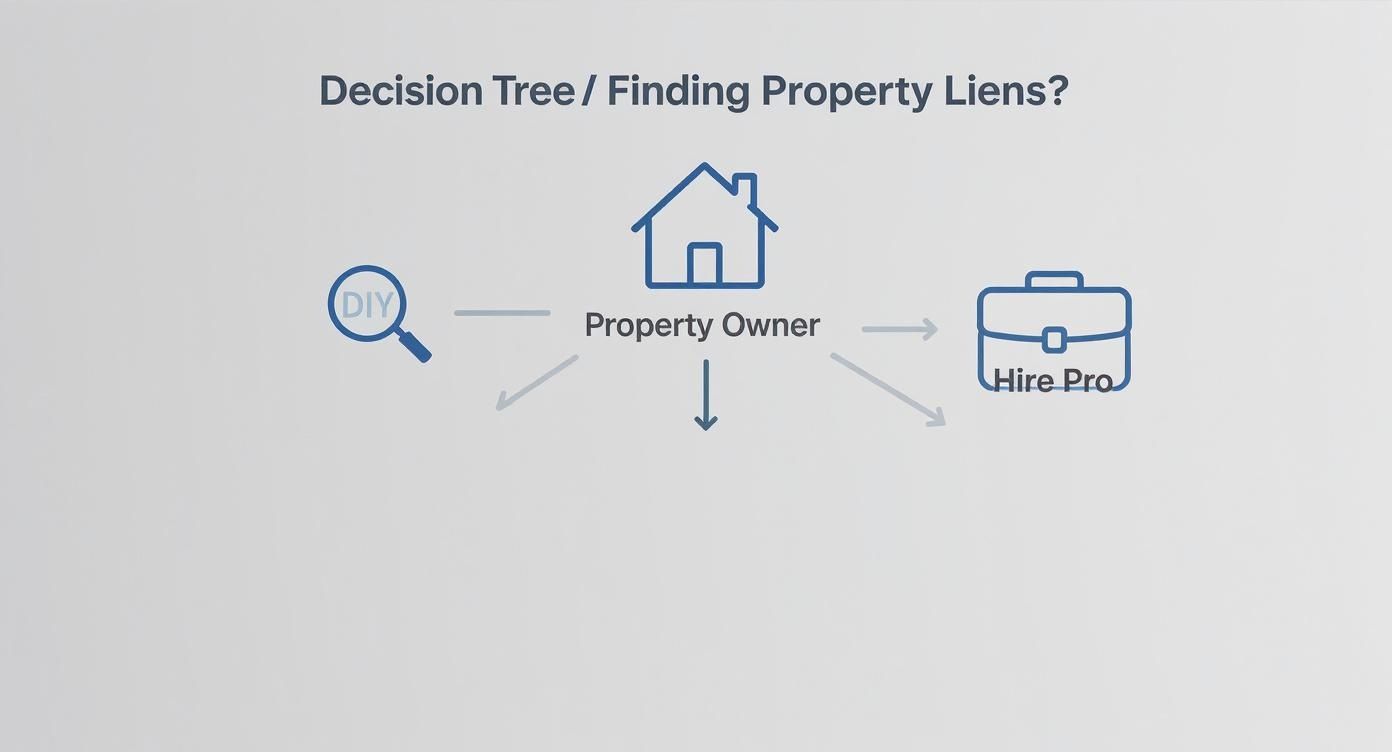
No matter which discovery path you take, the goal is the same: gather all the necessary information so you can choose your resolution strategy effectively.
Negotiating a Settlement
When a full payoff is off the table, negotiation becomes a powerful tool. Many creditors, particularly those holding judgment liens, would rather receive a guaranteed partial payment now than engage in a lengthy and uncertain collection process. Success hinges on solid preparation and a clear, compelling offer.
Start by gathering all relevant financial documents. This may include bank statements, profit and loss statements, or a summary of other outstanding debts related to the property or owner. The goal is to present a realistic picture of what can be paid. A well-supported argument demonstrating that a reduced lump-sum payment is the best outcome for all parties can be highly effective.
"Negotiation is always an option and may likely be the best option," explains attorney Dan Mantzaris. He notes that a qualified attorney can often work to "reduce the amount to be paid to satisfy the lien."
Consider this real-world scenario: a property owner was encumbered with a $15,000 judgment lien from an old business debt, blocking a critical refinance. By presenting the creditor with evidence of limited cash flow, they successfully negotiated a settlement for $9,000—a 40% reduction. The creditor agreed because immediate cash-in-hand was more valuable than the possibility of a larger, future collection.
Disputing an Invalid Lien
What if the lien shouldn't exist in the first place? Clerical errors, mistaken identity, or even fraudulent filings can result in an invalid lien. If you have evidence that the lien is invalid—such as proof of prior payment or a breach of contract—you have a clear path to challenge it.
The first step is to contact the lienholder in writing. Present your evidence and formally request that they file a voluntary release. If they refuse, legal action may be necessary. This typically involves one of two routes:
- Filing a Notice of Contest: In some jurisdictions, this legal notice forces the lienholder to initiate enforcement action within a specific timeframe (often 60 days). If they fail to act, the lien is automatically extinguished.
- A Lawsuit to Vacate: A more formal court action where you petition a judge to declare the lien invalid and order its permanent removal from property records.
Challenging a lien is a complex legal process that usually requires the expertise of a real estate attorney to ensure all procedures are followed correctly and to protect your client's rights.
Getting the Lien Legally Wiped From Your Record

Resolving the underlying debt is a major milestone, but it's not the final step. This is a critical point where deals can falter: the lien does not automatically disappear. You must take the final, non-negotiable step of getting it legally and permanently removed from public records.
It is a significant professional misstep to assume the creditor will handle the final recording. While they are legally obligated to provide a release document upon payment, the responsibility for getting that document officially recorded often falls to the property owner or their representatives. Failure to do so means the lien will continue to cloud the property's title.
H3: First, Secure the "Lien Release" Document
Once the debt is satisfied—either through full payment or a negotiated settlement—the lienholder must issue a formal document that officially cancels their claim.
Depending on the jurisdiction and lien type, this document may be called:
- Lien Release: The most common term.
- Satisfaction of Mortgage: Used specifically when a mortgage lien is paid off.
- Certificate of Release: Typically used for federal tax liens settled with the IRS.
Regardless of its name, this document is the official proof that the debt is resolved. The matter is not closed until this signed and notarized document is secured.
H3: The Final Mile: Filing With the County
With the signed release in hand, the final step is to file it with the same government office where the original lien was recorded—typically the county recorder or clerk of court. This action officially updates the public land records and clears the title.
Paying off the debt is just the first part of the process. The lienholder must provide a release or satisfaction document, which you then need to file with the proper government authority, like a county recorder. This is the only way to officially remove the lien from your property's title. The lien will continue to be a problem until that release is officially on the books, so don't delay. You can find more detail about the formal lien removal process on LexisNexis.com.
Never take a creditor's word that they "took care of it." Always follow up with the county recorder’s office to verify the recording. Obtain a copy of the recorded release for your files as ultimate proof that the title is clear.
For real estate professionals managing multiple properties and lien releases, this final step can become a logistical bottleneck. A centralized system is invaluable. A platform like TitleTrackr helps you manage the entire workflow, from initial title search to confirming the final release has been recorded. It ensures no critical step is missed, allowing your team to close the file on one deal and move to the next with complete confidence.
Key Documents in the Lien Removal Process
After navigating negotiation and payment, several key documents are required to achieve a clear title. Understanding their purpose and who is responsible for each is crucial for a smooth workflow.
The table below breaks down the essential documents.
| Document Name | Purpose | Who Provides It? | Where to File It |
|---|---|---|---|
| Lien Release | Officially cancels the lien, stating the debt has been paid or settled. | The lienholder (creditor) | County Recorder's Office |
| Satisfaction of Mortgage | A specific type of release for when a mortgage loan is paid in full. | The lender (mortgagee) | County Recorder's Office |
| Certificate of Release | The official document used by the IRS to release a federal tax lien. | The Internal Revenue Service (IRS) | County Recorder's Office |
| Recorded Release Copy | Your official proof that the release has been filed and is public record. | The County Recorder's Office | Your personal records |
Treat this as your checklist. Securing the signed release is not enough; obtaining the recorded copy is the final confirmation that the title is truly clear.
Modernizing Lien Resolution With Technology
Let’s be honest, the traditional lien resolution process is broken. It’s a fragmented workflow of manual record searches, endless paperwork, and the constant risk of human error. A single missed deadline or overlooked claim can derail a transaction, leading to financial losses and reputational damage.
This operational friction is more than just an inconvenience; it's a significant business risk. When your team is waiting for confirmation that a lien release has been recorded, a cloud of uncertainty hangs over the title. This ambiguity grinds transactions to a halt, delaying closings and frustrating clients.
Moving Beyond Simple Searches
The solution isn't just about finding liens faster—it's about managing the entire resolution lifecycle from discovery to closure. Your firm needs to transition from a disjointed, manual process to a unified, transparent workflow where every step is tracked and verified.
Imagine an active management system instead of a static report. Picture being able to monitor the status of creditor negotiations, receive automated follow-up reminders, and get an instant alert the moment a lien release is officially filed. This level of oversight isn't just an improvement; it's a fundamental shift in how you manage title curative work.
Peace of mind in real estate comes from certainty. Technology provides that certainty by replacing manual guesswork with automated verification, ensuring every lien is not just settled but officially cleared from the record.
A Unified Platform for Lien Management
This is exactly why we built TitleTrackr. Our platform is designed to do more than just uncover every lien on a property with pinpoint accuracy. It provides a comprehensive suite of tools to manage the entire resolution lifecycle in one central hub. You can track communications, monitor negotiation progress, and—most importantly—receive definitive confirmation that the release has been recorded. The loop is officially closed.
For real estate professionals, this delivers more than just time savings. It mitigates risk, accelerates closing timelines, and enables you to provide the seamless, efficient experience your clients demand. Developers looking to build custom solutions can leverage our powerful tools via the TitleTrackr developers portal to integrate our technology into existing systems.
Stop letting outdated processes create bottlenecks and risk. Bring clarity, control, and confidence to your lien resolution workflow. Request a demo with TitleTrackr today and discover what it means to secure a clean title, every single time.
Common Questions About Removing Property Liens
When you're trying to figure out how to get a lien off a property, a ton of questions always come up. It's a process that can feel incredibly tangled, but getting straight answers to the most common sticking points gives you the confidence to move forward.
Let's break down some of the questions we hear all the time.
How Long Does a Lien Stay on Your Property?
This is a big one, and the answer is: it depends. The lifespan of a lien varies wildly based on what kind it is and the laws in your state.
A judgment lien, for example, usually hangs around for 7-10 years. The catch is that the creditor can often renew it, kicking the can down the road and keeping their claim on your property alive. On the other hand, a mechanic's lien is a much shorter-term problem. It might expire in as little as a year if the contractor doesn't follow up with a lawsuit.
Mortgage liens are the most straightforward—they stick around until you pay off the loan. Tax liens? Those can be notoriously persistent. It's absolutely critical to check your local state statutes to know exactly what rules you're playing by.
Can I Sell a House With a Lien on It?
Yes, but with one non-negotiable condition: the lien must be paid off before or at the time of closing so that clear title can be transferred to the new owner. In nearly every transaction, proceeds from the sale are used to satisfy the lien at the settlement table.
The settlement agent or closing attorney orchestrates this. They pay the lienholder directly from the sale proceeds, and the amount is deducted from the seller's net proceeds. This is standard industry practice to ensure the buyer receives a clean, unencumbered title. If the sale price is insufficient to cover the lien, the transaction becomes a "short sale," which requires the lienholder's explicit approval to proceed.
A lien doesn't have to be a deal-killer, but it definitely adds a layer of complexity to closing. The secret is to tackle it head-on with your settlement agent to keep the transaction smooth for everyone.
What if a Lien Is Invalid or Fraudulent?
Discovering an invalid lien on a property requires immediate action. If you have clear evidence that a lien has expired, is fraudulent, or was filed in error, the first step is to contact the lienholder and formally request a voluntary release.
If the lienholder is unresponsive or uncooperative, legal action is the next step. This often involves filing a "quiet title" lawsuit, where you petition a court to issue a judgment officially declaring the lien invalid. A court order will compel its removal from the public record. This is not a DIY project; you'll almost certainly need a good real estate attorney to navigate this process correctly.
For more answers, feel free to dig into the resources on our TitleTrackr FAQ page.
Navigating the complexities of lien removal demands diligence, precision, and a robust process. TitleTrackr is engineered to eliminate uncertainty, providing a single platform to not only uncover every lien but to manage the entire resolution workflow from start to finish. Ensure every title is clear and every deal closes without a hitch.
 blog.titletrackr.com
Leave a comment