

When a property changes hands, a mountain of paperwork and a dozen different players are involved. For industry professionals, navigating this complexity is the job. But for clients, it's easy to get lost. One of the most crucial, yet often misunderstood, players in this process is the title company.
So, what exactly is our role?
Think of a title company as the detective and the security guard for every real estate transaction, all rolled into one. We are the neutral third party whose main job is to ensure the property has a "clean" history. We verify the seller's right to sell and ensure no old debts or surprise claims will haunt the new owner after closing. For title professionals, delivering this certainty is the core of our business.
Your Guide to Understanding a Title Company's Value

Let's use an analogy. You wouldn't buy a used car without checking its history report for accidents or seeing if the seller has a loan on it, right? A title company does the same thing, but for a far bigger investment: a home. We act as an impartial referee, digging through decades of public records to verify the seller’s legal right to transfer ownership.
This deep dive is critical. It uncovers hidden issues like unpaid property taxes, liens from contractors, or even a forgotten heir who might have a claim to the property. Without this painstaking work, a new homeowner could be dragged into nasty legal fights and face major financial losses over problems that started long before they ever saw the house.
The Three Core Jobs of a Title Company
At its heart, a title company's role comes down to three essential duties that safeguard everyone involved in the deal:
- Title Search: This is the investigative phase. We meticulously examine the property's historical records to find any potential problems, or "defects," in the title.
- Title Insurance: Once the title is cleared, we issue an insurance policy. This protects the new owner and their mortgage lender from financial loss if an unknown title issue pops up in the future.
- Escrow & Closing Services: We act as a secure holder for all the money and documents, managing the final closing where funds are distributed, papers are signed, and ownership officially changes hands.
Let's break down these key functions even further.
Key Roles of a Title Company at a Glance
| Role | What It Means for Your Client |
|---|---|
| Title Search & Examination | Searching public records for liens, easements, or ownership disputes, ensuring the seller can legally sell the property. |
| Issuing Title Insurance | Providing a policy that protects their investment against any future claims or undiscovered title defects. |
| Escrow Agent | Holding earnest money and other funds in a secure account until the deal is officially closed. |
| Closing Coordination | Preparing closing documents, scheduling the final signing, and ensuring all money is paid to the right people. |
By handling these critical jobs, the title company provides the security and confidence needed to move forward with one of the biggest purchases of your client's life. We are the bedrock of a safe, legitimate real estate transaction.
The Three Core Functions of a Title Company

To really get what a title company does, you have to break it down into its three main jobs. Each one acts as a critical layer of defense for what's likely the biggest purchase your client will ever make. Together, they make sure the path to homeownership is secure and legally sound from the first step to the last.
At the very heart of the process is the title search. Think of it as a detailed historical background check on the property.
1 The Title Search Uncovering the Past
A title professional, often called an abstractor, dives deep into public records, sometimes digging back 50 years or more. They’re hunting for any "clouds" or "defects" on the title—which is just industry speak for potential problems. This meticulous work is absolutely essential to confirm that the seller actually has the legal right to sell the property. You can learn more about the deep-dive these pros perform in our guide on the role of title abstractors.
This search is designed to catch a whole host of hidden issues, such as:
- Unpaid Property Taxes: Old owners might have left behind a tax bill that’s now attached to the property.
- Liens: These are legal claims against the property for unpaid debts, like from a contractor (a mechanic's lien) or a previous mortgage.
- Ownership Disputes: You'd be surprised how often an unknown heir or an ex-spouse pops up with a claim to the property.
- Easements: A utility company or even a neighbor could have a legal right to use a piece of your land.
So, what happens if something is found? The title company gets to work trying to resolve it before closing. But what about the problems that even the most thorough search can't possibly find?
2 Title Insurance Your Financial Shield
That’s where the second core function comes in: title insurance. Unlike car or health insurance that covers future events, title insurance protects against things that happened in the past. It's a financial shield against title defects that could pop up months or even years after a new owner has settled in.
A forged signature on a deed from decades ago, for example, could suddenly put ownership in question. Without title insurance, a homeowner could be on the hook for massive legal fees and, in the worst-case scenario, lose their home. It’s a one-time premium paid at closing that protects them for as long as they or their heirs own the property.
3 Escrow Services The Neutral Ground
Finally, the title company serves as a trusted escrow agent. We are the unbiased third party that holds all the important documents and money involved in the deal. This includes everything from the earnest money deposit to the lender's funds and the seller's final payment.
Acting as an escrow agent means the title company ensures that no money changes hands and the property deed is not transferred until every single condition of the sales contract has been met by both the buyer and the seller.
This role keeps everything fair and orderly, preventing disputes when it's time to close. Once all the boxes are checked, the title company distributes the funds to the right people, records the new deed with the county, and facilitates a smooth transfer of ownership.
Why You Need a Title Company for Your Real Estate Transaction
It's one thing to know what a title company does, but it’s another to understand why our role is absolutely essential. Think of us as the primary risk-mitigation team in any real estate deal. Our meticulous work is what stands between your client and a world of potential financial loss and messy legal fights over a flawed property title.
When your client is making one of the biggest investments of their life, they need absolute certainty. The title company delivers that peace of mind by confirming the seller has the clear, undisputed legal right to sell the property. Without that critical step, the buyer could find themselves inheriting liens, old debts, or even ownership disputes they had no idea existed.
Averting a Property Nightmare
Here’s a story that perfectly illustrates this. A homebuyer was on the verge of closing on their dream home when the title search uncovered a $50,000 mechanic's lien. It was filed years ago by a contractor who had done a major renovation and never got paid.
Had this slipped through the cracks, the new buyer would have legally inherited that massive debt the second they signed the papers. Instead, the title company ensured the seller cleared the lien before the deal could move forward, saving the buyer from a devastating financial and legal headache.
This is exactly why a title company isn't just another vendor in the process—we are guardians of the investment. We protect clients from the hidden skeletons in a property's past, ensuring their new chapter starts with a clean slate.
The Growing Importance of Title Protection
And it seems more people are recognizing just how crucial this protection is. The title insurance industry in the United States pulled in roughly $4.5 billion in premiums during the second quarter of 2025 alone, which is a big 10% jump from the previous year. This isn't just a random number; it shows how vital title companies have become in keeping property deals stable and secure. You can find more details on this trend in the growth of the title insurance industry at Scotsman Guide.
Navigating the Title and Closing Process Step by Step
The closing process can feel like a tangled web of paperwork and legal steps, but your title company is the expert navigator who guides clients through it all. We manage a precise sequence of events that takes a signed purchase agreement and turns it into a successful closing, making sure every last detail is handled before the keys change hands.
It all kicks off the moment the ink is dry on the purchase agreement. Once that document hits our desk, we officially open escrow. Think of escrow as a secure, neutral ground where all the money, documents, and instructions for the sale are held safely until every single condition is met. This is usually when the buyer makes their earnest money deposit.
The Investigation Phase
With escrow open, the real detective work begins. The title company immediately orders a title search, a deep dive into years—sometimes decades—of public records. We're hunting for any issues that could threaten ownership rights, like hidden liens, unpaid property taxes, or old ownership disputes. This is the crucial step that confirms the seller actually has the legal right to sell the property with a clean slate.
After the search, the company produces a title commitment. This document is essentially a promise to issue the final title insurance policy. But just as important, it lists any requirements that need to be met before closing and any exceptions the policy won't cover. It’s a preview of the final insurance coverage and a clear roadmap of what needs to be fixed.
If any problems—often called "clouds on the title"—pop up, the title company gets to work clearing them. This could mean coordinating with the seller to pay off an old contractor's lien or tracking down a signature on a legal document to resolve a messy ownership claim from a past divorce.
This entire flow is about transforming potential risks into a secure, protected transaction, giving everyone total peace of mind.
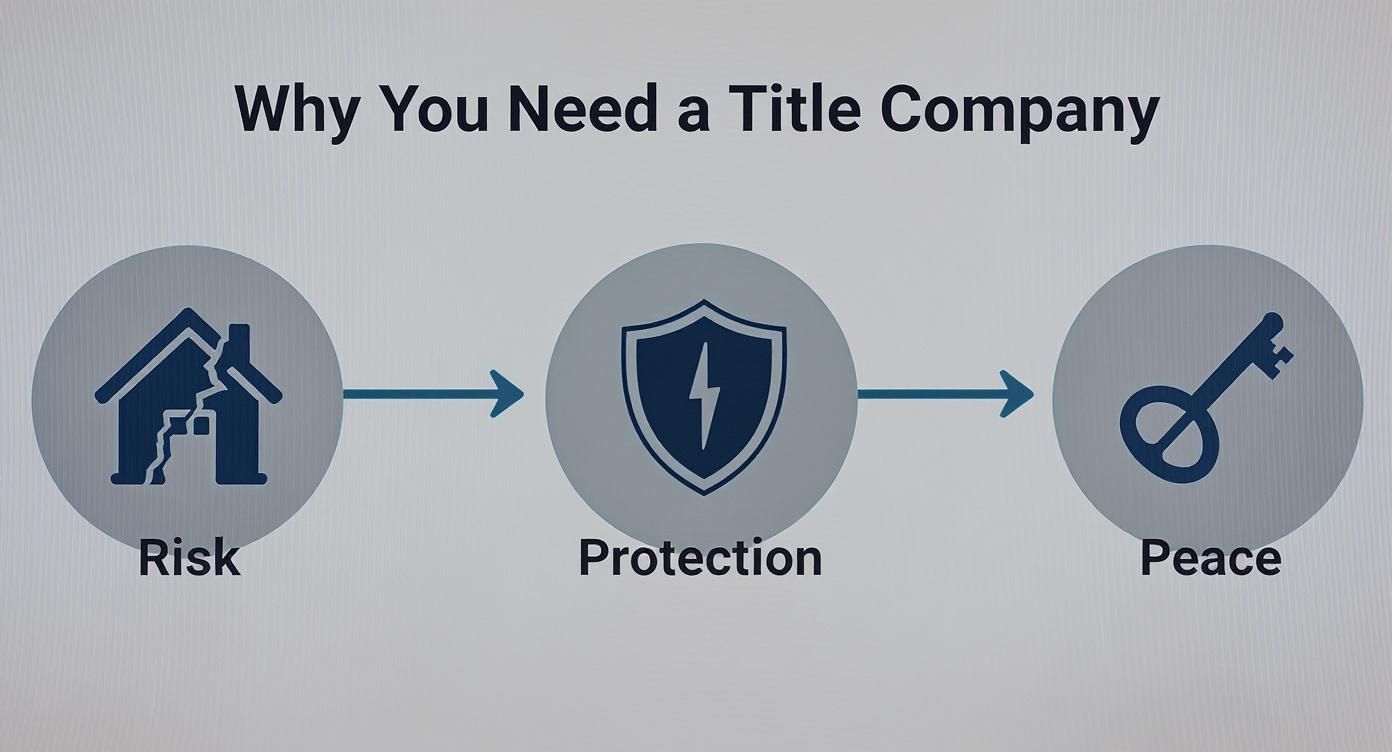
Ultimately, the infographic shows how a title company takes the inherent risk of a real estate deal and turns it into the security you need to close with confidence.
Preparing for Closing Day
While title issues are being ironed out, the title company also works hand-in-hand with the lender to get final loan documents ready. We prepare the Closing Disclosure (CD) or HUD-1 Settlement Statement, a document that breaks down every single dollar involved—every fee, every credit, every charge—for both the buyer and the seller. This is delivered a few days before closing for review.
Finally, we schedule the main event: the closing. Here, all parties come together to sign the final stack of paperwork. The title company then takes over, disbursing all the funds, paying off the seller's existing mortgage, and officially recording the new deed with the county. It's only after that final recording that the deal is truly done, and the property officially has a new owner.
How Modern Title Companies Overcome Industry Challenges
The title industry isn't exactly known for being on the bleeding edge of technology, but that’s starting to change. Fast. Today’s title companies are navigating a minefield of volatile markets, shrinking profit margins, and the ever-present threat of sophisticated wire fraud. These pressures are pushing the industry away from its slow, paper-heavy roots toward smarter, more secure ways of doing business.
The most forward-thinking firms aren't just weathering the storm; they're embracing the shift. Instead of getting buried under manual document reviews and disjointed email threads, they’re adopting integrated platforms that bring everything together—centralizing workflows, automating the grunt work, and locking down sensitive information from beginning to end.
Adopting Technology for Speed and Security
This push for modernization isn't just about chasing the latest trend; it's born from real, urgent needs. With serious economic headwinds, growth and fraud prevention have become the top priorities for any title company that wants to stick around. To stay competitive, many are turning to tech solutions like centralized document management and automated workflows to ramp up efficiency and cut down on operational costs, a trend highlighted in recent analysis of key trends for the title industry in 2025.
This is where AI-powered tools become a genuine game-changer. Imagine an AI-driven dashboard that instantly organizes all transaction data, flags potential red flags, and tracks every file's progress in real-time.
This kind of interface gives title professionals one single source of truth. It completely replaces the chaos of cluttered spreadsheets and endless email chains with a clear, actionable overview of their entire pipeline.
By automating data extraction and centralizing communication, modern title companies can dramatically reduce the risk of human error, speed up turn times, and deliver a more secure and transparent closing experience for everyone involved.
The TitleTrackr Advantage
Solutions like TitleTrackr are at the very front of this movement. By applying generative AI directly to the title search and abstracting process, TitleTrackr gives companies the power to:
- Automate Data Extraction: Instantly pull critical information from dense legal documents, slashing manual labor by up to 90%.
- Centralize Workflows: Manage all documents, communications, and reports from a single, secure platform. No more jumping between systems.
- Strengthen Fraud Prevention: Create a secure, fully auditable trail for every single transaction, which minimizes the risk of wire fraud.
This tech-forward approach doesn't just put out today's fires—it builds the foundation for a more profitable and resilient business tomorrow. By turning manual, error-prone tasks into fast, automated workflows, companies can finally focus on what really matters: closing deals securely and efficiently. To see how others are making this exact transition, you can explore more about industry technology trends on our blog.
Ready to see how AI can completely reshape your title operations? Request a demo of TitleTrackr today and get a firsthand look at the future of title management.
Your Top Questions About Title Companies, Answered
Even with a roadmap of the process, it's natural to have a few more questions rattling around. Let's tackle some of the most common ones we hear, breaking down the practical details of cost, timelines, and key roles to make sure you're feeling confident heading into your transaction.
What's the Difference Between a Title Company and an Escrow Company?
This is a classic point of confusion, and for good reason—their duties can definitely seem to overlap. At its core, a title company is like a property historian and an insurance provider rolled into one. Their main job is to research a property's legal ownership history (the "title") and then insure it against future claims.
An escrow company, on the other hand, is the neutral third party that holds onto all the money and important paperwork until every condition of the sale is met. Think of them as the trusted safekeeper of the deal. Many title companies also offer escrow services, which is why you often hear the terms used together, but their fundamental functions are distinct.
Who Actually Picks and Pays for the Title Company?
There’s no single, universal rule here. It really depends on local customs, which can vary by state or even county. In some areas, it’s standard for the buyer to choose and pay for the title services. In others, the seller takes the lead.
Oftentimes, who picks the title company and how the fees are divided up is just another negotiable point in the purchase agreement. It's very common for the buyer and seller to split the costs at closing, so make sure you clarify this with your real estate agent early in the game.
How Long Does the Title Search Actually Take?
A standard title search usually wraps up in about one to two weeks. This window gives the title abstractor enough time to dig through decades of public records to make sure the property has a clean history.
But that timeline isn't set in stone. If the property has a long and tangled ownership past, or if the search uncovers problems like old liens or unresolved easements, it will take extra time to sort everything out before you can close. These are just a few common questions, but you can find more in-depth answers over on our title company FAQs page.
Stop letting manual processes and hidden risks dictate your closing timeline. TitleTrackr uses AI to automate data extraction, centralize your workflows, and secure your transactions, boosting efficiency by up to 90%. Request a demo today to see how we can transform your operations: https://titletrackr.com
 blog.titletrackr.com
Leave a comment