

Starting a title company is a significant undertaking, but with a strategic approach, it’s an achievable and highly rewarding venture. The process boils down to three key phases: mapping out your business plan, navigating the state licensing maze, and building the operational and tech backbone of your agency.
Think of it as creating a detailed blueprint for success. Your future hinges on having a clear roadmap that is realistic about the financial commitments and designed to meet the high expectations of today’s real estate market. This guide provides that blueprint, showing you how to build a competitive agency from the ground up.
Your Blueprint for a Modern Title Agency
Jumping into the world of title and escrow isn’t a decision to be made lightly. It’s a major commitment of both time and capital. Before you get lost in the details of daily operations, you need a firm grasp of the financial requirements and a realistic timeline for the startup phase.
This overview gives you a bird's-eye view of the core stages, from the initial concept all the way to your grand opening.
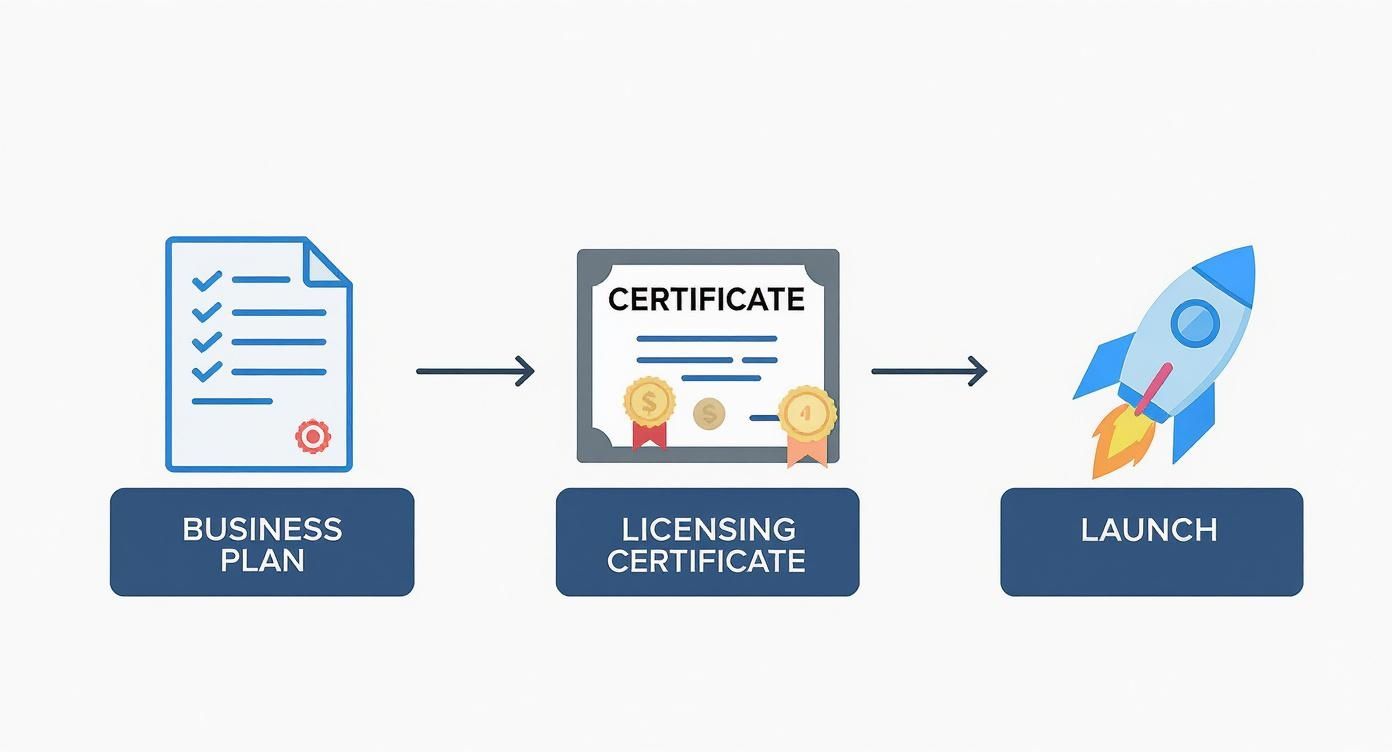
As you can see, each step logically builds on the one before it. There are no shortcuts—just meticulous planning and flawless execution.
The Initial Investment of Time and Money
Let's be direct: setting up a title agency requires significant capital. Based on industry data, you should plan for startup costs ranging from $150,000 to $300,000. This budget covers all the essentials: licensing fees, bonding, setting up an office, investing in the right technology, and hiring your first key team members.
As for the timeline, expect it to take anywhere from 3 to 6 months from the day you start the licensing paperwork to the day you process your first closing. For a closer look at the industry's financial pulse, it's always a good idea to review recent title insurance industry results.
These initial numbers make one thing crystal clear: a well-researched business plan isn't just a formality—it's a survival guide. Your budget must be brutally realistic, covering not just one-time setup costs but also enough operating capital to sustain the business for at least six months.
A classic mistake I see new agency owners make is underestimating the cash flow needed to bridge the gap before the revenue stream becomes steady. Securing enough funding from day one is absolutely non-negotiable.
To give you a clearer picture of what to expect, here’s a breakdown of the primary expenses and timelines you’ll be looking at.
Initial Startup Cost and Timeline Overview
| Expense Category | Estimated Cost Range | Key Considerations |
|---|---|---|
| Licensing & Bonding | $5,000 – $25,000 | Varies wildly by state. Some states require significant surety bonds. |
| Technology & Software | $20,000 – $50,000+ | Includes production software, accounting systems, and security tools. |
| Office & Equipment | $15,000 – $60,000 | Depends on location, size, and whether you buy or lease furniture/tech. |
| Professional Fees | $5,000 – $15,000 | Legal and accounting fees for business formation and setup. |
| Initial Staffing | $50,000 – $100,000+ | Covers salaries for the first 3-6 months for key roles. |
| Marketing & Branding | $5,000 – $20,000 | Website, logo, initial marketing materials, and launch campaigns. |
| Operating Capital | $50,000 – $100,000 | "Just in case" fund to cover unexpected costs and early cash flow gaps. |
This table is a guide, not a guarantee. Your actual costs will depend heavily on your market, business model, and the strategic choices you make early on.
Core Components of Your Launch Plan
To build an agency that can compete and thrive, you need to master a few critical elements from the get-go. These are the foundational pillars that will define your company's structure, efficiency, and reputation.
A successful launch means you're laser-focused on:
- Your Business Model: Who is your ideal customer? Will you be the go-to for residential deals, dive into the complexities of commercial real estate, or carve out a niche like new construction? Defining your value proposition early is key.
- Navigating Regulatory Hurdles: This is where you must do your homework. Dig into your state's specific rules for licensing, bonding, and insurance. Honestly, this is often the most time-consuming part of the entire setup process.
- Integrating Smart Technology: In today's market, your tech stack is a strategic weapon. Choosing the right software to manage your workflow isn't just about convenience. A platform like TitleTrackr can be the difference-maker, empowering you to deliver faster, more accurate service than the competition.
- Building Your A-Team: You can't do it all yourself. Identify the essential roles you need to fill, from a seasoned title examiner who can spot trouble a mile away to a client-facing escrow officer who can keep deals on track.
By concentrating on these pillars, you’re not just getting your company off the ground—you're building a launchpad for long-term growth and success.
Crafting Your Business Plan and Financial Model
A business plan is much more than a document for investors. It's your strategic compass—the guide you'll reference for every major decision as you launch your title company. Forget generic templates; your plan must be a living document that captures your unique vision and the specific market you intend to win.
The first critical question to tackle is your niche. Will you enter the high-volume residential resale market? Or perhaps you'll focus on the detailed, high-touch needs of first-time homebuyers. You could even tackle the complex world of commercial real estate. Your choice here will shape everything that follows: your marketing strategy, your hiring priorities, and the technology you invest in.

Defining Your Market and Competitive Edge
Once you’ve identified your target audience, it’s time for a brutally honest competitive analysis. Who are the dominant players in your area? What is their reputation? One company might be known as the low-cost leader, while another is the premier choice for white-glove service on multi-million dollar properties.
Your job is to find the gap they’re leaving open.
Perhaps you discover a group of real estate agents who are constantly frustrated by slow turnarounds and poor communication. That's your opening. This is where you define your unique value proposition—the specific promise you make to your clients that nobody else can match.
For instance, you could build your entire brand around being the most tech-forward, efficient agency in town. By leveraging a platform like TitleTrackr, you can realistically promise realtors significantly faster title searches and automated updates. In a competitive market, that speed isn’t just a convenience; it’s a powerful advantage that helps them close deals faster. That focus on speed and accuracy becomes your brand.
Building a Realistic Financial Forecast
With your market strategy set, it's time to crunch the numbers and build the financial engine of your business plan. You need to create detailed projections that prove your company isn't just a good idea, but a profitable one. A strong financial model is built on three key pillars.
- Cash Flow Projections: This is your map of money moving in and out of the business, month by month. It's absolutely essential for managing day-to-day operations and making sure you have enough cash on hand to pay the bills before the revenue starts rolling in consistently.
- Operational Budget: Get granular here. This is a detailed list of every single anticipated cost, from office rent and salaries to software subscriptions and your crucial E&O insurance. I’ve seen too many new owners underestimate these costs, and it's a painful mistake.
- Revenue Forecasts: Don't just pull numbers out of thin air. Dig into local real estate transaction data to project your potential income. Base your forecast on realistic market share goals, looking at the average number of closings in your area and the standard fees for each.
Building this model is more than just an exercise; it forces you to think through every single part of your operation, from how many people you need on day one to how much you can truly afford to spend on marketing.
A common pitfall for new title company owners is creating overly optimistic revenue forecasts without grounding them in local market data. Your financial model must be built on a foundation of realistic assumptions, not just ambition.
This meticulous financial planning is how you stress-test your entire business concept. It helps you spot potential cash flow problems months down the road, giving you time to adjust before they become crises. A resilient financial model is what separates a company that limps through its first year from one that thrives for decades to come.
Navigating State Licensing and Compliance Hurdles
You've got your business plan sketched out. Now for the part that can feel like a maze: state licensing and compliance. This is where the rubber truly meets the road, and frankly, it can be the most intimidating step for anyone learning how to start a title company.
But here’s the right way to look at it: this isn't just a hurdle. It’s the foundation upon which your entire reputation will be built. Get this right, and you’re setting your agency up for long-term trust and legal security.
https://www.youtube.com/embed/Ap9guXzfa-k
Every state has its own rulebook, and there are absolutely no shortcuts. Your first stop should always be your state’s department of insurance. They hold all the keys—licensing requirements, educational prerequisites, and financial stability mandates. Trying to wing it without their official checklist is a recipe for serious delays.
Deconstructing the Core Requirements
The compliance puzzle has a few key pieces that you'll find almost everywhere, even if the details vary. Getting your license is all about meticulously assembling these components, because one tiny error on an application can easily set you back weeks, killing your momentum.
In the U.S., regulatory compliance is non-negotiable. Every new title agency must be licensed by the state’s insurance department, pass background checks, and maintain ongoing compliance with consumer protection laws. The average time to complete the licensing process is 4 to 8 weeks, but don't be surprised if it stretches to several months in states with stricter requirements. For more industry context, you can check out the latest data on title premium volume and market share from ALTA.
This timeline really drives home how important it is to get everything right the first time. The two biggest areas you’ll need to lock down are your insurance coverages and financial securities.
-
Surety and Fidelity Bonds: These aren’t optional; they're essential. A surety bond is your guarantee to customers that you'll fulfill your obligations. A fidelity bond protects your business (and your clients) from losses caused by employee dishonesty. States usually set minimums, often starting around $50,000.
-
Errors and Omissions (E&O) Insurance: Think of this as your professional liability safety net. E&O insurance protects you if a claim of negligence or a simple mistake is made during a transaction. Most states require at least $250,000 in coverage, but you’ll find that many underwriters will require more.
Building Your Compliance Framework
Getting the license is just the starting line. Staying compliant is a daily commitment that needs to be baked into your operations from day one—not slapped on as an afterthought.
When you take a proactive approach, you’re not just avoiding regulatory penalties. You're building deep, lasting trust with your clients and partners.
"Many new agency owners focus solely on passing the licensing exam and securing a bond. But the real challenge—and opportunity—is in creating a culture of compliance that protects your clients and your business for the long haul. It's an ongoing process, not a one-time event."
A great way to start is by integrating industry standards directly into your workflows. The American Land Title Association (ALTA) Best Practices framework is the perfect blueprint. It covers everything from licensing and escrow accounting procedures to privacy policies and data security. Following these guidelines isn't just a good idea—it’s what lenders and underwriters expect.
Integrating Compliance with Technology
Let’s be honest, trying to track compliance manually is a nightmare waiting to happen. This is where modern tech becomes your best friend, turning a potential weakness into a real strength. The software you choose shouldn't just be for managing closings; it needs to be a core part of your compliance system.
Take a platform like TitleTrackr, for instance. It was designed with security and accuracy at its core. By automating tasks like data extraction and report generation, it dramatically reduces the risk of human error—a leading cause of E&O claims.
When your team can rely on AI-driven tools for repetitive, detail-heavy tasks, they are freed up to focus on high-level oversight and quality control. This fusion of smart technology and sound processes is exactly how a modern title company maintains impeccable compliance without slowing down operations.
Building a Tech-Forward Operational Infrastructure
You've navigated the maze of licensing and compliance. Now comes the exciting part: building the operational engine that will power your title company. In today's market, your technology isn't just a back-office expense; it's your primary competitive weapon. A smart, modern infrastructure is what enables you to deliver the speed, accuracy, and transparency that will win clients and keep them coming back.
This is about more than just buying software. It’s about creating a seamless, interconnected system for everything from handling escrow accounts to fending off cyber threats. Your operational core needs to be solid, efficient, and scalable from day one.

Choosing Your Underwriter and Setting Up Escrow Accounts
One of the very first operational decisions you’ll make is selecting a title insurance underwriter, and it’s a critical one. This isn't just a vendor; it's a strategic partnership. Your underwriter provides the insurance policies you'll issue, but they should also be a source of industry expertise, training, and support when you encounter complex issues.
When vetting potential partners, don't just focus on commission splits. Evaluate their reputation, financial stability, and, importantly, how well their technology integrates with modern title production software. A great underwriter acts as a true partner invested in your success.
Simultaneously, you must establish your escrow accounts. These are not typical business checking accounts. They are heavily regulated trust accounts for holding client funds, and the rules are strict. Partner with a bank that has deep experience with real estate trust accounts and understands the intense record-keeping and reconciliation requirements.
Embracing Automation with AI-Driven Technology
Let's face it: the days of spending weeks hunched over dusty courthouse records for a title search are over. Successful modern agencies thrive by automating tedious, repetitive work. This frees up your most valuable asset—your people—to focus on solving complex title problems and building client relationships.
Consider the traditional title search process: a skilled examiner manually plows through decades of deeds, mortgages, and court records. It's incredibly time-consuming and, no matter how experienced the examiner, is susceptible to human error.
AI completely revolutionizes this model.
An AI-powered platform can analyze thousands of documents in minutes, extracting crucial data points and flagging potential chain of title issues with incredible accuracy. This dramatically slashes turnaround times, which is a massive selling point for real estate agents working to close deals in a fast-paced market.
A huge mistake I see new title company owners make is trying to save a few bucks by building their business on outdated tech. It's a false economy. Investing in a modern, AI-powered platform from the get-go is the single best way to compete with the big, established players.
Core Systems for a Modern Title Agency
To get your operation running smoothly and securely, you need to implement three key systems. These will form the backbone of your agency.
-
Document Management System (DMS): You will be managing a high volume of sensitive documents. A secure, cloud-based DMS is non-negotiable for organizing, storing, and sharing files safely with all parties in a transaction. Look for features like version control, granular access permissions, and audit trails to maintain compliance.
-
Cybersecurity Framework: Title companies are prime targets for hackers due to the large sums of money involved in transactions. Your defense must be multi-layered, incorporating email encryption, secure networks, multi-factor authentication, and ongoing employee training on how to spot phishing scams.
-
Digital Closing Platform: The demand for remote and hybrid closings is here to stay. A digital closing platform allows you to offer Remote Online Notarization (RON) and e-closings, providing critical convenience for clients who cannot attend an in-person closing.
The TitleTrackr Advantage in Your Workflow
Implementing all these systems can feel daunting, but a unified platform simplifies the process significantly. This is where a solution like TitleTrackr becomes a game-changer for a new agency. It's not just another piece of software; it's a complete operational ecosystem designed to automate the most time-consuming parts of the title process.
By integrating AI directly into your workflow, TitleTrackr automates data extraction from legal documents and generates clean, professional reports in seconds. This means a small, agile team can handle a much higher volume of work with far greater accuracy. For anyone learning how to start a title company, that level of efficiency is the most direct path to profitability.
To see how AI can transform your agency’s operations, explore the automation capabilities of TitleTrackr. You’ll see how you can achieve a massive efficiency boost from day one, giving you the power to deliver superior service that builds a loyal client base right out of the gate.
Assembling Your Team and Launching Your Brand
Your technology is set and your business plan is solid, but now comes the most important component: the people. A title company is a service business built on trust and relationships. This is where you transition from building the engine to finding the right crew to fly the plane.
Your launch success will hinge on two critical factors: hiring a top-tier team with deep expertise and building a brand that resonates with the real estate agents, lenders, and buyers you want to serve.

Recruiting Your Core Team
Let’s be realistic: you can't do it all yourself. Juggling roles as the lead examiner, escrow officer, and business developer is a recipe for burnout and, worse, costly mistakes. Your first few hires are not just expenses; they are foundational investments that will define your company’s culture and capabilities.
Start by focusing on these essential roles:
- An Experienced Title Examiner/Abstractor: This person is the technical backbone of your entire operation. They need an almost obsessive eye for detail and enough experience to identify red flags in a property's history from a mile away. This is not a role for a novice—you need someone who has untangled complex title issues before and knows exactly how to resolve them.
- A Client-Focused Escrow Officer: Think of your escrow officer as the face of your company during the most critical part of the transaction. They must be a masterful communicator, hyper-organized, and completely unflappable under pressure. Look for someone who can confidently guide agents and their clients through the closing process with total clarity and empathy.
- A Business Development Pro: You need a hunter. This individual's sole focus is to build relationships and bring in deals. They will be your brand ambassador, actively networking at industry events, meeting with real estate offices, and selling your unique value proposition to the local market.
When you're starting out, you're not just offering a job—you're offering a mission. Sell early hires on the opportunity to build something from the ground up and grow with the company. By creating an environment where expertise is valued and exceptional service is the standard, you'll attract and retain top talent.
I see so many new owners hire for skill alone, and it's a huge mistake. While expertise is critical, you have to hire for culture fit. A small, tight-knit team that genuinely works well together will run circles around a group of talented but disconnected individuals every single time.
Crafting a Brand That Screams "Trust"
With your A-team in place, it's time to build a brand that communicates reliability and expertise. Your brand is more than a logo; it's the promise you make to every client. For a new title agency, that promise must be one thing above all else: trust.
Your go-to-market strategy needs to be laser-focused. Don't try to be everything to everyone. Zero in on the niche you identified in your business plan. Your messaging, website, and marketing materials should all speak directly to the pain points of that specific audience.
A professional online presence is non-negotiable. Your website must be clean, easy to navigate, and immediately answer the question, "Why should I work with them?" For instance, if your competitive edge is speed powered by superior technology, showcase that prominently on your homepage.
Your Go-To-Market Playbook
Your initial marketing push should be a smart mix of digital savvy and traditional relationship-building. Here’s a practical game plan:
- Build a Professional Website: This is your digital storefront. It needs to clearly outline your services, introduce your expert team, and make it incredibly easy for potential clients to contact you.
- Get Active on Professional Networks: Use platforms like LinkedIn to connect with local real estate agents, lenders, and attorneys. Don't just add connections—share valuable content about the closing process or local market trends to establish yourself as an industry authority.
- Network with a Purpose: Don't just show up to random events. Identify the key real estate brokerages and lending institutions you want as clients. Offer to host a "lunch and learn" to demonstrate your expertise and introduce your team.
Ultimately, your brand will be forged in the transactions you close. A smooth, transparent, and on-time closing is the most powerful marketing tool you have. Every positive closing experience builds your reputation and turns satisfied clients into your most passionate advocates.
Common Questions About Starting a Title Company
Even with the best-laid plans, launching a new business always raises questions. The title industry is no exception. Aspiring owners consistently grapple with the same core concerns about finances, competition, and what it really takes to run a successful agency day-to-day.
Let's tackle some of the most pressing questions we hear all the time to give you the clarity and confidence to move forward.
How Much Does It Realistically Cost to Start a Title Company?
This is always the first question, and for good reason. While the number can shift based on your state and business model, a realistic startup budget usually lands somewhere between $150,000 and $300,000. That figure covers several critical, non-negotiable expenses you'll face right out of the gate.
A significant portion goes to licensing and bonding fees, which can run from $10,000 to over $50,000 depending on state requirements. Then there's technology. Your title production software and cybersecurity tools are a major investment, often costing between $20,000 and $60,000. You also have to budget for initial staffing, marketing, and securing that all-important Errors & Omissions (E&O) insurance.
It's absolutely crucial to have at least six months of operating capital in reserve. This is your safety net, covering all your expenses before closings start generating a steady, predictable stream of revenue.
What Are the Most Important Skills for a Title Company Owner?
While experience as a title agent or escrow officer is a huge advantage, the most vital skills for an owner are a blend of industry knowledge, business acumen, and strong leadership. You don’t need to be the top expert on every task, but you must understand the fundamentals of the entire operation.
A deep grasp of real estate transactions, title insurance principles, and regulatory compliance—think RESPA and ALTA Best Practices—is paramount. Strong financial management skills are also non-negotiable. You’ll be living and breathing budgets, cash flow, and profitability.
Beyond the technical side, your success will hinge on your ability to lead a team and build relationships. Networking to bring in clients like real estate agents and lenders is just as important as knowing how to read a title commitment. Above all, you need an obsessive attention to detail, as even a small error in this business can escalate into a major legal and financial problem.
How Can New Title Companies Compete with Established Players?
Breaking into a market with long-established competitors can feel like an uphill battle, but new companies have a secret weapon: agility. You can successfully compete by focusing your energy in three key areas.
-
Embrace Modern Technology: This is your greatest advantage. Older, larger firms are often burdened by clunky, outdated systems. You can build your entire agency on a modern, AI-powered foundation. A platform like TitleTrackr automates title searches and streamlines workflows, allowing you to offer faster, more accurate service from day one.
-
Specialize in a Niche Market: Don't try to be everything to everyone right away. Instead, become the go-to expert for a specific niche, such as commercial properties, new construction developments, or even a particular geographic area. Specialization is the fastest way to build a powerful reputation.
-
Deliver Superior Customer Service: This is where you can truly differentiate yourself. Provide proactive, personalized communication to real estate agents and their clients. When you build loyalty through exceptional service, you generate powerful word-of-mouth referrals that large, impersonal companies often struggle to match.
What Is the Biggest Challenge When Starting Out?
From our experience, the biggest challenge is a one-two punch: navigating the complex web of regulations while simultaneously building a client base from scratch. Obtaining your state licenses, surety bonds, and underwriter approvals is a meticulous and often slow process. One misstep can cause expensive delays that stall your launch.
The moment you're operational, the challenge pivots to sales and marketing. You have to convince real estate agents, lenders, and attorneys to leave their long-standing relationships and trust your brand-new company with their deals. This requires a persistent and strategic networking effort focused on proving your value, whether that’s through faster turn times or white-glove customer service.
If you're looking for more in-depth answers, you can find additional information in our frequently asked questions about title operations.
Ready to build a modern, efficient title company that outcompetes the old guard? See how TitleTrackr can give you an immediate competitive edge by automating your workflows and delivering unparalleled accuracy. Request a demo with TitleTrackr today and discover the power of an AI-driven title platform.
 blog.titletrackr.com
Leave a comment