

Every piece of land has a story. It’s a long, often tangled history written in deeds, mortgages, liens, and court judgments. Before anyone can safely buy or sell a property, someone has to meticulously piece that entire story together.
That critical role belongs to the real estate abstractor. They are the property detectives behind every transaction, the expert investigators who ensure a secure real estate deal has a solid foundation to stand on. This guide explores their vital role, the challenges they face, and how modern solutions are transforming their workflow.
The Property Detectives Behind Every Real Estate Deal
Imagine buying your dream house, only to find out the seller didn't actually have the right to sell it. Or discovering there are unpaid taxes from a decade ago, or that a contractor put a lien on the property for a job that was never paid for.
These "clouds" on a title can completely derail a closing and drag a new owner into years of costly legal battles. The abstractor's primary job is to hunt down and expose these issues before they become your problem by building a complete history known as the chain of title.
Uncovering the Hidden Story
This isn't just about pulling records; it's a genuine investigation. A skilled real estate abstractor navigates a maze of public information, sometimes digging through dusty courthouse archives and other times untangling complex digital databases. Their mission is to find every single document that has ever affected the property.
This investigative work involves several key tasks:
- Tracing Ownership: They follow the lineage of ownership from the current seller all the way back, sometimes for decades, to confirm an unbroken and legitimate chain.
- Identifying Encumbrances: They search for any claims against the property. This could be anything from mortgages and liens to easements or unpaid property taxes.
- Verifying Legal Descriptions: They ensure the property's legal description is precise and consistent across every historical document, leaving no room for error.
- Compiling the Abstract: Finally, they organize all their findings into a detailed report—the abstract of title—which paints a crystal-clear picture of the property's legal standing.
The accuracy of an abstractor's work is non-negotiable. A single overlooked document or misinterpreted legal clause can have massive financial consequences. Their attention to detail is what makes a secure transaction possible.
The stakes are incredibly high. In a market where transactions are moving faster than ever and becoming more complex, the pressure to be both quick and flawless is immense. This is where modern tools become essential. Platforms like TitleTrackr are designed to support these professionals by automating the tedious parts of the search. This frees up the abstractor to focus their expertise on critical analysis, ensuring every property's story has a secure and happy ending.
Uncovering a Property's Past Step by Step
Think of a real estate abstractor’s job as a masterclass in methodical detective work. When a new title order hits their desk, it kicks off a meticulous investigation to build out the property's complete history—what we in the industry call the chain of title. This isn't just about pulling files; it's about following a paper trail, often decades long, to make sure the path to ownership is clear and unbroken.
The first move is always to lock down the property’s legal description and confirm the current owner. An abstractor can't rely on a simple street address; they need the official legal description to dive into the public records. From there, they start with the most recent transaction—usually the deed that put the property in the current seller's name—and begin working their way backward in time.
Navigating the Maze of Public Records
This journey back in time means digging through a whole slew of documents, each one holding a vital piece of the property's story. An abstractor's search has to be both wide and deep, leaving no stone unturned.
Here are the key documents they're hunting for:
- Deeds: These are the official papers that transfer ownership. The abstractor traces every single deed to ensure there’s a continuous, unbroken line of owners.
- Mortgages: Any loans tied to the property have to be found. The abstractor looks for not just the mortgage itself but also the corresponding release that proves the debt was paid off.
- Liens and Judgments: These are nasty surprises. Unpaid contractor bills (mechanic's liens) or court rulings against a past owner can attach to the property, and they absolutely must be found.
- Tax Records: The abstractor has to verify all property taxes are paid up. Unpaid taxes create a high-priority lien that can stop a sale in its tracks.
- Easements and Covenants: These documents spell out who else might have rights to the property (like a utility company) or any rules restricting how the land can be used.
Every document gets a fine-toothed comb. It’s not enough to just find them; they have to be accurate. A misspelled name, a wonky legal description, or a missing signature from 50 years ago can create a massive headache today. This is where an abstractor's sharp eye and deep experience really make a difference.
This graphic breaks down the core workflow, from digging up the initial records to the final analysis and verification.
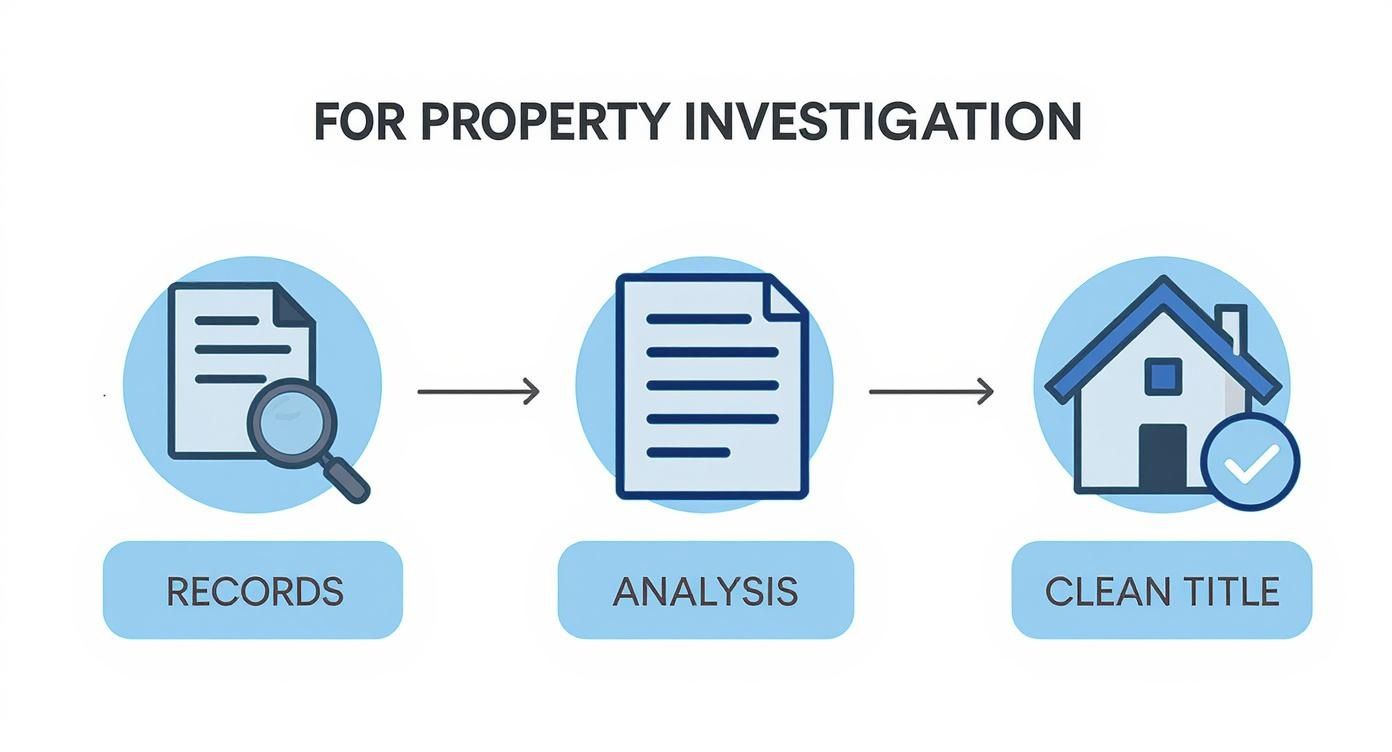
As you can see, the process is all about taking a huge amount of raw data and funneling it down to a clear, simple answer about the property's title status.
Identifying Clouds on the Title
As the abstractor puts this historical puzzle together, they’re on high alert for any red flags that could derail the sale. In the business, we call these issues "clouds on the title"—basically, any claim or hiccup that makes ownership uncertain.
A cloud could be anything. Maybe it’s an old mortgage from 30 years ago that was never officially marked as paid off. Or it could be an heir from a previous owner who was never properly bought out. Even a simple boundary dispute with a neighbor can cloud a title. The abstractor’s job is to spot these clouds so they can be cleared up before the deal closes.
This investigative role is more critical now than ever. With property markets booming and transactions getting more complicated, the need for meticulous verification is at an all-time high. In the U.S. alone, the real estate market was valued at over $100 trillion, with projections for even more growth. This staggering volume rests on the shoulders of abstractors, who are unfortunately facing a talent shortage as many experienced pros head toward retirement. You can dig into more real estate statistics and trends to get a sense of the market's incredible scale.
After all the records have been gathered and analyzed, the abstractor pulls everything together into a formal report called an abstract of title. This document lays out the entire chain of ownership and flags every issue they found. It’s the playbook that gives the title company and attorneys everything they need to make sure the title is clean, insurable, and ready for a smooth closing.
The Essential Skills of a Top Abstractor
Knowing where to find public records is just the starting point. The real magic happens in the interpretation, and the difference between a good abstractor and a great one comes down to a specific blend of skills—part detective, part historian, and part legal scholar.
These are the core competencies that allow them to cut through the noise of complex property law and deliver the clear, reliable information every real estate transaction hinges on.
The Analytical Mindset
First and foremost, a top-tier abstractor has to have an analytical mind. They spend their days poring over dense legal documents, faded handwritten records, and convoluted property descriptions that might be centuries old. This isn't just about reading; it's about connecting the dots between deeds, mortgages, and court judgments to piece together an accurate timeline.
Their real skill lies in spotting the things others might miss—a slight inconsistency in a name, a gap in the ownership chain, or a poorly worded easement that could spell disaster down the road. This kind of analytical rigor is also crucial for landmen working with mineral rights, where precision is everything. You can learn more about the role of a landman in our related guide.
An abstractor’s job is to make sense of a property's chaotic past. Their analytical skill is the tool they use to bring order to that chaos, ensuring the final abstract of title is a trustworthy foundation for the transaction.
Obsessive Attention to Detail
In the world of title abstracting, there are no small mistakes. A single misspelled name, a transposed number in a legal description, or a missed lien can derail a multi-million dollar transaction and open the door to costly legal battles.
This is why an obsessive attention to detail isn't just a nice-to-have; it's absolutely essential. We're talking about an intense focus while sifting through hundreds of pages of records, verifying every date, name, and figure with painstaking accuracy. The best abstractors are methodical, constantly cross-referencing information and double-checking their own work to root out any chance of human error.
Unwavering Ethical Integrity
Finally, the entire profession is built on a foundation of trust. An abstractor must have unwavering ethical integrity, acting as an impartial investigator presenting the unvarnished history of a property.
Their findings directly influence massive financial decisions, and everyone involved—from the buyer and seller to the lender and insurer—is counting on their honesty. This commitment to ethics ensures every report is a true and complete picture of the property's legal standing. Without that integrity, the system of secure property ownership we rely on would quickly fall apart.
To succeed, an abstractor needs a balanced mix of technical know-how and crucial soft skills. They need the ability to decipher complex legal language just as much as they need the patience to trace a property's history through generations of documents.
Here's a breakdown of the core competencies that truly define a skilled abstractor:
Core Competencies for a Real Estate Abstractor
| Skill Category | Specific Skill | Application in Abstracting |
|---|---|---|
| Technical Skills | Legal Document Analysis | Interpreting the language and implications of deeds, mortgages, liens, and judgments. |
| Public Records Research | Navigating county courthouse systems, both digital and physical, to locate relevant documents. | |
| Title Chaining | Systematically tracing property ownership backward in time to establish a clear and unbroken chain. | |
| Analytical Skills | Problem-Solving | Identifying discrepancies, gaps in the record, or "clouds" on the title and determining the next steps. |
| Critical Thinking | Assessing the validity and relevance of each document to the overall property history. | |
| Pattern Recognition | Spotting recurring issues or unusual entries that could indicate a larger problem with the title. | |
| Soft Skills | Meticulous Attention to Detail | Ensuring 100% accuracy in transcribing names, dates, and legal descriptions to prevent costly errors. |
| Time Management | Juggling multiple searches simultaneously while adhering to strict closing deadlines. | |
| Ethical Judgment | Maintaining impartiality and integrity when reporting findings, regardless of the outcome. |
Ultimately, it's the combination of these skills that allows an abstractor to transform a tangled web of historical records into a clear, concise, and reliable abstract of title.
The Challenges Facing Modern Abstractors

While an abstractor’s core mission hasn’t changed—to deliver a clear and accurate property history—the world they work in gets more complex by the day. Today's professionals face a unique gauntlet of obstacles that test their skills, patience, and precision.
These aren't just minor headaches. They are significant operational bottlenecks that can slow down every single real estate transaction, impact profitability, and introduce unnecessary risk. Overcoming them is key to staying competitive.
Wrestling with Outdated Record Systems
One of the biggest, most persistent challenges is the wild inconsistency of public records. While some counties have gone digital, many others are still running on physical ledgers, microfilm, and paper filing systems that haven't been updated in decades. This forces abstractors to be masters of two completely different worlds.
On any given day, an abstractor might find themselves in a courthouse basement, sifting through dusty, handwritten documents and trying to decipher faded cursive from a century ago. It’s a painstaking manual process that’s not just incredibly time-consuming but also ripe for human error. A single misread entry could derail an entire closing.
The Growing Complexity of Property Histories
The days of a simple chain of title from one individual owner to the next are long gone. Modern property histories are often tangled webs of sophisticated legal and financial structures that demand deep expertise to unravel.
A real estate abstractor today has to navigate a minefield of complexities:
- Corporate and Trust Ownership: Properties are frequently held by LLCs, corporations, or complex family trusts, each adding layers of legal paperwork that must be meticulously reviewed.
- Foreclosure and Bankruptcy Records: A history of foreclosure or bankruptcy adds a massive burden, forcing the abstractor to verify that all legal proceedings were handled correctly and every creditor’s claim was satisfied.
- Frequent Refinancing and HELOCs: It's common for properties to have multiple mortgages and lines of credit recorded against them. Each one needs to be tracked down and verified as paid and released.
These issues turn a seemingly straightforward search into a high-stakes investigation. The pressure to maintain perfect accuracy is immense.
A single oversight—a missed lien or an improperly discharged mortgage—can trigger major financial and legal consequences for the buyer, seller, and lender. The pressure to be flawless is constant.
Relentless Pressure of Tight Deadlines
The modern real estate market moves at lightning speed, and closing deadlines are tighter than ever. Abstractors are constantly caught in a tug-of-war between the need for thorough, painstaking research and the relentless demand for speed from agents, lenders, and clients.
This high-stress environment creates a critical need for efficiency. For those juggling enormous amounts of information, knowing how to integrate systems effectively is critical. For a deeper look at the technical side, you can explore our developer resources to see how seamless connections are built.
This demand for speed only gets more intense as the market grows. With the global real estate market projected to reach trillions of dollars, the abstractor's role is absolutely essential to managing the surge in transactions. The accuracy and efficiency of their work directly fuel this massive economic engine, and these pain points show exactly where technology provides much-needed solutions.
How AI Is Empowering the Modern Abstractor

Anyone who's spent a day in the life of an abstractor knows the grind. You're constantly up against the clock, wrestling with messy property histories and records that feel like they belong in a museum. It's a tough job. But these very challenges have lit a fire under innovators, leading to a new class of tools designed to help, not replace, the expert abstractor.
This is where artificial intelligence comes in. Think of AI as the ultimate partner, one that takes on the most tedious, repetitive parts of the job so you don't have to.
This isn’t about outsourcing your brain to a machine. Far from it. AI-driven platforms like TitleTrackr are a force multiplier for your expertise. They handle the monotonous data collection, freeing you up to focus on what you do best: high-level analysis and solving the tricky puzzles that only a human expert can.
From Manual Search to Automated Discovery
Imagine trying to find a single sentence in a library full of unorganized books. That’s pretty close to what a traditional abstractor faces every day. AI completely flips that script by automating the grunt work of searching and pulling information with incredible speed.
A human abstractor could easily spend hours—sometimes days—digging through courthouse archives and digital databases. An AI tool can run that same search and get it done in a tiny fraction of the time.
Here are a few things this technology handles beautifully:
- Instant Document Digitization: Got an ancient, handwritten deed or a blurry microfilm record? AI uses Optical Character Recognition (OCR) to convert it into clean, searchable digital text in a snap.
- Targeted Data Extraction: The system knows what to look for. It can scan hundreds of documents at once and pull out specific details like names, dates, legal descriptions, or lien amounts.
- Anomaly Detection: By spotting patterns across the entire title chain, AI can flag things that don't quite add up—like a missing signature or a mortgage that was never released—and bring them to your attention.
This shift changes the abstractor’s role from data hunter to data strategist. Your job is no longer about finding the information, but about interpreting it.
By taking over the low-level tasks, AI lets the modern real estate abstractor work at the top of their game. They can pour their energy into clearing complex title clouds and guaranteeing the report's integrity, delivering more value in less time.
A Smarter, More Focused Workflow
When you bring AI into the abstracting process, you get a workflow that’s both faster and more reliable. A platform like TitleTrackr becomes the central command center where all this smart data processing happens, giving you a clear, organized view of a property's entire history.
The real magic of a tool like this is the instant clarity it brings. It turns a chaotic pile of documents into an organized, color-coded summary that pinpoints potential risks right away.
This is a game-changer, especially in commercial real estate, where an abstractor's role is more critical than ever as markets shift. The sheer volume of deals in major cities requires skilled pros who can navigate tangled zoning laws, environmental rules, and tenant agreements. AI-powered tools give them the backup they need to handle this complexity with confidence. You can check out the latest commercial real estate market insights to see just how fast things are moving.
The Human-AI Partnership
Let's be clear: AI is a tool, not a replacement. Its superpower is churning through massive amounts of data with incredible speed. What it can't do is apply the nuanced judgment and real-world understanding that comes from years of experience.
The future of abstracting is a team effort:
- AI Performs the Heavy Lifting: The platform runs the search, scans thousands of records, and flags potential problems.
- The Abstractor Provides the Expertise: The human expert steps in to review what the AI found, investigate the flagged issues, and use their deep industry knowledge to make the final call.
This partnership produces a higher quality abstract in way less time. The abstractor is empowered to take on more work without ever compromising the rock-solid accuracy that the industry is built on. For any abstractor looking to stay ahead, this blend of human skill and machine efficiency is the answer.
Ready to see how AI can sharpen your workflow and boost your productivity by up to 90%? Request a demo of TitleTrackr today and see how you can spend less time searching and more time analyzing.
The Future of Property Title Investigation
The story of a property is written in its documents—deeds, liens, and old court records tell a tale as old as the property lines themselves. For generations, the real estate abstractor has been the skilled historian tasked with piecing this complex narrative together. Their meticulous work has always been the bedrock of a secure transaction, the final word that a title is clear and ready to be transferred.
As we've seen, this foundational role is being squeezed by outdated systems, tangled property histories, and a market that demands everything be done yesterday. But these challenges aren't a dead end. They're the catalyst for the next evolution of the profession. The future of property investigation isn't about replacing human expertise but amplifying it with truly powerful tools.
A New Era of Human-AI Collaboration
The idea that technology will make abstractors obsolete comes from a fundamental misunderstanding of their value. Sure, an AI can scan a million documents in a minute, but it can't replicate the nuanced judgment, critical thinking, and ethical integrity of a seasoned professional. It can flag a discrepancy, but it can’t interpret its true legal weight or strategize the best path to a solution.
The future we see is a powerful partnership. It's a model where technology handles the exhaustive, eye-glazing data collection, freeing up the real estate abstractor to operate at their highest level.
The modern abstractor is becoming less of a record-digger and more of a strategic analyst. They are the final authority, the human expert who validates, interprets, and solves the complex puzzles that AI uncovers, making them more valuable than ever before.
This collaborative approach ensures that securing property ownership in the modern age combines the best of both worlds: unwavering human diligence supercharged by smart innovation.
Becoming Part of That Future Today
The tools to make this future a reality aren't just on the horizon; they’re here now. By adopting platforms that automate the search and extraction grind, abstractors can shift their focus from monotonous tasks to high-impact analysis. This allows them to deliver faster, more accurate results and solidifies their role as indispensable experts in any real estate transaction.
This new chapter for the real estate abstractor is about working smarter, not harder. It’s about using technology to elevate your skills, eliminate bottlenecks, and provide unparalleled value to your clients. The path forward is clear, and it starts by embracing the tools that empower you to do your best work.
Are you ready to step into the future of title investigation?
Request a demo of TitleTrackr and see how you can become a more strategic, efficient, and invaluable part of every real estate deal.
Frequently Asked Questions
When you dig into the world of real estate titles, a few questions always seem to pop up. Here are some of the most common ones we hear, broken down with straightforward answers.
What Is The Difference Between an Abstractor and a Title Examiner
Think of it like a detective and a judge in a courtroom drama.
The abstractor is the detective on the ground. Their job is to hit the archives, hunt down every public record tied to a property—deeds, mortgages, liens, you name it—and compile it all into a single, detailed file. This file is the "abstract."
The title examiner is the judge. They take the case file prepared by the real estate abstractor and analyze it. They're looking for any legal red flags, hidden claims, or "clouds" that could jeopardize ownership. The abstractor gathers the evidence; the examiner delivers the final verdict on the title's health.
Is Real Estate Abstracting a Good Career Path
Absolutely. It's a surprisingly stable and rewarding career path that often flies under the radar. As long as people are buying and selling property, there will be a need for skilled abstractors.
Every single transaction—from a family home to a commercial skyscraper—needs a thorough title search. This makes the role absolutely essential to the health of the real estate market. It provides a level of job security that's hard to find, plus plenty of room to grow, especially for those who get comfortable using new technology to work smarter.
Key Takeaway: The job isn't going away because of AI—it's evolving. Technology is taking over the grunt work of data collection, freeing up abstractors to focus on the tricky, analytical parts of the job that require real human insight. This actually makes the role more strategic and valuable than ever.
Will AI and Automation Replace Real Estate Abstractors
Nope, not a chance. AI isn't here to replace abstractors; it's here to be their most powerful tool. Think of it as a super-charged assistant.
AI-driven platforms can tear through mountains of documents in minutes, doing the heavy lifting that used to take days. This lets the human abstractor focus on what they do best: interpreting bizarre legal language, solving unique title puzzles, and putting their name behind the accuracy of the final report. It's the perfect partnership—technology provides the speed and scale, while the human expert provides the critical thinking and final sign-off.
For more answers like these, feel free to check out our full list of frequently asked questions on our website.
Ready to see how AI can give your abstracting workflow a serious boost? TitleTrackr turns tedious manual searches into a fast, automated, and insightful process. Request a demo of TitleTrackr today and get a firsthand look at the future of title investigation.
 blog.titletrackr.com
Leave a comment