

A right of way is a legal right for someone to travel across a property they don't actually own. It’s not about ownership, but about a specific, limited permission. Think of a shared driveway or a utility company needing access to its power lines.
This distinction is absolutely critical for title professionals. A right of way isn't just a footnote; it can dramatically impact a property's value and how it can be used. Missing one during a title search can expose your clients—and your business—to significant financial and legal risk.
Understanding Right of Way in Real Estate

Here's a simple way to picture it. Imagine a property is like a private room in a house. The owner controls everything inside that room. A right of way is like a designated hallway that cuts right through the middle of it, allowing other people to pass from one side to the other.
The room's owner still owns the floor space where the "hallway" is, but they can't block it. Crucially, the people using the hallway don't get any ownership rights to the room itself. They can't redecorate, move the furniture, or decide who else gets to use the hallway. Their right is strictly limited to passage. This is the fundamental difference between a right of way and outright property ownership, and it’s a concept that sits at the very heart of title examination.
The Core Difference Between Access and Ownership
Getting this distinction right is the first step in identifying potential risks during a title search. When you find a right of way in a property's history, you aren't looking at a transfer of land. What you're really examining is a legal agreement that burdens one property for the benefit of another person, a company, or even the general public.
This legal burden can show up in several ways that directly affect what a property owner can and can't do:
- Restricted Development: The owner might be barred from building structures, putting up fences, or even planting trees if they could obstruct the right of way.
- Required Maintenance: In some agreements, the property owner is on the hook for maintaining the path—like paving a driveway or clearing snow—even though others are the ones using it.
- Potential for High Traffic: A quiet, private right of way for a single neighbor is one thing. A public right of way used by dozens of people every day is another thing entirely, impacting privacy and peace.
To make this crystal clear, let's break down the key differences between holding a right of way and owning a property outright.
Right of Way vs Property Ownership At a Glance
| Aspect | Right of Way | Property Ownership (Fee Simple) |
|---|---|---|
| Primary Right | Right of use (e.g., passage, access) | Right of possession, control, and exclusion |
| Nature of Interest | Non-possessory | Possessory |
| Duration | Can be temporary or permanent | Perpetual (lasts forever) |
| Control | Limited to the specific purpose of the right | Full control over the entire property |
| Ability to Transfer | May or may not be transferable | Freely transferable (sell, gift, inherit) |
| Responsibility | Usually defined in the agreement | Full responsibility for taxes, maintenance |
This table is a great cheat sheet, but the real-world implications are what truly matter for your clients.
A right of way is a legal encumbrance that grants a specific use right without transferring title. Missing one during a search can lead to significant legal and financial consequences for the property owner, from blocked construction projects to unexpected public access.
This is exactly why meticulous research is a non-negotiable part of your professional due diligence. Every right of way introduces a new layer of complexity that has to be fully understood and documented. An overlooked access right isn't just a clerical error; it’s a potential bombshell that could go off years after a deal closes, creating expensive and stressful disputes.
For title abstractors and landmen, mastering the nuances of these access rights is essential for delivering a clear and accurate title report that protects everyone involved.
How Rights of Way Are Legally Created
A right of way doesn’t just pop up overnight. It’s a formal, legally binding agreement that’s forged through a specific process and cemented in official records. For any title professional, understanding how these rights come into existence is just as critical as knowing what they do.
These aren’t casual handshake deals; they are formal encumbrances, meticulously laid out in documents that become part of a property’s permanent legal history. You'll most often find them tucked inside deeds, sketched onto plat maps, or detailed in standalone documents called easement agreements. Think of these records as the right of way's birth certificate—they spell out its purpose, location, and all the parties involved.
Dominant vs. Servient Estates Explained
To make sense of these documents, you first need to get familiar with the two key players in any right of way agreement: the dominant estate and the servient estate. It might sound like complex legal jargon, but the concept is really just a simple give-and-take.
- The Dominant Estate is the property or person that benefits from the right of way. It's the landlocked parcel that finally gets a driveway or the utility company that needs a path to its power lines.
- The Servient Estate is the property that is burdened by the right of way. It's the land that "serves" the needs of the dominant estate by allowing someone to cross it.
Picture two lots: Parcel A sits right on the main road, but Parcel B is stuck behind it with no way out. If the owner of Parcel A grants a driveway across their land for Parcel B's owner, then Parcel B is the dominant estate (it gets the benefit) and Parcel A is the servient estate (it carries the burden).
Common Methods for Creating a Right of Way
Rights of way are usually established in one of three ways, and each has its own legal footprint that changes how you approach a title search. Knowing these methods helps you spot how an access right was born and what kind of evidence you should be hunting for in the records.
-
Express Grant or Reservation: This is the most common and clear-cut method. An express grant is exactly what it sounds like—a property owner formally gives someone else the right to use their land in a written document, like a deed. On the flip side, a reservation happens when an owner sells off a piece of their property but reserves a right of way over that sold piece for their own continued use.
-
Implied Easement by Necessity: This one isn't born from a written agreement, but from sheer circumstance. The classic case is a landlocked property. If a big parcel of land is split up and sold off, and one of the new, smaller parcels is left with no access to a public road, the law might imply an easement by necessity across the other parcel. It’s a practical rule to prevent land from becoming completely useless.
-
Prescriptive Easement: This is often the messiest and most contentious of the bunch. A prescriptive easement is earned through long-term, continuous, and open use of someone else’s property without their permission, but also without them putting a stop to it. The requirements vary by state, but the timeline is often 15-20 years of uninterrupted use. It’s basically the "squatter's rights" version of access.
At its core, a right of way is all about the relationship between two properties. Your job is to figure out if that relationship was created by a clear written agreement, a legal necessity, or long-term adverse use. That's how you assess its validity and impact.
Each of these creation methods requires a different investigative strategy. An express grant sends you straight to the documents for careful analysis. A potential prescriptive easement, however, might have you digging through old aerial photos or tracking down affidavits from neighbors.
The work done by professionals, like the landmen TitleTrackr serves, is all about piecing together this complex legal puzzle. Recognizing where a right of way came from is always the first step to verifying its legitimacy and delivering a clean title.
Getting to Grips with Different Types of Right of Way
Pinpointing a right of way is only the first step. To really understand what it means for the property, you have to know exactly what kind it is. Not all access rights are built the same—they show up in different forms, each with its own set of rules, purposes, and headaches for a property owner.
Think of it like this: you have quiet neighborhood streets, massive eight-lane freeways, and private gravel drives. They all let you travel, but how they're used, who can use them, and the rules of the road are worlds apart. It's the same with the rights of way you'll dig up in title records. They range from public roads for everyone to unseen utility paths just for a power company.
Public vs. Private Right of Way
The first and most important split is between public and private rights of way. This one distinction tells you immediately who gets to use the access and how wide-ranging that use is. It’s the first question you should ask when looking at any access agreement.
A public right of way is pretty straightforward: it’s granted for everyone’s use. The most obvious examples are the roads, highways, and public walking paths we use every day. Government bodies establish these to keep communities connected and functioning. When you see a public road slicing through a property, the owner can't put up a gate—that road belongs to the public.
On the flip side, a private right of way is a specific deal between certain people or entities. It could be a shared driveway that lets a neighbor get to their landlocked property, or maybe a path a few homeowners use to get to a lake. The key here is exclusivity. Only the people or groups named in the agreement have the legal right to pass through.
Getting the public versus private distinction right is absolutely critical. A public right of way can seriously affect a property’s privacy and what can be built on it. A private one, however, creates a direct legal tie to specific neighbors, opening up a completely different set of potential arguments and responsibilities.
This idea of a public right of way is a global concept, shaping everything from city planning to which side of the road we drive on. Funnily enough, this is deeply connected to traffic patterns worldwide. Today, 141 out of 195 UN-recognized countries drive on the right-hand side, meaning about 66.1% of the world's population lives in right-hand traffic countries. This has become the standard since 1919, when the split was nearly even, and it affects how cars are made, how safe international travel is, and the very layout of our public roads. You can dive deeper into the history of these traffic systems on Wikipedia.
Common Examples and How They Affect Property
Beyond the public-private divide, rights of way get even more specific based on their purpose. As a title professional, you’ll run into these three all the time. Being able to spot them is crucial for giving clients the full picture of what they’re buying into.
-
Ingress and Egress Easements: This is probably the most common type you'll see. "Ingress" is just a fancy word for the right to enter a property, and "egress" is the right to exit. This right of way is all about access—usually a driveway or path that connects a property to a public road. It’s a lifeline for any landlocked parcel, and its impact is typically limited to that specific pathway.
-
Utility Easements: These are everywhere but often out of sight. Utility easements give companies the right to run and maintain their equipment across a property. We're talking power lines, water pipes, sewer systems, and even fiber optic cables. While you won't see daily traffic, these easements can put serious limits on what an owner can do. Building a shed, planting a large tree, or even digging a pool can be completely off-limits in these areas.
-
Conservation Easements: This one is a bit different because it's a right of way that stops something from happening rather than granting access. A property owner voluntarily gives up certain development rights to a land trust or government agency. The goal is to protect the land's natural beauty, wildlife, or agricultural use. This kind of right of way can significantly reduce a property's market value, but it can also come with some nice tax benefits for the owner.
Each type leaves a unique footprint on a property’s title and how it can be used in the real world. Nailing down the specific category is the first step toward advising clients on what an encumbrance truly means, ensuring there are no nasty surprises waiting for them after closing.
Uncovering Rights of Way in Title Records
Finding a right of way is where a title professional’s real detective work begins. It’s a systematic hunt for documented—and sometimes undocumented—burdens on a piece of property. To do it right, you need to know exactly where to look, what red flags to watch for, and how to read the clues you find along the way.
The search always starts with the most obvious sources: recorded deeds, current and past surveys, and subdivision plats. These documents are the home base for express grants, but the trail rarely ends there. You’ll also find rights of way buried in court records from old lawsuits or in municipal and county files detailing public roads and utility easements.
The Systematic Search Process
A proper title examination is so much more than just pulling the latest deed. It’s about building the entire chain of title, then putting every single link under a microscope, scanning for any mention of access, passage, or use. A methodical approach is the only way to ensure nothing critical slips through.
Here’s a breakdown of the essential steps every comprehensive search should include:
-
Review the Full Chain of Title: Trace the property's ownership history all the way back. Scrutinize every single deed for language that grants or reserves a right of way. You're looking for key phrases like "subject to," "together with," or specific clauses that describe access for others.
-
Examine Plat Maps and Surveys: These visual records are pure gold. A plat map for a subdivision will often show utility easements, shared driveways, and public access roads right on the drawing. Old surveys can be even more telling, revealing paths or roads that don't exist anymore but whose legal rights are still very much alive.
-
Search Public and Utility Records: Don't forget to check with the local city, county, and utility companies. They keep their own separate records for public roads, sewer lines, water mains, and power grids that might not be mentioned in the property's deed but are absolutely legally binding.
-
Look for Physical and Anecdotal Evidence: Not every right of way is neatly written down. A well-worn path, a gravel road cutting across a corner of the property, or obvious signs of long-standing use by neighbors are all red flags. These clues often point to a potential prescriptive easement, which demands a deeper dive into historical aerial photos or even getting affidavits from adjacent landowners.
This infographic breaks down the common categories you'll likely uncover during your search.
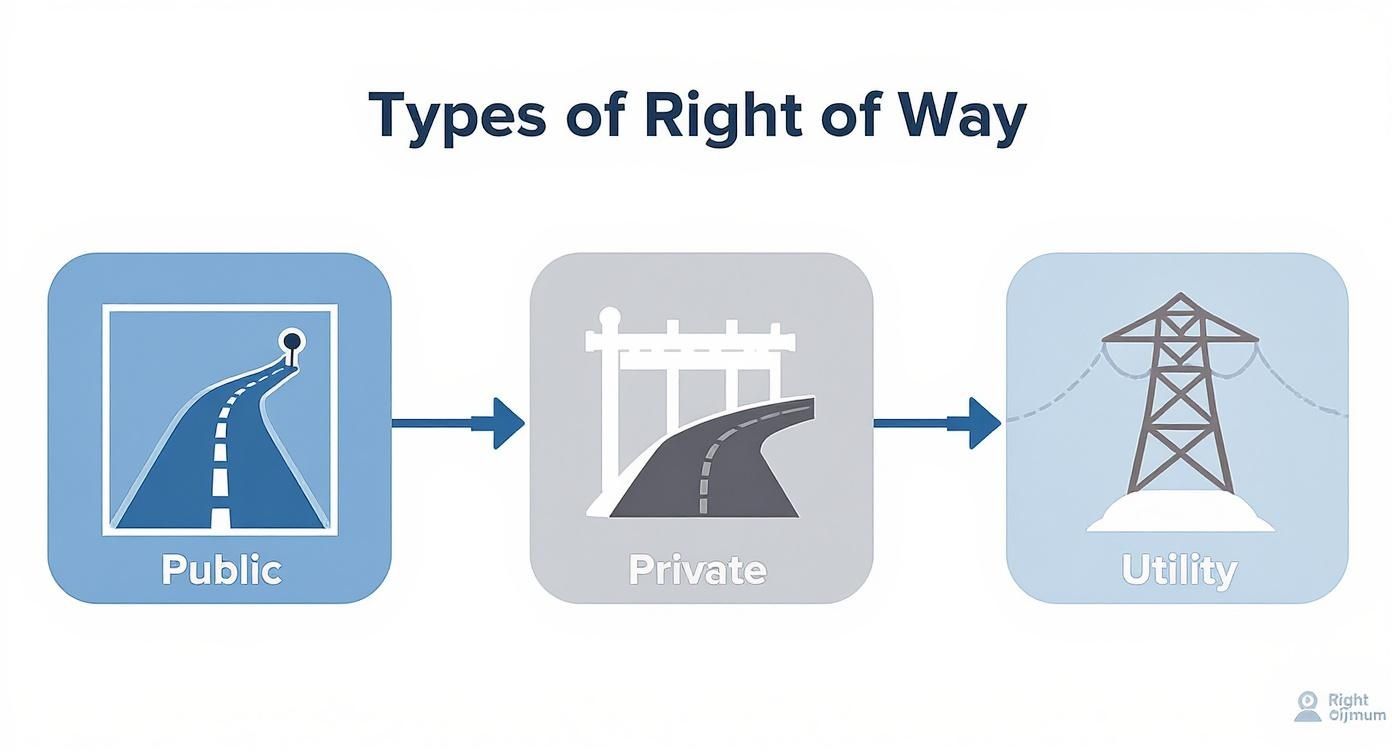
As you can see, each type—from a public road to a private driveway or a hidden utility line—carries its own set of rules and implications for the property owner.
Leveraging Technology to Cut Through the Noise
The old-school search process is incredibly time-consuming and riddled with opportunities for human error. Manually digging through decades of dense, often handwritten legal documents makes it far too easy to miss a critical clause. A single overlooked document can spiral into costly claims and legal nightmares down the road.
This is where technology changes the entire game. Modern platforms are built to automate the painstaking work of document review and data extraction, turning a manual grind into a smart, tech-powered workflow. With advanced search capabilities, you can find the crucial documents and pinpoint the relevant language in a fraction of the time.
The goal isn't just to find documents faster; it's to find the right information with greater accuracy. Technology helps you connect the dots between deeds, plats, and other records, flagging potential conflicts or unrecorded rights that a manual review might miss.
For instance, a platform like TitleTrackr can scan thousands of pages of historical records in seconds, flagging any mention of "easement," "access," or "right of way." It can even spot patterns that hint at a prescriptive use claim, giving you a major head start on investigating those tricky unrecorded rights. This approach dramatically lowers the risk of an oversight that could blow up a transaction.
By bringing these tools into your process, you shift from being reactive to proactive. Instead of just looking for what’s explicitly recorded, you can identify potential issues and investigate them more thoroughly, delivering a higher level of assurance to your clients. For title professionals, this technological shift is critical for staying accurate and efficient. To see how these modern solutions can improve your workflow, explore the specialized tools available for title abstractors and see how a better process leads to better protection. This evolution ensures that even the most hidden right of way is brought to light before it can ever become a problem.
The High Cost of Missing a Right of Way
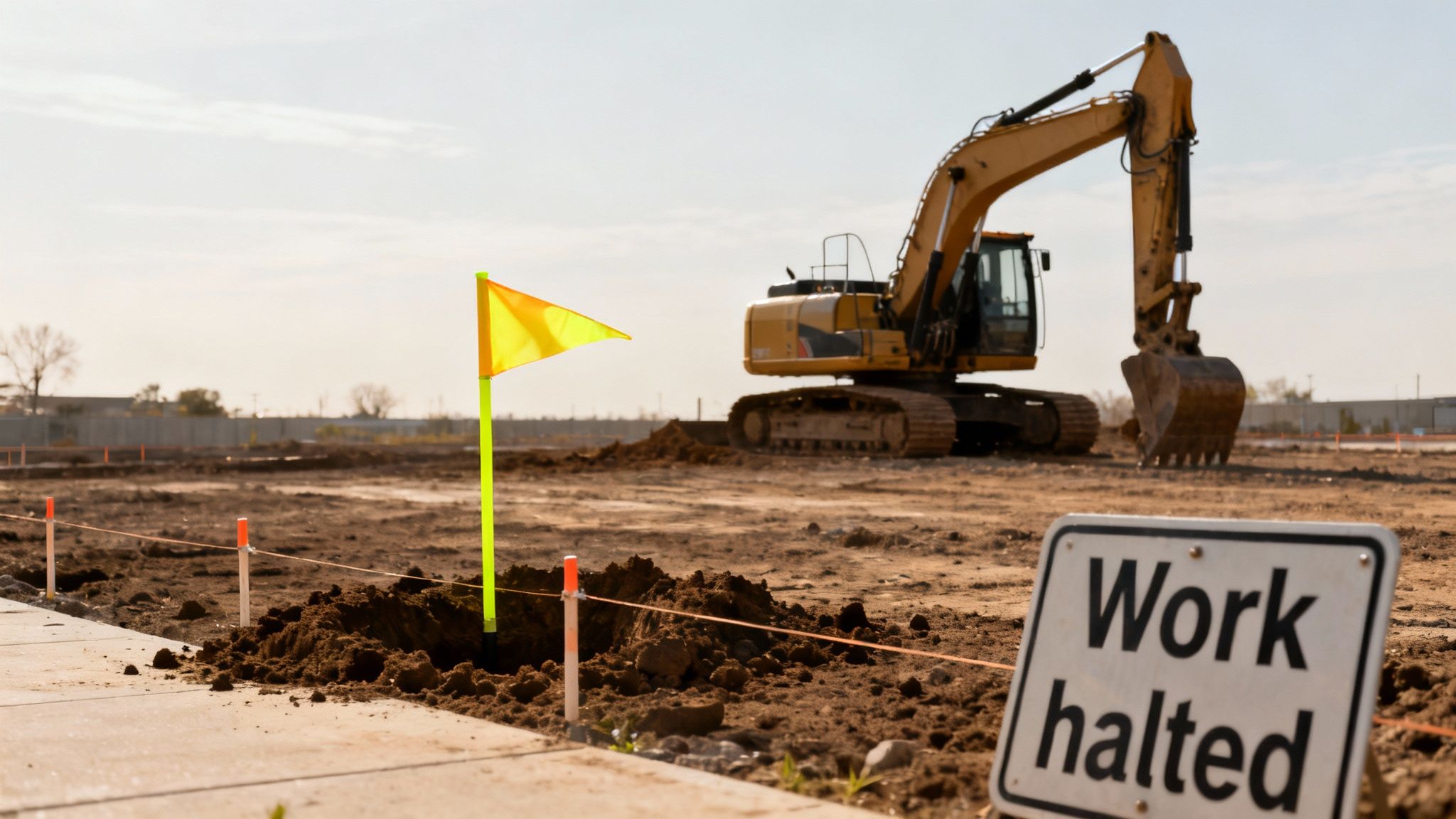
In the world of title work, there's no such thing as a "minor" oversight. Every detail matters, because a mistake isn’t just a clerical error—it's a ticking time bomb. Missing a right of way can spark some of the most catastrophic scenarios in real estate, turning a client’s dream property into a legal and financial quagmire.
The consequences aren't just theoretical. They ripple out, causing massive project delays, dragging everyone into expensive litigation, and permanently staining a professional's reputation. A single missed easement can bring a multi-million dollar development to a grinding halt or rob a new homeowner of their privacy overnight.
When Development Dreams Turn into Legal Battles
Picture this: a developer sinks $5 million into a perfect piece of land, ready to build a luxury condo complex. The title search came back clean, so they break ground. But six months into construction, a utility company shows up with a court order, shutting the entire site down.
What happened? An old, obscure utility easement—a right of way for a major underground gas line—was buried deep in a supplementary document from the 1950s. It was completely missed during a rushed manual search and runs straight through the planned foundation.
The fallout is immediate and brutal:
- Project Shutdown: Construction freezes. Crews and heavy machinery sit idle, racking up huge daily costs.
- Forced Redesign: The entire architectural plan is now useless. A complete redesign is needed, a process that will take months and add hundreds of thousands to the budget.
- Legal Fallout: The developer, understandably furious, sues the title company for negligence, kicking off a long and costly court battle.
This entire disaster was preventable. A more thorough search, one powered by technology designed to flag key terms across thousands of documents, would have caught that easement before a single shovel hit the dirt.
The Homeowner's Worst Nightmare
It's not just the big commercial projects at risk. Think about the family who just bought their forever home, complete with a big, private backyard for the kids. A few weeks after moving in, they're horrified to find strangers casually walking right through their property.
They soon discover an unrecorded prescriptive easement. For decades, the community had been using a path through their yard to get to a nearby park. Because it was never formally documented, the right of way was missed in the title search. The private sanctuary they paid for is actually a public footpath.
An undiscovered right of way transforms a property's greatest asset into its biggest liability. What was once a source of value and enjoyment becomes a constant source of conflict and intrusion.
The homeowners are now trapped. They can't build a fence, their privacy is gone, and their property value has nosedived. Their only option is to file a claim against their title insurance policy—a stressful, draining process that can't give them back their peace of mind.
The importance of clear access rights even impacts our daily lives on a massive scale. Public rights of way are tested daily by traffic congestion, a problem costing the global economy hundreds of billions each year. The average driver in London loses 46 minutes a day to traffic, while New York City holds the title for the slowest commute in the U.S. These stats, highlighted in the global traffic index data on TomTom.com, show just how critical well-defined access is.
These stories all point to one critical truth: a meticulous title search isn't just a box to check. It's the essential shield standing between your clients and financial ruin. Using powerful tools like TitleTrackr isn't a luxury—it's the foundation of modern due diligence, giving you the accuracy needed to protect both yourself and your clients from these devastating oversights.
Modern Solutions for Complex Title Searches
Uncovering every single right of way can feel like an impossible task, but modern technology offers a powerful way forward. Instead of drowning in paperwork, specialized tools help you work smarter, not harder. This shift lets you boost your accuracy, work more efficiently, and ultimately deliver better results for your clients.
Software like TitleTrackr was built to solve the biggest headaches of manual searches. It's designed to dig up obscure historical documents and flag potential problems long before they can blow up a closing. A better process simply leads to better protection for everyone involved.
From Manual Grind to Intelligent Workflow
Making the jump from traditional methods to a tech-first approach gives you an undeniable edge. Forget spending hours manually combing through dense legal documents. You can now automate the discovery process.
This shift frees you up to focus your real expertise on analysis and interpretation, not just retrieval.
Here’s how adopting a modern solution changes the game:
- Increased Accuracy: AI-powered tools scan thousands of documents in seconds, catching keywords like "easement" or "access" that the human eye can easily miss. This dramatically cuts the risk of an expensive oversight.
- Enhanced Efficiency: When you automate the repetitive stuff, you get your valuable time back. This means you can handle more work without letting quality slip, and clients get faster turnaround times.
- Proactive Risk Management: By spotting potential conflicts or unrecorded rights early on, you can deal with them head-on and stop them from derailing the entire deal.
The idea of clear right-of-way rules isn't just for property law; it’s a principle we see every day in things like traffic management. Think about roundabouts—they work because of simple, clear protocols. France, the world leader with 967 roundabouts per million people, has seen them cut fatal crashes by up to 90%.
This success story shows how a well-defined system, whether for roads or for title searches, creates safer and more efficient outcomes for everyone. You can see more data on how roundabouts are impacting global traffic safety by reviewing the full analysis on Statista.com.
Ultimately, the goal is to move from a reactive search process to a proactive strategy. Technology gives us the tools to not only find information faster but also to uncover deeper insights, ensuring every right of way is identified and understood.
See how a better process leads to better protection by scheduling your TitleTrackr demo today.
Clearing Up Common Questions About Right of Way
Even the most experienced abstractors run into confusing situations with access rights. Let's tackle some of the most common questions that pop up in the field, because getting these details right is what separates a good title search from a great one.
One of the biggest points of confusion is the difference between a right of way and an easement. It's best to think of it like this: an easement is the broad legal concept, while a right of way is just one specific flavor of it.
So, while every right of way is technically an easement, not every easement is a right of way. An easement can grant all sorts of permissions (like letting a utility company run a power line), but a right of way is strictly about the right to travel across a piece of property.
How a Right of Way Affects Property Value
This is where things can get interesting, as the impact on a property's value is a real double-edged sword. On one side, a right of way can be a property's saving grace. It can provide critical access to a landlocked parcel, instantly making it usable and much more valuable.
But on the flip side, it can be a major headache. A public right of way that sees a lot of traffic can kill a property's privacy and appeal, which can definitely drag down its market price. The financial impact really boils down to the nitty-gritty of the agreement—who can use it, why, and how often.
The most crucial takeaway is that a right of way’s value is entirely contextual. It can be a property’s lifeline or its biggest liability, all depending on the specific terms of the agreement and its physical location.
Can a Right of Way Be Removed
This is a big one. Can you get rid of a right of way? The short answer is yes, but it’s rarely a simple process. It almost always requires a specific legal action to terminate it.
Here are a few ways these rights can be extinguished:
- Mutual Agreement: If both property owners (the dominant and servient estates) agree, they can sign a written agreement to terminate the right.
- Abandonment: This is more than just not using it. The dominant estate holder has to show a clear, deliberate intention to permanently give up the right of way.
- Merger of Properties: If one person ends up owning both the dominant and servient properties, the right of way is automatically dissolved. It just merges away.
Knowing these legal routes is key when advising clients on their options. For a deeper dive into these topics and others, feel free to check out the answers on our FAQ page.
Unearthing every document tied to a right of way is a serious challenge, but it's not one you have to tackle alone. TitleTrackr uses AI to cut through the noise, helping you pinpoint critical records with more speed and precision than ever before.
Ready to see how a modern workflow can protect you and your clients? Request a demo with TitleTrackr today.
 blog.titletrackr.com
Leave a comment