

A land title search is the cornerstone of any secure real-estate transaction. It's the essential due diligence that protects against legal challenges and financial liabilities that can emerge long after a deal is closed. A comprehensive search delves into a property's history to verify true ownership and uncover any claims or liens that could jeopardize your investment.
In today's fast-paced market, this step is non-negotiable.
Why a Meticulous Title Search Is Non-Negotiable

Before diving into the methodology, it's crucial to understand the stakes. A land title search isn't just a procedural checkbox; it's a fundamental risk-management strategy. It protects buyers, lenders, and developers from costly, unforeseen problems. Cutting corners in this area can lead to devastating financial and legal consequences, derailing projects and erasing profits.
Consider the real-world risks: closing on a commercial property only to discover a decade-old, unpaid tax lien. Or worse, a previously unknown heir emerges with a valid claim to the land. These scenarios are not hypothetical; they are the direct result of incomplete or inaccurate title searches. For any serious professional, the cost of a mistake far outweighs the investment in a thorough process.
Protecting Your Investment
At its core, searching land titles is about securing your capital and ensuring the marketability of the asset. A meticulous examination of public records confirms that the seller has the legal authority to transfer the property and that the new owner will not inherit pre-existing financial burdens.
The process involves constructing a clear historical narrative of the property by verifying several key elements:
- A Clear Chain of Title: Establishing an unbroken and logical sequence of ownership. Any gaps or unusual transfers are immediate red flags requiring deeper investigation.
- Absence of Encumbrances: Identifying and resolving any liens (from mortgages or unpaid bills), easements (granting usage rights to others), or covenants that restrict property use.
- Legal Property Description: Ensuring the legal description on all documents is precise and corresponds exactly to the physical property being transacted.
A deficient search can leave your organization liable for another party's debt or entangled in complex boundary disputes.
A title search is a historical investigation into a property. Without it, you are essentially buying blind, exposing your organization to risks that could have been easily identified and resolved before closing.
The Cost of Inaccuracy
In a competitive market, speed is paramount. However, when conducting title searches, speed cannot compromise accuracy. A rushed analysis can easily overlook critical details buried in complex, poorly digitized, or handwritten records from decades past.
For example, a simple clerical error in a deed from 30 years ago can create a "cloud on the title"—a legal ambiguity that renders the property difficult to finance or sell. Resolving such issues post-closing is invariably a costly and time-consuming process involving legal counsel and significant project delays. Recognizing these risks underscores the need for precision and highlights why modern tools are becoming essential for guaranteeing accuracy without sacrificing the speed today’s market demands.
The Old-School Way: A Look at Traditional Land Title Searches
Before the advent of advanced software, a land title search was a manual, labor-intensive process. It required patience, a meticulous eye for detail, and physical visits to county courthouses or recorder's offices. This traditional method remains the foundation of the title industry, and understanding its mechanics reveals both the logic of title verification and its inherent bottlenecks.

The process typically begins at the local county recorder’s office, the repository for all official property documents within that jurisdiction. The first challenge is often simply identifying the correct office, as records are filed based on the property's physical location.
Diving into the Public Records System
Once at the correct location, one must navigate the local public records system. While many counties have digitized their records, the quality, completeness, and user-friendliness of these online systems vary dramatically. Others still rely on physical grantor-grantee indexes—large ledger books where transactions are logged by the names of the buyer and seller.
The manual workflow involves:
- Finding the Starting Point: Beginning with the current owner's name and working backward through the grantee index to locate the deed that transferred the property to them.
- Tracing the Chain of Title: Using the seller's (grantor's) name from that deed to repeat the process, moving back in time from one owner to the next.
- Examining Every Document: For each link in the chain, pulling the physical or scanned documents—deeds, mortgages, liens, releases—and scrutinizing them for red flags and critical information.
This process is painstaking. A single overlooked document or misinterpretation of an entry can compromise the entire search. This is where the expertise of professional title abstractors is invaluable; their trained eye is crucial for spotting these subtle but significant details.
Making Sense of Historical Documents
A major challenge in a traditional title search is interpreting archaic documents. Different types of deeds carry different legal implications. For example, a warranty deed offers the buyer the highest level of protection, whereas a quitclaim deed merely transfers the seller's interest without any guarantees.
The manual search process is a blend of historical research and detective work. It involves piecing together a puzzle from clues scattered across decades—sometimes centuries—of records written in archaic language and cursive handwriting.
The sheer volume of these searches highlights their importance. A recent report, for example, tracked 388,762 public searches of land registers in a single month. While this figure fluctuates with market conditions, it demonstrates the constant, high-stakes demand for accurate property verification. This manual effort is not only slow but also prone to human error, making it incredibly difficult to execute efficiently and at scale.
Navigating Common Pitfalls and Record Discrepancies
Even the most straightforward property transaction can conceal a complex web of historical errors. The title search process often feels less like following a clear path and more like assembling a fragmented puzzle. What appears to be a minor issue can quickly escalate into a major obstacle, derailing timelines and creating significant legal exposure.
Public records are imperfect. Clerical errors from decades past—such as misspelled names or imprecise legal descriptions—can create a cloud on the title. This ambiguity makes it difficult to establish clear ownership and can halt a transaction. Furthermore, unrecorded claims, such as informal family agreements or an unfiled contractor’s lien, can surface unexpectedly.
The Problem of Incomplete Records
One of the most significant challenges is a "break" in the chain of title, which occurs when a deed or other transfer document is missing from the public record. This leaves a critical gap in the ownership history, making it impossible for a manual search to verify the legitimate transfer of property from one owner to the next.
These are not isolated incidents; they reflect systemic issues in historical data management.
- Human Error: Typos and misfiled documents are common, especially in older, paper-based record systems.
- Missing Documents: Deeds can be lost, improperly recorded, or were never filed, creating gaps in the ownership chain.
- Undisclosed Heirs: When a previous owner dies without a clear will, unexpected claims from previously unknown heirs can emerge, complicating the title.
This challenge is global. The World Bank estimates that only 30% of the world's population has legally registered land titles. Moreover, less than half of all countries have fully mapped the private land within their own capital cities. This pattern of inconsistent record-keeping affects even the most developed markets. You can read more about these global land record challenges to understand the full scope of the issue.
A title search, at its core, is all about managing risk. Every discrepancy, no matter how small, represents a potential future lawsuit that must be identified and resolved before capital is committed.
Why Small Discrepancies Matter
It can be tempting to dismiss a minor name variation or a slight boundary inconsistency as trivial. However, these small details are often the first indicators of deeper problems. For instance, a quitclaim deed used to correct a typo may have inadvertently introduced a new ambiguity into the title's history.
Without a robust verification process, you are essentially gambling on an incomplete and potentially flawed historical record. This is why a surface-level data pull is so dangerous. Every document must be cross-referenced, and every link in the ownership chain must be validated to ensure the title is clear, marketable, and secure.
How AI Transforms the Title Search Process
The traditional manual title search is a foundational but flawed process, fraught with potential for human error, frustrating delays, and operational inefficiencies. After decades of relying on fragmented records and manual document analysis, the industry is now embracing a smarter, more efficient solution driven by artificial intelligence.
AI-powered platforms are revolutionizing the title search industry, delivering unprecedented gains in both speed and accuracy.
Instead of dedicating days to sifting through archaic ledgers or navigating clunky county websites, modern tools automate the heavy lifting. Platforms like TitleTrackr are engineered to instantly access and analyze millions of digital records, cross-referencing data points that would take a human researcher days to connect. This is not just about accelerating workflow; it's about achieving a superior level of precision and confidence.
Automating Discovery and Red Flag Detection
One of the most powerful applications of AI is its ability to identify potential red flags in seconds. An AI agent can scan a property's complete recorded history and immediately flag inconsistencies or issues that require expert review.
This automated system excels at catching critical issues like:
- Unresolved Liens: The system detects outstanding financial claims from mortgages, contractors, or tax authorities that could cloud the title.
- Hidden Easements: AI identifies rights-of-way or usage rights granted to other parties that might not be obvious in the primary deed.
- Chain of Title Gaps: Where a manual search hits a dead end, AI can analyze surrounding data to suggest likely connections or pinpoint the exact location of a missing record.
This automated detection serves as an expert assistant, ensuring no critical detail is overlooked. It empowers your team to focus on high-value analysis and problem-solving rather than getting bogged down in tedious data collection.
This infographic highlights the common pitfalls that AI is specifically designed to overcome.
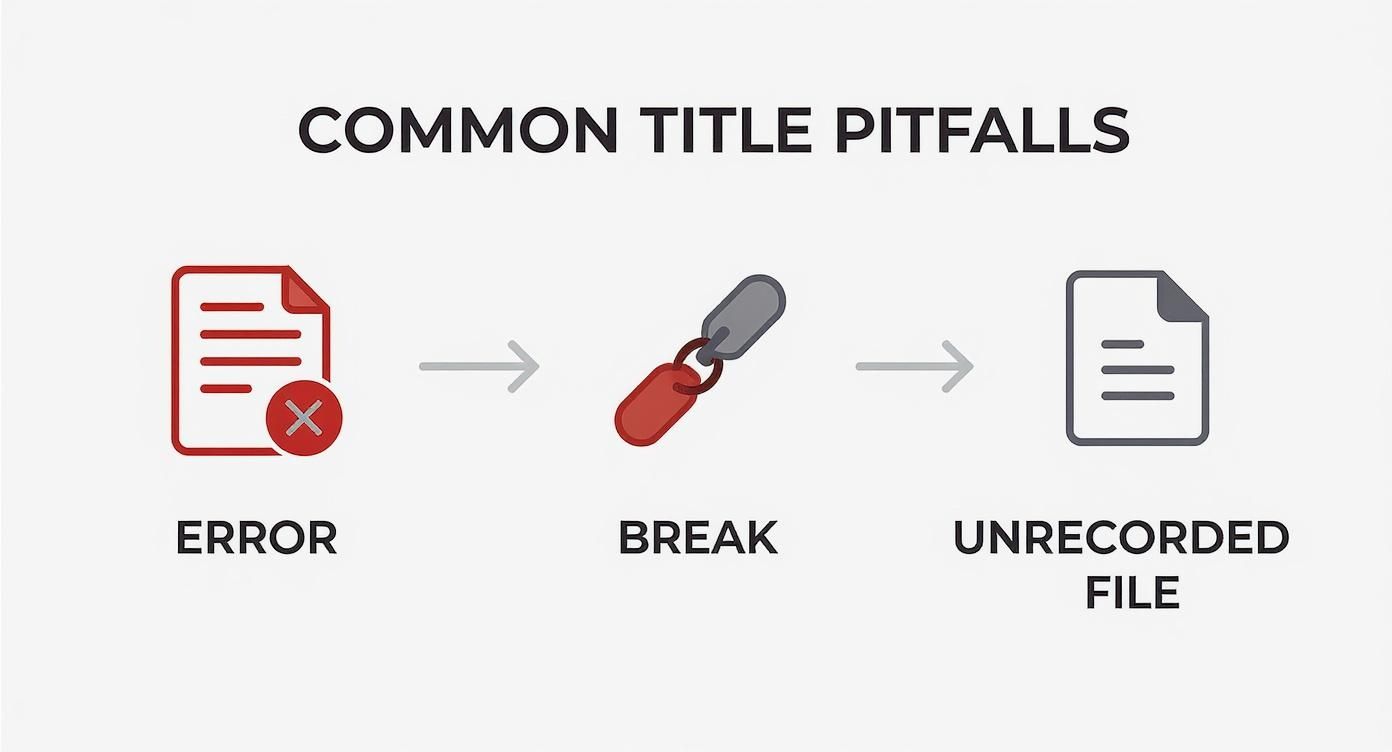
It illustrates how easily errors, breaks in the chain, and unrecorded documents can derail a manual search, underscoring the necessity of a more robust verification process.
From Days to Minutes A Real-World Comparison
To appreciate the impact, consider a common scenario: a title search for a commercial property with a complex, multi-decade history. Manually, this is a week-long project involving coordination with multiple county offices, examination of hundreds of pages of dense legal documents, and meticulous construction of the title chain. The risk of missing a single crucial document is ever-present.
Now, process the same search through an AI platform like TitleTrackr.
The system ingests the property details, executes a comprehensive search across all relevant digital records, and generates a preliminary title report in minutes. It automatically constructs a clear chain of title and delivers a summarized list of all identified liens, easements, and other encumbrances for expert review.
AI does not suffer from fatigue or overlook a detail at the end of a long day. What once required 40+ hours of manual labor can now be accomplished with greater accuracy in the time it takes to get a coffee. This is not an incremental improvement; it is a fundamental transformation of an entire workflow.
The table below provides a stark comparison between the traditional manual process and the modern AI-powered approach.
Manual vs. AI-Powered Title Search
| Metric | Manual Search Process | TitleTrackr AI Search |
|---|---|---|
| Time to Completion | 2-5 days (or more) for a standard search. | Under 15 minutes for a preliminary report. |
| Data Sources | Limited to accessible county portals, physical records. | Accesses a nationwide network of digital databases instantly. |
| Error Potential | High risk of human error from fatigue or oversight. | Minimal. AI cross-references data to flag inconsistencies. |
| Red Flag Detection | Relies on the abstractor's experience to spot issues. | Automated flagging of liens, gaps, and easements. |
| Cost | High labor costs due to extensive time investment. | Significantly lower operational costs per search. |
| Reporting | Manual compilation of reports is slow and tedious. | Instantly generates organized, easy-to-read reports. |
The advantages of AI extend beyond mere speed. The gains in accuracy and the dramatic reduction in labor costs are transforming business operations. This shift toward AI-driven searching land titles is enabling professionals in real estate, energy, and land development to close deals faster, reduce operational overhead, and deliver more reliable results to their clients.
Interpreting Your Findings and Taking Action
Data acquisition is only the first step. The true value of a land title search lies in accurately interpreting the findings and executing a clear action plan.
Whether your report was generated in minutes by an AI tool like TitleTrackr or took days to compile manually, this next phase is about converting raw data into confident, strategic decisions. The search results will illuminate any potential issues or "encumbrances" attached to the property, and a correct interpretation is critical to protecting your investment.
Decoding Common Title Issues
Your search will likely uncover various findings, each with distinct implications. Understanding their meaning is essential for effective risk management.
Common issues include:
- Liens: These are legal claims against a property for an unpaid debt, such as an unpaid mortgage, a contractor’s mechanic’s lien, or a tax bill. All liens must be satisfied and released before a clean title can be transferred.
- Easements: An easement grants another party the right to use a portion of the property for a specific purpose, such as a utility company needing access to maintain power lines.
- Covenants: These are rules or restrictions on land use, often imposed by a homeowners' association or a previous owner.
The ultimate goal is to achieve a "clear title"—one that is free from any liens, disputes, or other encumbrances. Acting decisively on your findings is the only way to get there.
Your Action Plan for Clearing the Title
Once issues are identified, swift action is crucial. In a market where transaction velocity is key, delays are costly. A recent report noted that property sale agreements skyrocketed 78.8% year-over-year, reaching a total value of $53.5 billion. In such an environment, operational efficiency is a competitive advantage. More details on this market activity can be found in this analysis of land conveyancing processes.
A methodical approach is required.
Categorize each issue by severity and begin contacting the relevant parties to resolve outstanding claims. For complex issues, such as boundary disputes or a broken chain of ownership, consulting with real estate counsel is not just advisable—it is essential.
For development projects, you can see how TitleTrackr’s AI assists with complex document analysis on our developers page.
Your Questions, Answered
Even with a comprehensive guide, specific questions arise when dealing with the complexities of land titles. Here are answers to some of the most common queries from industry professionals.
How Long Does a Typical Land Title Search Take?
The timeline varies significantly. A search on a newer property with a clear ownership history might be completed in a few hours of focused work.
However, for older properties with complex histories—involving multiple owners, foreclosures, or known title defects—a manual search can easily extend to several days or even weeks. This is where technology provides a decisive advantage. An AI-powered tool like TitleTrackr can reduce this time to minutes by automating the labor-intensive process of data retrieval and analysis.
What Is a Cloud on Title and How Is It Found?
A "cloud on title" is any document, claim, unreleased lien, or encumbrance that creates uncertainty regarding true ownership. It is a critical red flag that can halt a transaction.
Examples include a lingering claim from a previous owner's estate, a mortgage that was satisfied but never officially released in public records, or even a clerical error in a past filing. A meticulous title search is designed to detect these clouds. AI excels at this, cross-referencing millions of documents to identify minute inconsistencies that a human might overlook.
A cloud on title doesn't always kill a deal, but it must be resolved. Finding these issues early is key to keeping a transaction on schedule and avoiding costly, last-minute legal interventions.
Can I Perform a Land Title Search Myself?
Professionals can certainly conduct preliminary searches using public records, and following the steps in this guide can provide an initial assessment of a property's history.
However, for legally binding transactions, engaging a professional title service or utilizing a professional-grade platform is imperative. This is not only a best practice for risk management but is also a standard requirement for obtaining title insurance and securing financing.
For more detailed answers, please visit our comprehensive FAQ page.
Ready to see how AI can revolutionize your title search workflow, saving hundreds of operational hours while delivering more accurate results? Discover the platform that is setting the new industry standard.
 blog.titletrackr.com
Leave a comment