
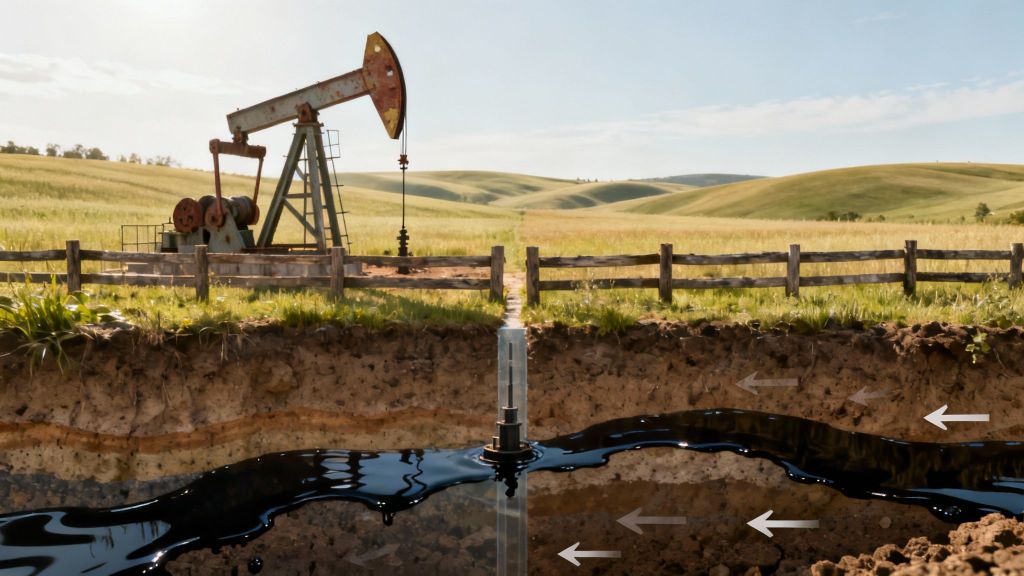
Ever heard the phrase "finders, keepers"? The law of capture is basically that, but for valuable resources hidden deep underground.
It’s a legal rule that says whoever first "captures" a free-flowing resource—like oil, natural gas, or groundwater—by bringing it to the surface gets to own it. This is true even if that resource seeped over from your neighbor's property. For any professional in the energy sector, understanding this cornerstone of property rights is not just academic—it's critical for mitigating risk and securing assets.
What Is the Law of Capture, Really?

Let's break it down with a simple analogy. Imagine a giant underground milkshake—that’s your oil reservoir—and it sits beneath several different properties. Each landowner has a straw they can stick into the ground.
The law of capture says that whoever has the longest straw and can drink the fastest gets to keep whatever they pull up. It doesn’t matter if they’re slurping up milkshake that was originally under someone else’s land. Once it’s up their straw, it’s theirs.
This "first to possess" concept gives landowners the right to extract and own whatever they can pull from their own land, creating a framework where speed and operational readiness are paramount.
The Core Idea: Possession Is Everything
At its heart, the law of capture is all about turning a shared, wandering resource into private property through physical control. Before anyone drills, the oil and gas down there don't technically belong to anyone. They're just sitting in a common pool.
But the moment a landowner drills a well and brings that oil to the surface, it becomes their exclusive property.
This principle has massive implications for landmen, attorneys, and title examiners. It creates a huge incentive—a race, really—to drill as quickly as possible to secure a share before neighboring operators drain the reservoir dry.
The rule of capture creates a clear, if not intensely competitive, framework for ownership. It’s not about where the oil came from underground, but who first grabbed it at the surface. This is why verifying clear title before drilling is non-negotiable.
This table breaks down the core tenets of the law of capture and what they mean for industry professionals.
Key Principles of the Law of Capture
| Principle | Explanation | Real-World Consequence |
|---|---|---|
| First to Possess | Ownership is granted to the first party to extract and control the resource on their own land. | Operators are incentivized to drill quickly to maximize their share, making pre-drilling title verification a critical path item. |
| Fugitive Nature | The rule applies to mobile resources (oil, gas, water) that can migrate underground. | You can legally drain a resource that originated under a neighbor’s land, as long as your well is on your property. |
| No Liability for Drainage | A landowner is not liable for draining resources from a neighboring property through legal extraction on their own land. | The only recourse for a neighbor is to drill their own well to capture their share ("offset drilling"), escalating the need for accurate leasehold data. |
| Surface Control is Key | Ownership is determined not by where the resource lies underground, but by who controls it at the surface. | Establishes a clear line for property rights, but elevates the risk associated with unverified mineral rights and leasehold interests. |
Ultimately, this seemingly straightforward rule forms the basis for incredibly complex challenges in modern resource management and title verification.
Historically, this has had a huge effect on the oil industry. The idea that you could own any oil you pumped, regardless of its origin, kicked off a drilling frenzy. Landowners raced to put up as many wells as they could, which often led to overproduction, volatile prices, and depleted fields. If you want to dive deeper, the think tank Resources for the Future has some great insights on the historical impact.
Understanding these fundamentals is the first step. As we'll see, this simple "finders, keepers" concept has spun a complicated web of regulations and legal risks, making meticulous title research more critical than ever.
The Wild West Roots of Resource Law

To really get a handle on the law of capture, you need to imagine the absolute chaos of the early American oil boom. Its legal DNA, believe it or not, has nothing to do with geology or minerals. It was actually lifted from old English common law principles designed to deal with wild animals, a concept known as ferae naturae, or "wild nature."
Centuries back, English courts had to figure out who owned a fox or a deer that wandered from one lord's estate to another. They landed on a simple rule: the animal belonged to whoever physically captured it. Ownership wasn't about where the animal came from, but about who successfully hunted it on their own property.
Fast forward to the first oil gushers erupting in states like Pennsylvania and Texas. The courts were stumped. Oil and gas, much like wild animals, were fugitive resources—they migrated unseen beneath the surface, completely ignoring the neat property lines drawn on a map. Without a specific legal playbook for these "wandering minerals," judges reached back and adapted the old rule of the hunt.
From Wild Animals to Black Gold
Applying this ancient doctrine to a modern industrial resource had explosive results. It sent a clear message to landowners: the oil under your feet isn't really yours until you bring it to the surface. Just as a fox could dart onto a neighbor's land and be legally taken, so could the oil and gas.
This kicked off a frantic, all-out race to drill. The "drill, baby, drill" mentality wasn't just about greed; it was about pure self-preservation. If you didn’t get your well pumping right away, your neighbor would, and they could legally drain the entire shared reservoir dry, leaving you with absolutely nothing.
The law of capture treated underground oil and gas like a wild herd. The resource belonged to no one until it was captured, turning property ownership into a frantic competition for extraction.
The outcome was a landscape defined by rapid, and often reckless, development. Thousands of derricks shot up side-by-side, creating a forest of steel as every landowner scrambled for their piece of the pie.
Fueling a Nation and Igniting Conflict
This fierce competition, supercharged by the law of capture, had a massive impact on the country's growth. The aggressive push in the oil industry led to huge production volumes and low prices, which helped fuel the rise of the automobile in America. In fact, this framework was seen as a good thing for meeting market demand all the way up until around 1920, as it drove the industry to expand at a breakneck pace. You can explore more about these economic impacts and the history of oil production.
But this free-for-all also caused incredible waste, endless legal fights, and dangerously depleted oil fields. It quickly became obvious that the Wild West approach to resource extraction couldn't last. The chaos it unleashed paved the way for the modern regulations and legal limits that now govern the industry, adding layers of complexity that every title professional must navigate today.
How the Law of Capture Works Today
Don't let its ancient roots fool you—the law of capture is a powerful force shaping today's energy and resource landscape. It still writes the fundamental rules for oil and gas extraction, but its application has grown much more complex over the years. From old-school vertical wells to modern hydraulic fracturing, the core idea holds: you own what you can pull out of the ground from your own property.
This doctrine gets really interesting with fracking, where an operator can tap into massive underground formations that stretch far beyond their lease lines. Even if a hydraulic fracture crosses into a neighbor's mineral estate, the operator who kicked it off is generally entitled to every drop of oil or gas that flows back. The neighbor’s only real option isn't a lawsuit for trespass—it's to drill their own well and start competing.
But this "finders, keepers" rule isn't just for oil. It also plays a huge role in who gets to use groundwater, though state laws have added plenty of twists and turns to that story.
Application in Oil and Gas Production
In the world of oil and gas, the law of capture basically sets up a system of competitive extraction. A single well drilled on one piece of land can legally drain oil from a reservoir shared with the property next door. This reality is the bedrock of the industry's entire operational strategy, driving decisions on where to drill and how fast to get pumps running.
- Traditional Drilling: With conventional vertical wells, the rule encourages landowners to drill "offset wells" right along their property lines. It’s a defensive move to counteract a neighbor's well from siphoning away their resources.
- Hydraulic Fracturing (Fracking): In the vast shale plays, the law protects operators who fracture rock formations deep underground. Even if those fractures creep across lease lines, the operator gets to keep whatever they extract.
This is precisely why knowing the exact lease boundaries and mineral rights is so critical. For professionals in this space, solid data isn't just helpful, it's non-negotiable. Having the right resources for landmen is essential for sorting through these tangled ownership puzzles.
The law of capture forces a "use it or lose it" mindset. It essentially tells mineral owners, "If you don't get your resources out of the ground, your neighbor will." This puts incredible pressure on getting title verification done right—and right now.
Groundwater Rights: A Different Story
When it comes to water, things get a lot more complicated. Unlike oil and gas, which are often treated as simple commodities, water is recognized as a vital public resource. That fundamental difference has led to some major legal forks in the road.
Texas, for instance, is famous for its strict, almost absolute, adherence to the rule of capture for groundwater. A landowner there can pump as much water as they want from beneath their property, even if it dries up their neighbor's well, and they generally won't be held liable.
But many other states have backed away from this model, putting more guardrails on water extraction.
- Reasonable Use Doctrine: This approach, popular in many states, lets landowners use groundwater for beneficial purposes on their own land. But it stops them from being wasteful or shipping water off-property if it hurts their neighbors.
- Correlative Rights Doctrine: Common in places like California, this rule views landowners as having shared rights to the aquifer below. Everyone is entitled to a reasonable share, not just whoever can pump the fastest.
These state-by-state differences show that the law of capture isn't a one-size-fits-all rule anymore. Its modern-day application is a patchwork quilt of old legal precedent and new regulations, all trying to strike a balance between private property rights and the public's need for sustainable resources.
Modern Limits on the Rule of Capture
The old "drill, baby, drill" free-for-all sparked by the law of capture simply couldn't last. The absolute chaos of the early oil booms made one thing crystal clear: an unchecked rule just leads to wasted resources, permanently damaged reservoirs, and a never-ending parade of lawsuits.
To rein things in, states and regulatory bodies stepped up. They built a framework of legal guardrails to balance an individual landowner's rights with the need for smart, efficient resource development for everyone.
While the core idea of capture is still with us, it’s no longer a wild west scenario. Today's operators have to work within a complex system of limits designed to promote fairness and prevent the kind of physical and economic waste that once defined the industry. These modern rules don't get rid of the law of capture; they just bring it into a more sustainable, modern era.
The Doctrine of Correlative Rights
One of the biggest checks on the rule is the doctrine of correlative rights. The easiest way to think about it is as a "fair share" principle. It’s a legal concept that says every mineral owner over a common reservoir has a right to a reasonable shot at producing their equitable portion of the oil and gas without being wasteful.
What this means in practice is that you can't drill in a way that intentionally or negligently harms the shared reservoir. For example, an operator can't just crank production to excessive rates if it tanks the natural reservoir pressure, because that could stop others from ever getting their share of the resources out of the ground. It puts a brake on the aggressive nature of the capture rule by adding a duty to act like a responsible neighbor.
Well Spacing and Density Rules
To stop that iconic—but incredibly inefficient—sight of oil derricks packed shoulder-to-shoulder along property lines, states brought in well spacing rules. These regulations are straightforward: they dictate how far apart wells must be from each other and from property lines.
For instance, a state agency might say that for a specific oil formation, only one well can be drilled per 40-acre tract. This simple rule prevents over-drilling, protects smaller landowners from getting boxed out by bigger neighbors, and helps ensure the entire reservoir is drained much more efficiently.
These regulations effectively transform the law of capture from a mad dash into an orderly process. They ensure that resource extraction is guided by geology and engineering, not just a race to the property line.
Pooling and Unitization Agreements
Maybe the most advanced limits on the law of capture are pooling and unitization. In the modern world of oil and gas, especially with shale plays where horizontal wells can stretch across dozens of small properties, these legal tools are absolutely essential.
- Pooling: This is the act of combining small or oddly shaped tracts of land into a single drilling unit that meets the state's spacing requirements. All the mineral owners within that "pooled" unit share in the royalties from the single well, usually based on how much of their land is in the unit.
- Unitization: Think of this as pooling on a massive scale. Unitization involves combining all, or a very large part, of a producing reservoir into one giant unit. A single operator then develops the entire field as a whole. This approach maximizes how much oil and gas can be recovered and ensures every owner gets their fair slice, completely eliminating the need for competitive drilling.
These cooperative agreements fundamentally change the "every person for themself" dynamic of the original capture rule. They force efficiency and fairness into the equation, but they also add a new layer of complexity to any title search. The rule of capture has massive implications for both the economic and environmental sides of oil extraction, and historically, it pushed landowners to drill too many wells, often reducing the total amount of oil recovered.
To fix this, states passed laws to protect the correlative rights of neighboring landowners, with bodies like the Texas Railroad Commission creating conservation laws to regulate how resources are pulled from the ground. You can learn more about these U.S. oil and gas regulations and their history.
Why the Law of Capture Complicates Title Searches
When it comes to title work, the law of capture turns a standard property examination into a high-stakes, three-dimensional puzzle. On the surface, a title search seems straightforward: you verify ownership of a piece of land. But because resources like oil, gas, and water are fugitive—meaning they migrate underground—a simple check of the surface title is dangerously incomplete.
A proper examination demands a much deeper dig. Title professionals have to go way beyond surface deeds to untangle a complex web of severed mineral rights, dense lease agreements, and overlapping regulatory orders. The very nature of these assets means what your neighbor does on their property can directly impact the value and rights of the land you're examining.
This creates some serious challenges. A title that looks clean at first might actually be burdened by a mineral severance from decades ago or tied up in a pooling agreement that splits royalties in ways you'd never see in the public record.
The Hidden Risks in Title Verification
Getting this wrong can have severe financial and legal blowback. An overlooked lease clause or a simple misunderstanding of how correlative rights apply in a particular field can spell disaster. These aren't just hypotheticals; they turn into real, costly problems.
Some of the most common pitfalls include:
- Costly Litigation: Arguments over drainage or who gets paid what can lock up assets in court for years, draining money and bringing projects to a dead stop.
- Lost Royalties: A botched title search could mean mineral owners completely miss out on royalty payments they are rightfully owed from a well in a pooled unit.
- Worthless Drilling Permits: An operator might sink millions into preparing a well, only to find a fatal flaw in the mineral title that invalidates their permit and turns their investment into a total loss.
These hidden liabilities make verifying ownership incredibly difficult. For a closer look at the hurdles involved, our resources for title abstractors and searchers offer some valuable context on how to tackle these issues.
Under the law of capture, you aren't just verifying ownership of a static piece of land; you're confirming rights to a dynamic, shared resource that is constantly in motion and subject to the actions of others. This fundamental uncertainty is the core challenge.
The infographic below shows how modern rules like correlative rights and pooling add even more layers for title professionals to sort through.
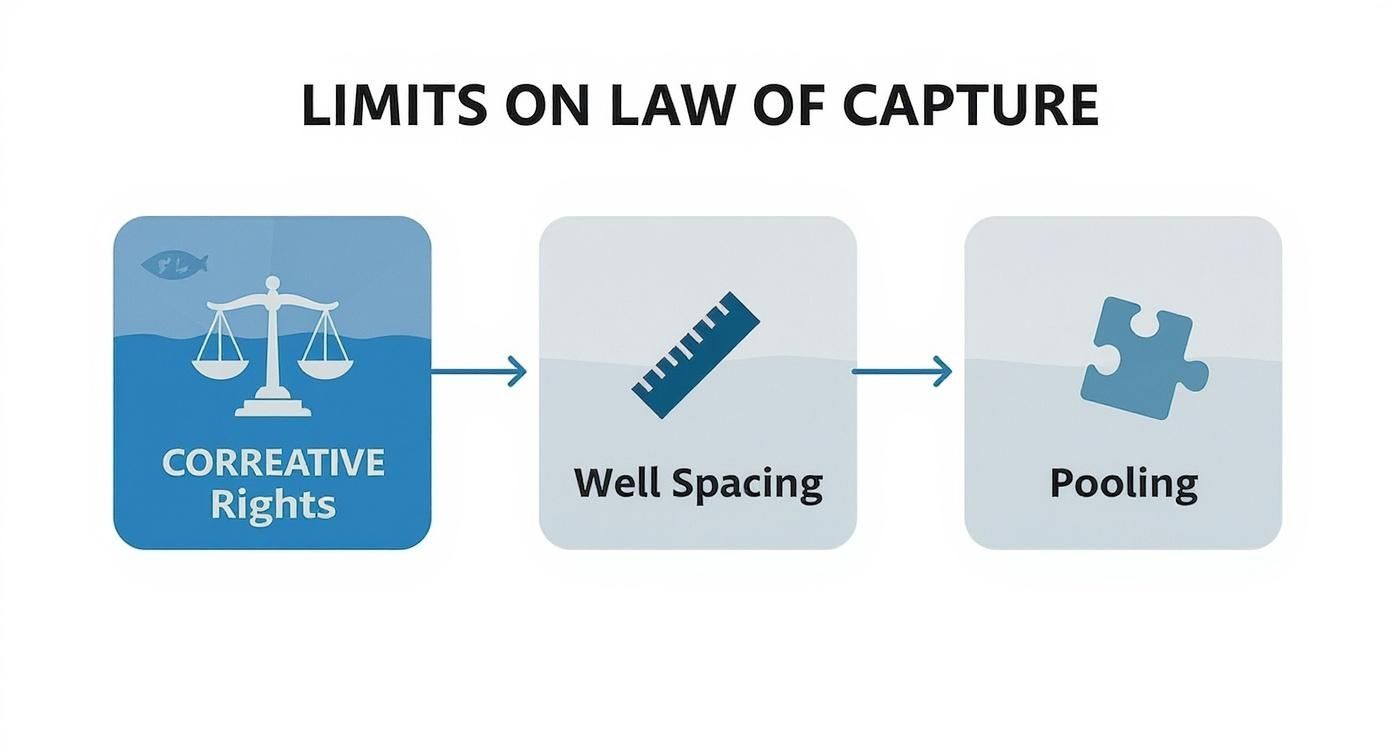
This decision path makes it clear: while the law of capture is the starting point, a title search has to account for all the regulatory frameworks that tweak those basic rights, adding critical steps to the verification process.
The Urgent Need for a Better Solution
The sheer volume of paperwork—from deeds and leases to division orders and regulatory filings—can be crushing. Trying to manually cross-reference all this information is not only painstakingly slow but also ripe for human error. A single missed document or a misinterpreted clause can break the entire chain of title.
This environment screams for a specialized, accurate, and efficient solution. To protect assets and make sound decisions, industry professionals need a way to cut through the noise, quickly spot potential conflicts, and get a clear, complete picture of all the property rights involved. Navigating the minefield created by the law of capture requires more than just diligence; it requires the right tools.
Navigate Title Complexity with TitleTrackr
The law of capture creates a minefield of potential title defects. Sifting through decades of deeds, leases, and regulatory filings by hand isn't just slow—it's a recipe for expensive mistakes.
A single missed pooling agreement or a severed mineral right can derail an entire project, sparking legal battles and vaporizing royalties. In this high-stakes environment, you need a tool built for absolute clarity and speed.
That's where TitleTrackr comes in. It's engineered to cut through the complexity. Our platform gives title examiners, landmen, and legal teams a powerful advantage by automating the grunt work of data aggregation and untangling convoluted mineral rights chains.
It actively flags potential conflicts, from correlative rights issues to confusing unitization agreements, giving you a crystal-clear picture of who owns what.
Stop losing hours to manual document review and kill the risk of human error. TitleTrackr slashes verification time and delivers accurate, actionable insights that protect your assets and get you to the finish line faster.
See the difference for yourself. We invite you to explore how our platform works with a complimentary trial of TitleTrackr and find out how much time you can save.
Got Questions? We've Got Answers
The law of capture can feel like a throwback to a different era, mixing old-school property rules with today’s complex regulations. It's no wonder questions pop up. Here are some of the most common ones we hear from industry professionals navigating these complexities.
Can I Sue My Neighbor for Draining Oil from Under My Land?
In a world with only the pure, old-school law of capture, the answer is generally no. If your neighbor drills a well on their own property and starts pulling up oil from a reservoir you both share, your main recourse is to drill your own "offset" well to get your fair share. It was basically a race to the bottom.
But that’s not the whole story anymore. Modern state regulations on well spacing, pooling, and something called correlative rights have seriously changed the game. These rules offer real protection against a neighbor acting negligently or wastefully, making sure you have a fair shot at the common pool.
What’s the Difference Between Mineral and Surface Rights?
Think of it like a two-layer cake. Surface rights give you control over the top layer—the land itself and any buildings on it. Mineral rights, on the other hand, give you ownership of what’s underneath that surface, like oil, gas, and other resources. These two sets of rights can be sliced apart and sold to different people.
Here’s the kicker: the owner of the mineral rights almost always has the legal right to use the surface as reasonably needed to get to those underground resources. This is a massive detail in any property deal in places rich with oil and gas.
This very separation of rights is what makes title searches so tricky. A perfectly clean surface title tells you absolutely nothing about who owns the valuable stuff underground—and that’s where the law of capture comes into play.
How Does Unitization Put a Leash on the Law of Capture?
Unitization is one of the most powerful tools used to tame the "every person for themselves" nature of the capture rule. It’s a process where multiple properties sitting over a single reservoir are consolidated and operated as one big, coordinated unit. The whole wasteful race to drill is called off.
Instead of a dozen different owners frantically pumping, the entire field is developed in the most efficient way possible. Royalties from production are then shared among all the mineral owners based on a formula they agreed on beforehand. It’s a cooperative approach that gets more resources out of the ground and makes sure everyone gets a fair piece of the pie.
Navigating the tangled web of mineral rights and title issues demands absolute precision. TitleTrackr was built to bring that kind of clarity to your work, automating document analysis and flagging potential conflicts so you can make decisions with complete confidence. See how it works and request a demo with TitleTrackr today.
 blog.titletrackr.com
Leave a comment