

Trying to find out who owns a piece of property is rarely a simple Google search. In the U.S., property ownership information is technically a matter of public record. The catch? Those records are often siloed in local county assessor's or recorder's offices, forcing professionals to navigate clunky, county-specific websites or even take a trip to the courthouse. For any serious real estate, energy, or legal professional, this manual process is a major bottleneck.
The first step is always identifying which local jurisdiction holds the keys to the property's records, but that's just the beginning of a complex, often frustrating, journey.
Why Is Finding a Property Owner So Difficult?

Before diving into the "how," understanding the "why" is crucial for any industry professional. The single biggest obstacle is that the United States has no central, national database for property ownership. Instead, we operate on a patchwork of thousands of disconnected systems at the county level.
This decentralized approach means real estate professionals, investors, and landmen are stuck navigating a maze of different rules, processes, and record-keeping styles for every single county. The data is completely siloed. A search process that works perfectly in one Texas county might be useless in the one right next door, killing efficiency and introducing unnecessary risk.
The Challenge of Outdated and Disconnected Systems
A surprising number of counties still rely on outdated systems—records that haven't been digitized and are stored only on paper or microfilm. This creates a massive roadblock for anyone trying to conduct research remotely and efficiently. The quality and accessibility of these local land registries vary wildly, turning what should be a straightforward task into a time-consuming investigation.
This isn't just a U.S. problem. Globally, the situation is even more fragmented. World Bank experts estimate that only about 30% of the world's population has a legally registered title to their land. Many countries are decades behind on converting their land registries to digital formats, making online searches a non-starter. You can dig into more data on global land ownership challenges to see how different places handle these records.
This lack of a unified system is intentional, rooted in a long tradition of local governance over property matters. For modern professionals who need fast, accurate data, though, it’s the single biggest bottleneck in their workflow.
The Rise of Anonymous Ownership
As if fragmented systems weren't enough, another growing headache is the use of anonymous LLCs and trusts to hold property. A search might turn up a generic-sounding entity like "123 Main Street Holdings, LLC" instead of the actual person behind it. While a common strategy for privacy, it adds another frustrating layer of complexity for anyone trying to identify the true owner.
Unraveling these corporate veils requires a new level of detective work, cross-referencing county records with state business registries and other databases. Understanding these hurdles is the first step toward building a smarter search strategy—and it makes a clear case for why modern tools that automate this process are becoming essential for any professional serious about property research.
Getting Your Hands on Public Records
The traditional, tried-and-true method for finding a property owner is going straight to the source: public records. For decades, this has been the bedrock of property research. These essential documents are managed at the county level, typically by two key offices: the County Assessor and the County Recorder (sometimes called the County Clerk).
Think of these two offices as holding different chapters of a property's life story.
The County Assessor's office is focused on property taxes. Their records are a fantastic starting point because they directly connect a piece of land to a taxpayer—the owner. The County Recorder's office is where you'll find the legal paper trail: deeds, mortgages, liens, and other documents that show the property's transaction history. Both are crucial for a thorough search.
Your First Stop: The County Website
Most counties now have online portals where you can search these records. The challenge? The quality of these websites varies wildly. Some are modern and user-friendly, while others feel like a time capsule from 1998, slowing down your workflow considerably.
To start your search, you'll need at least one of these pieces of information:
- Property Address: The most common starting point. A simple search should pull up the property's file.
- Assessor's Parcel Number (APN): Every property gets a unique APN for tax purposes. If you have this number, it’s a direct link to the exact record you need, cutting through any confusion.
- Previous Owner's Name: If you know who owned the property before, you can trace the chain of title forward to find the current owner.
This is the fundamental process at the county assessor's office—connecting an address to a parcel number to an owner.
As you can see, all these data points are linked together in the local government's system. They form the fundamental building blocks of any property search you'll ever do.
What to Do When You Hit a Brick Wall
It happens to every professional. The online portal is down, the records aren't digitized, or the property is owned by an anonymous LLC. When the trail goes cold online, you might need to physically visit the county office or bring in a local professional.
This is where you feel the full weight of America's decentralized approach to property records.
Here's a staggering fact: the U.S. has around 3,200 counties, and there's no standardized national system for managing parcel data. Property records are a patchwork quilt of local histories and unique filing systems, which directly impacts how easy—or how difficult—it is to find reliable owner information.
This fragmentation is exactly why local expertise is priceless. Professionals like title abstractors are masters of their domain, fluent in the specific quirks of their local county offices. They know the ins and outs of local record-keeping and can often dig up information that’s practically invisible to an outsider. You can learn more about the specialized role of title abstractors and see how they tackle these very challenges.
When your own search stalls, turning to their expertise or a powerful automation tool is the smart next move.
Using Digital Tools and Online Databases
While digging through county websites is the foundational first step, real efficiency gains come from using dynamic digital tools that move beyond basic document searches into something far more interactive and intelligent.
One of the best examples is the Geographic Information System, or GIS. A GIS map is a "smart map." It takes a standard map and layers it with valuable property data—parcel boundaries, zoning rules, and, most importantly, owner information.
This allows you to visually scan an entire neighborhood, click on any property, and instantly see its associated public records. It’s a game-changer for scouting multiple properties or when you don't have a specific address to work with.
The Wild West of Third-Party Databases
Beyond free county GIS tools, there's a huge market of third-party property databases. These services aggregate data from thousands of county offices and other public sources, packaging it into a single, user-friendly platform. The promise is a one-stop-shop that saves you from bouncing between dozens of clunky government websites.
But before you invest, you need to understand the trade-offs.
- The Good: They usually have a much cleaner interface, faster search functions, and extra data points like a property’s sales history or estimated value.
- The Bad: That convenience comes at a price—subscriptions can be expensive. More importantly, the data itself is often outdated. Since they are aggregating information, there can be a significant delay, meaning the records you’re looking at could be weeks or even months old.
The real issue with many of these digital tools is that they’re just repackaging the same old fragmented public data. They make it look nicer and search faster, but they don't fix the underlying problems of inaccuracy or the headache of unraveling complex corporate ownership structures. This is the crucial gap between simple data aggregation and true, automated title intelligence.
This challenge isn't just local; it's global. The ability to find and verify property owners is directly linked to a country's legal framework. According to The Heritage Foundation's Property Rights Index, the global average score for property rights is a dismal 53 out of 100. This shows massive differences in how transparent and reliable property data is worldwide.
Countries with strong property rights tend to have public records you can trust. You can see how property rights impact data accessibility for yourself.
Ultimately, these tools are a step up from manual research, but they are a bridge, not the destination. They pave the way for the next generation of platforms that deliver real-time, verified answers without the runaround.
Comparison of Property Search Methods
Choosing the right method depends on your specific needs—are you just casually curious, or are you conducting serious due diligence? This table breaks down the common approaches to help you decide.
| Search Method | Typical Cost | Speed | Data Accuracy | Best For |
|---|---|---|---|---|
| County Clerk/Recorder | Free to low-cost (for copies) | Slow | High (Primary Source) | Verifying specific documents or legal filings when time is not a factor. |
| County GIS Maps | Free | Moderate | Generally Good | Visually identifying properties in a specific area without an address. |
| Third-Party Databases | Subscription-based ($$ – $$$) | Fast | Varies (often has a lag) | Quick lookups, getting a broad overview, and accessing aggregated data. |
| Hiring a Professional | High ($$$$) | Varies | Very High | Complex commercial deals, legal disputes, or when 100% accuracy is required. |
| TitleTrackr | Subscription-based | Instant | High (Real-time verification) | Automating the entire search process for real estate professionals. |
Each method has its place. Manual county searches are the gold standard for accuracy but are slow. Third-party databases offer speed but can sacrifice reliability. For professionals who need both speed and accuracy, an automated solution like TitleTrackr is the clear path forward.
Dealing With Complex Ownership Structures
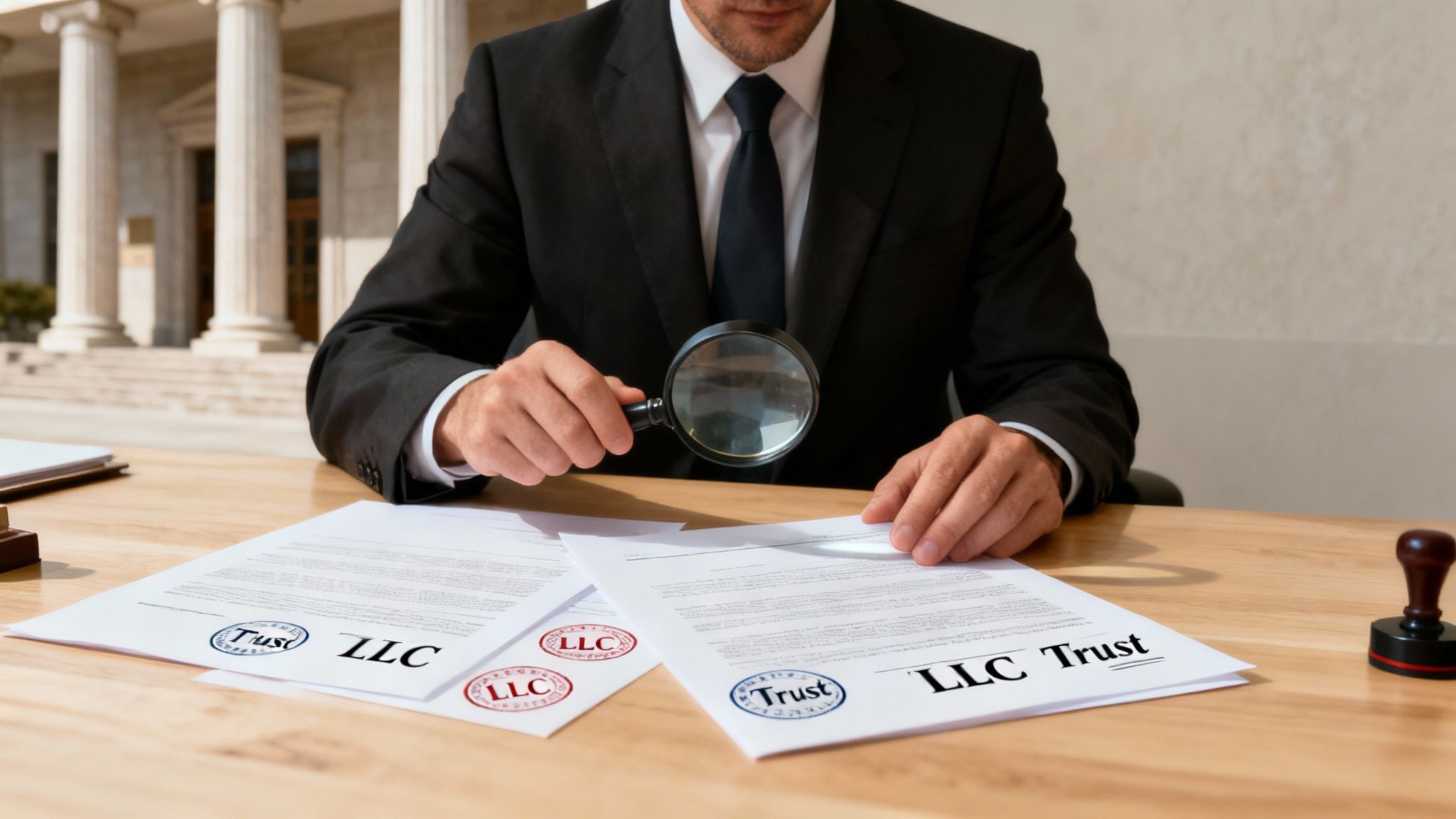
You’ve done everything right. You dug through the county assessor’s site, found the parcel number, and even pulled the latest deed. But the owner isn’t a person. It’s "123 Elm Street Holdings, LLC" or "The Smith Family Revocable Trust."
This is where most manual property searches hit a brick wall. It’s a frustrating moment, but it’s not the end of the road.
When ownership is masked by a legal entity, your strategy must shift. You're no longer just looking for a name; you're peeling back the layers of a legal structure. The key is knowing where to find the next piece of the puzzle.
Unmasking an LLC or Corporation
If a property is owned by a Limited Liability Company (LLC) or a corporation, the county recorder's office is just your starting point. These business entities must be registered with the state, usually through the Secretary of State’s office. This creates a new trail of public records to follow.
Every state has a searchable business registry online. By plugging in the name of the LLC, you can often uncover crucial details that link the faceless entity back to real people.
- Registered Agent: The person or service legally designated to accept official mail for the LLC.
- Principal Office Address: This address can point to the business's physical location or where its managers operate.
- Members or Managers: Depending on the state’s filing requirements, you may find the names of the people who manage or own the company.
Suddenly, your property search has turned into a corporate investigation. You have to jump from county-level property data to state-level business filings. It's a manual, often clunky process that highlights why a connected data solution is so valuable. The headache of navigating these separate systems is something professional landmen work to overcome daily in their research.
Decoding Properties Held in Trusts
Trusts throw a different—and often trickier—wrench into the works. A trust is a private legal arrangement. The trust document itself, which names the beneficiaries (the real "owners"), is not a public record. This can be a huge roadblock when you're trying to figure out how to find property owner name for a property held in trust.
However, you are not out of options. The key public document is the deed that transferred the property into the trust. This document will almost always name the trustee—the person or entity responsible for managing the trust’s assets.
The trustee is your most important clue. While they may not be the ultimate beneficial owner, they are the legal point of contact and decision-maker for the property. Finding the trustee’s name on the deed gives you a concrete person to research further.
In some cases, the deed might also mention the date the trust was created, which can help you distinguish it from other trusts with similar names.
Tackling these advanced searches manually is possible, but it consumes valuable time and requires cross-referencing multiple, disconnected databases. It’s exactly where the limits of traditional search methods become crystal clear, pushing professionals toward tools that can connect these dots automatically.
Automate Your Search with TitleTrackr
If you've ever found yourself lost in the maze of county websites, GIS maps, and state business registries, you know how frustrating and time-consuming manual searches can be. Every step is a time-suck, pulling you away from high-value work. Professionals can spend hours—sometimes days—piecing together a puzzle from a dozen different sources, just hoping the final picture is accurate.
This is where projects stall and competitive advantages are lost. While traditional methods have their place, relying on them alone means you're always playing catch-up. What if you could turn that multi-day research grind into a few clicks?
Beyond Simple Data Aggregation
Many online databases are just repackaging the same public data you could find yourself, often with a serious time lag. TitleTrackr is engineered differently. It’s not just a database; it’s an automation engine that actively pulls and cross-references information in real time from countless sources—county records, corporate filings, tax data, and more.
This means you get a complete, verified ownership picture without the manual legwork. The platform is built to handle the complex situations that trip up other tools.
- Corporate Shields: Instantly connect an LLC or corporation back to its registered agents and key members.
- Trustee Identification: Cut through the noise and quickly identify the trustee for properties held in a trust by analyzing the deed directly.
- Chain of Title: See the entire ownership history laid out clearly, saving you from having to pull and read every single document by hand.
It’s the difference between being handed a box of puzzle pieces and seeing the finished picture, synthesized and presented in a single, clean dashboard.
The screenshot above shows how TitleTrackr brings together complex ownership data, so you don't have to jump between a half-dozen websites to connect the dots yourself.
Reclaim Your Time and Gain an Edge
The real value here isn't just about finding information; it's about getting back the hours lost to clunky, inefficient workflows. Professionals who switch to this level of automation report efficiency boosts of up to 90%. Imagine what your team could achieve with that reclaimed time.
The question stops being "how do I find the property owner's name?" and becomes "how fast can I get a verified answer and move on to the next deal?" This shift from manual digging to automated discovery is what separates the top pros from everyone else.
You’re no longer just finding a name. You’re getting instant access to the full story behind the property. This leads to faster due diligence, more accurate assessments, and the ability to make smarter decisions when it counts. It’s the definitive solution for anyone who needs reliable property owner information without the endless runaround.
Ready to see how it can transform your workflow? Request a demo with TitleTrackr and discover a faster, more accurate way to work.
Common Questions About Finding Property Owners
Even with a solid strategy, questions inevitably arise during a property search. Here are answers to some of the most common ones industry professionals encounter.
Getting these answers straight will help you move forward with more confidence and clarity.
Is It Legal to Look Up a Property Owner's Name?
Yes, it is 100% legal. In the United States, property ownership is public information. This is a core principle of property law, supported by regulations like the Freedom of Information Act (FOIA). Government bodies like county recorder's offices are required to make this data accessible to the public.
However, there’s a critical distinction between accessing information and using it. Looking up an owner's name for legitimate real estate research, due diligence, or legal matters is perfectly fine. The line is crossed when that information is used for purposes like harassment or illegal marketing, which are regulated by privacy laws.
Why Can't I Find the Owner on Zillow or Redfin?
This is a frequent point of confusion. You're browsing Zillow or Redfin and see property history and tax data, but not the owner's name. This is by design.
These sites are real estate marketplaces, not public record databases. Their business model is to connect you with a real estate agent, who then acts as the gatekeeper to more detailed information. They intentionally omit verified owner names to protect homeowner privacy and maintain their lead generation process.
While useful for a quick overview of a property's sales history or tax assessment, they are not the official source for ownership. For that, you must go to the primary source—county records—or use a professional tool that pulls directly from them.
Think of it this way: Zillow gives you the story of the house, but official records and specialized platforms like TitleTrackr give you the legally verified story of its ownership.
What If the Property Is Owned by an LLC or Trust?
Encountering a property owned by an LLC or trust is not a dead end—it's a pivot point. This is the most common roadblock professionals face, and where manual research becomes most time-consuming.
When you find an LLC, your next step is the Secretary of State's business registry for the state where the LLC was formed. A search there can uncover the registered agent, managers, or even members of the company.
Trusts are more challenging, as they are designed for privacy. The trust agreement itself is private, but the deed transferring the property into the trust is a public document. That deed will name the trustee—the person or entity legally in charge of managing the property. Finding the trustee provides a name and a direct point of contact for your research. Answering how to find property owner name in these situations is about connecting the dots between different government systems.
Stop wasting hours trying to piece together incomplete data. TitleTrackr automates this entire hunt, linking county property records with state business filings to give you a complete, verified ownership picture in seconds. Request a demo with TitleTrackr and see how you can get that time back.
 blog.titletrackr.com
Leave a comment