

Think of a title abstract as the complete biography of a property. It’s a detailed, chronological collection of every public record tied to a specific piece of land, telling its story from the original owner all the way to the present day. For professionals in real estate, energy, and land management, this historical record is the absolute foundation for secure, profitable transactions.
Unpacking the Property's Backstory
Imagine you're evaluating a high-value asset, like a classic car. You wouldn't invest without a detailed history report, right? You'd need to know about previous owners, any accidents, or outstanding loans. A title abstract serves the exact same purpose for a piece of property, just on a much deeper and more critical level. It’s the comprehensive report that answers the tough questions before you invest.
The main goal is to verify that the seller has a "clear title," meaning they hold the undisputed legal right to sell the property. This deep dive uncovers potential problems that could otherwise kill a deal or spark costly legal battles down the road.
These hidden issues can be anything from:
- Unpaid property taxes from a decade ago
- An old mortgage that was never officially marked as paid
- Legal claims from a previously unknown heir
- Easements granting a utility company rights across your land
This process essentially brings together all the puzzle pieces—deeds, maps, tax records, and legal filings—to form a complete picture of ownership.
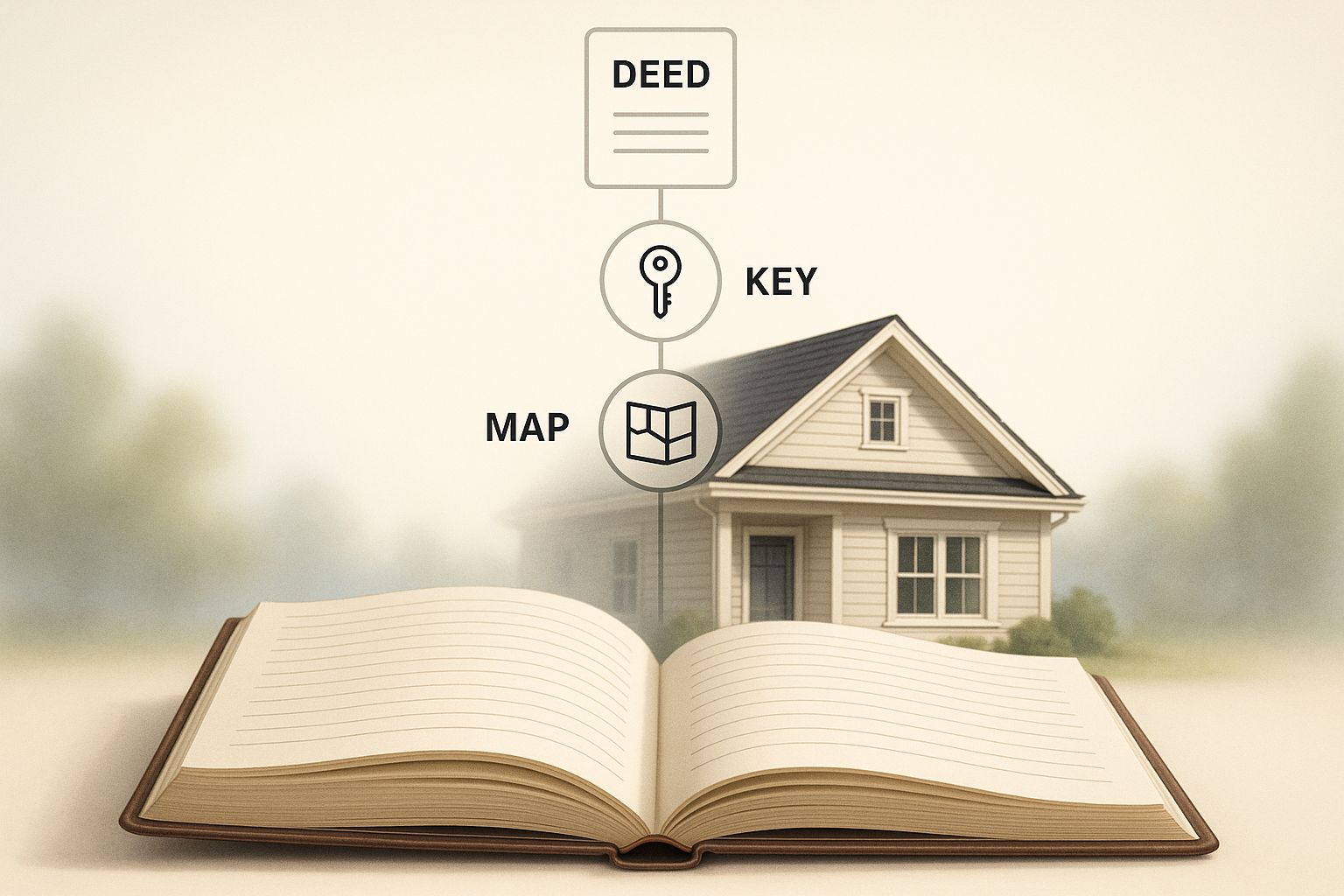
As you can see, the abstract weaves together all these different documents into a single, cohesive story of the land's history.
To make it even clearer, here’s a quick breakdown of what a title abstract actually contains and why each part matters.
Quick Guide to Title Abstract Components
A brief overview of the essential information a title abstract provides to verify clear ownership.
| Component | What It Reveals |
|---|---|
| Chain of Title | The complete history of property owners, from the first to the current. |
| Legal Description | The precise, legally recognized boundaries and location of the property. |
| Mortgages & Liens | Any outstanding debts or claims against the property that must be settled. |
| Easements & Covenants | Rights granted to others (like utility access) or restrictions on land use. |
| Judgments & Lawsuits | Any legal actions or court rulings that could affect the property's title. |
| Tax Records | The history of property tax payments to ensure there are no unpaid dues. |
Each of these components is a critical piece of the due diligence puzzle.
The Foundation of Secure Transactions
Without this thorough background check, buyers, lenders, and developers are essentially flying blind. A clean abstract provides the confidence needed for all parties to move forward, ensuring the transaction is built on solid legal ground.
Traditionally, assembling this historical record has been a slow, manual, and often painful process. But understanding what a title abstract is sets the stage for appreciating how modern solutions like TitleTrackr are turning this painstaking task into a fast and accurate workflow. This foundational document is the first step toward making secure, efficient, and profitable decisions in any land-based industry.
Decoding the Anatomy of a Title Abstract

To really grasp what a title abstract is, you have to look under the hood. It's less like a single report and more like a meticulously organized case file, with each document adding a new chapter to the property's story. This collection is what gives the abstract its power to lay bare a property's complete legal and financial life.
The absolute heart of every abstract is the chain of title. Picture it as a literal chain of ownership, linking the very first recorded owner all the way to the person selling it today. If just one of those links is weak or missing—say, a deed was filed incorrectly 50 years ago—the entire chain is compromised, putting the current deal at risk.
Key Documents Inside the Abstract
A professional abstractor’s job is to be a detective, hunting down and assembling every relevant document that could possibly affect the property's title. This is painstaking work that demands deep knowledge of public records. You can see just how vital these professionals are and what tools help them thrive by exploring resources for title abstractors.
Here are the usual suspects they're looking for:
- Deeds: These are the legal papers that make the transfer of ownership official. An abstract will include different kinds, like warranty deeds (which give the buyer the most protection) and quitclaim deeds (which just transfer interest without any guarantees).
- Mortgages: This covers every home loan ever recorded against the property. A huge part of the job is making sure all previous mortgages were fully paid off and formally released.
- Liens: Think of these as legal claims on the property for an unpaid debt. They can pop up from anywhere—unpaid property taxes (a tax lien) or a contractor who never got paid for a kitchen remodel (a mechanic's lien).
- Easements: An easement gives someone else the right to use a slice of the property for a specific reason, like the utility company needing access to its power lines.
The way these documents are pieced together is all about making the information clear and easy to navigate. Interestingly, that same need for clarity shows up in other fields. For instance, in academic circles, about 92% of research papers now pack keywords into their titles and abstracts to make them easier to find in online databases. You can read the full research about maximizing searchability to learn more.
An abstract is more than a history lesson; it's a diagnostic tool. Each document is a data point that helps an examiner identify past issues that could create future legal and financial headaches for a new owner.
For example, an old mortgage from a previous owner that was never formally released can come back to haunt a new buyer. It creates a "cloud" on the title that has to be resolved before the property can ever be sold again. Similarly, uncovering a surprise easement might mean the new owner can't build that swimming pool they were dreaming of. Every single component in the abstract has real-world consequences, which is why this detailed work is so critical to proving a property is truly free and clear.
Why the Title Abstract Is Your Critical Risk Shield
It’s one thing to know what goes into a title abstract, but it’s another to see it in action. That’s where its real power shines. Don’t think of it as just a dusty historical document; it's a proactive shield against financial and legal nightmares. For any professional whose work touches land, the abstract is the bedrock for making confident decisions.
In real estate, a solid abstract protects both buyers and lenders from nasty surprises. Just imagine closing on what you think is a clear property, only to find out there’s a $50,000 mechanic's lien attached to it from a contractor the last owner never paid. Suddenly, you could be on the hook for someone else’s debt.
A title abstract isn’t just paperwork; it’s a high-stakes investigation that prevents past mistakes from becoming your future problems. A single missed detail can derail multi-million-dollar projects.
Protecting High-Stakes Investments
This risk shield is even more crucial in the energy sector. When a landman is scouting locations for a new solar farm or a drilling site, the abstract is the ultimate go/no-go signal. It’s what confirms the mineral rights haven’t been secretly sold off to another party and that some ancient easement won't block construction right where you need to build.
Here are a few all-too-common disasters an abstract helps prevent:
- The Hidden Heir: An abstract can dig up a long-lost relative who has a legitimate claim to a piece of land, stopping a straightforward sale from turning into a messy courtroom brawl.
- The Ancient Lien: It might uncover an unreleased mortgage from 70 years ago—a "cloud on title" that has to be cleared before the property can be legally transferred.
- The Surprise Easement: It could reveal a utility company's right-of-way that slices right through the most valuable part of the land, making a developer's plans impossible.
These scenarios drive home why the abstract is an indispensable tool. For professionals in the energy industry, getting the details right in land records is non-negotiable. You can get a deeper look into the specific challenges and solutions for landmen to see just how critical this gets.
At the end of the day, the title abstract delivers the certainty needed to invest capital, lock in financing, and move forward without looking back.
Navigating the Hurdles of Traditional Abstracting

While a finished title abstract offers a clear path forward, getting there has traditionally been a frustrating bottleneck. The old-school way involves a labor-intensive trek through dusty courthouse basements, clunky digital archives, and scattered public databases. Abstractors spend hours upon hours manually piecing together a property's history, often with the clock ticking on a high-stakes deal.
This manual approach is riddled with roadblocks that stall projects and drive up costs for everyone. Each hurdle adds another layer of uncertainty and risk to time-sensitive transactions, turning a straightforward task into a major liability.
Common Roadblocks in Manual Abstracting
The challenges aren't just about speed; they're about accuracy and ensuring nothing gets missed. An abstractor might hit a dead end with a mysterious gap in the chain of title, maybe from a deed that was never properly recorded decades ago. Or they might have to decipher century-old handwriting, where one misinterpreted name or number could derail the entire process.
Other all-too-common frustrations include:
- Stubborn Unreleased Liens: Hunting down proof that an old mortgage or contractor's lien was officially paid off can feel like a wild goose chase.
- Fragmented Digital Records: Even when counties have gone digital, the records are often incomplete or spread across multiple systems that don’t talk to each other. This forces abstractors to jump between different platforms, hoping they don’t miss anything.
- Human Error: The risk of a simple typo is always there. A mistyped legal description or a missed encumbrance can cloud a title and cause massive headaches down the line.
Think about how crucial a good summary is. In academic research, for example, over 90% of readers look only at a paper's title and abstract before deciding whether to read the whole thing. It just goes to show how vital clear, distilled information is—a principle that's just as critical in title work. You can find more insights on the impact of titles and abstracts on visibility.
These challenges aren't just minor annoyances; they are fundamental flaws in a process that demands absolute precision. Every delay and potential error chips away at the confidence needed to close deals securely.
When you lay out all these pain points, it’s obvious the traditional method just can’t keep up anymore. This is exactly why a modern solution was needed—one designed specifically to eliminate these inefficiencies for good.
How Technology Is Changing the Title Abstracting Game
The days of title abstracting being a slow, manual grind are over. A smarter, much faster approach is here, powered by intelligent automation. AI is completely reshaping how abstracts are created, turning what was once a painstaking research project into an efficient, predictable workflow. This isn't just a small tweak; it’s a fundamental change that gives your business a competitive advantage.
Tools like TitleTrackr can now scan millions of digital and physical records from countless sources almost instantly. Instead of waiting weeks, a comprehensive abstract can now be put together in a tiny fraction of the time. This technology dives deep into county records, legal archives, and other data troves to pull together the complete story of a property with incredible speed.
It’s More Than Just Speed—It’s Intelligent Automation
But smart technology does more than just gather data; it actually makes sense of it. The real advantage comes from its ability to intelligently flag potential issues, spot gaps in the chain of title, and present all its findings in a clear, actionable format. This virtually eliminates the risk of human error that can creep in when trying to decipher old handwriting or accidentally overlooking a crucial document.
Think of it this way: in academic research, an estimated 80-90% of manuscripts get rejected early on simply because of unclear titles and abstracts. Precision is just as critical in property records. If you're curious about how vital clear summaries are in other fields, you can read these insights on scholarly communication.
This shift to automation provides a serious competitive edge. It’s not just about moving faster; it's about delivering superior accuracy, realizing significant cost savings, and gaining the confidence that comes from basing decisions on the most complete data possible.
By handling the tedious data collection, automation frees up skilled professionals to focus their energy on high-value analysis and client strategy. To see how this kind of efficiency can transform your own work, you can learn more about automated solutions on our blog.
This is what a title abstract is becoming—not a slow, uncertain process, but a fast, data-driven foundation for success. It’s time to see this efficiency for yourself.
Request a demo of TitleTrackr today.
Common Questions About Title Abstracts
Even with a solid grasp of what a title abstract is, a few practical questions almost always pop up. It's easy to get tangled in the details, but getting clear answers to these common sticking points is the key to managing property deals with confidence. Let's clear up any lingering confusion.
The whole point is to give you straightforward, actionable answers so you feel completely ready to handle one of real estate’s most critical documents.
Abstract vs. Insurance: What’s the Difference?
This is probably the number one point of confusion, and it’s a big one. People often use "title abstract" and "title insurance" interchangeably, but they are two very different things that serve completely different functions.
- A Title Abstract is the historical report. Think of it as a private investigator digging into a property's entire life story. It compiles every public document—deeds, mortgages, liens, you name it—to create a complete chain of title. It's the raw evidence, the facts of the case.
- Title Insurance is the protection policy. After reviewing the abstract, an insurer issues a policy that protects the new owner or lender from financial loss if some hidden title bombshell—like a forged deed or an unknown heir—surfaces down the road.
Simply put, the abstract is the research, and the insurance is the safety net you get based on that research.
How Long Does a Title Abstract Take?
The timeline for getting a title abstract has been completely upended by technology. In the past, a professional abstractor could take anywhere from a few days to several weeks to pull everything together. The timeline was at the mercy of how messy the property's history was and how well-organized the local county records were.
That's ancient history now. Modern automated solutions have changed the game. Platforms like TitleTrackr, which scan millions of digital records in seconds, can often generate a full report in a matter of minutes or hours, not days. That kind of speed is a massive advantage when a deal is on the line.
A title abstract is a foundational document, and the speed and accuracy of its creation can directly impact the success of a transaction. Delays in abstracting can create costly bottlenecks for real estate, energy, and development projects.
Who Prepares a Title Abstract?
Creating a title abstract is a job for a highly skilled professional. This isn't something you hand off to an intern. It's typically prepared by a certified abstractor, a specialized title company, or a real estate attorney. These experts know exactly how to navigate the maze of public record systems, interpret dense legal documents, and spot the red flags that could jeopardize a title.
Can I Perform My Own Title Search?
Technically, the records are public, so you could try. But should you? Absolutely not. Performing a title search and compiling an accurate abstract is definitely not a DIY project.
The process requires a deep understanding of legal jargon, property law, and the unique quirks of how each county records information. If you miss a single document or misread a filing, the financial fallout could be disastrous. It's precisely why this critical task is almost always left to professionals who have the right expertise and, increasingly, the right tools for the job.
Stop chasing down documents and start closing deals faster. TitleTrackr uses AI to deliver comprehensive, accurate title abstracts in a fraction of the time. Request a demo today!
 blog.titletrackr.com
Leave a comment