

Think of a title report as a property's official biography. It’s a critical document that digs into a property's ownership history and legal standing, giving you a complete picture before you make a significant investment. This report is your first and best defense against any nasty legal or financial surprises down the road, ensuring a secure transaction for everyone involved.
Your Property's Official Background Check
You wouldn't buy a used car without pulling its history report, right? The same logic applies to real estate, but the stakes are exponentially higher. A title report serves this exact purpose, acting as the property's definitive record. It clearly lays out who has the legal right to the property and what claims or restrictions are attached to it.
This document isn't just another piece of closing paperwork; it’s a non-negotiable for everyone involved. For buyers, it’s peace of mind that the seller actually has the right to sell the property. For sellers, it confirms the title is clean, which helps prevent last-minute snags that could kill the deal. For title companies and law firms, it’s the foundation of a smooth, efficient closing.
Why This Report Matters
At its core, a title report is a detailed legal summary of a property's status. It includes the nitty-gritty details like the official legal description, who the current owners are, and any outstanding debts, like mortgages or tax liens. The experts at FortuneBuilders offer some great insights into what these reports typically include.
To put it simply, a title report is your cheat sheet for understanding exactly what you're buying. For a quick overview, here's a breakdown of its key parts and what they tell you.
Title Report At a Glance
| Component | What It Reveals |
|---|---|
| Legal Description | The property's official boundaries, distinct from its street address. |
| Ownership History | A chronological list of all previous owners (the "chain of title"). |
| Mortgages & Liens | Any outstanding loans, unpaid taxes, or contractor claims against the property. |
| Easements | Rights granted to others to use the property (e.g., utility company access). |
| Encumbrances | Any restrictions or covenants that limit how the property can be used. |
| Judgments | Any court-ordered debts tied to the property or its owners. |
This table shows how each piece of the report contributes to a complete and transparent view of the property's legal health.
A clean title report is the foundation of a secure real estate investment. It ensures that the property you are buying is free from hidden claims that could emerge years later, protecting your ownership and financial future.
This infographic helps visualize how a title report functions like a magnifying glass, closely examining every detail of a property’s past, much like that car history report we talked about.
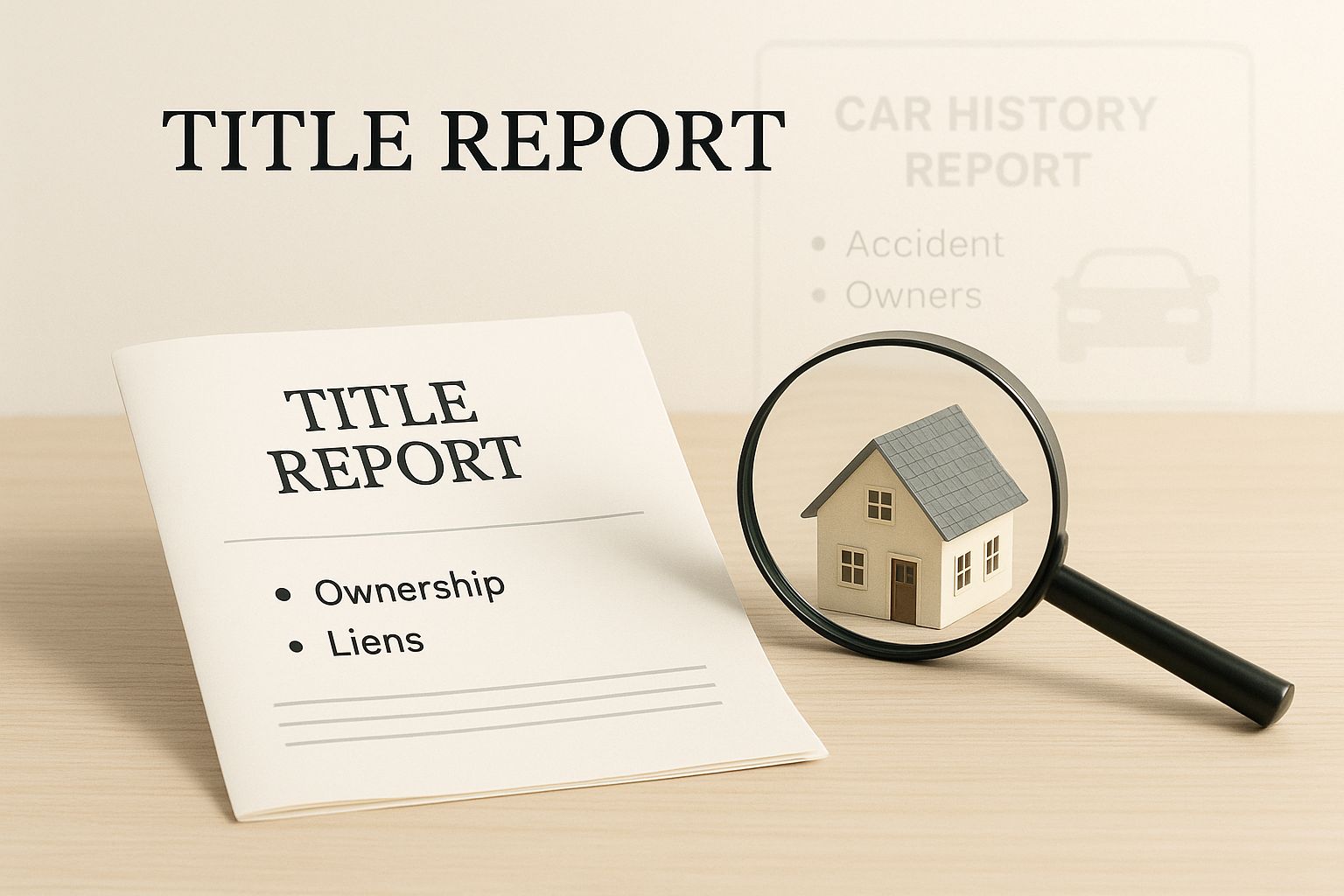
As the image illustrates, uncovering these details is absolutely essential for heading off future disputes and making sure you get a clear, undisputed title.
While this process is vital, it has historically been a slow, manual grind for title professionals. Fortunately, modern tools like TitleTrackr are completely changing the game. By automating the data extraction and report generation, TitleTrackr brings much-needed efficiency and accuracy to this crucial step of due diligence, freeing up your team for higher-value work.
Cracking Open a Title Report: What to Look For
At first glance, a title report can look like it's written in another language. It's packed with legal jargon, schedules, and exceptions that you just don't encounter in everyday life. But once you understand the basic structure, you'll see it’s telling the complete story of a property.
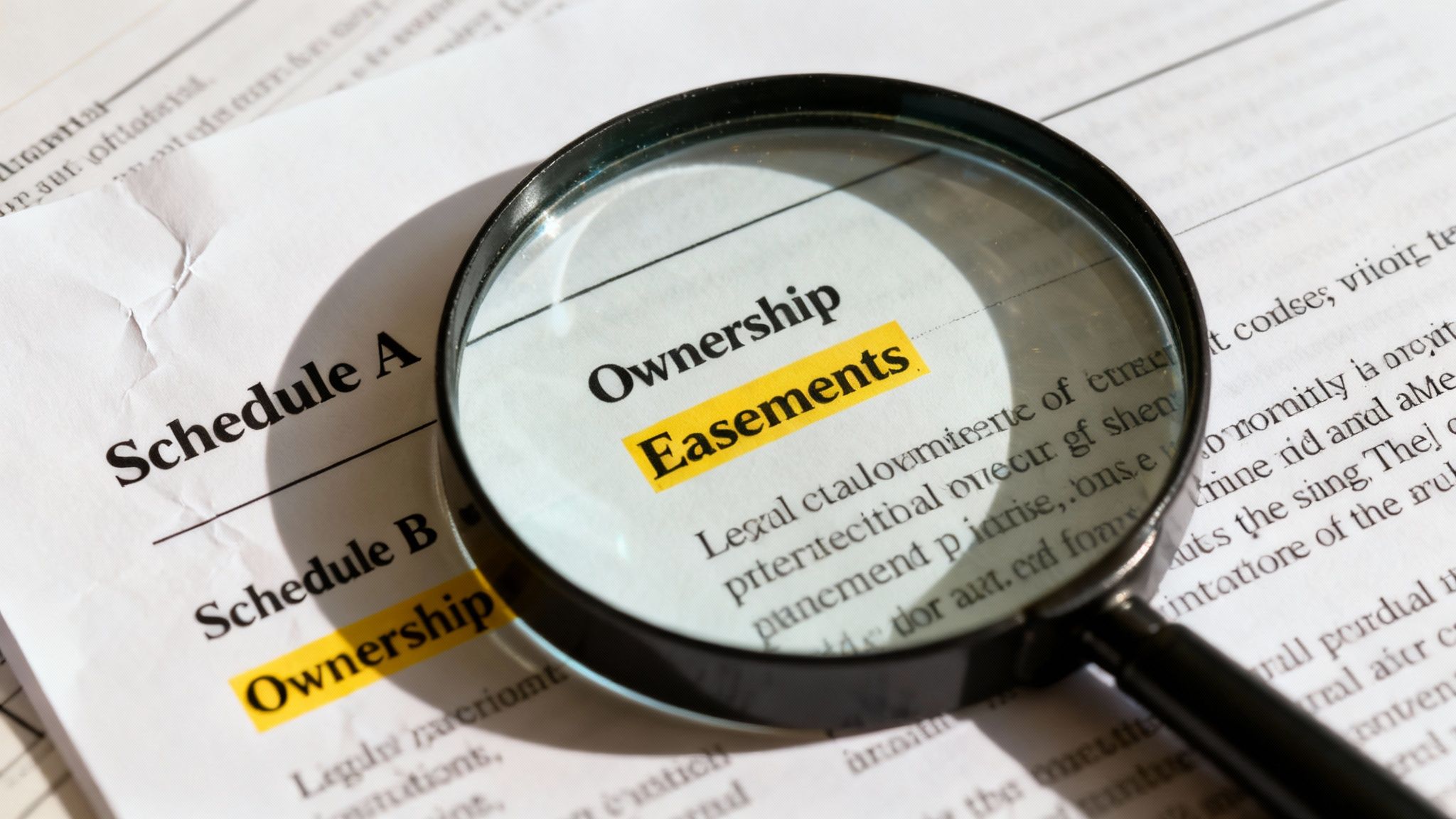
The whole thing is typically split into two main parts: Schedule A and Schedule B. A good way to think about it is that Schedule A is the property’s ID card—it lays out the basic, undisputed facts.
Schedule A: The Who, What, and Where
This section is all about the fundamentals. It's a straightforward summary of the most critical details, making it crystal clear what property we're talking about and who owns it.
- Legal Ownership: It clearly spells out the name of the current owner on record.
- Property's Legal Description: This isn't just a street address. It's the official, detailed description used in public records to identify the exact boundaries of the land.
- Policy Information: You'll also find the proposed dollar amount for the title insurance policy here.
Once those core facts are nailed down, the report dives into the more complex stuff.
Schedule B: The Fine Print and Potential Problems
This is where the real detective work begins. Schedule B lists everything the title insurance policy will not cover. These items are called "exceptions," and they represent potential issues that could impact your rights to the property down the road.
You'll commonly find things like:
- Liens: These are legal claims staked against the property, usually over an unpaid debt. A classic example is a mechanic's lien filed by a contractor who never got paid for a kitchen renovation.
- Easements: This is a right given to another party to use a specific part of your property. Think of a utility company needing access to run or maintain power lines across a corner of your land.
- Covenants, Conditions, and Restrictions (CC&Rs): These are essentially the neighborhood rules, often set by a developer or a homeowners' association (HOA), that govern how you can use the property.
A thorough review of Schedule B isn't just a good idea—it's absolutely critical. Missing a single exception, like an unrecorded easement, could spark a costly legal battle or even stop you from using the property the way you planned.
Getting through these sections demands a sharp eye and real attention to detail—skills that professional title abstractors hone over many years. Manually digging through these reports is a slow, painstaking process. This is where technology offers a competitive edge. Platforms like TitleTrackr use AI to instantly scan a report, flag key exceptions, and turn a dense legal document into a clear, actionable summary. This frees up your team to focus on solving problems instead of just trying to find them.
Understanding the Preliminary Title Report
In real estate, timing really is everything. While the final title report gives the official all-clear at closing, the preliminary title report is your indispensable early warning system.
Think of it as a sneak peek into a property's legal and financial background. Delivered shortly after escrow opens, it gives everyone involved a head start on digging into the details. This report offers a crucial snapshot of who owns the property, what restrictions are attached to it, and any financial claims that might be lurking.
The whole point is to catch potential problems—often called title clouds—long before they have a chance to blow up a deal. Finding an unexpected lien or an old ownership squabble at this early stage isn't a setback; it's a huge advantage.
Proactive Problem Solving
The preliminary report, or "prelim" as it's known in the industry, is your ticket to getting ahead of the game. In many hot real estate markets, it’s common to see a prelim pulled right when a property is listed, sometimes even before a buyer is in the picture. This allows sellers to find and fix issues like unpaid property taxes, old mortgages, or restrictive covenants that could scare buyers away. You can see how this plays out in California's competitive real estate scene at SanJoseRealEstateLosGatosHomes.com.
Let's look at a classic real-world example.
A family is selling their home, and the prelim uncovers a mortgage lien from a previous owner. The loan was paid off years ago, but the release was never officially recorded. If this popped up just days before closing, it would cause a full-blown panic and almost certainly delay the transaction.
But because it was caught early in the prelim, the seller has plenty of time to work with the title company and the original lender to get the right paperwork filed. What could have been a deal-killing crisis becomes a simple administrative task, paving the way for a smooth, on-time closing.
This is exactly why catching these things early is so fundamental to modern real estate. It saves time, money, and a massive amount of stress. For more on common title issues and how to solve them, check out the other articles on the TitleTrackr blog.
Of course, manually combing through these reports is a huge time-sink for title professionals. That's where a tool like TitleTrackr comes in—it automates the entire analysis, flagging potential issues in seconds so your team can jump straight to solving problems instead of searching for them, increasing efficiency and client satisfaction.
Navigating Title Reports in Commercial Real Estate
When you step into the world of commercial real estate, everything gets bigger—the buildings, the dollars, and definitely the paperwork. The title report for an office building or industrial park isn't just a longer version of a residential report; it's a completely different animal, packed with legal and financial complexities that demand a serious, expert eye.
These documents can uncover a tangled mess of issues that can stop a multimillion-dollar deal dead in its tracks. A meticulous title review isn't just a box to check; it’s one of the most critical risk-management moves you can make.
Unique Challenges Hiding in Commercial Titles
A commercial title report has to do much more than just confirm who owns the property. It needs to unravel a whole host of specialized issues you just don't see in a typical home sale.
- Complex Ownership Structures: Forget a simple husband-and-wife deed. Commercial assets are often held by LLCs, tangled partnerships, or intricate trusts. You have to dig deep to figure out who actually has the legal authority to sign on the dotted line.
- Zoning and Land Use Restrictions: These are the rules that dictate what you can build, who you can lease to, and how the property can be used. Miss one tiny restriction, and your entire business plan or development project could be toast.
- Layered Easements and Covenants: Think of all the overlapping access rights needed for a shopping center—utilities, delivery trucks, customer parking, signage. Each one is a recorded easement or covenant that must be analyzed to understand its real-world impact.
These aren't just fine print. They are fundamental factors that can make or break a property's value and its future potential.
An overlooked title defect in a commercial deal can trigger a domino effect, blocking financing, creating expensive legal battles, and ultimately destroying the return on investment.
Mitigating High-Stakes Risk with Precision
Commercial title reports are your first line of defense against hidden legal and physical problems, like old land use claims or encroachments that could kill a new development. In fact, these kinds of title headaches are responsible for delaying negotiations in an estimated 15-20% of commercial deals worldwide. You can get more expert insights on these challenges from the team at Terrydale Capital.
Trying to comb through these dense reports by hand is not only agonizingly slow, but it's also a recipe for human error. One missed detail could literally cost millions. This is where modern, specialized tools become non-negotiable for forward-thinking title companies.
An AI-powered platform like TitleTrackr was built to handle the unique beast that is commercial real estate. It automates the heavy lifting—extracting critical data points, flagging confusing ownership chains, and identifying restrictive covenants in seconds, not days. By serving up clear, actionable insights, it gives your team the power to tackle risks head-on and close high-stakes deals with confidence. Request a demo and see how TitleTrackr can safeguard your next commercial investment.
How to Resolve Common Title Issues
Finding a problem on a title report can feel like hitting a brick wall. Suddenly, a smooth transaction grinds to a halt. But here's the thing: it rarely means the deal is dead. Most of the time, it's just a hurdle you need to clear with a methodical approach. A red flag like a lien or an encroachment isn't a stop sign—it's a signal for your team to begin the resolution process.
Your first move is always to get a crystal-clear understanding of the issue. A mechanic's lien left over from an unpaid contractor is a completely different beast than a boundary dispute with a neighbor. Once you know exactly what you're dealing with, it's time to open up the lines of communication with the seller and the title company.
Creating a Path to Resolution
Honestly, effective communication is what turns a potential deal-breaker into just another item on the to-do list. Everyone involved—the buyer, the seller, the agents, the title company—wants to get to the closing table. Collaboration is your best tool.
A typical resolution workflow usually looks something like this:
- Identify the Defect: Nail down the specific issue in the title report. Is it a lien, a judgment, or a forgotten easement?
- Consult with Experts: Lean on your title officer and legal counsel. They know the legal hoops you need to jump through to clear the issue.
- Negotiate and Act: Work with the seller to take corrective action. This could mean paying off an old debt to get a release of lien, hashing out a new property line with a neighbor, or even seeking a court order to quiet the title.
This process can get messy. You're often juggling multiple parties, a mountain of paperwork, and some very tight deadlines. Every step has to be meticulously documented and tracked, because a single missed follow-up can throw the entire closing timeline into chaos.
Tackling title issues isn't really about the problem itself. It's about how efficiently you manage the resolution process. A disorganized workflow just leads to delays, frustrated clients, and deals that fall apart at the eleventh hour.
This is precisely where having a centralized platform makes all the difference. Instead of drowning in a sea of emails, phone calls, and spreadsheets, TitleTrackr gives you a unified workspace to manage the entire workflow. The moment an issue is flagged by the AI, your team can track every curative step, assign tasks, and monitor progress in real time. It brings much-needed transparency and order to what has always been a chaotic part of the business.
Ready to see how a streamlined workflow can protect your deals and save your team countless hours? Request a demo with TitleTrackr today and turn title problems into simple, trackable solutions.
A Few Lingering Questions
Even with a clear understanding of the basics, a few questions always pop up. It's completely normal. Let's tackle some of the most common ones to clear up any final uncertainties you might have.
How Long Does It Take To Get a Title Report?
The turnaround time for a title report really depends on the property itself. If you're dealing with a standard home in a modern subdivision with a clear ownership history, you might see the report in just a few days.
But for a commercial property, a rural tract of land, or a historic building with a century of owners, the search can easily stretch to a week or more. The process hinges on a deep dive into public records, and if those records are disorganized or still on paper, it just takes more time to do it right.
What Is the Difference Between a Title Report and Title Insurance?
This is a fantastic question and a crucial point to understand. The title report is the diagnostic; it's the detailed summary of the property's history, showing you exactly what the title search found—ownership details, liens, easements, and other potential roadblocks. Think of it as the X-ray results from the doctor.
Title insurance, on the other hand, is the protection plan you get based on those results. It’s an actual insurance policy that defends you and your lender from financial loss if a hidden title issue—one that even a thorough search couldn't find—pops up later on.
A title report shows you the known risks. Title insurance protects you from the unknown ones.
Who Pays for the Title Report?
This is almost always a negotiation point in the purchase agreement. Who foots the bill for the title search and insurance can vary quite a bit depending on state laws and even local customs.
- In many areas, it's common for the seller to pay for the owner's title policy, as a way of proving they're delivering a clean title.
- In other markets, the buyer is expected to cover this expense as part of their closing costs.
- And sometimes, the cost is simply split between both parties.
The key takeaway is that this is always spelled out in the contract, so there are no last-minute surprises at the closing table.
Can a Title Report Expire?
Absolutely. A title report is just a snapshot in time—it reflects the state of the public record on the very day the search was performed. Because a new lien, lawsuit, or claim could be filed at any moment, that snapshot can become outdated fast.
That's why title companies perform one last "bring-down" search right before the ink is dry at closing. This final check ensures nothing has changed since the initial report was issued. For more deep-dive answers, feel free to check out our comprehensive TitleTrackr FAQ section. This last step guarantees the information is 100% current at the moment of transfer.
Getting a handle on title reports is a huge step, but wrestling with the documents manually is still a slow, error-prone headache for any title professional. TitleTrackr uses AI to automatically pull and analyze the data, turning those dense legal reports into clear, actionable summaries in seconds. See how you can boost your team's efficiency by up to 90% and close deals with a whole new level of confidence.
 blog.titletrackr.com
Leave a comment