

When you hear the term "deed-restricted community," it's easy for clients to get lost in the jargon. For industry professionals, however, understanding the nuances is critical. In simple terms, it's a neighborhood where a specific set of rules—officially known as Covenants, Conditions, and Restrictions (CC&Rs)—are legally attached to a property's deed.
These aren't just friendly suggestions from a neighborhood watch. The purpose of these rules is twofold: to maintain a consistent aesthetic across the community and, just as importantly, to protect the property values for every single resident. This legal framework is the backbone of planned developments, and mastering its details is key to a smooth transaction.
What Exactly Is a Deed-Restricted Community?
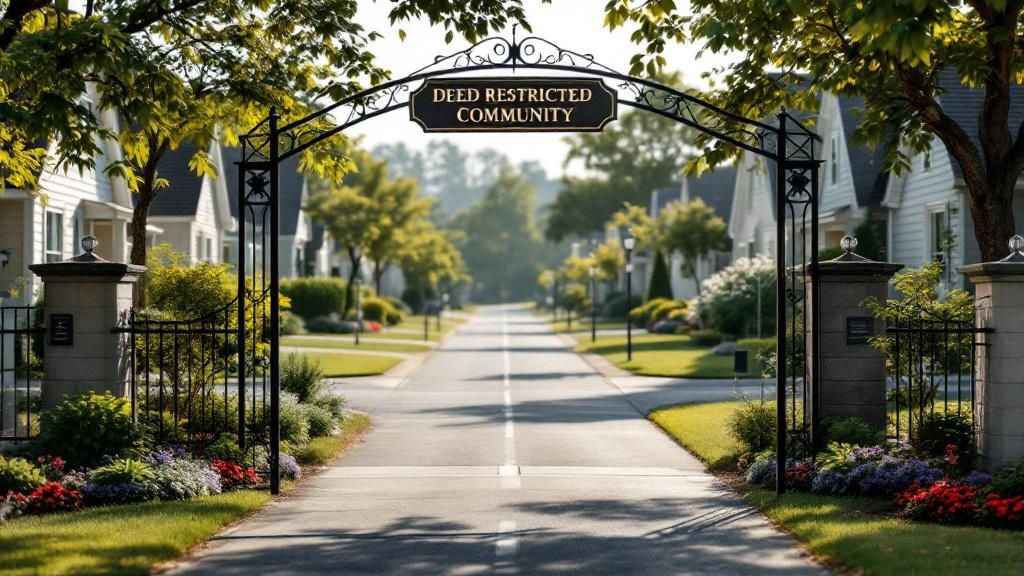
Think of a home in one of these communities as an asset that comes with a pre-written, legally binding rulebook. This isn't an informal agreement; it’s a contract that "runs with the land," meaning the rules apply to the current owner, the next owner, and every owner thereafter.
The process begins when a developer maps out a new subdivision. They create a master document, the "Declaration of Covenants, Conditions, and Restrictions," which lays out the ground rules for the entire neighborhood. This document is then officially filed in the public property records, becoming a permanent part of that community’s legal DNA—and a critical component of any title search.
How These Rules Function in Practice
Once recorded, CC&Rs govern many aspects of what a homeowner can (and can't) do with their property. The goal is to create a cohesive and predictable environment, a major selling point for many buyers. Enforcement typically falls to a Homeowners Association (HOA) or a similar governing body elected by residents.
For homeowners, this translates to specific guidelines on daily life. Common restrictions include:
- Architectural Consistency: Rules often dictate acceptable exterior paint colors, fence styles, or even the type of mailbox permitted at the curb.
- Property Maintenance: You'll find standards for lawn care, landscaping, and general exterior upkeep to ensure the entire neighborhood maintains its value.
- Land Use: There may be restrictions on activities like running a business from home, parking commercial vehicles, or the number and type of pets allowed.
To make it easier to see how these pieces fit together, here’s a quick summary of what deed restrictions typically cover.
Key Components of Deed Restrictions at a Glance
| Component | What It Governs | Primary Purpose |
|---|---|---|
| Architectural Standards | Exterior modifications, paint colors, building materials, fences, sheds. | Maintain a uniform and aesthetically pleasing appearance. |
| Maintenance Obligations | Lawn care, landscaping, exterior upkeep, trash can storage. | Prevent neighborhood blight and ensure properties are well-maintained. |
| Land Use Rules | Home-based businesses, rental restrictions, vehicle parking, pets. | Preserve the residential character and quality of life for all homeowners. |
This table shows how each component is designed to contribute to the community's overall stability and value.
Essentially, deed restrictions are the legal framework of a planned community. They define its character and standards, ensuring one person's choices don't negatively impact the value and enjoyment of their neighbors' properties.
For any homebuyer, real estate pro, or title abstractor, understanding what a deed-restricted community means is the crucial first step. These rules are far more than suggestions—they're enforceable covenants that directly shape daily life and the long-term investment potential of a home.
The Legal Framework of Deed Restrictions
So, how exactly do a neighborhood's "rules" get legal teeth? It’s not just a friendly agreement. The power behind deed restrictions comes from a specific legal process that turns those guidelines into a binding contract that can impact a property's title.
It all starts with the developer. Before the first home is sold, the developer drafts the Covenants, Conditions, and Restrictions (CC&Rs). They then file this document with the public land records for the county. This one move legally attaches those rules to every single property in the community.
Once recorded, these covenants officially "run with the land." This is a crucial legal concept. It means the rules don’t just apply to the first buyer; they stick to the property itself, binding every subsequent owner. That's why understanding the legal side of what a deed-restricted community means is non-negotiable before closing a transaction.
Enforcement: The Role of the HOA
Who's the referee? That job almost always falls to a Homeowners Association (HOA). The HOA, typically run by a board of residents, is the governing body that ensures everyone plays by the rules. If a rule is broken, they have a clear (and escalating) process for enforcement.
- Friendly Reminders: It usually starts with a simple notice sent to the homeowner pointing out the violation.
- Formal Warnings and Fines: If the issue isn't fixed, the HOA can issue formal warnings and start levying fines, as spelled out in the CC&Rs.
- Legal Action: In serious or persistent cases, the HOA has the authority to take the homeowner to court. This could even lead to a lien being placed on the property until the issue is resolved—a major concern for title professionals.
The Importance of Clear Legal Language
For any of this to hold up, the language in the CC&Rs has to be crystal clear. Vague, ambiguous rules are notoriously difficult to enforce and can lead to costly legal challenges. The process can vary by state, but it always hinges on the restrictions being properly recorded and not having expired.
The legal power of a deed restriction is not a suggestion; it's a recorded covenant that binds an owner to community standards the moment they close. Thorough due diligence isn't just best practice—it's essential risk management.
This is exactly why developers have to get the legal language right from the very beginning. For developers looking to create clear and enforceable community standards, precision isn't just a good idea—it's essential to prevent future liabilities. Getting it wrong can open the door to years of disputes and undermine the entire framework designed to protect the community's value.
Everyday Rules You Might Encounter

So, what does living in a deed-restricted community actually feel like day-to-day? While the legal documents can feel overwhelming, the rules themselves are usually practical. They’re all about creating a predictable, cohesive neighborhood.
These regulations typically fall into a few key areas that directly shape what a homeowner can and can't do. Getting a handle on them is the key to advising clients on whether this kind of community is the right fit for their lifestyle.
Architectural and Aesthetic Guidelines
By far, the most common rules are the ones that control the outside appearance of a home. This is the "secret sauce" that maintains the community's consistent look and feel. In fact, about 70% of new single-family homes in the U.S. are built in communities with these rules, largely to protect property values for everyone.
You'll often find specific guidelines for:
- Exterior Paint Colors: Forget that neon green a client was considering. Most communities have a pre-approved palette of colors they need to stick to.
- Fencing: The rules will likely dictate the material, style, and height of any fence.
- Additions and Structures: Thinking of building a deck, putting up a shed, or even mounting a satellite dish? An owner will almost certainly need to get approval from an architectural review committee first.
These standards are in place to prevent a hodgepodge of styles that could drag down the neighborhood's appeal. To dig a little deeper, you can learn more about how these communities maintain property values.
Property Maintenance Standards
It's not just about how things look—it's also about how they're cared for. Deed restrictions set a baseline for property upkeep, ensuring every home contributes positively to the neighborhood’s overall condition.
A core principle of deed-restricted communities is shared responsibility. A well-maintained lawn not only boosts a home’s curb appeal but also supports the value of every property around it.
Common maintenance requirements include things like regular lawn mowing, keeping landscaping tidy, and rules against leaving trash cans out on the street all week. You may also find restrictions on where boats, RVs, or junk cars can be stored so they aren't visible from the road.
Lifestyle and Use Regulations
Finally, some rules govern how the property is used. These are all about preserving the quiet, residential character of the community.
You might run into limits on parking commercial vehicles in a driveway, for instance. There could also be restrictions on the number or breeds of pets, or even rules that prohibit running certain types of businesses from a home. The goal here is to minimize disruptions and maintain a high quality of life for everyone living there.
Weighing the Benefits and Drawbacks of Community Rules
So, is a deed-restricted community the right move for a client? It really boils down to a classic trade-off: giving up some personal freedom in exchange for powerful collective benefits. For many homeowners, the structure and predictability are a huge draw, offering a built-in way to protect their investment and ensure a certain quality of life.
On one hand, the perks are tangible. You get consistent property maintenance standards, meaning you don’t have to worry about a neighbor’s unkempt lawn tanking property values. Plus, you often get access to shared amenities like swimming pools, clubhouses, or private parks—features that are professionally managed and might be out of reach otherwise. This carefully curated environment is a big reason why these communities often maintain strong and stable property values.
The Trade-Offs Every Homeowner Faces
But those benefits don't come for free. The most obvious trade-off is the financial one. Homeowners are on the hook for monthly or annual HOA fees that cover professional management, landscaping, and amenity upkeep. And those fees can—and often do—go up over time.
Beyond the money, owners also sacrifice a bit of personal expression. The rules can govern everything from the color of the front door to the type of fence installed. For homeowners who cherish creative freedom, these limitations can feel restrictive. Getting approval for even minor changes can turn into a bureaucratic headache, and disputes with the HOA can arise over rule interpretation.
This infographic gives you a snapshot of the common financial and administrative hurdles homeowners can run into.
As you can see, the costs and potential delays tied to HOA oversight are real considerations that add another layer to the home-buying decision.
To make things simpler, let's break down the core advantages and disadvantages you'll want to consider.
Weighing the Benefits and Drawbacks
| Advantages (Pros) | Disadvantages (Cons) |
|---|---|
| Protected Property Values: Consistent standards help maintain a desirable neighborhood aesthetic and can boost home values. | HOA Fees: A mandatory and often increasing monthly or annual financial obligation. |
| Access to Amenities: Enjoy professionally managed pools, parks, gyms, and clubhouses. | Limits on Personal Expression: Strict rules on paint colors, landscaping, and home modifications. |
| Community Maintenance: Common areas are consistently maintained, creating a clean and attractive environment. | Potential for Disputes: Disagreements with the HOA board over rule enforcement or interpretations can arise. |
| Reduced Neighbor Nuisances: Rules often prevent issues like unkempt yards, loud noise, or derelict vehicles. | Bureaucratic Hurdles: An approval process is often required for even minor exterior changes to your home. |
At the end of the day, it's a personal call. You have to weigh what you value most.
So, what does a deed restricted community mean for your client? It means making a choice between the security of a well-kept community and the total freedom to do whatever they want with their property.
Balancing these pros and cons against your client's lifestyle, budget, and personality is the key. It requires an honest look at what they truly want in a place to call home.
How Deed Restrictions Support Affordable Housing

When most people think of deed restrictions, they picture rules about fence heights or paint colors. But there’s another, more powerful use for them: creating and protecting affordable housing.
Cities and nonprofit groups are increasingly using this legal tool to keep homes within financial reach for lower-income families. It’s a smart way to build long-term stability in communities, shifting the focus of deed restrictions from simple aesthetics to vital economic inclusion. By attaching specific affordability rules—or covenants—to a property's deed, they can create a lasting supply of housing that isn't at the mercy of a hot real estate market.
The Mechanics of Affordability Covenants
The idea behind it is straightforward but incredibly effective. An affordability deed restriction puts a legal cap on the home's future sale price. This is what stops the property from being snapped up and flipped for a massive profit, ensuring it remains affordable for the next qualifying family.
So, how does it actually work? There are a few common approaches:
- Capping the Resale Price: The deed might flat-out state the maximum price the home can ever be sold for.
- Limiting Appreciation: Instead of appreciating at the same pace as the market, the deed might allow the home's value to grow at a slow, controlled rate.
- Income-Based Qualifications: The rules will often require that any future buyer must meet specific income requirements to be eligible to purchase the home.
The real beauty of this system is that it creates a sustainable cycle. The initial public subsidy that helped the first buyer doesn't just vanish when they sell. Instead, it gets passed on, helping the next family, and the next.
This strategy has become a cornerstone of modern urban planning. In some U.S. cities, over 50% of new affordable housing units are now created using these exact deed-restricted mechanisms. It’s a proven model for keeping homeownership opportunities alive. To see more on how this works, you can discover more insights about how deed restrictions preserve homeownership opportunities.
Why Title Searches Must Uncover Every Restriction
For title professionals and real estate agents, missing even a single deed restriction can derail a deal long after closing. A truly thorough title search isn't just a good idea—it's an absolute necessity to protect everyone involved. Letting one of those critical covenants slip through the cracks can set off a chain reaction of negative outcomes.
The new homeowner could suddenly be on the hook for expensive compliance costs, fixing a violation they never knew existed. Even worse, it could spiral into a messy title claim that jeopardizes the entire sale and damages your professional reputation. The challenge is that these restrictions are often buried deep inside dense legal documents, making them frustratingly easy to miss with a manual search.
The High Stakes of Incomplete Searches
Failing to spot these rules isn't a small clerical error. The risks are substantial and can include:
- Costly Violations: Imagine a new owner being forced to repaint their entire house or tear down an unapproved fence they just paid for.
- Legal Challenges: The HOA could initiate legal action, leading to fines or even placing a lien against the property.
- Transaction Delays or Cancellations: Finding a major restriction at the eleventh hour can stop a closing dead in its tracks.
Missing a deed restriction isn't just an inconvenience; it's a direct threat to the integrity of the title and the client's investment. This is where modern solutions become essential for mitigating risk.
This is exactly why technology like TitleTrackr was developed. It’s a solution engineered to meticulously scan for these covenants, ensuring a clean title and a smooth closing. For title professionals dedicated to thorough due diligence, having the right tech in your corner protects both your clients and your business from these costly oversights.
Common Questions About Deed Restrictions
When digging into what a deed-restricted community really means for a property, a few practical questions always arise. Getting your head around these nuances is crucial, whether you're advising a client or making a decision for yourself. Let's tackle some of the most common ones.
One of the first things people ask is whether deed restrictions can be changed or removed. The short answer is yes, but it’s rarely a walk in the park. Amending these rules usually demands a vote from a hefty majority of homeowners—often 67% or more—as spelled out in the community's governing documents. The process is designed to be difficult to maintain stability.
Another big question is what happens when someone violates the rules. If an HOA, for instance, rejects a homeowner's plan to build a new deck, the owner typically has the right to appeal. In many areas, the homeowner has about 30 days to request a formal hearing with the board to present their case and hopefully find a resolution.
How Long Do Deed Restrictions Last?
It's natural to wonder if these restrictions have an expiration date. While some very old covenants might have termination dates built-in, most modern deed restrictions are written to be perpetual. They "run with the land" indefinitely.
This structure is intentional, designed to uphold the community's character and standards for every future owner, which helps lock in long-term property values.
You have to understand that these rules are permanent. A deed restriction isn't a temporary guideline; it's a lasting legal obligation tied to the property itself. That's what makes a thorough title search so absolutely critical before buying.
For a deeper dive into specific scenarios, you can find more answers in our detailed deed restriction FAQ section. Arming yourself with this knowledge is the best way to avoid surprises down the road.
Navigating the complexities of deed restrictions requires precision and clarity. TitleTrackr uses advanced AI to meticulously scan property records, uncovering every covenant and condition that could impact a closing. Ensure your title searches are flawless—request a demo of TitleTrackr today.
 blog.titletrackr.com
Leave a comment