

The first thing to understand about a property lien is that you can’t just ignore it. To get it removed, you have to satisfy the debt, get the lienholder to sign off, and file the right paperwork with the county. And that last part is absolutely critical—just paying what you owe doesn't make the lien magically disappear from the public record, a fact that can bring any real estate transaction to a grinding halt.
Your First Steps in Tackling a Property Lien

Finding a lien is the kind of problem that can stop a real estate deal in its tracks. It creates a “cloud” on the title, making it nearly impossible to sell or refinance until it's resolved. For title agents and real estate professionals, dealing with this swiftly isn't just a good idea; it's essential to keep the transaction moving forward. How you handle these initial steps sets the tone for the entire resolution process.
Your first move should always be a comprehensive title search. This isn’t just about confirming the lien exists. It’s about digging into its origin, its priority against other claims, and its legitimacy. The best way to get this done is to order a detailed report from a licensed title agency or a professional abstractor. While many counties have online portals, those databases don’t always tell the whole story and can lack the depth needed for a secure closing.
Identify the Lien and Its Source
Once the title search brings a lien to light, you need to figure out exactly what you're dealing with. Is it a voluntary lien that was agreed to, like a mortgage? Or is it an involuntary one that was placed on the property without direct consent? This distinction is crucial because it completely changes your strategy for getting the lien removed.
You’ll typically run into one of these common types:
- Mortgage Liens: The most common lien out there, used to secure the loan for the property purchase.
- Tax Liens: Filed by the government (federal, state, or local) for unpaid property or income taxes.
- Mechanic's Liens: Placed by contractors or suppliers who provided labor or materials for the property but never got paid.
- Judgment Liens: These come from a court ruling, where a creditor won a lawsuit against the property owner for a debt.
To give you a clearer picture, here’s a quick breakdown of the lien resolution workflow that every title professional must master.
Quick Guide to Resolving a Property Lien
This table summarizes the essential actions required to resolve a property lien from discovery to closure, turning a potential deal-breaker into a manageable task.
| Action Step | Objective | Key Consideration for Professionals |
|---|---|---|
| Discover & Identify | Uncover all liens and understand their type and origin. | A professional title search is non-negotiable for accuracy. |
| Validate the Claim | Confirm the lien's accuracy and legal standing. | Look for clerical errors, incorrect amounts, or improper filing. |
| Contact Lienholder | Open communication to get an official payoff amount. | The recorded amount may not include interest or fees. |
| Negotiate & Pay | Settle the debt, sometimes for a lesser amount. | Get any settlement agreement in writing before sending funds. |
| Secure Lien Release | Obtain a legally binding "Satisfaction of Lien" document. | This is the official proof that the debt has been paid. |
| File with County | Record the release document with the proper authorities. | This is the only way to officially clear the title record. |
Following these steps ensures you don't miss a beat in clearing the title efficiently and professionally.
Validate the Lien and Plan Your Approach
Believe it or not, not every lien is valid. Simple clerical errors, cases of mistaken identity, or a lienholder who didn't follow proper filing procedures can make a lien completely unenforceable. This is why you must meticulously validate every detail. Scrutinize the recorded document—check the names, the property description, and the debt amount.
An owner of a property subject to a lien always has the right to challenge or dispute the lien through litigation. If a lienholder fails to follow the detailed legal steps required for a lien to be valid, it can be successfully contested.
This is where having a reliable system makes all the difference. Manually digging through county records is a slow, error-prone process. Modern solutions like TitleTrackr streamline this critical first step by automating the extraction of key data, allowing your team to identify and validate liens with speed and accuracy, preventing costly delays. For more on the detailed work involved, check out the insights from our network of abstractors here.
Decoding the Different Types of Property Liens
Not all liens are created equal. Your strategy for getting one removed depends entirely on the specific type you're dealing with. It's like a diagnosis—you can't prescribe a treatment without knowing the ailment. For any title professional, understanding the legal basis, recording process, and release procedures for each is absolutely fundamental to your role.
At its core, a lien gives a creditor a legal claim to a property until a debt is settled. They fall into two broad categories: voluntary liens, which are agreed upon like a mortgage, and involuntary liens, which are imposed without the owner's consent, like a tax lien. This distinction is the first branch in the decision tree for resolving the claim.
The Most Common Liens You Will Encounter
In day-to-day title work, you’ll run into a handful of lien types again and again. Each one has its own personality and quirks that dictate how you handle it during a real estate transaction.
- Mortgage Liens: These are voluntary and by far the most common. They secure the loan a borrower takes out to buy a property.
- Tax Liens: These are involuntary liens filed by government bodies for unpaid federal, state, or local taxes. An IRS tax lien, for example, has a rigid, form-driven removal process that’s a world away from a local property tax issue.
- Mechanic's Liens: Also involuntary, these are filed by contractors or suppliers who provided labor or materials to improve a property but never got paid.
- Judgment Liens: Stemming from a lawsuit, these involuntary liens are slapped on a property after a court rules in favor of a creditor.
The infographic below shows the very first step: uncovering these liens through a detailed public records search. It breaks down the data sources you’ll be pulling from and the key findings you’re looking for.
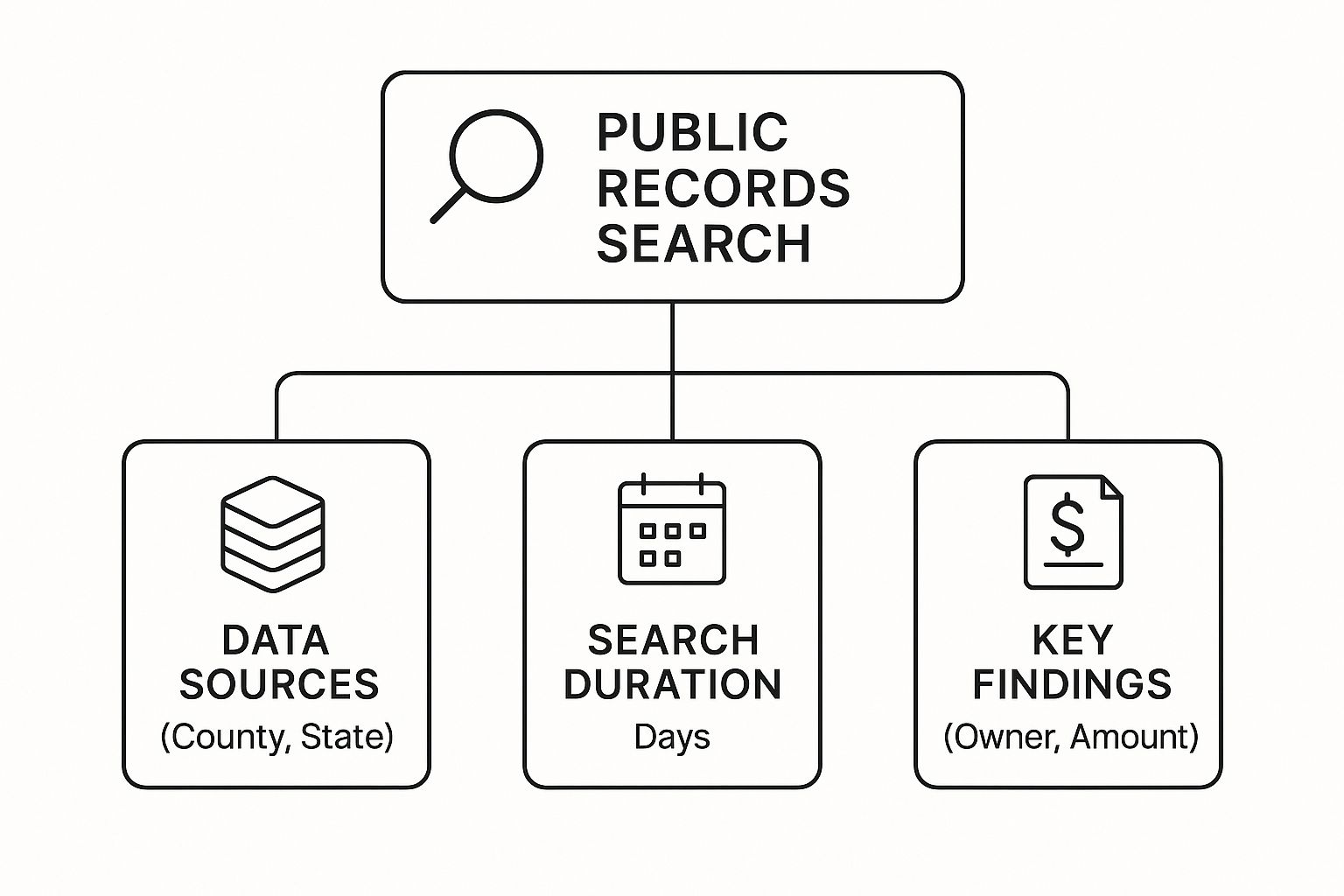
As you can see, this process is all about synthesizing data from various sources to nail down critical details like the property owner and the lien amount. This is the bedrock of the entire lien resolution process, and automating it is the key to efficiency.
Understanding Lien Priority and Its Impact
One of the most critical concepts you have to master is lien priority. This hierarchy dictates the order in which lienholders get paid from the proceeds of a property sale. As a rule of thumb, priority is determined by the "first in time, first in right" principle—whoever recorded their lien first gets paid first.
But it's not always that simple. Certain liens, especially those for property taxes, often jump right to the front of the line regardless of when they were filed. This is what's known as "super-priority." For instance, a primary mortgage might have been recorded years ago, but an unpaid property tax bill from last year will take precedence.
Lien priority isn’t just a legal technicality; it’s a financial reality that can make or break a closing. A junior lienholder might get nothing if the sale proceeds only cover the senior liens, which dramatically impacts negotiation leverage.
Think about a property with a $300,000 primary mortgage and a $50,000 Home Equity Line of Credit (HELOC) recorded a year later. If that property sells for $340,000, the primary mortgage holder gets their full amount. But the HELOC lender only gets $40,000, leaving them with a $10,000 shortfall. This is exactly why identifying every single lien and its priority is non-negotiable.
Navigating the Nuances of Different Lien Types
Let’s put this into a real-world context. Say a title search uncovers both an IRS tax lien and a mechanic's lien on a property heading to closing. The IRS has a very structured process for getting a payoff letter and filing a Certificate of Release of Federal Tax Lien. Meanwhile, the mechanic's lien might be from a local contractor who’s more open to a direct negotiation for a reduced settlement. Your approach has to be tailored to each specific lienholder.
This is where precise data extraction and management are essential. Manually trying to track documents, deadlines, and communications for multiple liens is just asking for trouble. For professionals managing complex land and energy projects, developing robust systems to handle these variables is key. Integrating technology can help manage these disparate workflows effectively—a concept you can explore further with insights from TitleTrackr's developer resources.
Mortgage liens are everywhere, securing loans for a huge number of homeowners. In the U.S. alone, around 62% of all owner-occupied homes had a mortgage in 2022. This prevalence means title professionals are constantly navigating the hierarchy between primary mortgages and secondary liens, a critical factor that can sway buyer interest and the smoothness of a sale. Having a clear grasp of each lien gives you the confidence to guide any transaction to a successful close.
Mastering Lienholder Negotiations and Payoffs

Once you've confirmed a lien is valid, the real work begins: engaging the lienholder. This isn't just about cutting a check. It’s a delicate dance of communication and negotiation that can make or break the financial outcome of a deal. Getting this stage right is the key to clearing a property lien without derailing a closing.
The first move is always to get an official payoff letter from the creditor. This is non-negotiable. It’s the only document that will give you the exact, up-to-the-minute amount needed to satisfy the debt. Don't ever assume the number you see on the recorded document is the final one; it rarely accounts for accrued interest, late fees, and other penalties.
How you make this initial request sets the tone for everything that follows. A professional and well-documented outreach shows you're serious and can make the lienholder far more cooperative from the start.
Crafting Your Communication Strategy
Your approach has to change depending on who you’re talking to. A giant national bank operates very differently from a local contractor or a government agency.
For instance, dealing with an IRS tax lien involves a rigid, structured process with specific forms and channels. There’s almost no room for casual negotiation there. On the other hand, a mechanic’s lien from a local roofer might be settled with a direct phone call. A personal touch and a clear explanation—like an impending property sale—can often open the door to a reasonable settlement.
No matter who the lienholder is, meticulous documentation is your best friend. Every email, phone log, and letter needs to be kept in one central place. This is where a tool like TitleTrackr really shines, providing a centralized platform to manage all the moving parts for multiple liens so nothing critical falls through the cracks. This level of organization strengthens your position and gives you a clear audit trail.
Tips for Negotiating a Lien Settlement
Here's a piece of advice many people miss: not all debts have to be paid in full. There's often wiggle room, especially with older judgment liens or debts from companies that have since been bought out. A creditor might much rather take a guaranteed partial payment now than chase an uncertain full payment later.
Consider a few practical strategies I've seen work time and again:
- Offer a Lump-Sum Payment: Proposing a single, immediate payment for a reduced amount is often compelling. It gives the creditor instant cash and gets the liability off their books.
- Leverage Time and Circumstance: If a judgment lien is getting close to its statutory expiration date, the creditor has a powerful incentive to take what they can get before it becomes worthless.
- Scrutinize the Debt: For older debts, always ask for a full validation of the amount owed. If they can't produce detailed records, you've just found powerful leverage to negotiate the total down.
Negotiation is often the most direct path to a resolution. A qualified professional can often work to reduce the amount required to satisfy the lien, especially when the alternative for the creditor is a costly and prolonged legal battle.
Before you finalize any settlement, read the payoff letter like a hawk. Make sure it explicitly states that your payment constitutes a full and final satisfaction of the debt and that they will provide a recordable release of lien. Any fuzzy language here is a red flag for future problems.
Ultimately, successfully navigating lienholder negotiations comes down to being prepared, organized, and flexible. When you understand who you're dealing with and keep flawless records, you can move through the process with confidence, clearing liens and keeping your transactions on schedule.
The Legal Pathways to Removing a Lien
Sometimes, a straightforward negotiation just doesn't cut it. When a lienholder digs in their heels or disappears completely, you aren't out of options. You just have to be willing to take the fight to the legal system.
This path is definitely more complex and demands a higher level of diligence, but it’s often the only way to force the removal of a stubborn lien and deliver a clear title to your client. Knowing how these legal tools work empowers you to guide clients through what can feel like an intimidating process.
This is where you shift from being a negotiator to a legal strategist.
Filing a Lawsuit to Quiet Title
One of the most powerful tools in your legal arsenal is the quiet title action. Think of it as a special type of lawsuit designed to resolve any competing claims or "clouds" on a property's title. You're essentially asking a court to step in and make a final, binding decision on who truly owns the property and which liens are valid.
A quiet title action is the go-to move in a few common scenarios:
- A Disputed Lien: You believe a mechanic's lien was filed improperly or is for a wildly inflated amount.
- An Old, Unreleased Mortgage: It happens more than you'd think. A mortgage was paid off decades ago, but the release was never recorded, leaving a ghost on the title.
- Boundary Disputes: Competing claims from neighbors can also muddy the waters, requiring a court to establish clear property lines once and for all.
The process kicks off by filing a complaint that names every single party with a potential interest in the property. The court then wades through all the evidence and issues a judgment that definitively clears the title. It’s a formal and often lengthy process, but the prize at the end is a clean, marketable title.
Using Bankruptcy to Eliminate Judgment Liens
For homeowners drowning in debt, bankruptcy can be a serious but strategic path to lien removal. Specifically, a Chapter 7 bankruptcy includes a mechanism to "avoid" certain liens that get in the way of a homeowner's state-granted property exemption. This works almost exclusively for judicial liens—the kind that stem from a court judgment.
The whole idea is to protect a debtor's right to their homestead exemption, which is a specific dollar amount of home equity shielded from creditors. If a judgment lien "impairs" that protected equity, the court can wipe it out.
Here’s a real-world example: A property is worth $250,000, with a $150,000 mortgage and a state homestead exemption of $75,000. If a creditor slaps a $30,000 judgment lien on the home, that lien eats directly into the protected exemption. A bankruptcy court has the power to eliminate it entirely.
This strategy won't work on voluntary liens like mortgages or statutory liens like property taxes, but it’s a powerful fix for judgment liens. In 2020, there were about 774,940 bankruptcy filings in the U.S., and 73.3% of those were Chapter 7, showing just how many people turn to this for debt relief. You can get more expert insights on this tactic from this in-depth analysis by Wolters Kluwer.
Navigating the court system to remove a lien isn't a DIY project. The procedural rules are incredibly strict, and one mistake can sink your entire case. Getting a qualified real estate attorney involved early is the single best thing you can do to make sure every move is legally sound.
When to Bring in a Real Estate Attorney
As a title professional, you can handle a lot. But knowing your limits—and when to call for backup—is critical. The second a dispute can't be solved with a few phone calls or standard paperwork, it’s time to get a real estate attorney on the line.
Hand the case over to an attorney when:
- A lienholder is giving you the silent treatment or refusing to negotiate.
- You have a strong suspicion that a lien is fraudulent or was filed incorrectly.
- The situation calls for a quiet title action or other legal filings beyond your scope.
- A massive lien is about to blow up a high-value transaction.
An attorney can draft formal demand letters that get a lienholder's attention, file the right documents with the court, and represent your client in any legal proceedings. Their involvement alone often adds enough weight to compel a difficult party to cooperate, sometimes resolving the issue without ever seeing the inside of a courtroom.
How to Properly Secure and File a Lien Release

Paying off a lien feels like crossing the finish line, but it’s really only half the battle. You haven't truly won until the lien is officially wiped from the public record. A simple clerical error or a missed filing at this stage can keep that lien clinging to the title, creating massive headaches for you down the road.
This is the administrative leg of the race, and it demands absolute precision. One wrong move here can derail a property closing just as easily as an unpaid debt.
Verifying the Lien Release Document
Once the debt is settled, the lienholder must provide a document that officially releases their claim. Depending on where you are, it might be called a Release of Lien, Satisfaction of Lien, or Lien Cancellation.
Before you do anything else, you have to scrutinize this document. A tiny mistake can render it invalid, forcing you to go back to the lienholder and start the whole process over.
When you get that release in your hands, check these details meticulously:
- Property Owner Information: Are the owners' names spelled perfectly? Do they match exactly how they appear on the title?
- Property Description: Does the legal description of the property match the deed to the letter? Cross-reference the parcel number, lot, and block.
- Original Lien Details: Does the release reference the original lien's filing number, date, and amount? This is a crucial link the county recorder needs to connect the release to the original claim.
- Notarization: Is the document properly signed by someone authorized at the lienholder company and correctly notarized? An improper notarization is a classic—and common—reason for rejection.
A lien release is more than a receipt. It's the legal instrument that officially clears the title. Treat it with the same importance as the deed itself, because without it, the cloud on your title remains.
This is where your attention to detail really pays off. Overlooking a simple typo or a missing signature can get the document kicked back by the county, sending you back to square one and causing completely avoidable delays.
Filing the Release with the Correct Authority
With a verified release document in hand, the next step is getting it on the record. This is the only way to officially scrub the lien from the property's title history. You'll need to file it with the same government office where the original lien was recorded—usually the County Recorder, Clerk of Court, or Register of Deeds.
Every county has its own quirks and specific procedures, fees, and formatting requirements. Before you send anything, confirm the following:
- Filing Fees: How much is it? What payment methods do they accept? Some are picky, so check if they take checks, credit cards, or cash.
- Cover Sheets: Does the county require a specific cover sheet with indexing information? Many do, and skipping it is a surefire way to get your filing rejected.
- Submission Method: Can you file it electronically, send it by mail, or do you have to show up in person?
Tax liens are a perfect example of why following procedure is so critical. The IRS can place a federal tax lien on a property for unpaid taxes—and in 2019 alone, the agency collected over $512 billion, with some of that coming from liens. The IRS issues a release only after the debt is fully paid, but you can sometimes request a "lien withdrawal" to remove it from public records under certain conditions. You can learn more about the intricacies of resolving IRS tax liens directly from the Taxpayer Advocate Service.
Automating for Peace of Mind
Let's be honest, manually tracking the status of a lien release filing is a chore. Did the county get it? Was it recorded correctly? Is the title officially clear? Figuring this out can involve a frustrating loop of phone calls and follow-ups.
This is where modern platforms offer a massive advantage. A system like TitleTrackr can automate the tracking of these filings, sending you alerts the moment the document is successfully recorded. It gives both you and your clients peace of mind that the title is officially clear, allowing the transaction to close without a hitch.
Common Questions About Removing a Property Lien
When you're knee-deep in clearing a title, questions are bound to pop up. Even when you have the basic steps down, certain curveballs can leave you scrambling for answers. Getting those questions handled quickly is what keeps a real estate transaction moving forward instead of grinding to a halt.
Let's break down some of the most common questions we see from title pros and property owners trying to get a title cleared.
How Long Does It Take to Remove a Property Lien?
This is always the first question, and the honest answer is: it depends. There’s no magic number. The timeline is completely dictated by the type of lien and how cooperative the lienholder is.
A straightforward, undisputed mechanic's lien with a contractor who just wants to get paid? You could have that resolved in a few days. Get the payoff letter, cut the check, and file the release. Done.
But if you're dealing with a contested judgment lien or, even worse, a federal tax lien, you could be looking at a months-long battle. Those situations often mean navigating formal legal channels, negotiating with massive government agencies, or even heading to court—and each step comes with its own built-in delays.
The real takeaway here is that you can't afford to wait. The second a lien pops up on a title search, the clock is running. Every day you delay contacting the lienholder or validating the debt is another day you’re pushing the closing date further out.
Having a solid system to track every email, phone call, and document is a lifesaver. This is where dedicated title software really shines, making sure no follow-up gets missed and things move as fast as the situation allows.
Can a Property Lien Expire?
Yes, most liens do have a shelf life, thanks to something called a statute of limitations. It’s a legal deadline that gives a creditor a specific window to enforce their claim. If they don't take action to foreclose on the property within that time, the lien can become unenforceable.
But don't be fooled—this is not a simple waiting game. The rules change dramatically depending on the state and the type of lien.
- Mechanic's Liens: These often have a very short fuse, sometimes as little as one year from the day they were filed.
- Judgment Liens: These stick around for much longer, often for a decade. In many states, the creditor can even renew it for another term.
- Mortgage Liens: The expiration for mortgages can get complicated and is often tied to the loan's maturity date.
- Federal Tax Liens: The IRS usually gets 10 years to collect on a tax debt after it's been assessed, and that clock applies to their liens, too.
Simply hoping a lien will expire is a terrible strategy. It leaves a cloud on the title for years, making it impossible to sell or refinance the property. The only smart move is to actively work on getting the lien removed. For more on specific scenarios, check out our comprehensive FAQ section, where we cover a ton of different title-related topics.
What if a Lien Is Not Removed Before Closing?
Finding an unresolved lien right before closing is the stuff of nightmares for a title agent. If that lien isn't properly paid and formally released from the public record, it stays attached to the property. That means the new buyer is essentially inheriting the seller's debt and the legal claim against their new home.
No reputable title insurance company will issue a policy on a property with a live lien, and no lender is going to fund a mortgage under those circumstances. It almost always ends one way: the closing is derailed. The sale gets delayed for weeks or months while the seller scrambles to fix the problem. Or, worse, it falls apart entirely when the frustrated buyer decides to walk.
This is exactly why proactive lien management isn't just a good idea—it's absolutely essential. Catching these problems early in the title search gives you the time you need to negotiate, pay, and get the release filed without putting the whole deal at risk. Tools that can automate finding and tracking these critical items are no longer a luxury; they're fundamental to ensuring a smooth closing for every client.
Clearing a title requires precision, diligence, and the right tools. With TitleTrackr, you can automate document analysis, track lien resolutions, and generate accurate reports in seconds. Stop letting manual processes create closing delays and start delivering a seamless experience for your clients.
 blog.titletrackr.com
Leave a comment