

A deed of easement isn't a sale. It’s more like a legally binding permission slip that grants one party the right to use another party's land for a very specific reason—and it becomes a permanent part of both properties' legal history. For title industry professionals, understanding the nuances of these documents is critical to delivering a clean, marketable title.
Unpacking the Deed of Easement
Think about two neighboring properties. One is a beautiful home, but it's completely landlocked with no direct way to get to the main road. The property right next door, however, has a long driveway that connects perfectly.
A deed of easement is the legal tool that would allow the landlocked homeowner to legally use a slice of their neighbor's driveway for access. It solves a real-world problem by creating a formal right of use. This isn't just a friendly handshake agreement; it's a recorded document that attaches to the land itself, not just the people who own it today.
The Two Key Players
Every easement involves two properties, and understanding their distinct roles is crucial to seeing how the whole thing works.
Let's break down the two parties involved in every easement agreement.
| Property Type | Role and Definition | Example |
|---|---|---|
| Dominant Estate | The property that benefits from the easement. It gains a specific right over the neighboring property. | The landlocked house that needs to use the driveway. |
| Servient Estate | The property that grants the easement and is "burdened" by the right of use. It "serves" the other property. | The house with the driveway that grants access. |
This relationship is what makes an easement so powerful.
This dominant/servient relationship is critical because it "runs with the land." In simple terms, this means if either property is sold, the new owners automatically inherit the rights and obligations of the easement. The new owner of the house with the driveway can't just decide to block off access one day.
A deed of easement is a powerful legal tool because it attaches a specific right to the land itself. This ensures that essential access or utility rights are not lost when a property changes hands, providing stability and certainty for property owners.
Why It Matters for Title Professionals
For any title searcher or abstractor, finding a deed of easement is a big deal. It represents a non-possessory interest in the property—a formal way of saying someone other than the owner has a legal right to be on the land for a specific purpose.
Missing an easement can cause massive headaches and financial fallout down the road. Imagine a developer buys a huge piece of land, only to find out later that a utility company has a long-standing easement to run power lines right through the middle of their planned building site. Ouch.
To be valid, the document must be drafted with precision and properly recorded in public records. It spells out the exact scope of the agreement, whether it's for a simple footpath or a major utility corridor, and dictates how the two properties will coexist. For anyone aiming to deliver a clean title, a crystal-clear understanding of every recorded easement is absolutely non-negotiable.
Exploring the Common Types of Easements
While the idea of an easement sounds simple enough, they don't all work the same way. In the real world, you'll run into several different types, and each one has its own specific impact on property rights. Knowing the difference is crucial for anyone digging into a title search, because each one carries its own unique set of challenges.
The biggest split is between easements that stick to the land itself and those granted to a specific person or company. This one distinction changes everything—it determines if the right is a permanent part of the property or just a temporary pass for a particular party.
This diagram breaks down the two main categories that nearly all easements fall into.
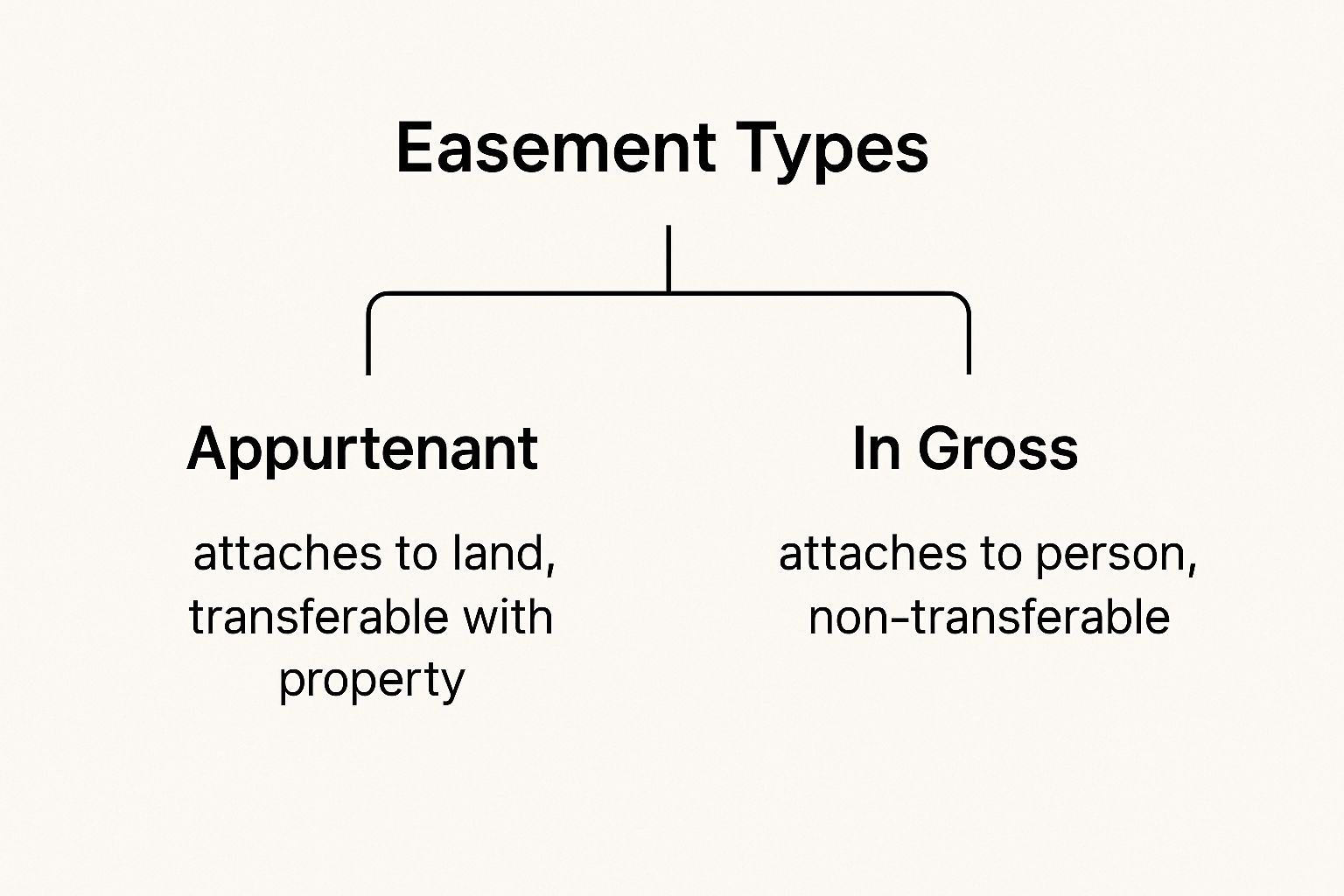
As you can see, it all boils down to whether the right is attached to the property (appurtenant) or to a person or company (in gross).
Easements Appurtenant: The Permanent Connection
An easement appurtenant is the kind you’ll see most often. It’s tied directly to the land itself. Think back to our landlocked property example—that right to use the neighbor’s driveway is a classic easement appurtenant. It benefits the dominant estate and "runs with the land," which is just a legal way of saying it automatically passes to every future owner of that property.
This kind of easement is meant to solve a practical problem, usually about access or use, and is intended to be a permanent fixture. You can't just sell it or give it away separately from the land it helps.
Easements in Gross: A Specific Right for an Entity
An easement in gross, on the other hand, benefits a specific person or company—not another piece of property. The textbook examples are utility easements. A power company, for instance, holds an easement in gross that lets it run electrical lines across dozens of different properties.
There's no dominant estate here. The right belongs to the utility company itself, no matter who owns the land their poles are on. These easements are the backbone of public infrastructure, making it possible for services like electricity, water, and internet to reach our communities.
An easement's classification—whether appurtenant or in gross—fundamentally alters its impact on a title. One creates a permanent relationship between two parcels of land, while the other grants a specific, often commercial, right to an outside party.
Prescriptive Easements: Acquired Through Use
Sometimes, an easement can pop into existence without any formal written agreement at all. A prescriptive easement is born when someone uses another person's land openly, continuously, and without their permission for a long time (the exact period is set by state law). It feels a lot like "squatter's rights" (adverse possession), but instead of claiming ownership, it only grants a right of use.
For instance, if your neighbor has been driving across the corner of your lot to get to their garage for 20 years without asking, they might just have a legal right to keep doing it. These unwritten rights are a massive red flag in a title search because there's no deed to find—just a potential claim lurking in the property's history.
Easements by Necessity: A Legal Lifeline
An easement by necessity is one created by a court when a property is completely landlocked with no way to get to a public road. The law basically assumes that no one would ever intentionally sell a piece of land that the buyer can't get to.
This easement is granted purely out of practical necessity to make sure the property isn't useless. The court steps in to figure out the most reasonable path for access across the neighboring servient estate.
These core types also branch out into more specialized forms, like conservation easements. These agreements, which restrict development to preserve land, really took off in the late 1990s and early 2000s. By 2003, over 5 million acres were protected by conservation easements held by trusts—a staggering jump from just 128,000 acres in 1980. You can explore more on the historical growth of these land preservation tools.
How Easements Create Title Search Nightmares

A deed of easement isn't just another document in the property file. For any title professional, it’s a potential landmine that can complicate, cloud, or completely derail a transaction. Finding these agreements during a title search is only the first step. The real work—and the real risk—is figuring out what they actually mean for the property today.
These documents can be ancient, filled with vague language that made sense in 1950 but is a legal headache now. A quick manual review simply isn’t enough to spot the subtle dangers hidden in dense legalese, turning what should be a smooth closing into a messy legal fight. This is where modern solutions become a competitive advantage, enabling teams to work faster and more accurately.
Uncovering Buried Risks in Old Documents
The trouble starts with the search itself. Easements are recorded against a property's title, but hunting down the original document—especially a dusty one from decades ago—takes some serious digging. Once you find it, that's when the real problems often surface.
Ambiguous or poorly defined terms are a massive red flag. An old deed might grant a vague "right of way for access" without spelling out the exact width, location, or what kind of use is allowed. This ambiguity is a recipe for conflict.
- Boundary Disputes: If the easement's path isn't legally described down to the inch, where is it really? This leads to nasty disagreements between neighbors over fences, landscaping, or new construction.
- Scope of Use: What does "access" actually permit? Can the dominant estate holder start driving heavy commercial trucks down a path that was only ever meant for foot traffic? A recent California case drove this point home when a court ruled that an old agricultural easement couldn't be used to haul cannabis without the servient owner's permission—it went way beyond the original scope.
- Maintenance Obligations: Who pays to fix the shared driveway when it's crumbling? If the deed is silent, you have a stalemate that often ends up in costly litigation.
The biggest risk in a title search isn't failing to find an easement—it's failing to understand its limits. An ambiguous deed of easement is a ticking time bomb just waiting for a new owner to set it off.
The Problem with Unrecorded Agreements
What’s even worse? Unrecorded easements. Things like prescriptive easements don't show up in the public record because they're established through long-term, unchallenged use. They're totally invisible during a standard title search and can pop up out of nowhere, creating a massive title defect.
Imagine a client buys a property, only to find out the public has been using a trail across it to get to a local park for the last 20 years. That could easily establish a prescriptive easement, permanently tying up the land and wrecking the new owner’s development plans.
Navigating Evolving Legal Language
The way we write legal documents has changed over time, adding yet another layer of complexity. For example, the HM Land Registry in the UK is now standardizing its language for clarity, swapping phrases like "the land has the benefit of any legal easements" for the more direct "the title includes any legal easements."
This shift highlights a huge industry challenge: old documents use all sorts of inconsistent and outdated terminology. A title professional needs to be more than just a good researcher; they have to be a bit of a legal historian, able to translate old-fashioned language into the context of modern law. This deep-dive analysis is absolutely critical for title searchers and abstractors who need to deliver a crystal-clear picture of a property's legal standing. To get it right, pros need tools that go beyond just pulling up documents, as we detail in our resources for title abstractors.
Missing a tiny detail in a deed of easement isn't just a simple mistake—it can lead to huge financial losses and legal liability. It's this high-stakes environment that makes modern technology so essential, helping to flag those ambiguities and make sure no detail, no matter how old, gets missed.
The Anatomy of a Bulletproof Easement
A clearly written deed of easement is your best defense against future headaches. Think of it this way: ambiguity is the enemy of a clear title. A well-drafted document acts as a precise instruction manual for how two properties will coexist, and skimping on the details is an open invitation for a decade-long legal battle over a simple right-of-way.
The whole game is about prevention. By nailing down every key component with meticulous detail, you’re not just creating an agreement—you're protecting property rights and forging a clear, marketable title that will stand the test of time.
Nailing Down the Parties and Property
First things first: you have to be crystal clear about who is involved and what land is affected. This sounds like a no-brainer, but you'd be surprised how often it's a source of costly mistakes. A sloppy document might fail to list the full legal names of the owners or use an old, inaccurate property description.
To get this right, every easement must include:
- Full Legal Names: State the complete, official names of all current owners for both the dominant and servient properties.
- Precise Legal Description: This is not the time for a simple street address. You need the official legal description for the entire servient property and for the specific easement area itself. This often means using metes and bounds or lot and block numbers.
Without this rock-solid foundation, the entire agreement is built on shaky ground.
Defining the "What" and "How": Purpose and Scope
Once the "who" and "where" are locked in, the "what" and "how" become the main event. Simply stating an easement is for "access" is a recipe for disaster. The document has to explicitly define the purpose of the easement and spell out any and all limitations on its use.
A great deed of easement anticipates future questions and answers them before they're ever asked. Vague language like "reasonable use" is just asking for a lawsuit; specific terms like "a 15-foot wide ingress and egress for residential vehicles only" provide clarity that lasts.
Take a recent California case, for example. A landowner held an old agricultural easement from 1998 and tried to use it to transport cannabis. The court shut it down, ruling that the new use went way beyond the scope of what was originally intended. This is a perfect illustration of why it’s critical to specify exactly what activities are allowed—and just as importantly, what's off-limits.
Planning for the Future: Maintenance and Termination
An often-overlooked but absolutely crucial piece of the puzzle is the maintenance plan. Who's on the hook for repairing that shared driveway? Who pays to maintain the underground utility line? A strong deed of easement assigns these responsibilities and dictates how costs will be split. Without it, a small pothole can easily escalate into a major neighborly war.
Equally important is having a clear exit strategy. While many easements last forever, some are meant to be temporary. The document should spell out the exact conditions under which the easement can be terminated, such as:
- Abandonment: The dominant estate owner stops using the easement for a specific period defined by law.
- Merger: The same person ends up owning both the dominant and servient properties.
- Express Agreement: Both parties sign a new written agreement to officially terminate the easement.
- Cessation of Necessity: The original reason for the easement disappears (for instance, a new public road is built, providing alternative access).
By meticulously addressing these core elements—parties, property, purpose, scope, maintenance, and termination—a deed of easement is transformed from a potential liability into a stable, predictable legal tool. This level of detail ensures everyone’s rights and obligations are protected for years to come.
Understanding the Rise of Conservation Easements
While most title professionals are familiar with the everyday utility and access easements, a specialized type has become a major force in property law: the conservation easement. This unique version of a deed of easement is a powerful tool for land preservation, letting landowners voluntarily place permanent restrictions on future development to protect a property’s natural or agricultural character.
Think of it as an easement in reverse. Instead of granting a right to use the land, a conservation easement removes certain rights from the property. The landowner essentially sells or donates their development rights to a land trust or government agency. That organization then takes on the permanent responsibility of monitoring the land to make sure the agreement is honored.
This creates a legally binding agreement that “runs with the land,” meaning every future owner is bound by the same development restrictions. In return for this permanent protection, landowners often receive significant tax benefits, making conservation easements an increasingly popular way to preserve family farms, forests, and vital wildlife habitats.
The Growth of a Movement
The use of conservation easements has absolutely exploded over the last few decades. What was once a niche legal instrument is now a mainstream conservation strategy, reflecting a major shift toward private land preservation.
The numbers tell the story. Between 1980 and 2015, land trusts protected over 56 million acres of land. By 2015, a staggering 16.7 million acres were specifically held under conservation easements. Even more telling, 77% of that land was managed by accredited organizations, showing a growing professionalism in the field. For a deeper dive, you can explore detailed findings on land trust growth.
This dramatic increase means title professionals are bumping into these complex agreements far more often than they used to.
Unique Challenges for Title Review
Conservation easements throw a few curveballs into a standard title review. Their perpetual nature and highly detailed restrictions demand a much closer look than your typical right-of-way agreement.
A normal title search might focus on access and financial encumbrances. But reviewing a conservation easement means digging deep into the specific limitations placed on the property—and they can get incredibly granular.
The core challenge of a conservation easement lies in its permanence and specificity. It's not just about a shared driveway; it's about a perpetual set of rules governing land use that can impact everything from building a shed to planting a garden.
For title professionals, this raises several critical questions that must be answered:
- What are the exact restrictions? The document could prohibit any new structures, limit timber harvesting, or even dictate specific farming practices. You have to know the fine print.
- Who is the monitoring party? A land trust or government agency holds the right to inspect the property and enforce the terms. This adds another stakeholder to the title that can't be ignored.
- Are there any reserved rights? Sometimes the landowner keeps specific rights, like building one additional home for a family member. These exceptions must be clearly defined in the document.
Gliding over these details is a recipe for disaster. A future owner could unknowingly violate the terms, leading to serious legal and financial headaches. As land use priorities continue to change, getting a handle on the complexities of conservation easements is no longer just good practice—it's essential for delivering a clear and accurate title.
Cut Through the Complexity of Easement Reviews with TitleTrackr
Let’s be honest: manually reviewing a dense deed of easement is a grind. It’s a slow, painstaking process that’s practically built for human error. You’re digging through pages of thick legal language, cross-referencing documents that might be decades old, all while knowing a single missed detail could snowball into a massive title defect.
This is precisely the headache TitleTrackr was designed to cure.
Forget spending hours trying to translate legalese. Our platform puts AI to work, automating the entire review from start to finish. TitleTrackr’s system doesn't just scan a document for keywords; it reads and understands it, instantly pulling out the critical easement terms you need—scope, duration, maintenance duties, you name it.
From Manual Slog to Automated Insight
This isn't just about moving faster. It's about shifting from tedious manual labor to smart, automated analysis that gives your team the confidence to make the right call. The platform pulls all your documents into one clean, simple dashboard, giving you a crystal-clear overview of every single encumbrance.
Here’s how TitleTrackr helps you get it right:
- Flag Ambiguities Instantly: The AI is trained to spot vague language or potential conflicts that could easily lead to disputes down the road.
- Slash Turnaround Times: We’ve seen teams cut their manual data extraction time by up to 90%. That frees up your experts to do what they do best: high-level analysis.
- Minimize Costly Risks: By ensuring no detail gets lost in the shuffle, you’re protecting both your clients and your firm from the financial nightmare of a clouded title.
The real win here isn't just about speed. It's about the consistency and rock-solid accuracy that automation brings to every single file. TitleTrackr turns the easement review from a potential liability into a standardized, risk-managed part of your workflow.
Stop letting complex easements create bottlenecks and unnecessary risk. It’s time to give your team the tools to navigate even the most tangled title searches with speed and precision.
Ready to see how we can completely change your operations? Find out more about our AI-powered solutions at TitleTrackr.com and book a demo today. It's time to experience a new standard of accuracy.
Deed of Easement FAQs
When you're digging into property records, deeds of easement can throw a lot of curveballs. The language can be archaic, the terms unclear, and the implications for the title significant. It’s only natural to have questions. Getting them answered is the key to preventing a headache down the road.
Here are a few of the most common questions we see from property owners and real estate pros.
Can a Deed of Easement Be Revoked?
You’d think so, but it's not that simple. Most easements are permanent and "run with the land," which is just a fancy way of saying they stick around even when the property sells.
That said, they aren't set in stone forever. An easement can be terminated if both property owners agree to it in writing, if the original reason for it disappears (like a road being rerouted), or if the party benefiting from it simply stops using it and shows intent to abandon it.
Who Is Responsible for Maintaining the Easement?
This is where things often get messy. Unless the document spells it out clearly, the general rule is that the dominant estate—that’s the party who benefits from the easement—is on the hook for maintenance.
A well-drafted deed of easement will leave no room for doubt, clearly stating who pays for what. It’s one of the first things you should look for to avoid future arguments.
Does a Property Owner Get Paid for an Easement?
Absolutely. Compensation is usually part of the deal, especially for easements in gross where a utility company needs to run lines across a property. The owner of the land (servient estate) is paid for giving up that right of use. It might be a one-time check or another arrangement, all laid out in the agreement.
Conservation easements have added a whole new dimension to this. Landowners can get significant tax benefits for agreeing to restrict development on their property. It's a concept that has exploded in popularity—by 2011, local and state land trusts were protecting over 6.2 million acres, a massive 148% jump in just over a decade. Discover more about the growth of conservation land protection.
Of course, these are just a few of the complexities that can pop up. For a deeper dive into the nitty-gritty, you might want to explore our full FAQ page. For any title professional, nailing these details is what separates a clean report from a risky one.
At TitleTrackr, we take the guesswork out of reviewing a deed of easement. Our AI platform pulls the key data, flags potential risks, and gives you the clarity you need in seconds, not hours. See how you can bring a new level of precision to your title search workflow and request a demo today at https://titletrackr.com.
 blog.titletrackr.com
Leave a comment