

Before signing off on any New Jersey real estate transaction, a critical piece of due diligence is non-negotiable: the property title search. This is far more than a simple closing-day checklist item. It's a comprehensive investigation into public records to verify legal ownership and, more critically, to uncover any claims or liens that could jeopardize the transaction. For title professionals, this process is the first line of defense against complex financial and legal liabilities. A meticulous search ensures the seller holds a clear and marketable title, allowing for a seamless transfer of ownership.
Why a NJ Property Title Search is the Bedrock of a Secure Transaction

It’s easy for stakeholders to view a title search as a formality, but for industry professionals, it is the foundation of a secure real estate investment. Bypassing this step means inheriting a property's entire history, sight unseen, along with every dispute and unpaid bill attached to it. This due diligence is fundamental to protecting all parties involved.
The objective is to establish a "clear title"—a title free of outstanding liens, ownership claims, or other encumbrances that could challenge the new owner's rights. It is the official confirmation that the seller is the sole owner with the full authority to transfer the property.
Uncovering Hidden Financial Burdens
A primary function of a title search is to identify financial claims, or liens, attached to the property. These debts must be satisfied before the title can be cleanly transferred. If missed, the liability transfers to the new owner, creating significant post-closing issues.
Common financial encumbrances discovered during a New Jersey title search include:
- Unpaid Property Taxes: Delinquent taxes can result in a government lien, which, if left unresolved, could lead to foreclosure.
- Mortgage Liens: Often, prior mortgages are not properly discharged after payoff, remaining on the title and clouding ownership until formally cleared.
- Mechanic's Liens: A contractor or supplier who performed work on the property but was not paid can file a lien to secure their claim.
- Judgments: If a previous owner lost a lawsuit resulting in a monetary judgment, that judgment can attach to their real estate assets.
Imagine a client purchasing a commercial property in Trenton, only to discover a $25,000 mechanic's lien from an unpaid HVAC installation months after closing. Without a proficient title search, this unforeseen liability becomes a significant problem for the new owner and a potential claim against the title policy.
Avoiding Legal and Ownership Disputes
Beyond financial claims, a title search uncovers legal issues that could restrict property use or challenge ownership entirely. These non-monetary issues are often more complex and difficult to resolve than a simple lien.
A property's history is written in public records. The title search reads that history to ensure there are no surprise chapters waiting to unfold after you've already bought the book.
These legal landmines can derail a sale or create long-term complications. A comprehensive search helps mitigate risks such as:
- Unknown Easements: An easement grants another party the right to use a portion of the land, such as a utility company needing access to infrastructure or a neighbor having a legal right-of-way.
- Chain of Title Gaps: A clear "chain of title" demonstrates an unbroken history of ownership. A gap, perhaps from an unrecorded inheritance, raises questions about the seller's legal authority to convey the property.
- Fraudulent Deeds: While rare, documents in the property's history may have been forged or executed by an individual lacking legal authority.
Executing a comprehensive property title search new jersey isn't merely an operational cost; it's a critical investment in risk management. By identifying these potential issues before closing, you protect your client's most significant asset from its past and ensure a smooth, defensible transaction.
Navigating New Jersey's Property Record Systems
A successful title search in New Jersey requires a deep understanding of where to locate official records. Unlike some states with a centralized database, New Jersey's public records are decentralized, primarily managed at the county level. Mastering this fragmented system is the first step toward constructing a property's complete history.
The two most critical destinations for title research are the County Clerk's Office (sometimes called the Register of Deeds and Mortgages) and the local Tax Assessor's Office. Each holds distinct but equally vital pieces of the title puzzle. The County Clerk serves as the property's official historian, while the Tax Assessor acts as its financial ledger.
The County Clerk: The Authoritative Source for Ownership History
The County Clerk's office is the repository for all legal documents affecting a property's ownership and any claims against it. This is where the bulk of the research occurs, tracing the chain of title—the chronological record of every owner. An unbroken chain is essential for establishing a clear title.
Key documents to be examined include:
- Deeds: The legal instruments that transfer property from seller to buyer. Every deed in the property's history must be meticulously inspected.
- Mortgages: These documents record loans secured by the property. It is crucial to verify that prior mortgages have been paid and officially discharged.
- Liens and Judgments: Claims against the property for unpaid debts, such as a mechanic's lien or a court-ordered judgment.
- Easements and Covenants: Documents that grant specific rights to others or impose restrictions on land use.
Record organization varies significantly between counties. Some offer robust online portals, while others require researchers to navigate microfilm or physical ledgers. This inconsistency presents a major operational challenge for professionals conducting a property title search new jersey across multiple jurisdictions.
A title search isn't just about finding a stack of documents. It's about understanding what they mean when you put them all together. One missed mortgage or a misfiled deed can create massive risks for the new owner.
For example, Burlington County provides a public records search system called PRESS, with records dating back to 1965. While a valuable resource, it has its own complexities—the search protocol differs for records pre- and post-2012. Furthermore, a 2023 change due to Daniel’s Law means certain documents are now redacted for privacy, adding another layer of complexity. You can explore the Burlington County PRESS system to see these nuances firsthand.
The Tax Assessor: The Key to Property Details
While the County Clerk manages ownership history, the local Tax Assessor's office provides the specific details of the property itself. This is the primary source for verifying foundational information.
The Tax Assessor's records provide:
- Tax Maps: These official maps identify the property's block and lot numbers, the unique identifiers required to look up records in most county systems.
- Property Tax Records: This is where you can find the property's assessed value, tax rate, and payment history, confirming whether any delinquent taxes exist that could result in a tax lien.
- Property Characteristics: The assessor’s files typically contain data on lot size, building square footage, and a list of all structures on the property.
Professionals like landmen understand how these fragmented systems can impede research. To address this, our guide for landmen provides insights into modernizing land research, demonstrating how to integrate these disparate data sources for more efficient and accurate work. Ultimately, a thorough search requires pulling data from both the Clerk and the Assessor to ensure a comprehensive examination.
Conducting a Manual Title Search In Person
While modern technology offers significant advantages, understanding the traditional, hands-on property title search in New Jersey is a foundational skill for every title professional. This classic approach requires patience, meticulous attention to detail, and on-site visits to county offices, providing an invaluable perspective on the mechanics of title examination.
The process begins not with a website, but at the local Tax Assessor’s office to secure the property's unique block and lot numbers. These identifiers are the keys that unlock all other records. With these numbers, the next stop is the County Clerk’s office, where the core investigative work takes place.
This graphic illustrates the flow of a manual search, from gathering initial identifiers to methodically reconstructing a property's complete historical and financial narrative.
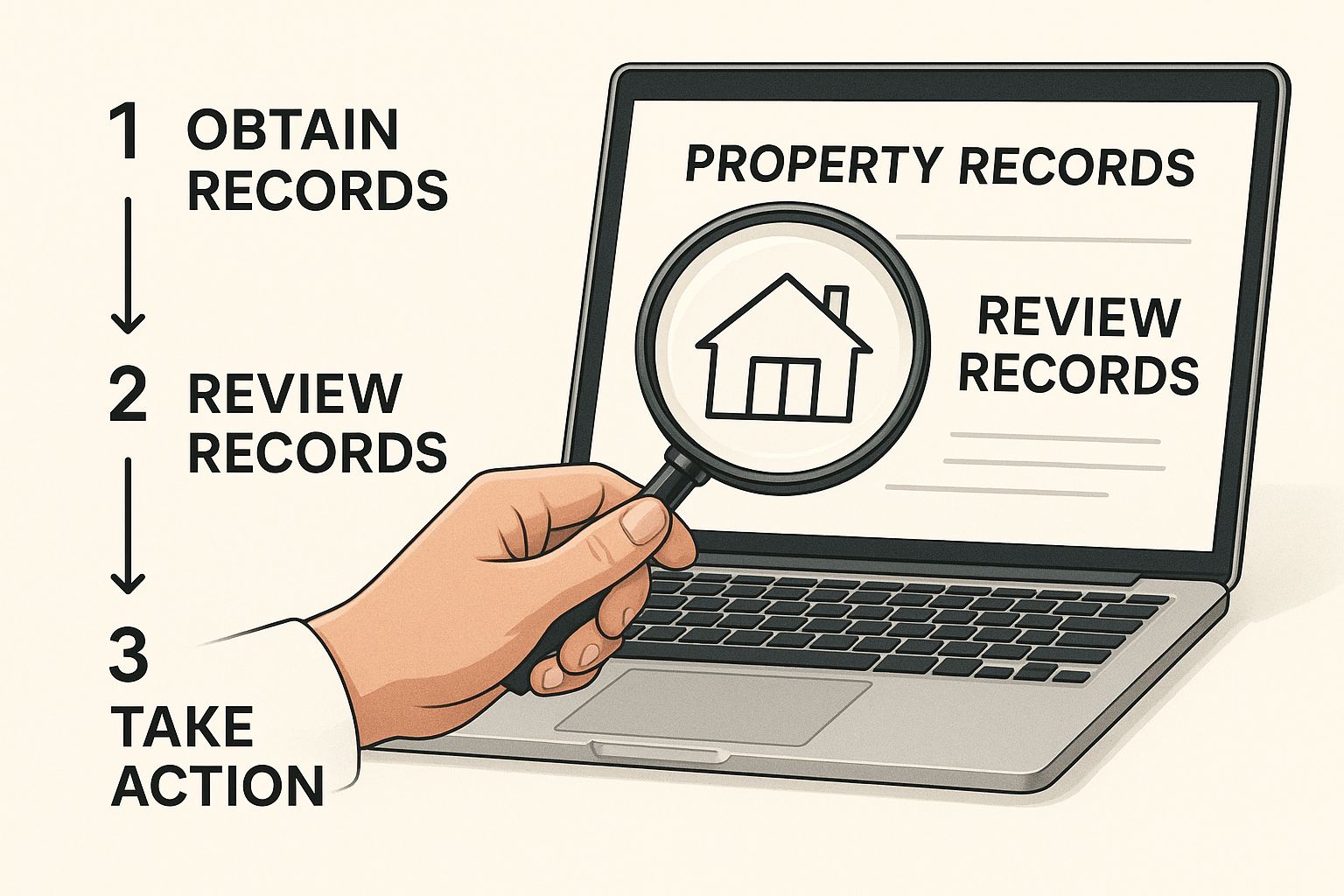
The workflow demonstrates a cyclical process of tracing ownership backward and then moving forward to identify liens and other encumbrances, demanding careful cross-referencing at every stage.
Tracing Ownership Backward to Build the Chain
Inside the public records room, the primary objective is to construct the "chain of title"—a chronological record of every owner. Starting with the current owner, you work backward one deed at a time. Using the county's public terminals or physical deed books, you locate the deed that transferred the property to the current owner.
This deed identifies the previous owner (the "grantor"). You then repeat the process for that individual, finding the deed that made them the owner. This leapfrogging continues back through time until you have traced the ownership history for at least 60 years, the industry standard for a full search in New Jersey.
A complete chain of title is non-negotiable. Even a single missing link—like an unrecorded inheritance or a faulty deed from decades ago—can create a cloud on the title that jeopardizes the entire transaction.
This is rarely a straightforward process. It often involves deciphering handwritten documents, interpreting faded signatures, and navigating complex legal descriptions. It is slow, methodical work where precision is paramount.
To track records effectively, knowing which offices hold which documents is essential.
Table: Key Information Sources for a NJ Title Search
This table outlines the primary offices involved in a manual title search and the specific records they maintain. Understanding these sources is fundamental to an efficient and thorough examination.
| Information Source | Primary Records Held | Key Search Parameters |
|---|---|---|
| County Clerk's Office | Deeds, Mortgages, Liens, Judgments, Foreclosure Records | Grantor/Grantee Names, Block & Lot, Document Number |
| Tax Assessor's Office | Tax Maps, Block & Lot Numbers, Property Tax Records | Street Address, Current Owner Name |
| Surrogate's Court | Wills, Probates, Estate Records | Decedent's Name, Date of Death |
| Superior Court of NJ | Statewide Judgments, Child Support Liens | Individual/Business Names |
A comprehensive search requires accessing all relevant sources, as a single missed record can have significant consequences for the title's clarity.
The Critical Search for Liens and Encumbrances
After establishing the complete chain of owners, the next phase is to reverse course. You must search forward in time, examining each owner's history for any financial claims or legal issues that arose during their period of ownership.
This is the most critical and labor-intensive part of any manual search. For every individual in the 60-year chain, a comprehensive search must be conducted for:
- Mortgages: Were all loans satisfied and properly discharged? An open mortgage from 30 years ago can still be a valid claim.
- Judgments: Did an owner lose a lawsuit that resulted in a money judgment? These judgments can attach to their real estate.
- Federal and State Tax Liens: Unpaid income or business taxes can create powerful liens against a property.
- Child Support Liens: Unpaid child support obligations are another common source of liens.
- Foreclosure Records: It is essential to determine if the property was ever involved in foreclosure proceedings.
Consider Monmouth County, whose Open Public Records Search System (OPRS) provides digital access to deeds from 1970 and mortgages from 1976. However, the county explicitly states that this digital database is for informational use only and cannot replace an official in-person search for legal purposes. This highlights a crucial point: even with digital tools, the authoritative work often must be completed on-site.
The sheer volume and complexity of this work underscore why professional title abstractors are essential to the real estate industry. They possess the expertise to navigate these records efficiently and identify red flags an amateur might overlook. The manual process, while foundational, is prone to human error and consumes an immense amount of time and resources.
Tapping into Online Databases for Preliminary Research
Before any on-site work begins, the modern title search starts at the desk. Online databases—both public and private—provide title professionals with a powerful head start on a property title search in New Jersey. These digital tools are indispensable for rapid preliminary research, enabling the collection of initial data and the identification of potential issues from the outset.
This initial reconnaissance allows researchers to pull basic property details, review tax information, and map out a preliminary ownership history. This digital first pass helps build a strategic research plan, saving countless hours that would otherwise be spent sifting through physical records.
However, a critical word of caution: most online portals are not legally sufficient for closing a real estate transaction and should never be considered the final word on a title's clarity.
State and County Online Portals
Many New Jersey counties now offer some form of online access to their property records. The quality and depth of these systems vary dramatically—some are comprehensive, searchable databases, while others are little more than basic indexes. Nevertheless, they are excellent for verifying block and lot numbers, checking tax assessments, and getting a snapshot of recent deeds.
A county portal is typically used to:
- Confirm current ownership and the most recent transfer date.
- Pull basic parcel data, such as lot dimensions and assessed value.
- Check for recent liens or mortgages that have been digitized.
Conducting this groundwork first establishes a solid foundation of understanding before committing to a more time-consuming manual search.
State-level resources can also provide a broader perspective. The New Jersey MOD IV Historical Database, for instance, contains over 93 million records from 1989 to 2022. It aggregates parcel and ownership data from all 21 county tax boards, offering an extensive historical view of property transitions. While not real-time, it is an invaluable tool for analyzing long-term ownership patterns. Learn more about the historical data available through Rutgers.
Knowing the Limits of Digital Research
The most significant pitfall in modern title research is relying solely on online databases. These resources are often incomplete or not fully up-to-date. Digitization is a slow, ongoing process, and many older records—especially those needed to establish a 60-year chain of title—are simply not yet available online.
Online databases can tell you what is there, but they can't always tell you what's missing. The real risks in a title search often hide in the documents that haven't been digitized yet.
Furthermore, online records can contain errors. A simple typo in a name or a mis-indexed document can send an entire search in the wrong direction. These digital findings should be treated as a guide to accelerate an investigation, not as a replacement for it.
Blending Modern Tools with Traditional Methods
The most effective title professionals employ a hybrid approach, combining the speed of digital research with the thoroughness of traditional, on-site methods. They use online databases to quickly gather names, dates, and document numbers, creating a preliminary outline of the property's history.
This strategy allows researchers to walk into the County Clerk's office with a clear roadmap. They already know which documents to pull and which owners require a closer look for potential liens or judgments. This transforms a potential fishing expedition into a targeted, efficient investigation.
The inherent challenge remains the fragmented nature of the data. Juggling multiple county websites, state databases, and third-party services is inefficient and increases the risk of error. This is precisely where a unified platform becomes a game-changer, aggregating disparate data sources into a single, cohesive interface. By automating data collection and analysis, professionals are free to focus on what truly matters: interpreting the data, not just gathering it.
The Modern Solution for Faster NJ Title Searches
After grappling with the limitations of manual searches and piecing together data from fragmented online systems, one conclusion is clear: the traditional model is no longer sufficient. The sheer volume of records, combined with inter-county inconsistencies, creates an environment ripe for human error and operational bottlenecks. The industry requires a more intelligent approach to conducting a property title search in New Jersey.
This is where modern technology provides a solution, not just to accelerate the process, but to fundamentally transform how the work is performed. The traditional approach forces professionals to be data jugglers. A modern solution consolidates all of that information into a single, intuitive dashboard where data from countless public and private sources is aggregated, standardized, and presented in a clean, actionable format. This eliminates the need to switch between dozens of browser tabs, dramatically reducing research time and cognitive load.
Automating the Chain of Title
Building the chain of title is one of the most tedious and time-consuming aspects of any search, requiring a painstaking trace of ownership back a full 60 years. Modern platforms like TitleTrackr have completely automated this laborious process.
Using intelligent algorithms, the system instantly analyzes decades of deeds, mortgages, and other filings to construct a complete ownership history in minutes, not days. This automation doesn't just save an immense amount of time; it introduces a level of precision that is difficult to achieve manually. The system immediately flags potential red flags—such as gaps in the chain or name variations—that a human eye might miss after hours of reviewing digitized records.
These automated checks are designed to identify:
- Ownership Gaps: Any break in the chronological flow of ownership is immediately highlighted for expert review.
- Unresolved Liens: The system cross-references every owner against lien and judgment databases, flagging any outstanding claims that could cloud the title.
- Document Errors: It can spot inconsistencies in legal descriptions or names that might indicate a problem with a past filing.
A Real-World Scenario: From Days to Minutes
Consider a common scenario: an abstractor receives an order for a complex commercial property in Trenton with a long history, multiple owners, several mortgages, and a potential easement from the 1970s.
The Traditional Way:
This search would consume several days. Day one would be dedicated to gathering initial data from online portals and the tax assessor. The next two to three days would be spent at the County Clerk's office, manually constructing the 60-year chain and then searching for liens against all previous owners. It is a detail-oriented grind with numerous opportunities for error.
The TitleTrackr Way:
Using TitleTrackr, the abstractor enters the property details. Within minutes, the platform aggregates all relevant digital records, builds the complete chain of title, and runs comprehensive lien searches on every owner in that chain. The system flags an undischarged mortgage from 1988 and a potential discrepancy in the property's legal description from a 1995 deed.
What once took the better part of a week is now wrapped up in under an hour. The abstractor can then focus their expertise on actually investigating the flagged issues, not on the manual labor of data collection.
This isn't about replacing professionals; it's about empowering them. By handling the heavy lifting of data aggregation and analysis, TitleTrackr frees up experts to apply their critical thinking and experience where it adds the most value. Their role shifts from data gatherer to strategic risk analyst, ultimately delivering faster, more accurate results for their clients. This efficiency creates a powerful competitive edge, allowing title professionals to increase their volume and confidence while reducing the risk of costly errors in New Jersey's fast-paced real estate market.
Common Questions About NJ Title Searches
Even for seasoned professionals, a property title search new jersey can present unique challenges and questions. Understanding timelines, potential roadblocks, and best practices provides confidence when navigating complex real estate transactions.
Here are some of the most common queries we address, providing clarity on what to expect and why each step is vital for protecting your client's investment.
How Long Does a Property Title Search Take in New Jersey?
The answer depends entirely on the methodology. A traditional, manual search involving physical visits to county offices can take anywhere from a few days to two weeks. The timeline is dictated by the complexity of the property's history and the efficiency of a particular county's record-keeping systems.
A property with a long and convoluted history—involving multiple owners, foreclosures, or numerous liens—will naturally require more time to examine. In contrast, using a professional title service leveraging a modern platform can often produce a preliminary report in a matter of hours. While this initial research is dramatically faster, the final, insurable report may still require a week or more for full certification.
What Are the Most Common Title Problems Found in NJ?
In New Jersey, a handful of common issues frequently "cloud" a title. Identifying these problems early is the primary objective of the search.
The most frequent title defects we encounter include:
- Undisclosed Liens: Often stemming from unpaid property taxes or contractors who were never compensated for their work (mechanic's liens).
- Errors in Public Records: Simple clerical errors, such as typos in names or incorrect legal descriptions on historical deeds, can create significant ownership confusion.
- Unknown Easements: An easement might grant a utility company or a neighbor the right to use a portion of the property, potentially conflicting with the new owner's plans.
- Breaks in the Chain of Title: Gaps in ownership history can be caused by unresolved inheritance issues, flawed foreclosures, or deeds that were never properly recorded.
- Fraud or Forgery: Though less common, forged signatures or fraudulent documents in a property's past can invalidate a seller's claim to ownership entirely.
To explore these and other potential hurdles in greater detail, you can review our frequently asked questions about title searches.
A title search is the investigation into a property's history to confirm legal ownership and find any existing issues. Title insurance, on the other hand, is the policy you buy to protect yourself from any hidden title defects that emerge after you've bought the property. The search finds known risks; the insurance protects you from unknown ones.
Can I Do a Property Title Search Myself in New Jersey?
Technically, yes. New Jersey's property records are public information, accessible to anyone. The process involves visiting the County Clerk's and tax assessor's offices to physically retrieve and review all documents tied to the property.
However, this is an incredibly complex and high-stakes task. A single overlooked document—a misfiled lien, an unrecorded deed, or a forgotten easement—can lead to significant financial loss and legal complications.
Because the risk is so high and lenders require a certified search to issue a mortgage, virtually all real estate transactions are handled by a professional title company or a real estate attorney. They not only possess the expertise to conduct a thorough search but can also issue the necessary title insurance policy that protects the investment.
Ready to see how you can complete a comprehensive New Jersey title search in minutes, not weeks? TitleTrackr uses advanced AI to automate the entire process, from building the chain of title to flagging critical risks instantly. Eliminate manual errors and gain a competitive edge.
Request a demo of TitleTrackr today and discover a smarter way to manage your title workflow.
 blog.titletrackr.com
Leave a comment