

As a real estate professional, getting your client's property onto the Multiple Listing Service (MLS) is a foundational step, but executing it flawlessly is what sets top performers apart. You can't just log on and create a listing yourself. The MLS is a tool for licensed real estate professionals, so you’ll need to work with one to get access.
For sellers, there are two primary routes. The traditional path is hiring a full-service real estate agent who manages every single detail. The other option, for the hands-on seller, is to use a flat-fee MLS service. Both strategies culminate in an MLS listing, which is the catalyst that syndicates the property to major real estate portals and puts it directly in front of buyers' agents.
Laying the Groundwork for a Winning MLS Listing

Before a home hits the market, the groundwork you lay can dramatically influence its sale price and time on market. This isn't just about a quick tidy-up. It's about crafting a powerful first impression that captures a buyer's attention the moment they see the listing online.
A realistic home valuation is the critical starting point. This requires a deep dive into recent, comparable sales (comps) within the immediate neighborhood. This data-driven approach is the only way to establish a price that is both competitive and defensible, setting the stage for a successful transaction.
Assembling Your Essential Documents
Getting your paperwork in order from the outset saves invaluable time and prevents future stress. Having a complete document package ready sends a clear signal to buyers and their agents that this is a serious, professionally managed sale. It streamlines the entire process.
Here’s a quick checklist of what to gather:
- The Property Deed: This is the non-negotiable proof of ownership.
- Property Tax Records: Buyers and their lenders need to know the annual tax liability.
- Utility Bills: A snapshot of recent bills gives a clear idea of monthly running costs.
- Appraisal Reports: A recent appraisal can be a powerful tool to validate the asking price.
- Homeowners Association (HOA) Documents: For condos or homes in planned communities, buyers must review the rules, regulations, and fees.
Preparing these documents is a critical step. At TitleTrackr, we see how organized sellers create smoother, faster transactions. Having verified information ready builds immediate trust and sets a professional tone for the entire sale.
Maximizing Appeal Through Repairs and Staging
With the documentation handled, the focus shifts to the property's physical presentation. Strategic repairs are key. Focus on high-impact, low-cost fixes that make a big visual splash—things like patching a small hole in the drywall, fixing a leaky faucet, or replacing a dated light fixture.
Staging is more than just decluttering; it's about depersonalizing the space to help buyers envision their own life there. This often means toning down personal decor, arranging furniture to maximize the sense of space, and ensuring every room is bright and inviting.
Finally, professional photography is non-negotiable. If you're going to invest anywhere, this is it. High-quality photos are what will make a buyer stop scrolling and book a showing.
This prep work is the foundation for a successful sale, especially in a market with consistent demand. With U.S. home sales projected to be around 4 million in 2025, a polished and well-prepared MLS listing is your best bet for standing out. You can find more data on the national housing market forecast on Realtor.com.
Choosing Your Listing Strategy: Agent vs. Flat-Fee
When it's time to get a property on the MLS, sellers stand at a crossroads. The choice between a traditional agent and a flat-fee service hinges on their budget, comfort level with the transaction process, and available time. As an industry professional, understanding both models allows you to better serve a variety of client needs.
The traditional route involves a licensed agent who handles the entire transaction lifecycle. From a detailed comparative market analysis (CMA) to price the home correctly, to managing showings, negotiating with buyers, and navigating the closing paperwork, they provide end-to-end service. This comprehensive support is paid for through a commission, typically a percentage of the final sale price.
On the other hand, the flat-fee MLS model is a compelling option for sellers confident in managing their own sale. For a single upfront fee, a licensed broker lists the property on the local MLS, and the seller takes control from there. They are responsible for fielding inquiries, scheduling showings, and negotiating offers directly.
The Full-Service Real Estate Agent
Working with a traditional agent means a seller is investing in expertise and the convenience of professional transaction management. The commission covers a suite of services designed to achieve the best possible price with minimal stress for the client. It's the complete, turn-key package.
The value proposition includes:
- Expert Pricing Strategy: Agents leverage detailed CMA data to position a home competitively from day one.
- Professional Marketing: This extends beyond a yard sign to include professional photography, compelling listing descriptions, and multi-channel property promotion.
- Negotiation Power: A skilled agent acts as an advocate, trained to negotiate terms and handle counteroffers to protect the seller's financial interests.
- Transaction Management: They serve as the central coordinator, liaising with inspectors, appraisers, and attorneys to ensure a smooth progression to closing.
The DIY Flat-Fee MLS Route
The flat-fee model provides direct MLS access and autonomy. For a few hundred dollars, a seller gains the crucial exposure of the MLS, which then automatically syndicates the listing to major real estate websites like Zillow and Realtor.com. This approach eliminates the listing agent's commission, but it's crucial to remember that sellers still need to offer a commission to the buyer’s agent—usually around 2.5-3%.
This image really drives home how much MLS exposure and professional presentation matter for your final sale.
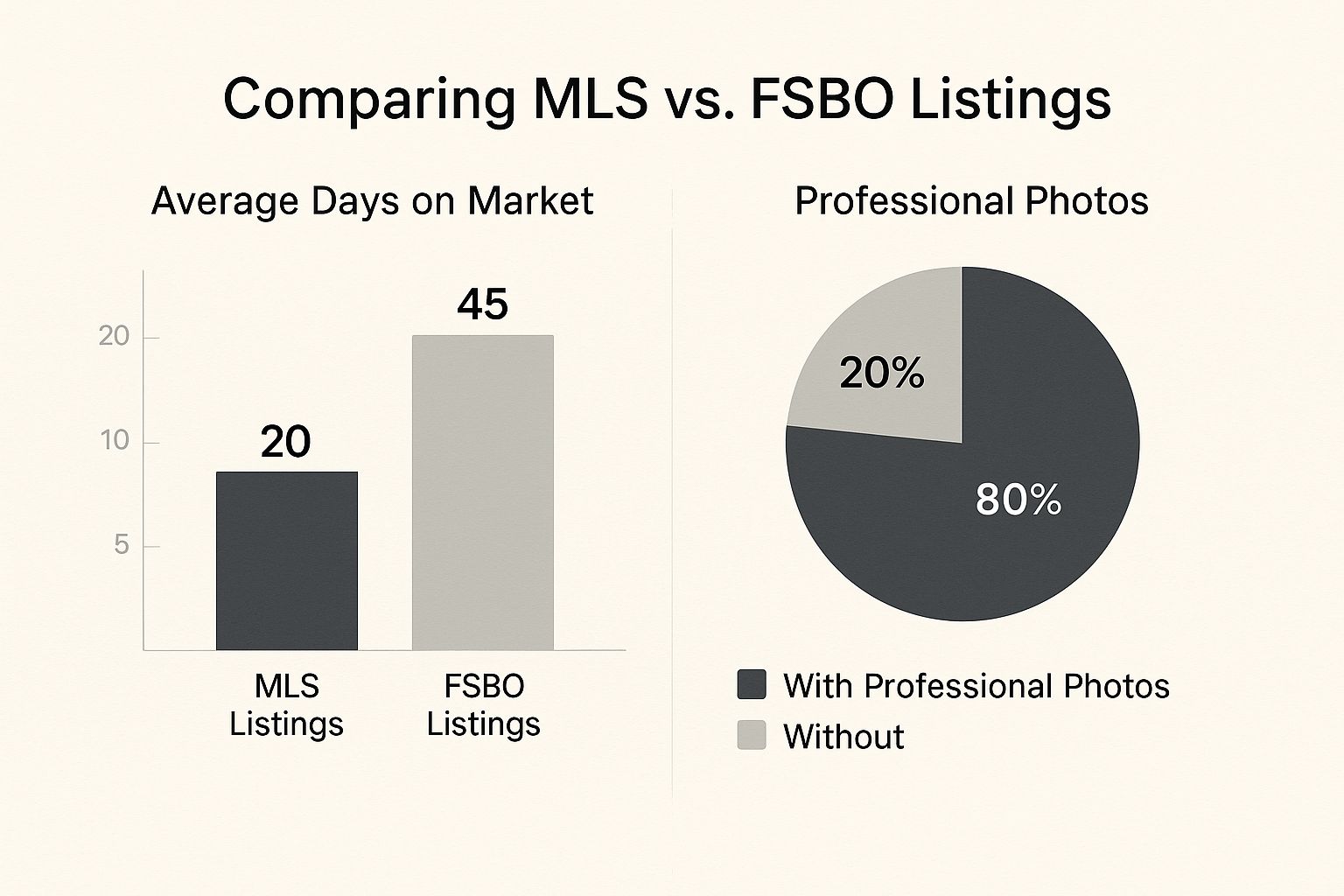
The data is clear. Properties listed on the MLS not only sell faster on average, but they are also overwhelmingly more likely to be marketed with professional photography—a key factor in attracting qualified buyers.
To help you weigh the options, here’s a straightforward comparison:
Traditional Agent vs. Flat-Fee MLS Service
| Feature | Traditional Real Estate Agent | Flat-Fee MLS Service |
|---|---|---|
| Cost Structure | Commission-based (typically 4-6% of sale price) | One-time upfront fee (typically $300-$1,000) |
| Services Included | Comprehensive: pricing, marketing, showings, negotiation, closing coordination | MLS listing and syndication only; other services are often à la carte |
| Your Involvement | Minimal; the agent handles most day-to-day tasks | High; you are responsible for showings, negotiations, and managing the transaction |
| Support Level | Full guidance and expert advice from a dedicated professional | Limited to basic listing support; you act as your own representative |
| Best For | Sellers who want a hands-off experience and expert representation | Experienced, confident sellers who want to save on commission and control the process |
The optimal choice is situation-dependent. A seller who values professional guidance and lacks the time to manage a sale will benefit from a traditional agent. Conversely, a seasoned seller aiming to maximize savings may find the flat-fee route a compelling alternative.
No matter which path you choose, ensuring your property's title and legal details are accurate from the start is non-negotiable. Platforms like TitleTrackr provide the verified data needed to build a trustworthy listing, preventing last-minute surprises that can derail a closing. Request a demo to see how our AI-powered tools bring clarity to your property data.
Creating a Listing That Stops the Scroll

In a market saturated with properties hitting the MLS daily, a listing must make an immediate impact. Consider it a digital handshake—it must be compelling enough to make a potential buyer pause their endless scrolling and focus on your property.
The details shared are about more than just square footage and room counts; they're about forging an emotional connection. In a competitive market, that connection is paramount. For perspective, the median sales price on the MLS in 2025 was around $352,900, and homes sat for a median of 43 days. The MLS is the central nervous system of real estate marketing, making mastery of the platform non-negotiable. You can see the latest housing data from realMLS to get a feel for the current landscape.
Writing a Description That Tells a Story
Generic, cookie-cutter descriptions are the fastest way to get lost in the noise. "3 bed, 2 bath" is a fact, not a feature. Your goal is to paint a picture and tell a story about what it truly feels like to live in the home.
Use language that evokes emotion. Instead of "big backyard," try "an expansive backyard ready for summer barbecues and weekend get-togethers." That simple change helps a buyer mentally move in.
From a practical standpoint, integrate keywords buyers are searching for, like "open concept," "updated kitchen," or "home office." Keep paragraphs short and scannable for mobile users.
The difference is stark:
| Weak Description Example | Compelling Description Example |
|---|---|
| Nice house with 3 beds, 2 baths. Has a backyard and updated kitchen. Good for families. Close to schools. | Welcome to your private oasis! This stunning 3-bed, 2-bath home features a bright, open-concept living space perfect for entertaining. The fully renovated chef's kitchen boasts granite countertops and stainless steel appliances. Step outside to a beautifully landscaped backyard, your personal retreat just moments from top-rated schools. |
Your Essential Photo and Visuals Checklist
Photos are the single most important element of an online listing. Poor-quality photos can kill a buyer's interest before they read a single word of your compelling description. Your mission is to showcase the home in its absolute best light.
A complete visual package gives buyers the confidence to schedule a showing. Here’s what is essential:
- The Perfect Curb Appeal Shot: A bright, welcoming photo of the front exterior.
- All Key Rooms: Living room, kitchen, dining area, every bedroom, and every bathroom.
- Highlight Features: Showcase a unique fireplace, a recently renovated bathroom, or a spacious walk-in closet.
- Outdoor Spaces: Capture the backyard, patio, or deck from its most flattering angles.
Today's buyers have come to expect more than just a handful of static photos. If you really want an edge, include a virtual tour or an accurate floor plan. These tools let buyers explore and connect with the home before they even set foot inside.
Providing detailed, accurate visuals builds trust from the start. This strategy is most effective when paired with verified property data. Using a tool like TitleTrackr to validate property details against official records creates a foundation of trust and helps prevent downstream complications.
Mastering the Technical Side of Your MLS Entry
With the property staged and a listing strategy in place, it’s time to manage the technical details of the MLS entry. This is where precision becomes paramount. Completing MLS forms isn't just data entry; it's building the digital foundation for the entire sale.
Whether you're using a full-service agent or a flat-fee MLS service, the input form demands complete accuracy. Every field—from square footage and HVAC age to specific school district boundaries—matters. A single error can have significant consequences.
Why Every Little Detail Matters
A seemingly minor error, such as an incorrect room count or misstated property taxes, can render a home invisible in filtered searches. Buyers and their agents rely heavily on these filters to navigate thousands of listings. If your data is off, you won't appear for the right audience.
Beyond search visibility, inaccuracies can lead to serious issues. Misrepresenting a key feature or omitting a mandatory disclosure could create legal exposure or cause a solid deal to collapse just before closing. Thoroughness isn't just best practice; it's essential risk management.
Here are a few common pitfalls to avoid:
- Incorrect Square Footage: Using an estimate instead of checking official records.
- Misclassified Rooms: Labeling a den or office a "bedroom" when it lacks a closet.
- Overlooking Disclosures: Forgetting to mention known issues like past water damage or a major structural repair.
- Inaccurate HOA Fees: Listing outdated monthly dues, which can disrupt a buyer's debt-to-income calculations.
When every piece of data you provide is correct from the get-go, you build immediate trust with buyers and their agents. A listing that holds up under scrutiny paves a much smoother road to the closing table.
Building Trust with Verified Data
This is where the right technology can provide a significant advantage, catching potentially costly mistakes before they become problems. An unverified listing can be a red flag for experienced agents, planting a seed of doubt that's hard to overcome. Verifying your data against official public records is the secret weapon for creating a strong, defensible listing.
Using a platform like TitleTrackr ensures your property information is cross-referenced with public records right from the start. This proactive step does more than just prevent last-minute closing delays caused by data discrepancies—it cements your listing's credibility from day one.
When agents see that your details are accurate and verified, it removes friction from the process and keeps things moving forward. Ready to see how AI-powered data verification can help you build a bulletproof listing and avoid those closing-day surprises? Request a demo with TitleTrackr today.
Keeping Your Live Listing Sharp and Competitive

Publishing a property on the MLS is the starting line, not the finish. From this point, the focus shifts from preparation to active management. A common mistake is treating a listing as a static advertisement; in reality, it's a dynamic asset that requires constant attention to maintain a competitive edge.
Monitor performance metrics like views, saves, and agent inquiries diligently. These numbers are direct market feedback. Low engagement from the start is a clear indicator that the price, photos, or description needs immediate adjustment.
Reading the Tea Leaves: When and How to Make Adjustments
Analyzing listing analytics reveals how buyers are reacting. A high volume of online views with few showing requests is a classic sign of an over-priced home. The photos attracted interest, but the price deterred action when compared to similar properties.
This situation requires proactive measures. If a week or two pass with strong online traffic but minimal real-world interest, a strategic price adjustment is likely necessary. Even a small reduction can expose the property to a new segment of buyers who previously filtered it out of their search.
Another effective tactic is refreshing the visuals. Swapping the primary photo for a striking twilight shot or a different interior angle can make the listing feel new again, catching the eye of buyers who may have previously overlooked it.
Responding to a Market in Motion
The real estate market is constantly shifting, and sellers must be prepared to adapt. The latest data shows that active inventory has jumped 24.8% year-over-year, which means more competition for you. Homes are also sitting on the market longer, with the median days on market now up to 58 days.
This pressure is also hitting prices, with about 20.6% of all MLS listings seeing a price cut in a single month. If you want to dive deeper into these trends, you can review recent housing data on Realtor.com.
This data isn't meant to be alarming; it underscores the importance of active listing management. Here are a few best practices to keep your listing optimized:
- Promote Your Open House: Utilize the dedicated fields in the MLS to schedule open houses in advance, ensuring they syndicate to all major real estate portals.
- Be Quick on Showing Requests: Respond immediately to showing requests. Motivated buyers and their agents operate with a sense of urgency.
- Act on Agent Feedback: After a showing, solicit honest feedback from the buyer's agent. Their insights on price, condition, or other factors are invaluable for making intelligent adjustments.
An optimized listing is built on a foundation of accurate, verified data. At TitleTrackr, we provide the AI-powered tools to ensure your property details are correct from day one, preventing closing delays and building buyer confidence. Request a demo to see how we bring clarity to your data.
Common Questions About Listing on the MLS
Navigating the MLS often brings up key questions for sellers and agents alike. Clarity on these common points helps ensure a confident and strategic approach to any sale.
Let's address some of the most frequent inquiries.
Can I List My Property on the MLS Myself?
This is the most common question. The direct answer is no. Only licensed real estate brokers have the credentials to post listings on the Multiple Listing Service. However, this doesn't lock sellers into a full-service agent relationship.
For Sale By Owner (FSBO) sellers can leverage a flat-fee MLS listing service. These services, operated by licensed brokers, will list a property on the local MLS for a one-time fee, providing the massive exposure needed without a traditional commission structure.
This route places the seller in control of the transaction. They handle inquiries, schedule showings, negotiate offers, and manage the closing process. It's an excellent option for sellers with the experience and confidence to manage their own sale.
How Quickly Will My Listing Show Up on Zillow or Realtor.com?
Timing is another major consideration. The good news is that the process is remarkably fast.
Once an agent or flat-fee service publishes a listing on the local MLS, it is typically active within 24 to 48 hours. The MLS then syndicates this data to major consumer-facing portals like Zillow, Trulia, and Realtor.com. This syndication process is usually seamless, with the property appearing on these high-traffic sites within approximately 24 hours of going live on the MLS, ensuring almost immediate market exposure.
In fact, Zillow's own policies require that listings marketed publicly are submitted to the MLS to keep the marketplace fair and open for all buyers.
The MLS is the central nervous system for all real estate data. Its powerful syndication network is what fuels the entire online property search world, guaranteeing your listing reaches the widest possible audience of buyers and their agents.
What Does It Cost to List a Property on the MLS?
The cost of an MLS listing is integrated into the chosen sales strategy.
- With a Traditional Agent: The MLS listing is part of a comprehensive service package. The cost is covered by the commission, typically 5-6% of the home's final sale price, which is split between the listing agent and the buyer's agent.
- With a Flat-Fee Service: A one-time, upfront fee, ranging from a few hundred to several hundred dollars, is paid. It is critical to remember this fee does not cover the buyer's agent commission. A competitive commission, typically 2.5-3%, must still be offered to attract buyers' agents.
How Do I Update My Listing After It Goes Live?
Market conditions change, and listings must be updated accordingly. Modifying a live listing is a standard and necessary part of the sales process.
If working with a traditional agent, a simple phone call or email is all that's needed to request a price adjustment or add an open house.
For those using a flat-fee service, the update process is governed by the provider's platform and terms. Many services include a certain number of free changes in their initial package, while others may charge a nominal fee for subsequent updates. Maintaining the accuracy of the listing's price and status is vital for a smooth transaction.
Making sure your property data is right from the very beginning prevents headaches and builds trust with potential buyers. With TitleTrackr, you can instantly verify property details against official records, creating a bulletproof listing that stands up to scrutiny. Request a demo with TitleTrackr today and see how AI-powered data verification can streamline your sale.
 blog.titletrackr.com
Leave a comment