

At its core, real estate title search software is a specialized tool built to automate the painstaking process of verifying a property's legal ownership. It transforms the manual grind of digging through public records into a smart, digital workflow designed to spot potential issues like liens or encumbrances and deliver clean title reports with unparalleled speed and accuracy.
This technology isn't just a nice-to-have; it's the engine that powers modern title companies, law firms, and lenders, enabling them to close deals faster, reduce risk, and scale their operations.
From Manual Deed Chains to Automated Clarity
If you’ve ever pictured a title search, you might imagine someone buried in a county recorder's office, surrounded by dusty ledgers and squinting at microfilm. For decades, that picture was reality. Tracing a property's history was a manual, painstaking job where one missed document or a single misinterpreted entry could put an entire transaction in jeopardy.
Think of it like trying to navigate a cross-country road trip using a shoebox full of old, faded paper maps. You might get there eventually, but the journey would be agonizingly slow, inefficient, and full of wrong turns. A single torn map or a misread street name could leave you stranded, costing you time and money.
The Shift to Digital Precision
Modern real estate title search software is like swapping those paper maps for a real-time GPS with live traffic updates. It automatically pulls the right documents, digitally links the entire chain of title, and uses intelligent analysis to flag risks almost instantly. It’s a huge leap forward, turning a reactive, labor-intensive chore into a proactive, data-driven process that fuels business growth.
The sheer complexity and volume of modern property records have made this shift a necessity, not a luxury.
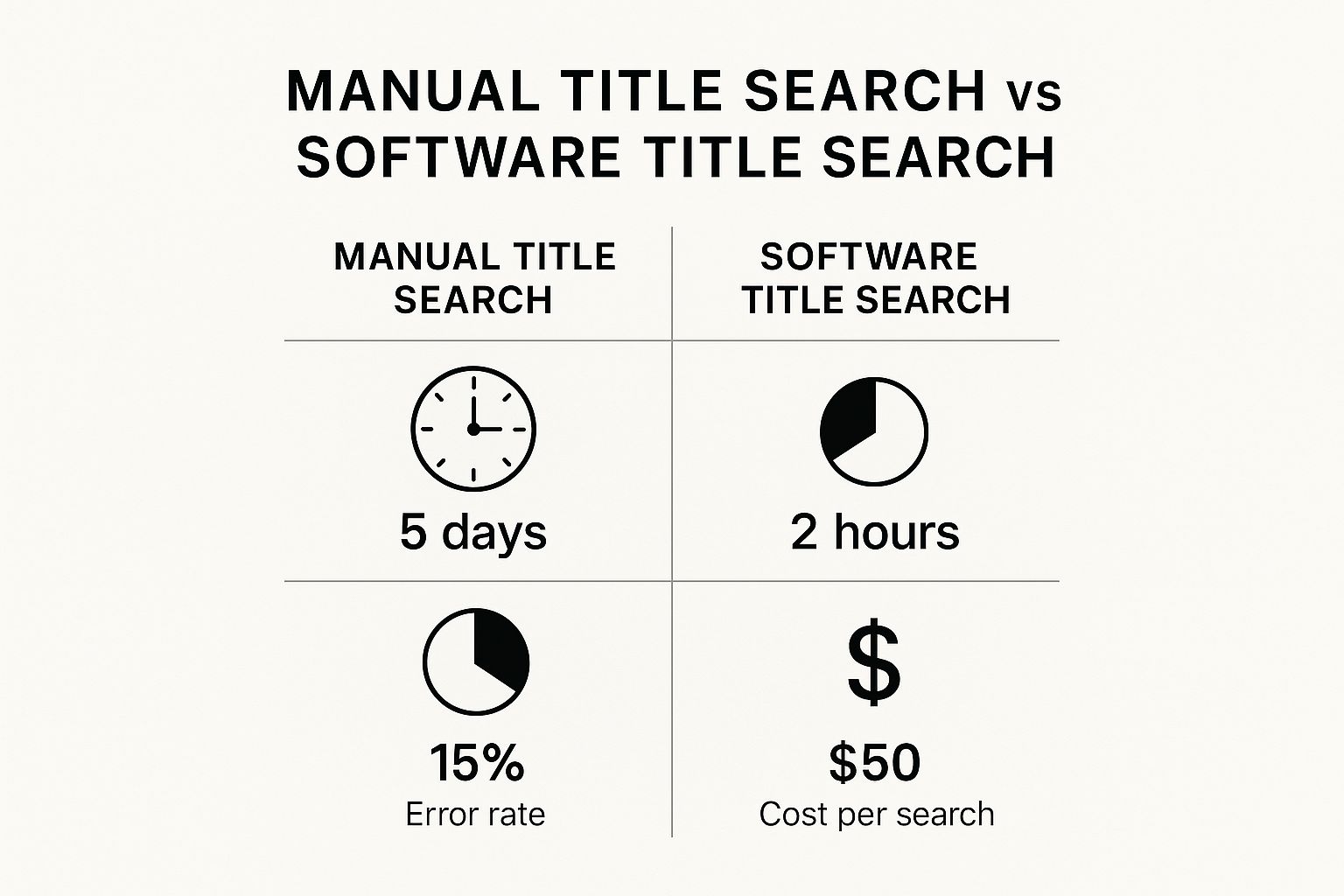
As you can see, the data paints a clear picture: automation brings a massive reduction in time, cost, and the kinds of errors that keep real estate professionals up at night.
The real win here isn't just about speed. It’s about the massive boost in accuracy and confidence. By taking manual data entry out of the equation and tapping directly into digital records, the software all but eliminates the human errors that lead to costly title defects. This frees up your skilled team to focus on resolving complex issues and providing exceptional client service.
This isn't happening in a vacuum. The global real estate software market was valued at around USD 13.73 billion in 2024 and is expected to hit nearly USD 57.84 billion by 2034. That explosive growth is being fueled by the industry’s hunger for digital tools that help manage transactions and squash risk. You can get the full story on these trends in the Zion Market Research report.
Manual vs Automated Title Search Comparison
To truly grasp the difference, let’s put the old way and the new way side-by-side. The contrast highlights just how much of a game-changer software has become for the industry.
| Attribute | Manual Title Search | Automated Software Search |
|---|---|---|
| Process | Physical visit to county offices, manually pulling and copying documents. | Digital access to multiple databases, automated data extraction and analysis. |
| Time | Days to weeks, depending on property complexity and record accessibility. | Hours to minutes, with near-instantaneous results for many properties. |
| Cost | High labor costs, travel expenses, and fees for physical copies. | Lower operational costs, predictable subscription fees, reduced labor hours. |
| Accuracy | Prone to human error (missed documents, misinterpretation, typos). | High accuracy, with AI flagging discrepancies and ensuring consistency. |
The takeaway is simple: automation delivers a faster, cheaper, and more reliable result. While human expertise is still crucial for interpretation and final judgment, software handles the heavy lifting, empowering your team to operate at a higher level of efficiency.
What to Look for in a Modern Title Platform

Let’s be clear: not all real estate title search software is the same. While plenty of tools can pull documents from a database, the truly powerful platforms offer a suite of integrated features built to solve the high-stakes problems title professionals face every single day.
These aren't just bells and whistles. They're the core components that directly impact your accuracy, efficiency, and ability to manage risk.
Understanding these functions helps you see the difference between a simple digital filing cabinet and a genuine partner in your due diligence work. It’s about getting actionable intelligence, not just a list of documents. This is what prevents small oversights from spiraling into major closing delays or, even worse, messy legal battles down the road.
Let's break down the features that really matter.
Automated Chain of Title Analysis
Trying to build a chain of title by hand is like putting together a 1,000-piece jigsaw puzzle without the picture on the box. You’ve got all the individual deeds and conveyances, but linking them in the right order without any gaps is a painstaking process where one mistake can throw everything off.
Modern software automates this entire headache. It digitally assembles the ownership history, chronologically connecting each document to the next.
But it’s not just about listing documents. The software actively analyzes those connections, flagging any gaps in time, inconsistencies in names, or breaks in the chain that require expert human review.
Think of this automated analysis as your built-in safety net, ensuring a complete and solid history of ownership is established before you move an inch further.
Instant Lien and Encumbrance Detection
One of the biggest landmines in any real estate deal is an undiscovered lien or encumbrance. These claims—from unpaid taxes, mechanics liens, or court judgments—can cloud a title and bring a closing to a screeching halt. Manually searching for them across different county and state databases can eat up days of your time.
The best title platforms solve this by plugging into multiple data sources and giving you a single, clean search. Key features to look for include:
- Real-Time Database Access: The software should connect directly to county records, tax assessor databases, and court judgment rolls, pulling the most current information available.
- Smart Filtering: It needs to intelligently sift through mountains of data to pinpoint relevant liens, mortgages, easements, and other claims tied specifically to the property you’re researching.
- Automated Alerts: Instead of making you hunt for problems, the system should flag potential issues with clear alerts, bringing the most critical information to your attention right away.
This proactive approach turns what was once a week-long manual slog into a process that takes just minutes. It gives you a crystal-clear picture of a property’s financial and legal baggage right from the start. For a deeper look at how this works in the real world, you can see how TitleTrackr empowers professional title abstractors and searchers to master these workflows. This is absolutely essential for cutting down risk and delivering a clean title report with confidence.
How AI Is Revolutionizing Title Examination

Simple automation was just the beginning. The real game-changer in the world of real estate title search software is the arrival of Artificial Intelligence. While earlier tools were great at digitizing manual tasks, AI-powered platforms are less like a fast calculator and more like an experienced analyst working right alongside you.
This shift is fundamentally changing how title examination gets done. We're moving beyond just pulling documents to actually interpreting them, identifying subtle risks, and delivering a level of insight that lets you close transactions with far more confidence.
Moving Beyond Keywords with Intelligent Interpretation
Traditional software often leans on basic keyword searches, a method that can easily miss critical details buried in dense legal jargon. AI, on the other hand, uses Natural Language Processing (NLP) to read and truly understand the context of documents like deeds, mortgages, and court filings.
Think of it this way: an AI with NLP doesn't just find the word "lien." It understands the crucial difference between a satisfied mortgage lien from 20 years ago and an active mechanic's lien that could blow up a closing. That's the power of NLP—it deciphers complex legal language, pulls out key data points, and categorizes information with a human-like grasp of what it all means.
This is exactly what platforms like TitleTrackr are built to do. The platform's dashboard gives you a clean, organized view of the data it has extracted and the issues it has flagged. This visual summary lets you instantly see what the AI found so you can focus your expertise where it matters most.
Proactive Risk Detection Through Machine Learning
One of AI's most impressive skills is its ability to learn from enormous datasets. In title examination, machine learning (ML) algorithms analyze thousands of historical property records to recognize the patterns that separate clean titles from those with hidden defects.
This allows the system to proactively flag anomalies that a human might otherwise overlook.
- Fraud Detection: The AI can spot unusual activity, like a property changing hands multiple times in quick succession or signatures that don’t line up with historical records, which could be red flags for fraud.
- Predictive Analysis: It can even forecast how complex a title search might be before you start, analyzing the property type and its history to give you a solid estimate of the time and resources you'll need.
This isn't just about finding existing problems; it's about getting ahead of future ones. By flagging subtle inconsistencies, machine learning gives you a crucial head start on resolving issues that could cause major delays down the road.
The industry is adopting this kind of tech quickly, and for good reason. Investment in real estate software is showing strong growth, with one report projecting a 9% CAGR even with the economic shifts of 2020. With 94% of venture capital investors agreeing that the pandemic sped up PropTech adoption, this new capital is fueling major digital changes. You can get more details on this transformation in the real estate software industry on mindk.com.
Real World Applications Across the Industry

The power of modern real estate title search software goes way beyond a simple residential closing. Different corners of the property and energy industries run into their own unique headaches, and this is where a versatile tool really shines, adapting to specific, high-stakes situations.
We’re not talking about a one-size-fits-all gadget. From fast-tracking mortgage approvals to locking down land rights for huge energy projects, the applications are as varied as the industries themselves. Each scenario shows how automation and AI solve a distinct pain point, proving just how valuable a comprehensive platform can be.
Accelerating Mortgage Lending and Underwriting
For mortgage lenders, time is money, and risk is the ultimate enemy. The old-school title search has always been a major bottleneck in the underwriting process, often pushing back closing dates and leaving borrowers frustrated. Before any money changes hands, lenders need rock-solid proof of a clean title.
Automated software tackles this problem head-on, turning around title reports in hours instead of days. This incredible speed lets underwriters make faster, more confident decisions. By instantly flagging liens or judgments, the software slashes the risk of funding a loan on a property with hidden title defects, protecting the lender's investment from the start.
Managing Complex Commercial Real Estate Deals
Commercial real estate transactions are a different beast altogether. These deals often involve multiple parcels, tangled zoning laws, and decades of convoluted ownership history. Trying to manually search a portfolio of commercial properties can quickly turn into a logistical nightmare.
This is where software becomes absolutely essential. It can untangle and connect the histories of multiple properties at once, giving you a single, unified view of the entire asset portfolio.
For commercial firms, the software provides the clarity needed to conduct thorough due diligence on multi-million dollar deals. It ensures every parcel is free of encumbrances, a critical step before closing complex acquisitions or securing financing.
Securing Land Rights for the Energy Sector
The energy industry—whether it’s oil and gas or renewables—can’t break ground without securing clear land and mineral rights. Tracing these rights, a process that creates a "run sheet," can be incredibly complicated. You're often digging back over a century and dealing with ownership split between dozens of people.
Specialized title search software automates this deep dive into historical records. It helps landmen rapidly identify every stakeholder and mineral rights owner, making sure all legal boxes are checked before drilling or construction ever begins. That level of precision is non-negotiable for avoiding costly legal fights and project delays down the road. For teams needing to integrate this data into their own systems, it's worth seeing how a platform provides API access by exploring the information available to developers on titletrackr.com.
How to Choose the Right Title Search Software
Choosing the right real estate title search software is a huge business decision, not just another purchase. Think about it: the right platform slips into your workflow and supercharges your efficiency and accuracy. The wrong one? It’s a constant headache, creating bottlenecks and forcing you to find clunky workarounds just to get the job done.
You need a solid game plan to pick a winner. Consider it a pre-flight checklist for your operations. If you focus on a few key things, you can cut through all the marketing fluff and find a tool that actually fits what you need—both for today and for the long haul.
Your Core Evaluation Checklist
When you're comparing your options, keep your focus locked on the features that will make a real difference in your daily grind. Don't get sidetracked by shiny objects; prioritize the non-negotiables.
-
Seamless Integration Capabilities: Your title software can't be a lone wolf. You need a platform with a solid API that plays nice with your existing closing software, CRM, and document management systems. This creates a single, smooth workflow and gets rid of all the annoying errors that pop up from manually copying data between different programs.
-
Intuitive User Interface (UI): A clunky, complicated system is a productivity killer. It slows everyone down and turns training into a nightmare. The best software is clean and logical, something your team can pick up fast. A user-friendly design means less time fighting with the tool and more time focused on what matters: delivering accurate title reports.
-
Scalability for Future Growth: The software that’s perfect for you now needs to be perfect for you in a few years, too. Make sure the platform can handle more search volume and more complex deals down the road without grinding to a halt. You need a solution that grows with you, not against you.
Security and Support: The Pillars of Trust
Beyond the core features, two things are absolutely essential for a long-term partnership: data security and customer support. If you skimp on either, you’re opening your business up to some serious risks and operational headaches.
Data security is not optional. You're handling incredibly sensitive information, and it needs the highest level of protection. If you need a reminder of what's at stake, just look at the 2024 data breach that exposed over 1.5 billion real estate records. You can read more about why secure property solutions are so critical in this market intelligence report.
Finally, check out the provider's customer support. You're not just buying software; you're looking for a partner. Find a team that's responsive and offers expert help when you need it. When you’ve got a technical question mid-search, reliable support is what keeps your business running.
A platform like TitleTrackr was built from the ground up to nail these key areas, from its intuitive AI-driven interface to its rock-solid security. But seeing is believing.
Ready to see how a modern title platform can transform your workflow? Request a demo of TitleTrackr today and witness the future of title examination firsthand.
Frequently Asked Questions
Bringing new software into your workflow is a big deal, and it’s smart to have questions. When it comes to something as vital as real estate title search software, you need straight answers before you commit. We’ve gathered the most common questions we hear from professionals who are thinking about making the switch to an automated, AI-driven platform.
Our goal is to tackle your practical concerns head-on—from data integrity to daily workflow—so you can move forward with total confidence.
How Accurate Is Automated Title Search Software
This is usually the first question people ask, and for good reason. The accuracy of any automated software comes down to the quality of its data. Top-tier platforms like TitleTrackr don’t mess around with third-party aggregators; they tap directly into county records, tax databases, and other official sources in real time. That direct line ensures the information is as current and reliable as it gets.
On top of that, AI-powered systems add another layer of verification. They’re built to cross-reference documents and intelligently flag inconsistencies a human might easily overlook. The result is often a final report that’s not just faster but actually more accurate than one produced by manual methods alone.
Can This Software Integrate With Our Current Systems
Adopting new tech shouldn’t mean you have to tear down your existing workflow and start from scratch. Modern title search platforms are built to play nice with others. The best solutions offer robust Application Programming Interfaces (APIs) that create a seamless connection with the tools you already rely on every day.
This means the software can talk directly to your:
- Closing and Escrow Software: To automatically push and pull data, cutting down on tedious manual entry.
- Customer Relationship Management (CRM) Systems: To keep all your client and property information perfectly synced up.
- Document Management Platforms: To easily file, store, and retrieve title reports and their supporting documents.
The whole point is to create one unified, efficient process with as little disruption to your team as possible.
What Kind of Support Can We Expect
Getting new software should feel like starting a partnership, not just making a purchase. Good software providers get this and offer comprehensive support to make sure you succeed. This support structure is a huge factor when picking the right platform.
Here’s what you should expect:
- A dedicated onboarding specialist who guides you through the entire setup.
- Plenty of online training resources, like video tutorials and how-to guides.
- Responsive and helpful customer service for when you have questions or run into a snag.
The goal is to get your team using the full power of the platform right from the start and to be there for you as your processes evolve. For a deeper dive, you can find a ton of great information on the TitleTrackr FAQ page. It’s all there to help you make a smart, informed decision for your business.
Ready to see how AI-driven automation can bring a new level of speed and accuracy to your title examination process? The best way to understand the impact of TitleTrackr is to see it in action.
 blog.titletrackr.com
Leave a comment