

A mineral rights title search isn’t just a background check on a piece of property. It's a full-blown historical investigation, a deep dive into decades of deeds, legal filings, and obscure records to figure out one thing: who really owns the valuable stuff underground. We’re talking about oil, gas, coal—the resources that can make or break a major investment.
The goal is to trace the chain of ownership all the way back, making absolutely sure there are no competing claims or hidden legal bombshells waiting to go off. For professionals in the energy and land sectors, getting this right isn’t just important; it’s the foundation of every successful project.
Why Mineral Rights Are So Complex
Before you even think about starting a search, you have to get your head around why this is so much harder than a typical real estate deal. You can see the land, you can walk on it. Mineral rights? They’re an entirely separate legal asset that can be sold, leased, or passed down completely independently of the surface.
This split is the heart of the matter. It creates what’s known in the industry as a severed estate, where one person owns the surface while another person—or, more often, a whole group of people—owns the minerals underneath. This single concept is why mineral rights searches are so incredibly complicated and the stakes are so high.
The Fragmented Chain of Title
Let’s play out a common scenario. Picture a family farm that’s been around for generations. Back in the 1920s, maybe the great-grandfather sold off the mineral rights to an oil company to get through a tough financial patch. Boom. Right there, the two estates were severed forever.
Fast forward a hundred years, and that simple transaction has likely spiraled into a complex mess.
Here’s how ownership gets so fragmented:
- Inheritance: When the original mineral owner passed away, those rights might have been divided among five kids. When they passed, their shares were split again among their heirs, and so on.
- Subsequent Sales: Over the decades, some of those heirs probably sold their tiny fractions. Others might have leased their shares to different companies, creating a tangled web of contracts.
- Vague Language: To make matters worse, old deeds were often written with ambiguous language. It's not always clear what was actually sold or retained.
This is how a single piece of land can end up with dozens of fractional mineral owners, each with a legally valid claim. A proper search has to untangle every single one of these threads.
A title search isn’t just about finding out who owns the rights today. It's about proving a perfect, unbroken chain of ownership from the very first government grant all the way to the present. One mistake, one missed document, and the entire investment could be worthless.
The Stakes of an Inaccurate Search
The consequences of getting this wrong are brutal. A missed conveyance means you just paid for rights that actually belong to someone else. An undiscovered lease could completely block you from developing the resources you thought you controlled.
These aren't small mistakes. They lead to incredibly expensive and time-consuming legal battles that can drag on for years, wiping out any hope of turning a profit.
This is why a meticulous title search is non-negotiable. Professionals spend countless hours digging through public records at county clerk offices and government archives, piecing together the history from deeds, lease agreements, and old court rulings. As you can learn at RangerMinerals.com, this painstaking work is the only way to avoid legal nightmares and ensure your investment is built on solid ground.
The Manual Approach to Title Research
If you want to understand the grit behind mineral rights, you have to appreciate the old-school manual title search. Forget fancy software for a moment. This is a journey that often leads to dusty courthouse basements, surrounded by towering stacks of fragile, handwritten ledgers. It’s a painstaking, hands-on process that demands patience, a deep well of expertise, and an incredibly sharp eye for detail.
The entire investigation doesn't start with a map or a satellite image, but with something far more fundamental: the legal description of the property.
This description is the absolute cornerstone of your search. You might get lucky and find it on a recent deed, but more often than not, you'll be piecing it together from older, less clear documents. It's the unique identifier that lets you pinpoint that exact parcel of land within a county's complex grid system.
Uncovering the Past in County Records
Once that legal description is in hand, the real detective work begins. Your next stop is almost always the county clerk or recorder’s office, the central vault for all things land-related. This is where landmen and researchers physically pull massive, heavy deed books, dig through lease agreements, and cross-reference tax records, often going page by page through decades—sometimes centuries—of history.
This process is so much more than just reading old cursive. It’s about interpretation. A single deed from 1890 might use vague language or a poorly defined property line that creates a ripple of ambiguity through every single transaction that followed. Spotting these potential landmines is a core skill in a manual search.
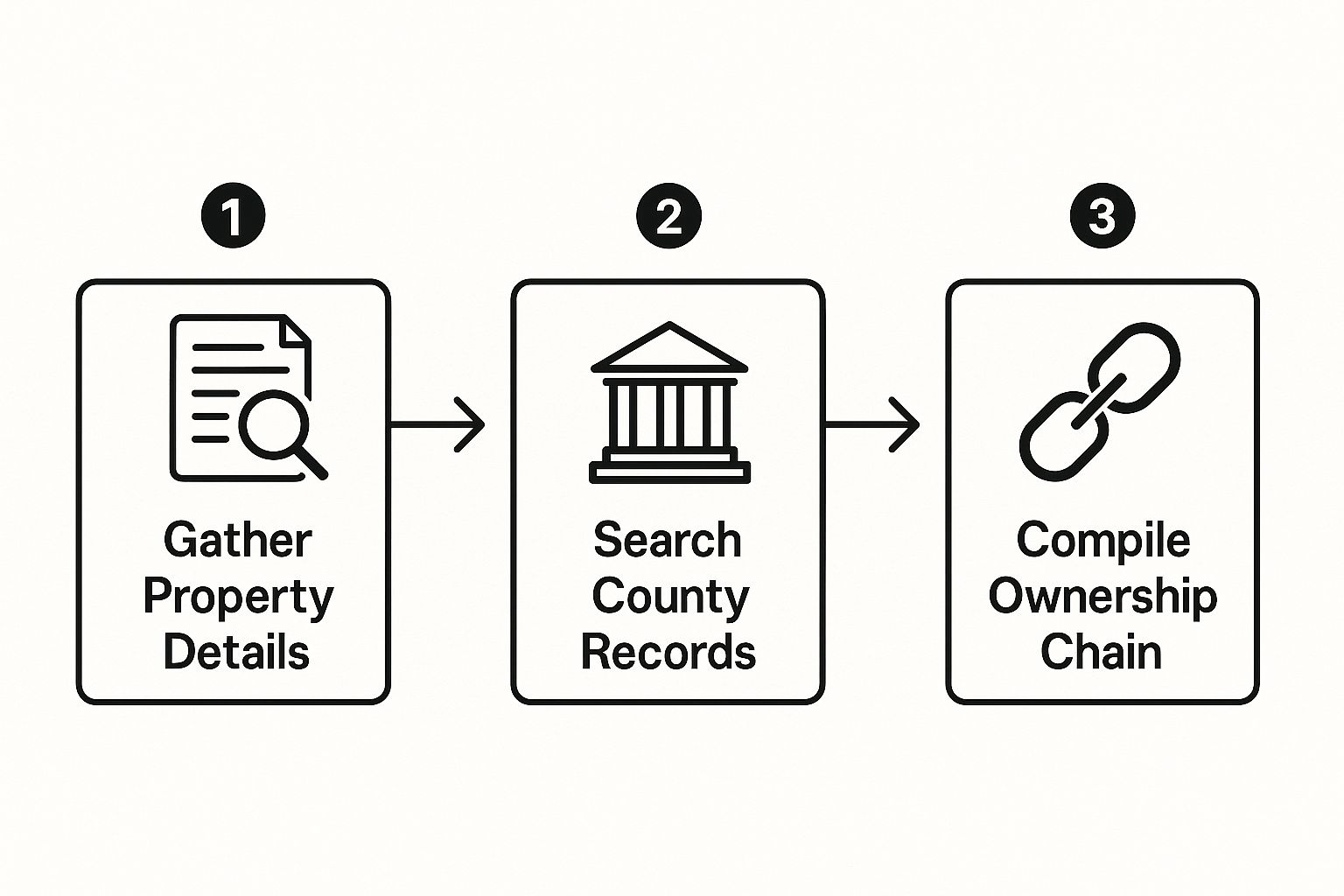
This workflow shows just how systematic you have to be. Each step builds directly on the last, and skipping a beat or missing a single document in the county records can derail the entire project.
Building the Chain of Title
The ultimate goal here is to construct a chain of title—a complete, chronological history of ownership that stretches from the present day all the way back to the original government grant or patent. Every single transfer, sale, lease, and inheritance has to be documented and perfectly accounted for.
You start with the current owner and work your way backward, one transaction at a time. Each document, or "link," must connect flawlessly to the next. If a link is broken—say, a deed was never recorded, or an heir's interest was completely overlooked—it creates a "cloud" on the title that has to be resolved before anyone can move forward.
A manual search often feels like you're trying to solve a complex puzzle with half the pieces missing. You can burn days tracking down a single unrecorded document or trying to decipher a will from the 1930s to confirm heirship, all while the project clock is ticking loudly in the background.
Some of the most common roadblocks that turn a simple search into a nightmare include:
- Heirship Issues: Tracing mineral rights through multiple generations of a family can be a tangled mess, especially when wills are unclear or distant family members are impossible to locate.
- Vague Descriptions: It’s not uncommon for older documents to use landmarks like "the old oak tree" or "the stone wall" that no longer exist, making it incredibly difficult to confirm property boundaries with any certainty.
- Unrecorded Documents: Sometimes, a sale or transfer happened on a handshake but was never officially filed with the county. This creates a gaping hole in the ownership chain that can be a real headache to fix.
These challenges highlight just how labor-intensive and specialized traditional title work is. The process demands an incredible level of expertise from the abstractors and landmen who perform these searches. For anyone in the field, understanding these traditional methods is crucial. Resources that detail the role of professional abstractors offer a deeper dive into the skills required for this craft, which is really a blend of historical research and legal detective work. One tiny oversight can have monumental financial consequences.
How Digital Tools Are Changing the Game
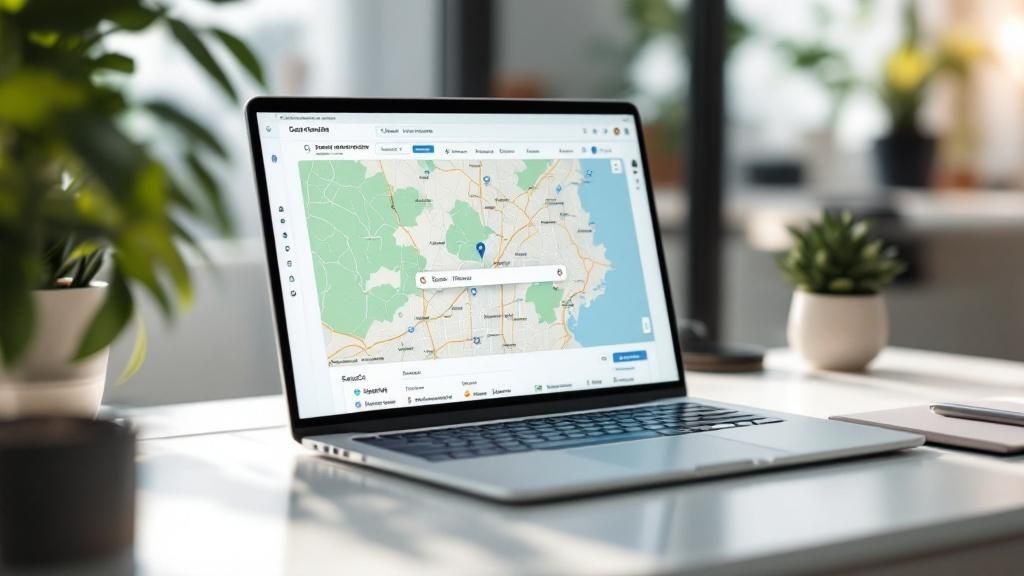
The days of being stuck in a dusty courthouse basement for weeks on end are finally starting to fade. Technology is making a real impact on how mineral rights title searches get done, turning what was once a manual craft into more of a data-driven science. The biggest leap forward has been the digitization of millions of public records.
This shift means that instead of physically thumbing through fragile deed books, you can now tap into huge online archives from your desk. It’s a massive time-saver, dramatically speeding up the initial legwork of verifying property descriptions and tracing ownership history.
The Rise of Digital Databases and GIS
The real transformation, though, comes from specialized digital databases and Geographic Information System (GIS) mapping tools. These platforms don't just give you a scanned document; they organize, index, and connect all the disparate pieces of information together. It creates a research environment that was unimaginable just a decade ago.
Imagine pulling up a county map and instantly seeing not just property lines, but also layers of data showing active wells, historical production numbers, and recently filed permits. That's what modern tools bring to the table. They provide a level of context that once took weeks of painstaking work to assemble.
The United States, for instance, holds over 20 million mineral ownership records, with a heavy concentration in states like Texas and New Mexico. Digital databases let researchers and investors rapidly scan indexed property descriptions by abstract, survey, or lot number to get a jump on verifying ownership.
Platforms like Enverus offer searchable, web-based maps that directly link mineral ownership data to specific oil and gas wells and their production records. You can learn more about how these tools fast-track mineral ownership research and see how they connect the dots.
Speed Comes with a Critical Caveat
While these digital tools give us incredible speed and efficiency, they aren't a magic bullet. The convenience of online archives comes with a major limitation that every pro in this field has to respect.
Digital records are often incomplete or just plain wrong. A scanned deed from 1910 might be misindexed, or a critical conveyance might have never been digitized in the first place. Technology gets you 90% of the way there, but the final 10% still demands an expert eye.
This is the crucial gap between today's databases and the next wave of innovation. While we've largely solved the problem of access to information, we haven't solved the problem of interpretation and accuracy. A skilled landman still has to validate the data, spot subtle inconsistencies, and know when it's time to make a trip to the physical courthouse to lay eyes on an original document. This exact gap is where more advanced solutions are starting to make their mark.
Using AI to Avoid Costly Title Search Errors
Digital databases certainly made finding documents faster, but they never solved the core problems that make mineral rights title searches so tricky. Speed is great, but it doesn't help interpret ambiguous language from a 1920s deed, spot a hidden conveyance clause, or connect the dots across a century of messy transactions. This is exactly where AI-driven platforms like TitleTrackr are making a real difference.
AI isn't just a faster way to pull documents; it’s a smarter way to analyze them. These systems are built to hunt down the expensive pitfalls that plague manual and digital searches, turning high-risk variables into clear, manageable data.
Identifying Ambiguity and Missed Conveyances
One of the most devastating errors in a title search is a missed conveyance—a subtle transfer of mineral rights buried so deep in a deed that it’s easy to overlook. Just as dangerous is ambiguous language that can spark massive legal fights years down the road.
Think about a deed from 1940 that says the seller keeps "one-half of all royalties from oil and gas produced." A human might interpret that one way, but an AI can instantly compare it to thousands of similar clauses from historical court rulings, flagging it as language that needs a serious legal review.
- Pattern Recognition: AI can scan a hundred years of deeds in minutes. It spots recurring phrases, weird reservations, or conflicting legal descriptions that scream "potential title defect."
- Contextual Analysis: It gets the nuance. It knows the critical difference between a mineral reservation and a royalty reservation—a distinction that can swing the value of an asset by millions.
- Heirship Complexity: When you're dealing with complex heirship, AI can help map out family trees and fractional ownership, making sure no heir gets left behind. This is a classic source of title failure.
This kind of AI-powered analysis automates the heavy lifting of data extraction.

You can see how a platform like TitleTrackr turns dense, unstructured legal documents into organized data you can actually use, speeding up the whole review process.
The New Industry Standard for Accuracy
Let's be honest, manual review has its limits. A researcher can only read so many documents in a day before fatigue sets in and mistakes happen. An AI-powered search, on the other hand, works at a scale that's just not humanly possible.
Imagine a tool that cross-references every single document in the chain of title against a massive database of legal precedents, flagging every potential problem for you. This isn't science fiction anymore; it's the real value AI brings to the table today.
By automating the most tedious and error-prone parts of the research, AI frees up skilled professionals to do what they do best: solve complex title problems, not just spend all their time trying to find them. The result is a more accurate and defensible title opinion.
This shift is quickly becoming the new benchmark for the industry. It delivers a level of due diligence that was impossible before, slashing risk for investors and developers. For landmen, adopting these tools is becoming non-negotiable if they want to stay competitive and deliver the rock-solid results their clients expect. Learning more about AI-powered tools for landmen can give you a serious edge.
When you use AI to analyze legal documents at scale, you’re not just moving faster—you’re working smarter. It catches the tiny details a human might miss after hours of squinting at cursive on a microfiche reader, preventing costly blow-ups before they ever happen.
Looking Beyond Local Property Records
A rock-solid mineral rights title search is your foundation, but real due diligence can't stop at the county courthouse doors. Think of it this way: mineral ownership doesn't exist in a vacuum. It's part of a much larger ecosystem, shaped by state regulations, national policies, and even global market shifts.
Ignoring these outside forces is like trying to navigate a ship by only looking at the deck; you're completely missing the currents and storms that actually control your journey.
Local records are great for telling you who owned what and when. What they won't tell you is that a new state law is being debated that could slam the brakes on drilling permits or introduce a hefty new tax. They certainly won't alert you to a federal policy change that could impact resource development across the board. A truly comprehensive search means widening your lens to see these powerful external forces.
The Impact of State and National Policies
State governments often have a surprising amount of control over mineral resources. In many cases, they might retain ownership of minerals under certain lands, like riverbeds or state parks, regardless of what the surface deed says. On top of that, evolving laws can throw curveballs that you'd never see in historical property records alone.
You have to ask yourself a few key questions:
- State Ownership Claims: Does the state have some pre-existing claim to the resources that could completely override a private title chain?
- Regulatory Changes: Are there new environmental regulations or severance taxes on the horizon that could tank the economic viability of your minerals?
- Geopolitical Precedents: How might a major policy shift on a national or even global level trickle down and affect your specific mineral assets?
A title can look perfect on paper at the local level but be functionally worthless if a broader government action makes the resources impossible or unprofitable to access. This is why a holistic view isn't just a nice-to-have—it's essential for managing your risk.
For example, a World Bank study pointed out a growing global trend: governments are tightening their grip on mineral industries through increased state control and nationalization. When countries like Russia, China, and India move to secure strategic resources, it sets a precedent. Those ideas can influence domestic policy debates here, adding new layers of political risk to any private mineral deal. You can get a deeper look into the findings on state engagement in the mineral sector to see how this plays out.
This evolving landscape means that any modern mineral rights search has to account for public ownership claims and political risk, which can change the validity of your rights almost overnight.
This is exactly where advanced platforms prove their worth. Tools like TitleTrackr are built to pull in these different data sources, helping you connect the dots between a local deed record and the bigger regulatory picture. By flagging potential conflicts and giving you a much more complete view, you can make investment decisions with real confidence, knowing you've seen the forces at play far beyond the local property lines.
Common Questions About Mineral Rights Searches
Even with the best tools at your fingertips, the world of mineral rights can feel a bit tangled. Let's walk through some of the questions that come up most often, both from clients and seasoned pros, to clear up the confusion.
One of the first things everyone wants to know is, "How long is this going to take?" And the honest answer is: it depends. A straightforward search with a clean, recent history might be done in just a few days. But if you’re dealing with severed rights, a dozen heirs, and records that go back to the horse-and-buggy era, you could easily be looking at weeks or even months of painstaking work to get it right.
Distinguishing Key Professional Roles
Another common hang-up is understanding the difference between a landman and a title attorney. It helps to think of a landman as the investigator on the ground. They’re the ones heading to the courthouse, poring over dusty record books, and tracing the chain of title piece by piece. They compile all their findings into a detailed report.
That’s when the title attorney steps in. They take the landman’s research, review it with a fine-toothed comb, and issue a formal legal opinion on the title’s status. This attorney’s title opinion is the official document that confirms who owns what and flags any issues—or "clouds"—that need to be fixed. You absolutely need both to conduct a complete, legally-sound examination.
Can You Perform Your Own Search
Technically, the public records are open to anyone. But should you do your own mineral rights search? Unless you have deep experience in this field, we strongly advise against it. The process is a minefield of potential mistakes. Misinterpreting a single document or missing one conveyance can lead to disastrous financial and legal headaches down the road.
The specialized knowledge of a professional landman or title researcher is invaluable for navigating these complexities. While a modern platform like TitleTrackr arms you with organized data and AI-driven insights, professional oversight is still the best practice for final verification.
This process is full of nuance, which is why we've put together even more answers for you. You can dive into a wider range of topics over on our comprehensive FAQ page to get a deeper understanding.
Ready to transform your title search workflow? TitleTrackr uses AI to deliver faster, more accurate results, cutting down research time and eliminating costly errors. Request a demo with TitleTrackr and see how you can bring clarity and control to your most complex projects.
 blog.titletrackr.com
Leave a comment