

Every property has a story—a legal history pieced together from decades of deeds, mortgages, and liens. A real estate abstractor is the detective who brings that story to light, ensuring a property is free and clear of any legal baggage. Their meticulous work is the bedrock of every secure real estate deal, preventing costly financial and legal nightmares down the road.
The Unseen Architect of Your Property Deal
Imagine buying your dream home, only to discover years later that a contractor's unpaid bill has resulted in a lien on your property. Suddenly, you're responsible for someone else's debt. This is precisely the kind of disaster a real estate abstractor prevents. They are the quality control experts for a property's legal past, digging deep into public records to confirm the seller has the undeniable right to sell it.
An abstractor’s primary role is to construct a clear and unbroken "chain of title"—a complete record of ownership stretching back through time. Think of it as a property’s family tree; any missing branch or mysterious relative could signal a serious problem. They sift through dusty courthouse archives, tax records, and modern digital databases to put this entire history together.
Why This Diligence Is Non-Negotiable
Without this exhaustive deep dive, a real estate transaction is built on shaky ground. An abstractor's findings protect everyone involved—the buyer, the seller, and the lender—from nasty surprises that could kill a deal or spark expensive legal battles long after closing. Their detailed summary, known as an abstract of title, is what a title insurance company uses to issue a policy that safeguards the new owner's investment.
Their work confirms the property is free from issues like:
- Unpaid property taxes or HOA dues
- Lingering mortgages from previous owners
- Legal judgments or liens filed against the property
- Hidden heirs who might suddenly appear with a claim
The abstractor’s role is crucial in any real estate transaction, as they provide the essential research and documentation that underpin the entire deal's legal integrity.
The following table breaks down their core duties and the direct impact each has on securing the transaction.
Key Responsibilities of a Real Estate Abstractor
| Responsibility | Impact on the Transaction |
|---|---|
| Public Record Search | Uncovers all recorded documents related to the property, like deeds, mortgages, and liens. |
| Chain of Title Verification | Confirms an unbroken history of ownership, ensuring the seller has the legal right to sell. |
| Lien and Encumbrance Identification | Discovers any outstanding debts or claims against the property that could become the new owner's problem. |
| Legal Description Accuracy | Verifies that the property's legal description is correct and matches what is being sold. |
| Preparation of the Abstract of Title | Creates the comprehensive report that a title insurance company uses to underwrite a policy. |
By meticulously performing these tasks, the abstractor clears the path for a smooth and secure closing.
Ultimately, the abstractor provides the confidence everyone needs to move forward. They confirm that the asset being purchased is exactly what it claims to be. Professionals looking to see how modern tools are making this process faster and more accurate can find more details on how technology is advancing the field for abstractors. Their diligent work is the unseen architecture supporting every secure real estate investment.
In essence, an abstractor doesn't just review documents; they validate the very concept of ownership. Their meticulous research ensures that when the keys are handed over, the new owner receives a clear, marketable title, not a collection of unresolved legal liabilities from the past.
Decoding the Abstractor Workflow Step by Step
Think of a real estate abstractor less as an administrator and more as a property detective. Their work isn’t a single task but a methodical investigation that kicks off the moment a title search is requested. The end goal? To produce a comprehensive report that certifies a property's entire legal history, providing the solid foundation every secure transaction needs.
This process is about building a complete story of the property's life—every owner, every loan, and every legal agreement tied to the land. Each step is critical, as one missed document could put the entire deal in jeopardy. Let's walk through the path an abstractor takes to bring clarity to a property's often-complex past.
This image captures the meticulous, detail-oriented nature of an abstractor's work. It’s all about a careful, focused review of legal documents.
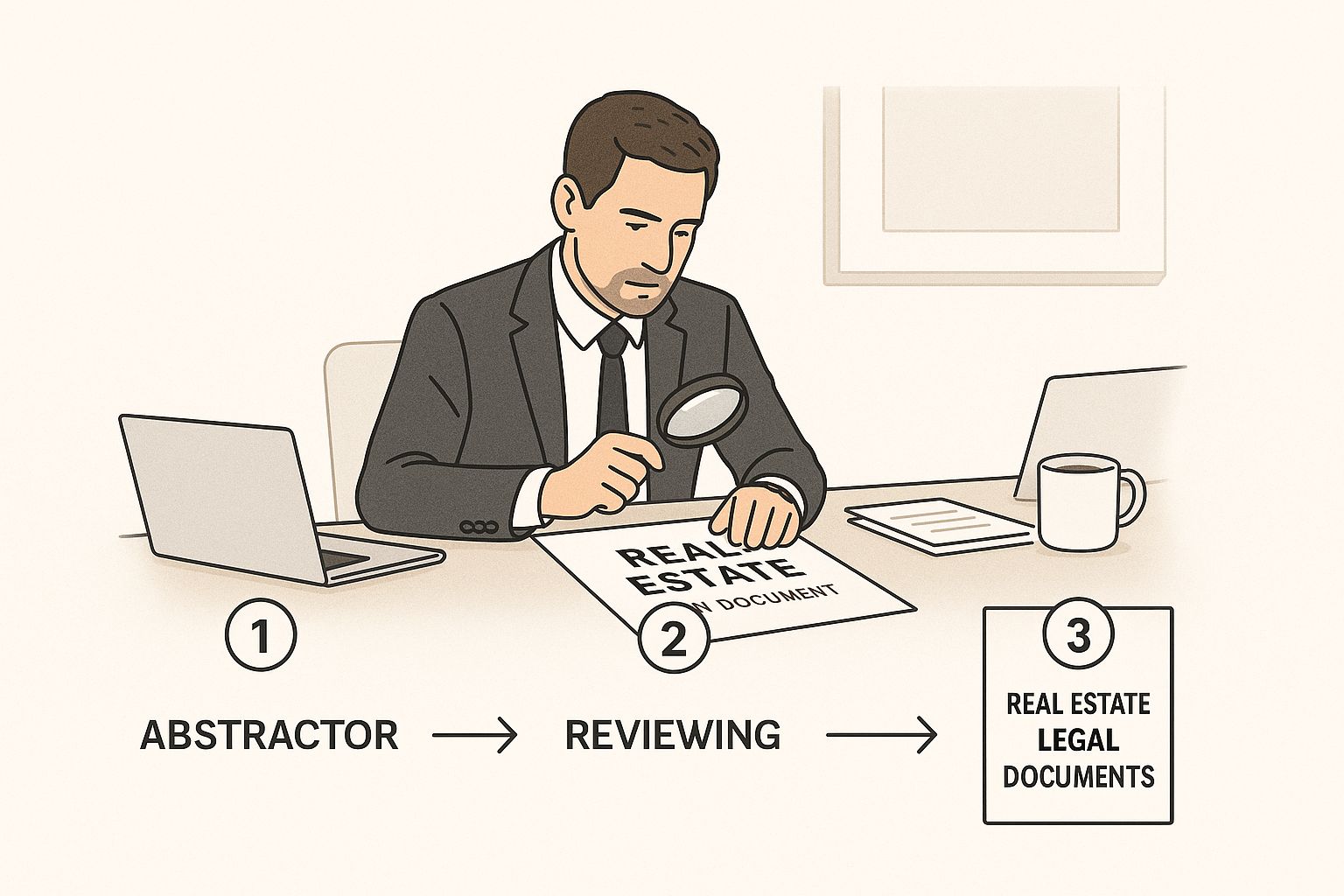
As you can see, the abstractor's desk becomes a hub of intense analysis, where every piece of paper represents a crucial moment in the property's history that has to be verified.
Initiating the Search and Building the Chain
First things first, you need a starting point. This is usually the property's current owner and its official legal description. From there, the abstractor starts working backward through time, document by document, to construct the chain of title. This is the sequential log of every single previous owner, and the goal is to ensure there’s a clear, unbroken line of succession.
Imagine the chain of title like an actual chain. Each past owner is a link. If a link is missing—say, a deed for a past sale was never recorded—it creates a "break" in the chain. That break is a major red flag that must be fixed before the property can safely change hands again.
To build this chain, an abstractor digs into all sorts of public records, including:
- Deeds: The official legal papers that transfer property ownership from one person to another.
- Mortgages: Records of any loans secured by the property, which have to be settled.
- Wills and Probate Records: Documents that show how a property was handed down through an inheritance.
This initial phase is all about building a historical timeline and making sure every ownership transfer is legitimate and accounted for.
Sifting Through Documents for Encumbrances
Once the ownership history is mapped out, the hunt begins for potential problems. In the title world, these are called encumbrances—claims or liabilities attached to the property that could hinder its value or ability to be sold. The abstractor puts their detective hat back on, searching for hidden issues that could cause headaches down the road.
An abstractor’s job is to ensure a property is free from any restrictions that could derail its sale. Their meticulous analysis is the best defense a new homeowner has against future claims and legal battles.
For instance, an abstractor might find an unpaid contractor's lien from a kitchen remodel that happened five years ago. If that isn't dealt with, the lien could become the new owner's problem to solve.
Common encumbrances include things like:
- Liens: These are legal claims against a property for an unpaid debt. Think tax liens, mechanic's liens (for unpaid construction work), or judgment liens from lawsuits.
- Easements: These give another party the right to use a part of the property for a specific reason, like a utility company needing access to power lines.
- Covenants and Restrictions: These are the rules, often set by an HOA or developer, that dictate how the property can be used.
Compiling the Abstract of Title
The final step is to pull all these findings together into a single, detailed report called the abstract of title. This document is a chronological summary of every single recorded document that affects the property. It’s the clean, organized picture of the property's legal standing.
This report is the grand finale of the abstractor's research. It's not just a stack of papers; it's a carefully curated history that gets handed over to a title examiner or an attorney. They'll use the abstract to issue a title opinion or a title insurance policy, which provides that final, crucial layer of protection for both the buyer and the lender.
Let's be honest: the path to a clear property title is rarely a straight line. For every easy, straightforward transaction, a real estate abstractor runs into another one riddled with problems that can stop a deal dead in its tracks. These challenges are the landmines of the property world, and it takes a sharp eye and deep expertise to navigate them safely.
Imagine finding a break in the chain of title for a property that’s been in the same family for a hundred years. Maybe a deed from a great-grandparent was never properly recorded, creating a huge gap in the legal history of ownership. A tiny oversight from decades ago can mushroom into a massive legal headache today, casting serious doubt on whether the seller even has the right to sell the property.
These kinds of roadblocks are far more common than most people think, and they highlight just how critical an abstractor's work really is.
Uncovering Hidden Liens and Encumbrances
One of the most frequent hurdles is digging up unexpected liens. A lien is simply a legal claim against a property for an unpaid debt, and it has to be settled before the property can be sold with a clean title. Abstractors are the ones who find these financial skeletons hiding in a property's closet.
You'd be surprised what turns up:
- Mechanic's Liens: A contractor who never got paid for a kitchen remodel five years ago might have placed a lien on the house.
- Tax Liens: Unpaid property taxes can lead to a government lien, which usually jumps to the front of the line and takes priority over almost everything else.
- Judgment Liens: If a previous owner lost a lawsuit and never paid up, a court could have attached a lien to their real estate.
For example, an abstractor might uncover a judgment lien from a decade-old credit card debt filed against a former owner. Even though the current seller had nothing to do with it, that lien is now stuck to the property and has to be resolved. This can cause major delays and a lot of frustration. Professionals like landmen, for instance, deal with this all the time, especially with complex mineral rights and tangled liens that require a whole other level of scrutiny. You can dive deeper into their world in our guide for landmen.
Tackling Forgery and Conflicting Descriptions
While not as common, fraudulent documents are a serious threat. A forged signature on a deed or an illegally recorded document can create a nightmare scenario, making it look like someone has a legitimate claim to a property when they absolutely don't. An experienced abstractor knows the warning signs and can spot inconsistencies that an untrained eye would easily miss.
Another big problem is conflicting property descriptions. Over the years, as land gets divided and sold, mistakes can creep into the legal descriptions. One deed might describe a boundary line using an old oak tree that fell down 50 years ago, while a more recent one uses precise survey coordinates. When these descriptions don't line up, it creates a fog of ambiguity around the exact property lines—a problem that has to be legally sorted out.
The real skill of an abstractor isn't just finding documents; it's piecing them together like a historical puzzle. They have to connect the dots across decades of records and spot the tiny discrepancies that could blow up a multi-million dollar deal.
The Pressure of Modern Market Dynamics
The complexity of the job is cranked up even higher by today's market conditions. The work of a real estate abstractor is absolutely essential, especially in busy markets with high transaction volumes. For instance, as of mid-2025, the U.S. housing market saw a 28.9% year-over-year jump in home inventory, marking the 20th straight month of growth in listings. This surge means more properties are changing hands, and more abstracting work is needed to keep up. You can find more real estate industry statistics on brimco.io.
All this volume puts immense pressure on abstractors to work faster without cutting corners on accuracy. Every single challenge, from a simple lien to a tangled chain-of-title mess, has to be meticulously resolved to protect everyone involved in the deal.
From Manual Searches to AI Automation
The job of a real estate abstractor has always been about obsessive attention to detail, but the tools they use are finally catching up. For generations, the work was defined by pure grit—think long days in musty courthouse basements, poring over heavy, leather-bound ledger books, and slowly piecing together a property's story one document at a time. This old-school approach worked, but it was painfully slow and left the door wide open for human error.
Picture an abstractor trying to build a property's history going back 100 years. That meant physically flipping through delicate deed books, trying to make sense of archaic handwriting, and cross-referencing tax records that were often a mess. Every clue they found meant a trip back to the office to compile notes, turning the whole thing into a logistical marathon that could drag on for days, sometimes even weeks.

This wasn't just slow; it was fundamentally inefficient. An abstractor could burn an entire day hunting for a single document, only to discover it was misfiled or impossible to read. These kinds of snags created huge bottlenecks in real estate deals, delaying closings and causing headaches for everyone involved.
The Shift to Empowered Analysis
Artificial Intelligence is completely changing that story. Modern platforms are ushering in a new era where technology takes on the repetitive, data-heavy lifting. This frees up the abstractor real estate professional to focus on what they do best: applying their expertise to critical analysis and solving complex problems. AI isn’t here to replace the abstractor; it’s a powerful tool that makes them better at their job.
Think of it this way: instead of digging for clues with a shovel, an abstractor can now send in a high-tech excavator. AI tools can scan thousands of digitized documents in minutes, pulling out key information like names, dates, legal descriptions, and liens with incredible accuracy. This lets the abstractor jump straight into the most important part of their work—interpreting the findings.
This shift means professionals spend less time buried in tedious data entry and more time on high-value work, like:
- Analyzing complex title issues: Digging into breaks in the chain of title or sorting out conflicting property descriptions.
- Interpreting nuanced legal language: Spotting potential red flags hidden in deeds, easements, or covenants.
- Collaborating with legal teams: Delivering clear, concise summaries to help get title defects resolved fast.
The result is a workflow that’s faster, more accurate, and far more efficient. What once took days of painstaking manual research can now be done in a fraction of the time, leading to quicker turnarounds for clients and fewer errors in the final report.
The true value of AI in this field isn't just about speed; it's about elevating the abstractor's role from a data gatherer to a strategic analyst. By automating the grunt work, technology empowers them to deliver deeper insights and greater security for every transaction.
Comparing Traditional and AI-Powered Methods
The difference between the old way and the new way is night and day. Platforms like TitleTrackr really bring this evolution to life, transforming clunky manual steps into smooth, automated workflows. It’s not just an upgrade in speed—it’s a fundamental change in how the job gets done.
For example, finding a specific lien in a traditional search could mean hours spent squinting at microfiche or scrolling through poorly indexed online archives. With an AI-powered system, an abstractor can just ask the system to find all liens tied to a property and get an answer in seconds. They can immediately see what they’re up against and start working on a solution.
Let's look at a direct comparison of the workflow to see just how different it is.
Manual Abstracting vs. AI-Powered Automation with TitleTrackr
The table below breaks down the practical differences, showing how a platform like TitleTrackr improves on each step of the traditional abstracting process.
| Process Step | Traditional Method | TitleTrackr AI Method |
|---|---|---|
| Document Collection | Physical trips to county courthouses and manual searches through record books or basic online portals. | Automated data extraction from multiple digital sources, pulling all relevant documents into one unified interface. |
| Data Extraction | Manually reading each document and transcribing key information like names, dates, and legal descriptions. | Generative AI reads and extracts critical data with high precision, flagging inconsistencies automatically. |
| Chain of Title Creation | Piecing together the ownership history chronologically by hand, a process prone to oversight. | AI instantly assembles the chain of title, visually mapping out the entire ownership history for quick review. |
| Report Generation | Manually typing and formatting the final abstract of title, often taking several hours. | Professional, client-ready reports are generated in seconds, adhering to existing company formats. |
This technological leap is shaping the future of the entire industry. By embracing AI-driven tools, abstractors can deliver faster, more reliable results, which means better service and more security in every real estate deal. The focus is no longer on the labor of the search, but on the quality of the analysis.
Why Modern Due Diligence Matters for Investors
In today's interconnected real estate world, a secure investment is built on one thing: flawless due diligence. For large-scale investors, especially those working across borders, the stakes couldn't be higher. Without proper vetting, a golden opportunity can quickly sour into a financial disaster.
This is where a pro, the abstractor real estate professional, becomes absolutely essential. They aren't just checking boxes; they're building a fortress of certainty around a high-value asset, delivering the verified, foundational data that gives investors the confidence to pull the trigger.
Navigating Global Market Complexities
Once you start investing internationally or even across state lines, a whole new layer of complexity comes into play. Every region has its own unique property laws, different ways of recording documents, and even its own geopolitical risks. Trying to assess these factors from a distance can feel like navigating a minefield, making a clean, verified title more critical than ever.
Economic shifts and sudden policy changes can muddy the waters even further. In 2025, global real estate investment volumes held up surprisingly well despite ongoing uncertainty, though they did dip by 2% year-over-year in the first quarter. In this climate, abstractors are crucial for cutting through the noise of complex property laws and pricing shifts that make investors nervous. You can read the full analysis of global real estate trends on ubs.com to dig deeper.
This complex environment simply demands a level of due diligence that old-school, manual methods can no longer keep up with.
The Foundation of Investor Confidence
When big money is on the line, trust is everything. Investors need absolute assurance that the asset they’re buying is free from hidden liens, ownership disputes, or other expensive surprises. Verified title data is the bedrock of this trust. It’s the concrete proof that an investment is secure.
In the world of high-stakes property investment, an abstract of title is more than just a historical report. It's a certificate of security, providing the definitive proof investors need to commit capital with confidence.
Without this guarantee, capital stays on the sidelines. It’s perfectly understandable—why would anyone pour millions into a deal if there's even a shadow of a doubt about the property's legal standing? A meticulously prepared abstract wipes that doubt away.
Standardizing Due Diligence with Modern Tools
This is exactly where modern technology steps in to bridge the gap between risk and confidence. AI-driven platforms like TitleTrackr are designed to standardize and dramatically speed up the due diligence process, delivering the security and efficiency needed to get deals done in even the most challenging markets.
Instead of wrestling with fragmented record systems and inconsistent documents, investors can lean on a system that brings clarity and control. TitleTrackr gives abstractors a huge advantage by automating the grunt work of data collection and verification, letting them produce faster, more accurate reports. For large-scale investors who need to make smart decisions quickly, this is a game-changer.
Ultimately, these modern tools are setting a new standard for due diligence. They give the abstractor real estate professional the power to slice through complexity, manage risk, and provide investors the unwavering confidence they need to act. By turning messy data into clear insights, technology ensures that major property investments are built on solid rock, not shifting sand.
Partnering with Technology for Future Success

The future of real estate title work belongs to professionals who don't just use technology, but truly partner with it. A modern abstractor real estate expert isn't just someone with traditional analytical skills; they're a hybrid, blending deep industry knowledge with tech-savvy efficiency to keep up with the market's blistering pace.
This shift isn't about replacing expertise—it's about supercharging it.
Think of automation as your most reliable assistant. It's the ally that handles the grunt work, freeing you from the monotonous, time-sucking tasks that used to clog up your day. Instead of losing hours sifting through disorganized digital records or manually piecing together reports, you can focus on what you do best: critical analysis and complex problem-solving. That’s where the real value is.
The Modern, Tech-Enabled Abstractor
The abstractor of tomorrow delivers a service that's simply better—defined by speed, precision, and genuine insight. By folding powerful AI platforms into their workflow, they're not just improving efficiency; they're creating a serious competitive edge.
Here’s what that looks like in practice:
- Unmatched Speed: AI tools can tear through thousands of documents in minutes, building a chain of title and flagging potential snags faster than ever thought possible.
- Enhanced Accuracy: Automation slashes the risk of human error. When you're not manually extracting data, you can be confident every critical detail is captured correctly.
- Reduced Operational Costs: A smoother workflow means you can handle more work, more efficiently. That translates directly to lower costs and happier clients.
This isn't some far-off concept. It's the new standard for anyone serious about leading the title industry.
The bottom line is this: technology elevates an abstractor from a simple data collector to a strategic analyst. It handles the routine work so you can untangle the complex knots, delivering a level of service that manual methods just can't touch.
Adopting the Tools That Define the Future
For any abstractor real estate professional who wants to stay ahead of the curve, the path forward is crystal clear. Using platforms like TitleTrackr is no longer just a nice-to-have—it’s essential for meeting the demands of modern clients. These tools give you the power to work smarter, faster, and with more precision than you ever could before.
Putting off this change means falling behind. The professionals who will own the future are the ones who see AI not as a threat, but as their single most powerful tool for growth. When you partner with technology, you deliver unbeatable value, close more deals, and cement your reputation as a forward-thinking leader.
Ready to see how AI-driven automation can transform your workflow? Request a demo of TitleTrackr today and get a firsthand look at the future of title abstracting.
Frequently Asked Questions About Real Estate Abstracting
When you're closing a real estate deal, a lot goes on behind the scenes. One of the most critical roles belongs to the real estate abstractor, but their exact function can be a bit of a mystery. Let's pull back the curtain and answer a few common questions.
Getting a handle on these roles makes the whole title verification process much clearer. Every pro involved brings a specific skill to the table, all working to make sure a property’s legal history is buttoned up and secure before anyone signs on the dotted line.
What Is the Difference Between a Title Abstractor and a Title Examiner?
It’s a classic partnership—think of the abstractor as the lead detective on a case and the examiner as the prosecuting attorney. The abstractor is the one hitting the pavement, digging through public records to gather every single document tied to a property. They pull together all the deeds, mortgages, liens, and judgments into a complete file called an "abstract of title."
Once that file is built, the title examiner steps in. They review the abstract with a trained legal eye, analyzing the chain of ownership and looking for any "clouds" or defects that could jeopardize the transaction. The abstractor builds the case; the examiner argues its merits and delivers the final verdict on the title's health.
How Long Does a Typical Title Search Take?
This is one of those "it depends" questions. For a newer property with a simple history and clean, digitized records, a search might wrap up in just a few hours. That's the best-case scenario.
But for an older property that’s changed hands many times over generations? You could be looking at days or even weeks of painstaking manual research. This is exactly where AI-driven platforms like TitleTrackr make a huge impact, slashing the time it takes to collect and analyze data and delivering results dramatically faster.
While a simple search can be quick, the complexity of a property's past is the ultimate factor. An abstractor must account for every historical detail, no matter how long it takes, to ensure the title is sound and the investment is protected.
Can I Do My Own Title Search?
Technically, anyone can walk into a courthouse and access public records. But doing your own title search is a massive gamble, and we strongly advise against it. Professional abstractors are experts for a reason—they've spent years learning how to navigate complex record systems and can spot subtle red flags that the average person would completely miss.
Just one overlooked document, like a forgotten lien from a previous owner or a break in the ownership chain, can lead to catastrophic financial losses and legal nightmares years down the road. The only surefire way to protect your investment is to trust a professional abstractor and get a title insurance policy. If you want to dive deeper, you can explore our detailed FAQ page on title work.
Ready to see how AI-driven automation can transform your title search workflow? Request a demo with TitleTrackr and discover how our platform delivers unmatched speed and accuracy. Learn more at https://titletrackr.com.
 blog.titletrackr.com
Leave a comment